
Automated workflow solutions in healthcare admissions can reduce referral review times by up to 40%, a game changer for facilities struggling with manual intake processes. This transformation helps skilled nursing and rehabilitation centers fill beds faster, reduce staff burnout, and improve documentation accuracy. This article explores how automation streamlines admissions, addresses common misconceptions, and provides practical steps to implement these technologies in your facility.
Table of Contents
- Introduction To Automated Workflows In Healthcare Admissions
- Key Benefits Of Automated Workflow Solutions In Healthcare Admissions
- Role Of Ai And Real-Time Data Integration In Admissions Automation
- Common Misconceptions About Workflow Automation In Healthcare Admissions
- Comparing Automated Vs Manual Admissions Workflows
- Practical Steps To Implement Automated Workflow Solutions
- Conclusion: Transforming Healthcare Admissions With Automation
- Explore Smart Admissions Solutions To Boost Your Facility’s Efficiency
- Frequently Asked Questions About Automated Workflows In Healthcare Admissions
Key takeaways
| Point | Details |
|---|---|
| Speed gains | Automation cuts referral review times by up to 40% and accelerates patient intake workflows significantly. |
| Error reduction | AI-powered systems reduce clinical documentation errors by about 20% during intake processes. |
| Revenue boost | Faster bed occupancy through streamlined workflows directly increases facility revenue and operational capacity. |
| Staff relief | Automated workflows reduce administrative burden by 50%, lowering burnout and freeing staff for patient-focused tasks. |
| Integration power | Real-time EMR and insurance portal integration cuts claim denials by approximately 25% through better eligibility verification. |
Introduction to automated workflows in healthcare admissions
Automated workflows in healthcare admissions represent technology-driven processes that handle repetitive administrative tasks without constant human intervention. These systems manage referral reviews, patient eligibility verification, clinical assessments, and documentation routing automatically. For skilled nursing homes, rehabilitation centers, and post-acute care providers, healthcare workflow automation admissions addresses critical operational bottlenecks that slow patient intake and strain staff resources.
Manual admissions processes create several persistent challenges for healthcare facilities:
- Referral reviews require hours of phone calls, faxes, and email exchanges to gather complete patient information
- Eligibility verification involves manually checking multiple insurance portals, leading to delays and potential errors
- Clinical assessments depend on paper forms or disconnected digital tools, creating fragmented workflows
- Documentation routing requires staff to physically transfer files or manually upload records between systems
These fragmented processes result in delayed admissions decisions, missed bed occupancy opportunities, and exhausted staff who spend more time on paperwork than patient care. Facilities operating without automation typically experience longer intake cycles, higher error rates in documentation, and reduced capacity to handle referral volume during peak periods. The cumulative effect impacts both operational efficiency and financial performance, making automation not just convenient but strategically necessary for competitive healthcare facilities in 2026.
Key benefits of automated workflow solutions in healthcare admissions
Automation delivers measurable operational and financial advantages that directly address the pain points of healthcare admissions coordinators. The most immediate benefit is time savings. Facilities implementing automated referral management report 40% faster review times, allowing admissions teams to process more referrals daily without adding staff. This speed advantage translates into quicker bed fill rates, reducing vacancy periods that represent lost revenue.
Increased bed occupancy creates substantial financial impact. When healthcare workflow automation admissions reduces intake cycles from days to hours, facilities capture referrals that might otherwise go to competitors. Every day a bed remains empty represents hundreds of dollars in lost revenue, making faster admissions processes directly profitable.
Staff workload reduction ranks among the top benefits for admissions coordinators. Automation handles routine tasks like eligibility checks, document requests, and status updates automatically. This shift allows staff to focus on complex cases requiring human judgment and relationship building with referral sources. Facilities using automated admissions report 20% fewer errors in clinical documentation during intake, supporting better regulatory compliance and patient care.
Key operational improvements include:
- Automated eligibility verification completes in minutes instead of hours, reducing claim denial risks
- Real-time status tracking eliminates phone tag between admissions staff and referral sources
- Standardized workflows ensure consistent documentation quality across all admissions
- Integration with EMR systems reduces duplicate data entry and associated errors
Compliance benefits emerge naturally from improved documentation accuracy. Automated systems create audit trails, timestamp all actions, and ensure required fields are completed before advancing workflows. This structure helps facilities meet regulatory requirements while reducing the administrative burden of manual compliance checks. When you streamline administrative tasks healthcare staff can redirect energy toward patient engagement and care coordination.
Pro Tip: Start by automating your highest-volume, most repetitive tasks first. Insurance eligibility verification typically offers the quickest return on investment because it’s time-consuming, error-prone when done manually, and directly impacts claim approval rates.
Role of AI and real-time data integration in admissions automation
AI-powered eligibility verification transforms one of the most time-consuming aspects of healthcare admissions. Traditional manual verification requires staff to log into multiple insurance portals, search for patient coverage details, and document findings separately. AI systems perform these checks automatically within seconds, cross-referencing patient information against current insurance databases to confirm coverage, benefit limits, and prior authorization requirements. This speed allows admissions coordinators to make placement decisions quickly, often while the referral source remains on the phone.

Real-time EMR integration eliminates data silos that slow admissions workflows. When intake automation healthcare admissions systems connect directly with electronic medical records, patient information flows seamlessly between systems without manual transfer. Admissions staff access complete clinical histories, current medications, and care plans instantly, enabling faster and more informed placement decisions. This connectivity reduces the back-and-forth communication that extends intake cycles.
Insurance claim denials drop approximately 25% when facilities use automated eligibility verification. The reduction stems from catching coverage issues before admission rather than discovering them during billing. AI systems flag potential problems like expired coverage, benefit exhaustion, or missing prior authorizations early in the intake process, giving staff time to resolve issues before patient placement.
Unified workflows prevent the bottlenecks that occur when different admissions tasks exist in separate systems:
- Referral information automatically populates across clinical assessment tools, eliminating redundant data entry
- Document requests trigger automatically based on referral type and payer requirements
- Status updates reach all stakeholders simultaneously through integrated communication channels
- Analytics dashboards consolidate data from multiple workflow stages for real-time performance monitoring
These integrated systems also support better decision-making through centralized data access. When admissions coordinators can view complete referral histories, current bed availability, and staff scheduling in one platform, they make more strategic placement decisions. The ability to integrate EMR with referrals creates operational visibility that manual processes cannot match, enabling facilities to identify trends, optimize workflows, and allocate resources more effectively.
Common misconceptions about workflow automation in healthcare admissions
The fear that automation eliminates jobs persists despite evidence showing technology augments rather than replaces healthcare staff. Automated workflows handle repetitive data entry, document routing, and system updates, but human expertise remains essential for clinical judgment, relationship management with referral sources, and handling complex cases. Facilities implementing automation typically redeploy staff toward higher-value activities like care coordination and referral source development rather than reducing headcount.
Small and mid-sized facilities often assume automation requires large budgets and extensive IT infrastructure. Modern SaaS platforms changed this dynamic completely. Cloud-based admissions automation requires no on-premise servers, integrates with existing systems through standard APIs, and typically goes live within weeks rather than months. Implementation costs have decreased substantially, making why automate admissions accessible even for facilities with limited technology budgets.
Concerns about automation compromising patient care quality contradict actual outcomes. Automation systems improve documentation accuracy, supporting better regulatory compliance and quality patient care. When administrative burden decreases, staff have more time for meaningful patient interaction and thorough clinical assessment. Automation creates consistency in workflows, reducing the variability that leads to oversights or incomplete documentation during manual processes.
Common myths that delay facility modernization include:
- Belief that staff lack technical skills to use automated systems, despite modern interfaces designed for non-technical users
- Assumption that automation creates rigid workflows that cannot accommodate facility-specific processes
- Fear that technology vendors provide inadequate support, though reputable platforms offer responsive customer service
- Worry that automated systems increase compliance risks, when the opposite is true due to built-in audit trails
These misconceptions often stem from outdated experiences with legacy healthcare IT systems that were difficult to implement and maintain. Current automation platforms prioritize user experience, offering intuitive interfaces that require minimal training. The shift from complex enterprise software to streamlined SaaS solutions removed many barriers that previously made automation impractical for healthcare facilities.
Pro Tip: Request pilot programs or trial periods from automation vendors. Hands-on experience quickly dispels concerns about complexity and demonstrates real workflow improvements, making it easier to gain staff buy-in and administrative approval for full implementation.
Comparing automated vs manual admissions workflows
Manual admissions workflows rely heavily on phone calls, fax machines, and email chains to gather patient information and coordinate placements. Staff spend hours tracking down missing documents, verifying insurance eligibility through multiple portals, and manually entering data into various systems. This approach creates bottlenecks during high-referral periods and increases error likelihood through repetitive data entry and information transfer between disconnected tools.
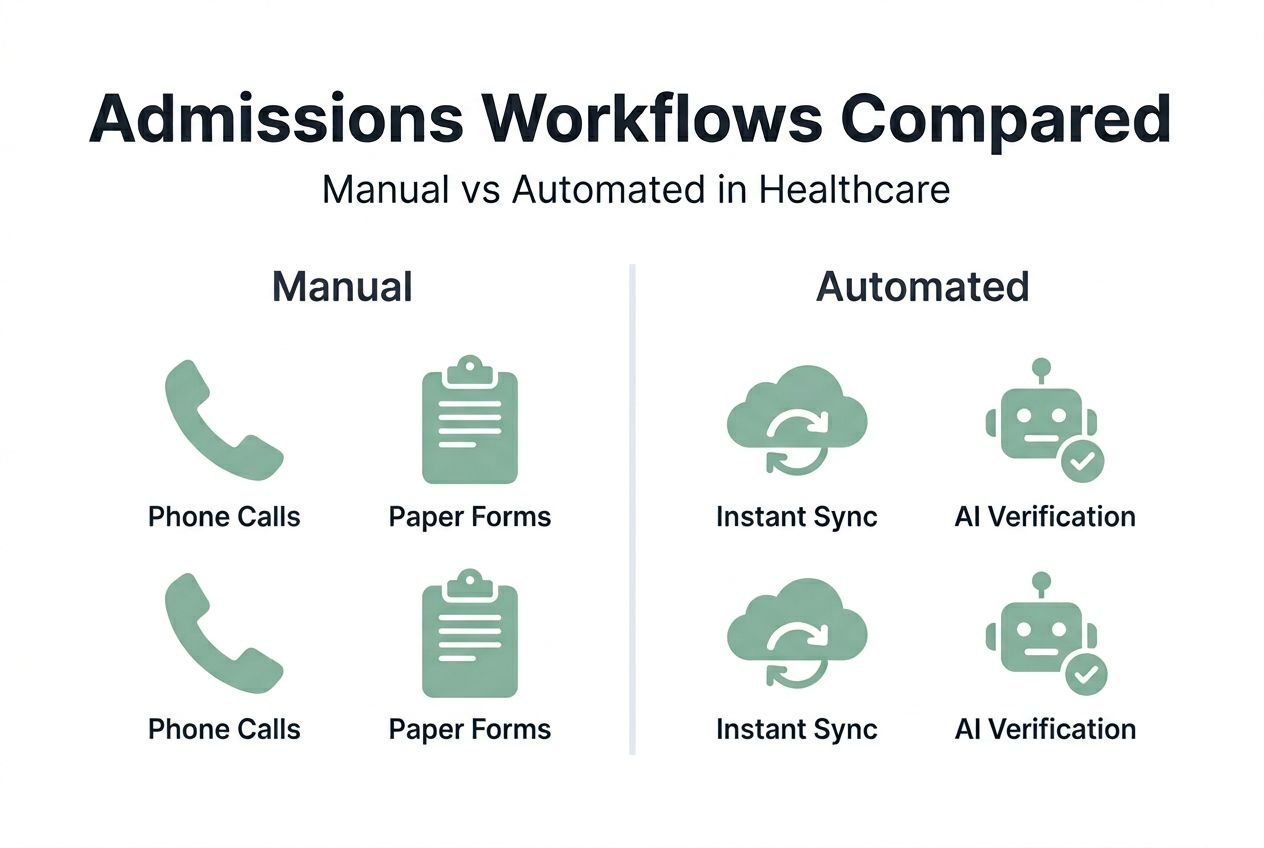
Automated workflows transform these processes through integration and intelligent routing. Referral information arrives electronically and automatically populates assessment tools. The system triggers document requests, verifies eligibility, and alerts appropriate staff based on predefined rules. Status updates flow to all stakeholders without manual notification. This orchestration reduces intake time by up to 40% while cutting paperwork burden by approximately 50%.
| Workflow Aspect | Manual Process | Automated Process |
|---|---|---|
| Referral intake | Phone/fax entry, manual data input | Electronic submission, auto-population |
| Eligibility verification | 30-60 minutes per patient, multiple logins | 2-5 minutes, single automated check |
| Document collection | Multiple follow-up calls, lost requests | Automated reminders, tracking dashboard |
| Clinical assessment | Paper forms, separate data entry | Integrated digital tools, pre-filled data |
| Decision timeline | 2-5 days average | 4-24 hours typical |
| Error rate | 15-20% documentation issues | 3-5% with validation rules |
The efficiency differences extend beyond speed to consistency and reliability. Manual processes depend on individual staff knowledge and attention to detail, creating variability in documentation quality and completeness. Automated workflows enforce standard requirements, preventing incomplete submissions and ensuring regulatory compliance through built-in validation.
Communication improvements represent another significant advantage. Manual workflows generate constant interruptions as staff field status inquiry calls from referral sources, family members, and internal stakeholders. Automated systems provide self-service portals where stakeholders check referral status independently, reducing phone volume and allowing staff to focus on substantive work. When you examine healthcare workflow automation examples, communication efficiency consistently emerges as a top benefit.
Operational metrics clearly favor automation:
- Average cost per admission decreases 30-40% through reduced labor hours and fewer errors requiring correction
- Referral source satisfaction improves with faster responses and consistent communication
- Staff overtime declines as automated systems handle routine tasks during off-hours
- Bed occupancy rates increase through faster intake cycles and improved capacity planning
The data quality advantage of automated workflows compounds over time. Clean, structured data enables meaningful analytics about referral patterns, payer mix, and workflow bottlenecks. Manual processes generate inconsistent data that’s difficult to analyze, limiting strategic decision-making. Facilities serious about intake process optimization faster admissions recognize that data quality improvements alone justify automation investment.
Practical steps to implement automated workflow solutions
Successful automation implementation starts with honest assessment of current workflow bottlenecks. Map your existing admissions process from initial referral contact through patient placement, documenting time spent on each task, common error points, and staff frustrations. This analysis reveals which processes offer the highest return on automation investment. Most facilities find eligibility verification, document collection, and referral tracking create the most significant pain points worth addressing first.
Platform selection requires evaluating compatibility with your existing technology ecosystem. The ideal automation solution integrates seamlessly with your EMR system and major insurance portals your facility uses regularly. Request demonstrations showing actual integration workflows, not just feature lists. Verify the vendor offers responsive customer support and provides training resources appropriate for your staff’s technical comfort level. Understanding what is referral management helps frame questions about specific functionality your facility needs.
Implement automation incrementally rather than attempting complete workflow transformation simultaneously:
- Begin with a single high-impact process like eligibility verification or document tracking
- Run pilot operations alongside existing manual workflows for 4-6 weeks to identify issues
- Gather feedback from frontline staff using the system daily and adjust configurations accordingly
- Expand automation to additional workflow stages once the initial process runs smoothly
- Monitor performance metrics comparing automated versus manual process outcomes
- Document standard operating procedures for automated workflows before facility-wide rollout
Staff training and change management determine whether automation delivers promised benefits or creates new frustrations. Schedule hands-on training sessions where staff practice common scenarios in the actual system rather than watching generic video tutorials. Identify champions among your admissions team who can provide peer support and answer questions as colleagues adapt to new workflows. Address concerns directly rather than dismissing resistance as technophobia.
Continuous improvement through analytics separates facilities that maximize automation value from those that simply replace manual work with digital tools. Review workflow analytics monthly to identify persistent bottlenecks, seasonal patterns, and opportunities for further optimization. Most platforms provide dashboards showing referral volume trends, average processing times, and completion rates for various workflow stages.
Pro Tip: Schedule a post-implementation review 90 days after going live to assess whether automation delivered expected benefits. Compare metrics like average intake time, error rates, and staff satisfaction against pre-automation baselines. Use this data to refine workflows and demonstrate ROI to facility leadership.
Conclusion: transforming healthcare admissions with automation
Automated workflow solutions deliver significant operational and financial advantages for healthcare facilities managing patient admissions. The evidence shows clear benefits including 40% faster referral processing, 20% fewer documentation errors, and 25% reduction in insurance claim denials. These improvements translate directly into better bed occupancy rates, increased revenue, and reduced administrative costs that strengthen facility financial performance.
Staff experience improvements prove equally valuable. Reducing paperwork burden by 50% and eliminating repetitive manual tasks allows admissions coordinators to focus on meaningful work requiring human expertise. Lower burnout rates and higher job satisfaction emerge naturally when technology handles tedious administrative duties. Facilities investing in automation report improved staff retention and easier recruitment as word spreads about modernized workflows.
The strategic advantage extends beyond immediate efficiency gains. AI-driven analytics provide insights into referral patterns, payer trends, and operational bottlenecks that inform better decision-making. Facilities using automated workflows gain competitive advantages through faster response times to referral sources and superior visibility into admissions pipeline health. As healthcare continues evolving toward value-based care models, the operational excellence enabled by automation becomes increasingly essential for facility success.
Explore smart admissions solutions to boost your facility’s efficiency
Ready to experience the benefits of automated workflows in your facility? Smart Admissions provides purpose-built solutions for skilled nursing and rehabilitation centers seeking to modernize patient intake processes. Our platform integrates seamlessly with your existing EMR and insurance systems to automate referral management, eligibility verification, and clinical documentation.
Discover how referral management overview capabilities can reduce your intake cycle times and increase bed occupancy. Explore automation healthcare admissions efficiency features designed specifically for post-acute care providers. Learn why automate admissions and see how facilities achieve measurable improvements in operational performance and staff satisfaction through intelligent workflow automation.
Frequently asked questions about automated workflows in healthcare admissions
How does admissions automation integrate with existing EMR and insurance systems?
Modern automation platforms connect through standard APIs that exchange data securely between systems without requiring custom programming. The integration automatically syncs patient information, clinical assessments, and eligibility verification results across platforms in real-time.
Will automation eliminate admissions coordinator positions at my facility?
Automation enhances rather than replaces admissions staff by handling repetitive tasks and allowing coordinators to focus on complex cases, relationship building with referral sources, and strategic activities. Facilities typically redeploy staff toward higher-value work rather than reducing headcount.
What measurable improvements can we expect in patient intake speed?
Facilities implementing automated workflows typically reduce referral review times by 40% and complete full intake processes in 4-24 hours compared to 2-5 days with manual workflows. Specific results vary based on facility size, referral volume, and which processes are automated.
How much training do admissions staff need to use automated systems effectively?
Most staff become proficient within one to two weeks of hands-on use. Modern platforms prioritize intuitive interfaces requiring minimal technical knowledge. Initial training sessions typically span 4-6 hours, followed by ongoing support as staff encounter new scenarios.
Are automated admissions workflows compliant with HIPAA and healthcare regulations?
Reputable automation platforms build compliance into their architecture through encrypted data transmission, access controls, audit trails, and regular security assessments. Automated workflows often improve compliance compared to manual processes by enforcing documentation standards and creating complete activity records for regulatory review.