
TL;DR:
- Automated workflows rapidly process referrals, reducing errors and improving compliance.
- Automation decreases staff burnout by handling repetitive administrative tasks.
- A hybrid approach balances automation’s volume handling with human judgment for complex cases.
Manual patient intake is one of the most persistent operational bottlenecks in skilled nursing and rehabilitation facilities. Your admissions team spends hours on phone calls, faxed referrals, duplicate data entry, and chasing down insurance verifications, all while beds sit empty and staff morale drops. Automation offers a practical, proven path forward. This article breaks down why automated intake workflows matter, what the five most impactful benefits are, how automation compares to manual processes, and what best practices your facility should follow to implement it safely and effectively.
Table of Contents
- Why automated intake workflows matter in healthcare
- 5 key benefits of automated intake workflows
- Comparing automated and manual intake workflows
- Frequently overlooked considerations and best practices
- Rethinking automation: What most facilities get wrong
- Upgrade your admissions with proven automation
- Frequently asked questions
Key Takeaways
| Point | Details |
|---|---|
| Save time and reduce errors | Automated intake workflows cut paperwork and help staff focus on critical tasks. |
| Improve compliance and safety | Automation ensures better regulatory adherence and reduces liability risks. |
| Enhance patient experience | Streamlined intake creates smoother, less stressful admissions for every patient. |
Why automated intake workflows matter in healthcare
Automated intake workflows use software to handle repetitive administrative steps in the patient admissions process. These steps typically include collecting patient demographics, verifying insurance eligibility, capturing clinical documentation, and routing referrals to the right staff members. Instead of relying on manual entry and phone-based coordination, automation tools connect directly with your EHR systems, insurance portals, and referral networks to move information quickly and accurately.
Skilled nursing facilities and rehabilitation centers face intake demands that are more complex than most care settings. You are managing high referral volumes, short decision windows, payer mix variability, and strict regulatory requirements, often simultaneously. A single delayed or incomplete referral can mean a missed admission, a longer length of stay for a patient waiting in an acute care bed, or a compliance gap that surfaces during an audit.
Manual processes make these risks worse. Common problems include:
- Delayed referral reviews due to fax-based communication and manual sorting
- Data entry errors that create billing discrepancies or eligibility denials
- Lost or incomplete documentation that stalls clinical assessments
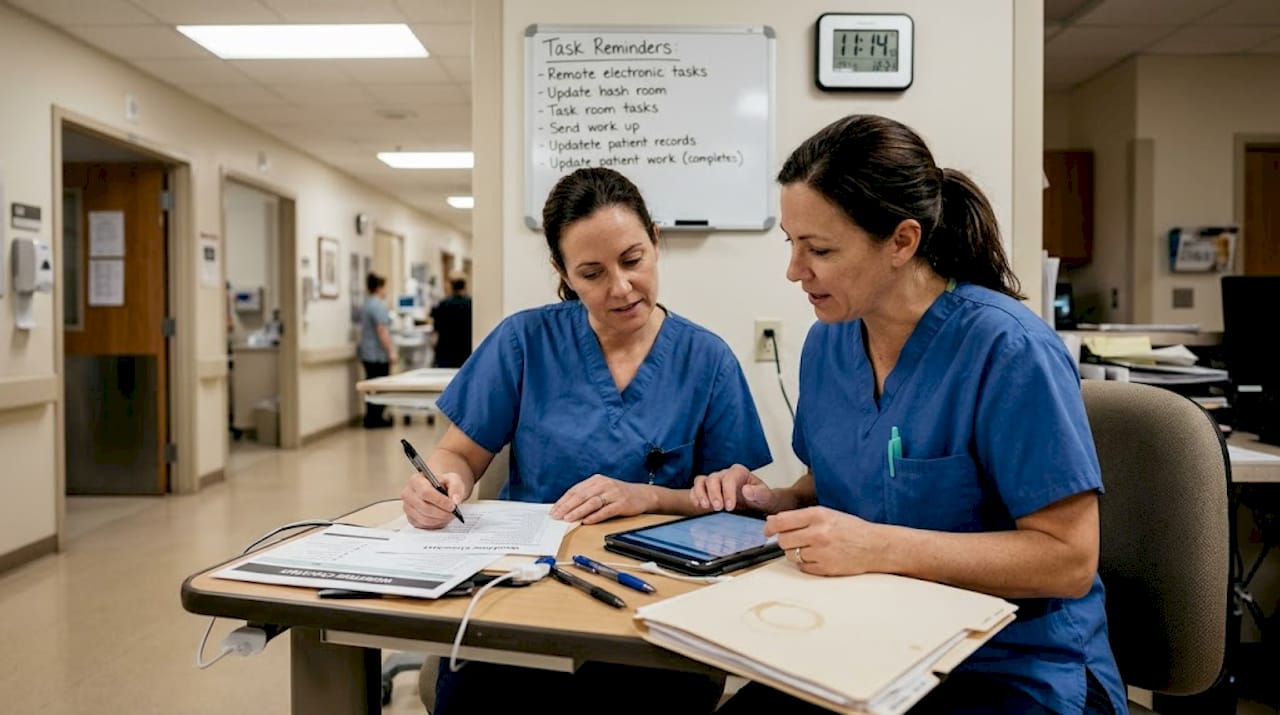
- Staff burnout from repetitive, low-value administrative tasks
- Inconsistent compliance with HIPAA and payer-specific documentation standards
Automation is designed to address each of these pain points directly. By handling routine tasks such as data capture, eligibility checks, and document routing, your team can focus on the decisions that actually require clinical and ethical judgment.
“Automate routine administrative tasks like data entry and verification, but preserve human involvement for nuanced judgment, ethical considerations, and family dynamics. Key concerns include bias, privacy, and liability.”
This is the framework that effective workflow optimization is built on. Automation handles volume and speed. Your staff handles complexity and care. Understanding this distinction is the starting point for any successful implementation of intake workflow automation in your facility.
5 key benefits of automated intake workflows
With the core challenges established, here are the five benefits that consistently drive adoption among skilled nursing and rehabilitation facilities.
- Faster processing times. Automated systems capture and route referral information in minutes rather than hours. Digital intake forms, real-time eligibility verification, and automated document requests eliminate the back-and-forth that slows manual workflows. Faster processing means faster bed placement decisions and higher occupancy rates.
- Fewer data entry errors. When staff manually key in patient information across multiple systems, errors are inevitable. Automation pulls data directly from source systems and validates it against payer requirements before submission. This reduces claim denials, billing discrepancies, and the rework that drains staff time.
- Stronger regulatory compliance. Automated systems can be configured to flag missing documentation, enforce required fields, and generate audit trails automatically. This keeps your facility consistently aligned with CMS requirements, HIPAA standards, and payer-specific rules, without relying on individual staff members to remember every checklist item.
- Reduced staff burnout. Repetitive administrative tasks are a leading contributor to admissions staff turnover. When automation handles data entry, form routing, and status tracking, your team spends more time on meaningful work: building referral relationships, supporting families, and coordinating care transitions. Research confirms that automating admin tasks while preserving human roles for judgment-intensive work improves both outcomes and staff satisfaction.
- Better patient and family experience. Faster intake processing means patients move from referral to admission more smoothly. Families receive timely updates, paperwork is completed digitally without repeated requests, and the overall onboarding experience feels organized and professional. These improvements support both satisfaction scores and long-term referral relationships.
For additional intake workflow improvement ideas tailored to admissions teams, there are practical resources available to help you prioritize where to start.
Pro Tip: Start by automating one or two high-volume, low-complexity tasks, such as digital intake forms or insurance eligibility checks. Demonstrate measurable time savings, then scale automation into more complex workflow stages.
Comparing automated and manual intake workflows
Having outlined the primary benefits, it helps to see how automation and manual processes stack up side by side across the dimensions that matter most to your admissions team.
| Workflow dimension | Manual process | Automated process |
|---|---|---|
| Referral processing speed | Hours to days | Minutes to hours |
| Data entry error rate | High, prone to transcription errors | Low, validated at source |
| Compliance consistency | Dependent on individual staff | Systematic, rule-based enforcement |
| Staff time on admin tasks | 60 to 80% of admissions workload | Significantly reduced |
| Audit trail availability | Inconsistent, paper-based | Automatic, timestamped |
| Initial setup investment | Low upfront, high ongoing labor cost | Moderate upfront, lower ongoing cost |
| Scalability | Limited by headcount | Scales with referral volume |
The trade-offs are real. Automation requires an upfront investment in configuration, staff training, and integration with your existing EHR and payer systems. There is also a period of adjustment as your team learns new workflows. However, the ongoing time savings and error reduction typically deliver a positive return within the first several months of full deployment.
For a deeper admissions automation comparison, including facility-specific use cases, additional analysis is available to guide your evaluation.
That said, automation is not appropriate for every step in the admissions process. Scenarios where human involvement remains essential include:
- Complex clinical assessments that require licensed clinical judgment
- Family conversations about care goals, placement decisions, and financial options
- Ethical situations involving patient capacity, guardianship, or end-of-life planning
- Non-routine cases such as patients with multiple comorbidities or disputed payer coverage
- Relationship-based referral management where personal connection drives volume
The goal is not to remove people from the process. It is to make sure your people are spending their time where they add the most value.
Frequently overlooked considerations and best practices
Facilities that rush into automation without proper planning often encounter problems that could have been avoided. Here are the considerations your leadership team should address before and during implementation.
Privacy and data security. Automated systems handle sensitive protected health information (PHI). Every integration point, from your EHR to your insurance portal, is a potential vulnerability. Ensure your vendor meets HIPAA requirements, uses encrypted data transmission, and provides clear data retention and access policies.
Algorithmic bias. Automated eligibility and clinical screening tools can inadvertently reflect biases present in the data they were trained on. This can affect which patients are flagged as high-risk or which referrals are prioritized. Regular audits of system outputs help identify and correct these patterns before they affect care equity.
Workflow dependence. When automation handles critical steps, a system outage can halt your entire intake process. Build contingency protocols so your team can revert to manual steps temporarily without losing data or missing admissions windows.
Studies indicate that routine intake automation can reduce administrative errors by 30 to 50 percent when implemented correctly, but that outcome depends on proper configuration, staff training, and ongoing oversight.
Best practices for safe and effective adoption:
- Conduct a workflow audit before selecting any automation tool
- Involve frontline admissions staff in configuration and testing
- Establish clear escalation paths for flagged or incomplete referrals
- Schedule quarterly reviews of system performance and error logs
- Train staff on both the automated tool and the manual backup process
For intake automation best practices and guidance on workflow automation safety, your team will find structured frameworks to support a responsible rollout.
Pro Tip: Configure your automation system to generate alerts for sensitive scenarios, such as referrals flagged for complex payer situations, missing clinical documentation, or patients with guardianship notes. These alerts keep human staff in the loop where it matters most.
Rethinking automation: What most facilities get wrong
The most common mistake we see is treating automation as a replacement for admissions expertise rather than a support tool for it. Facilities that automate aggressively, pushing every step through a digital workflow, often find that family satisfaction drops and complex cases fall through the cracks. Speed without judgment is not efficiency. It is risk.
The facilities that see the best results are the ones that use intake workflow insights to identify exactly where their team’s time is being wasted on low-value tasks, and then automate only those steps. They protect the human touchpoints: the family call, the clinical review, the relationship with the referring hospital discharge planner.
The future of admissions is not fully automated. It is a hybrid model where technology handles volume and your team handles nuance. That distinction is what separates facilities that thrive from those that simply adopt new software.
Upgrade your admissions with proven automation
If the benefits covered in this article resonate with the challenges your facility faces, the next step is exploring what a well-designed automation solution looks like in practice. Smart Admissions is built specifically for skilled nursing and rehabilitation facilities, with tools designed to reduce manual workload without removing the human expertise your team brings to every admission.
Explore the workflow automation advantages that facilities like yours are already using, review real-world workflow examples to see how automation performs across different intake scenarios, and access practical guidance to speed up intake documentation starting with your highest-volume processes. Your team deserves tools that work as hard as they do.
Frequently asked questions
What are the first steps to automate patient intake workflows?
Start with routine administrative tasks like digital forms, data capture, and eligibility checks before phasing in more advanced automation. This approach lets your team build confidence and measure results before expanding to more complex workflow stages, as research supports beginning with low-risk, high-volume tasks.
Can automation fully replace human staff in admissions?
No. Automation reduces paperwork and speeds up routine processing, but human expertise remains essential for clinical judgment, complex cases, family engagement, and ethical decisions. Studies confirm that preserving human roles alongside automation produces better outcomes than full automation alone.
Are there privacy or bias risks with automated intake?
Yes. Privacy and algorithmic bias are real risks that require careful system design, regular audits, and human oversight. Your vendor should meet HIPAA requirements and provide transparent documentation of how their system handles PHI and bias controls.
How does intake automation impact patient and family experience?
It streamlines the admissions process, reduces errors, and frees your staff to focus on communication and support rather than paperwork. Families benefit from faster decisions and a more organized onboarding experience, which research links to improved satisfaction and stronger referral relationships.