
TL;DR:
- Manual eligibility verification causes high claim denial rates and delays admissions.
- Automation using AI and RPA significantly reduces errors, speeds up verification, and improves revenue.
- Successful adoption requires proper integration, staff training, and a focus on teamwork and continuous improvement.
Eligibility errors are quietly draining revenue from skilled nursing and rehabilitation centers every day. In fact, eligibility errors cause 15 to 31% of all claim denials, a staggering figure that represents real dollars lost on cases your team already worked hard to admit. Manual verification workflows compound the problem by introducing delays, inconsistencies, and staff fatigue that slow your entire intake process. This guide explains what automation actually does, why it outperforms manual methods, and how your facility can make the transition confidently and efficiently.
Table of Contents
- The high cost of manual eligibility verification
- How automation transforms eligibility verification
- Tangible benefits: Fewer denials, faster admissions, and more revenue
- Getting started with automation: Key considerations and best practices
- What most admissions teams overlook about automation
- Accelerate your admissions with smart automation
- Frequently asked questions
Key Takeaways
| Point | Details |
|---|---|
| Denials drop sharply | Automation reduces eligibility-related claim denials by up to 70%, increasing revenue. |
| Admissions move faster | Real-time verification supports same-day admissions and better patient flow. |
| Staff workload shrinks | Automation cuts manual data entry and error-tracking, freeing your team for higher-value work. |
| Smooth integration is vital | Plan for technology and staff training to maximize automation’s benefits. |
The high cost of manual eligibility verification
For most skilled nursing and rehabilitation centers, insurance eligibility verification is still a largely manual process. A staff member logs into a payer portal, searches for the patient, reviews coverage details, and manually enters the results into your electronic health record (EHR) or practice management (PM) system. Multiply that by dozens of referrals per week, and the time cost alone becomes significant.
The financial consequences are even harder to ignore. Eligibility errors drive 15 to 31% of claim denials, and single facilities can lose millions annually in preventable rework and write-offs. Every denied claim requires additional staff time to investigate, correct, and resubmit, pulling your team away from higher-value work.
Here is a closer look at what manual verification actually costs your facility:
- Delayed admissions: When coverage cannot be confirmed quickly, patients wait longer for placement, and beds sit empty.
- Increased accounts receivable (AR) days: Unresolved eligibility issues push payment timelines out, straining cash flow.
- Higher denial rates: Outdated or incorrect coverage data leads to claims that payers reject outright.
- Staff frustration and burnout: Repetitive portal lookups and data re-entry demoralize your admissions team over time.
- Compliance risk: Inconsistent manual processes increase the chance of documentation errors that create audit exposure.
“The administrative burden of manual eligibility verification is not just an efficiency problem. It is a revenue problem that compounds with every new admission cycle.”
The operational ripple effect is real. When your admissions coordinators spend hours on repetitive verification tasks, they have less time for clinical coordination, family communication, and referral relationship management. Streamlining administrative tasks in your intake workflow is not optional anymore. It is a strategic priority for any facility serious about financial performance and staff retention.
The good news is that the problem is well-defined, which means the solution is too.
How automation transforms eligibility verification
Automated eligibility verification uses a combination of artificial intelligence (AI) agents and robotic process automation (RPA) to replicate and accelerate what your staff currently does manually. These systems log into payer portals, navigate multi-factor authentication (MFA) steps, retrieve coverage data, and push structured results directly into your EHR or PM system, all without human intervention.
AI agents and RPA can handle payer portal navigation, phone-based verification steps, and real-time data integration with EHR and PM platforms, delivering structured eligibility information to your admissions team in seconds rather than hours.
The difference between manual and automated workflows is not just speed. It is accuracy, consistency, and scalability.

| Feature | Manual verification | Automated verification |
|---|---|---|
| Speed | 15 to 30 minutes per patient | Under 2 minutes per patient |
| Error rate | High, due to manual data entry | Very low, structured data transfer |
| Staff involvement | High, repetitive tasks | Minimal, review and exception handling |
| Real-time updates | Rarely available | Continuous, payer-connected |
| Scalability | Limited by headcount | Scales with referral volume |
Integration is the key factor that makes automation practical. Modern platforms connect directly to payer systems using EDI (Electronic Data Interchange) transactions, FHIR (Fast Healthcare Interoperability Resources), and HL7 standards. This means your admissions team receives clean, actionable eligibility data inside the tools they already use.
AI-powered intake automation also supports real-time coordination between your clinical, financial, and admissions teams. When eligibility is confirmed instantly, bed assignment decisions can happen faster, and your team can focus on the patient experience rather than chasing down coverage details.
Pro Tip: Before selecting an automation solution, map your current EHR and PM systems and confirm that any vendor you evaluate offers native or API-based integration with those platforms. This single step will shorten your implementation timeline significantly.
The shift to AI-driven eligibility verification is not a distant future concept. Facilities adopting it now are already seeing measurable gains.
Tangible benefits: Fewer denials, faster admissions, and more revenue
The case for automation becomes concrete when you look at the numbers. Automation reduces denials by 30 to 70% and can generate $7.9 million in annual savings for every $100 million in claims processed. For a mid-sized skilled nursing facility, that level of financial recovery is transformational.
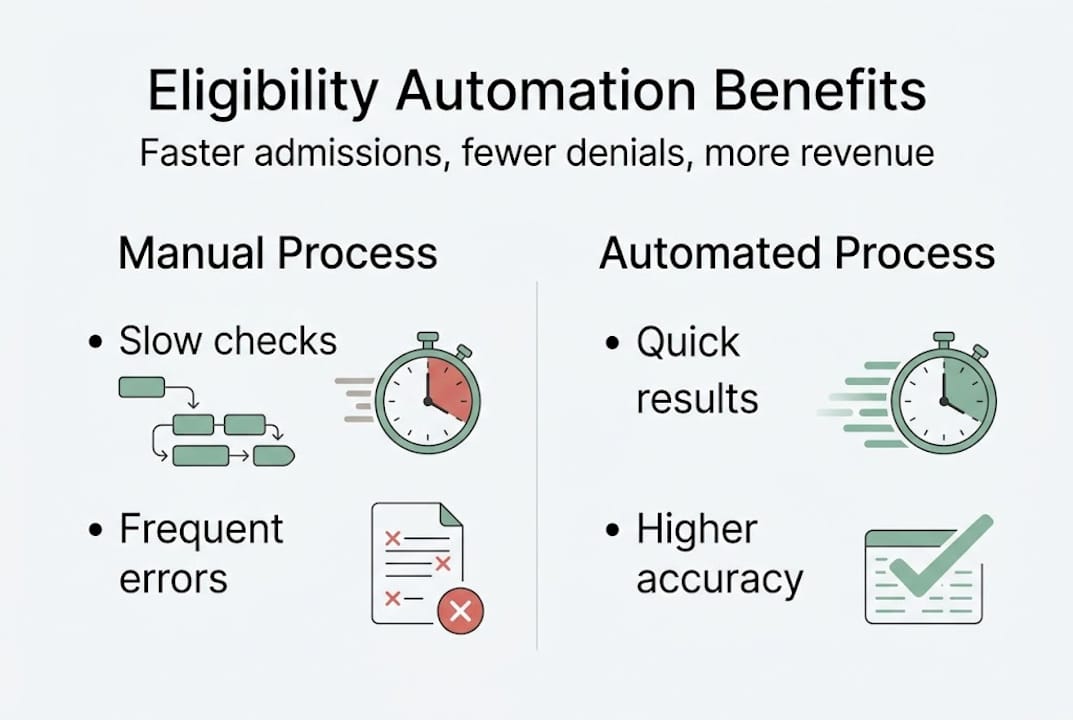
First-pass claim rates, meaning the percentage of claims paid without rework on the first submission, can climb to 95 to 99% with automated eligibility verification in place. That compares to industry averages that often fall below 85% for facilities still relying on manual workflows.
Here is a before-and-after view of what automation delivers:
| Metric | Before automation | After automation |
|---|---|---|
| Eligibility-related denials | 15 to 31% of claims | Under 5% of claims |
| Verification time per patient | 15 to 30 minutes | Under 2 minutes |
| First-pass claim rate | Below 85% | 95 to 99% |
| Annual cost of rework | Millions in staff time | Significantly reduced |
| Staff hours on verification | High, daily burden | Minimal, exception-based |
The benefits extend beyond the revenue cycle. Consider what your admissions team can accomplish when they are no longer spending hours on portal lookups:
- Faster bed placement: Confirmed eligibility means admissions decisions happen the same day, reducing empty bed time.
- Better referral relationships: When your team responds to referral sources quickly and accurately, those partners send more cases your way.
- Improved patient experience: Patients and families receive faster answers about coverage, reducing anxiety during an already stressful transition.
- Higher staff satisfaction: Removing repetitive, low-value tasks from your team’s workload directly reduces burnout and turnover risk.
- Stronger compliance posture: Automated, consistent data capture creates a reliable audit trail that manual processes cannot match.
Exploring admin automation benefits in more depth can help your leadership team build the internal business case for this investment. The data is clear: automation pays for itself quickly and continues generating returns as your referral volume grows.
Getting started with automation: Key considerations and best practices
Moving from manual to automated eligibility verification requires planning, but it does not have to be overwhelming. Implementation requires EHR and PM integration alongside structured staff training to ensure a smooth transition and lasting results.
Here are the critical steps your facility should follow:
- Assess your current workflow: Document how eligibility verification is currently handled, who does it, how long it takes, and where errors most often occur.
- Define your success metrics: Identify the KPIs you will track, such as denial rates, verification time, AR days, and first-pass claim rates.
- Select a solution with proven integration: Prioritize vendors that offer native connections to your existing EHR and PM platforms to avoid costly custom development.
- Plan your data migration carefully: Ensure historical eligibility data and payer configurations transfer cleanly to the new system.
- Train your admissions team thoroughly: Staff need to understand not just how to use the new tools, but why the process is changing and what their new role looks like.
- Establish a feedback loop: Create a simple process for staff to flag exceptions, errors, or workflow gaps so the system can be refined over time.
- Measure and report results regularly: Share early wins with your team and leadership to build momentum and justify continued investment.
Common pitfalls include underestimating the time needed for staff training and treating automation as a technology project rather than a workflow transformation. Change management matters as much as the software itself.
Pro Tip: Run a pilot with a small subset of your admissions team before a full rollout. This lets you identify integration gaps, refine training materials, and build internal champions who can support their colleagues during the broader transition.
Understanding the future of admissions technology will also help your team anticipate what comes next and position your facility for ongoing improvement.
What most admissions teams overlook about automation
Here is something worth saying directly: most facilities that struggle with automation adoption are not dealing with a technology problem. They are dealing with a culture problem.
Automation tools work. The data on denial reduction and time savings is consistent and well-documented. But the facilities that see the full return on investment are the ones that involve their admissions staff from day one, not just as end users, but as active contributors to workflow design.
When your team understands that automation removes the tedious parts of their job and gives them more time for meaningful work, adoption accelerates. When they feel like automation is something being done to them rather than for them, resistance slows everything down.
The other overlooked factor is continuous improvement. Automation is not a one-time implementation. Payer rules change, EHR configurations evolve, and your referral mix shifts. Teams that build regular review cycles into their workflow, checking exception rates, denial trends, and staff feedback, get dramatically better results over time.
Streamlining with AI is ultimately about empowering your people to do their best work, not replacing them. The facilities that internalize this distinction are the ones that build sustainable, high-performing admissions operations.
Accelerate your admissions with smart automation
Your facility does not have to keep absorbing the cost of manual eligibility errors. Smart Admissions gives skilled nursing and rehabilitation centers the tools to automate verification, reduce denials, and fill beds faster without adding headcount or complexity to your team’s workload.
From automation for bed occupancy to full intake automation solutions, Smart Admissions connects your admissions workflow to real-time payer data and EHR systems in a platform built specifically for post-acute care. You can also explore referral management system examples to see how other facilities have transformed their intake operations. The next step is a conversation with our team about what your specific workflow needs.
Frequently asked questions
How much can automated eligibility verification reduce claim denials?
Automated eligibility verification can reduce eligibility-related denials by 30 to 70%, pushing first-pass claim rates as high as 99% for facilities with optimized workflows.
What technology is used in automated eligibility verification?
These systems rely on AI agents and RPA to navigate payer portals, handle multi-factor authentication, and deliver structured eligibility data directly into your EHR or PM system in real time.
What should we prepare for when switching to automated eligibility?
Plan for EHR and PM integration and build a thorough staff training program to support adoption, manage the workflow transition, and sustain long-term performance gains.
Does automation mean layoffs for admissions teams?
No. Automation removes repetitive, error-prone tasks from your team’s workload and redirects their time toward higher-value activities like referral relationship management, clinical coordination, and patient communication.