
You've got a veteran referral on your desk. The family faxed over a DD214, your admissions coordinator gave it a quick glance, and everything looks good. The resident gets admitted, care begins, and your billing team submits the claim to the VA.
Then comes the denial.
The reason? The DD214 on file was a Member-1 copy: and you needed a Member-4.
This scenario plays out at skilled nursing facilities across the country more often than you'd think. And the financial consequences can be brutal. We're talking thousands of dollars in denied claims, delayed reimbursements, and compliance headaches that keep your team scrambling for weeks.
Let's break down exactly what separates these two document types and why getting it wrong is one of the most expensive mistakes in veteran admissions.
What Is a DD214, and Why Are There Multiple Copies?
The DD214, officially called the Certificate of Release or Discharge from Active Duty, is the single most important document for verifying a veteran's military service. It's issued when a service member separates from the armed forces, and it contains critical information about their service history.
Here's where it gets tricky: there are actually eight different copies of the DD214. Each copy is designated for a specific purpose: some go to the veteran, some to government agencies, and some to state archives.
The two copies that matter most for SNF admissions are:
- Member-1 (Short Form): The version typically given to veterans for general use
- Member-4 (Long Form): The complete, unedited version containing all discharge details
Most veterans carry their Member-1 copy because it's what they received at separation. And that's precisely where the billing problems begin.
The Critical Differences Between Member-1 and Member-4
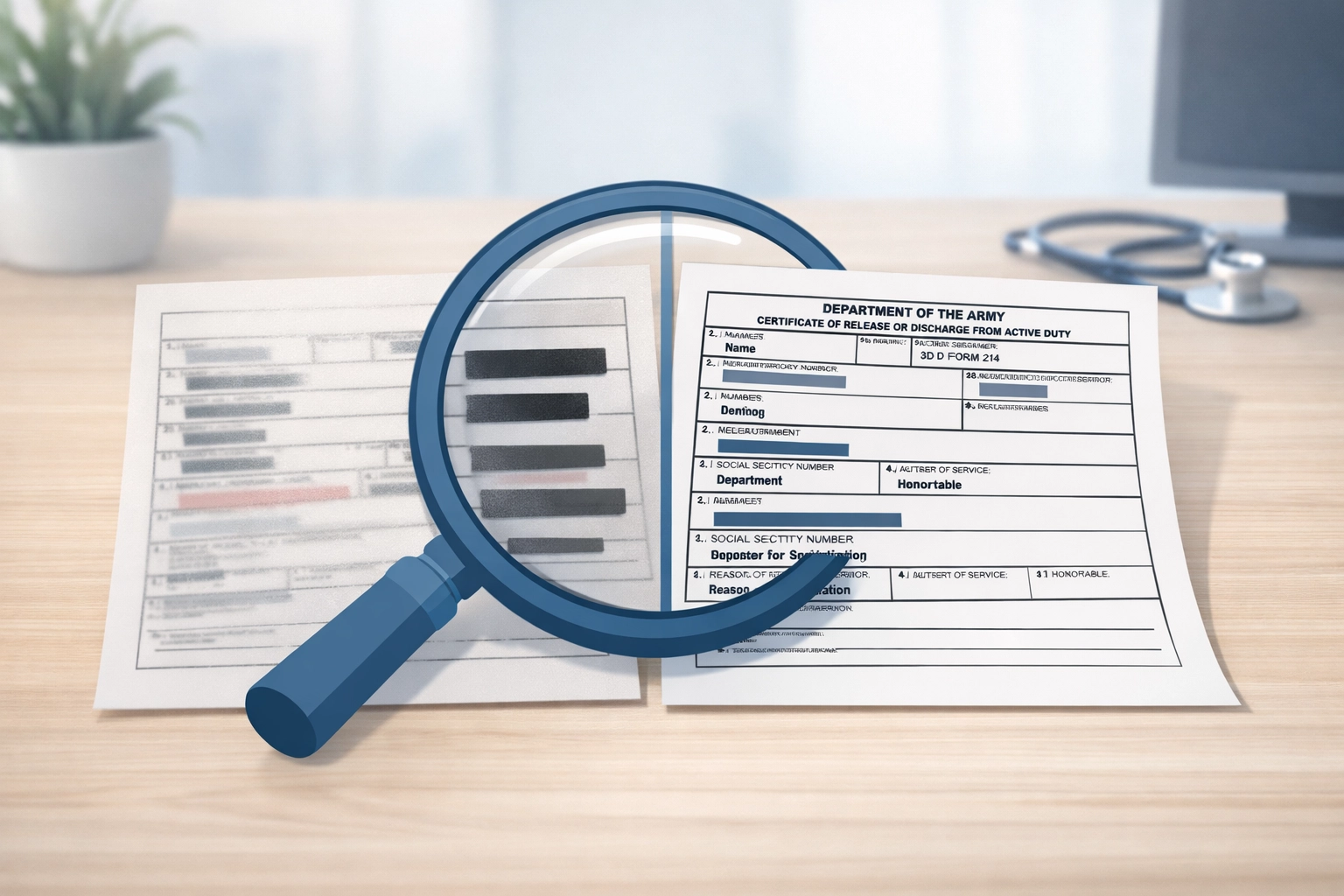
On the surface, both copies look nearly identical. Same layout, same government formatting, same faded typewriter font if we're dealing with older documents. But the Member-1 copy has three crucial pieces of information redacted:
1. Character of Service (Discharge Characterization)
This field indicates whether the veteran received an honorable discharge, general discharge, other-than-honorable discharge, or another separation type. VA benefit eligibility hinges heavily on this characterization.
2. Reason for Separation
This section explains why the service member left the military. It can include sensitive information like medical conditions, behavioral issues, or administrative reasons. The Member-1 copy intentionally omits this to protect veteran privacy.
3. Re-enlistment Code
This code indicates whether the veteran was eligible to return to military service. While less relevant for SNF billing, it's part of the complete service record.
The Member-4 copy contains all of this information unedited. Every other DD214 copy (Member-2 through Service-8) includes these details as well: only the Member-1 is the "short form" with redactions.
For VA billing and compliance purposes, that missing discharge characterization is a dealbreaker.
Why Member-1 Copies Lead to Billing Denials
Here's the uncomfortable truth: you cannot definitively verify VA benefit eligibility with a Member-1 copy alone.
The VA requires proof that a veteran received an honorable or general discharge to qualify for most healthcare benefits. Without the character of service field visible on the document, your billing team is essentially submitting a claim with incomplete eligibility verification.
And the VA will catch it.
When claims get denied for documentation issues, facilities face a cascade of problems:
- Delayed reimbursement while your team tracks down the correct paperwork
- Write-offs if the veteran or family can't produce a Member-4 copy
- Audit flags that can trigger deeper compliance reviews
- Staff time wasted on appeals, resubmissions, and phone calls
As we've covered in our breakdown of why DD214 format variations make manual verification nearly impossible, the visual similarities between document types make it incredibly easy for staff to miss these distinctions during a busy admissions shift.

The Compliance Risk You Can't Afford to Ignore
Beyond billing denials, accepting the wrong DD214 copy creates genuine compliance exposure for your facility.
VA Community Care and State Veterans Home programs have strict documentation requirements. If auditors discover that your facility routinely admitted veterans based on Member-1 copies without proper eligibility verification, you could face:
- Recoupment of previously paid claims
- Exclusion from VA referral programs
- Corrective action plans that consume administrative resources
- Reputation damage with VA case managers and hospital discharge planners
The common DD214 verification mistakes we see at SNFs almost always trace back to one root cause: staff simply weren't trained to identify which copy they were looking at.
And honestly? That's not their fault. When you're processing dozens of referrals and the document looks legitimate at first glance, who has time to scrutinize whether Box 24 is redacted?
How to Tell Member-1 from Member-4 (The Manual Way)
If your team is still verifying DD214s manually, here's what to look for:
Check the copy designation. Near the top or bottom of the document, you should see a label indicating which copy it is. Look for "MEMBER-1" or "MEMBER-4" in the header or footer area.
Examine Box 24 (Character of Service). On a Member-4 copy, this box will contain text like "HONORABLE," "GENERAL," or another discharge characterization. On a Member-1, this box may be blank, redacted, or marked "N/A."
Look at Box 25 (Separation Authority) and Box 26 (Separation Code). These fields relate to the reason for separation. If they're blank or redacted, you're likely looking at a Member-1.
Verify Box 27 (Re-enlistment Code). Same principle: missing information suggests a short-form copy.
The challenge? On older documents, especially those from the 1970s through 1990s, these fields may be faded, smudged, or formatted differently than modern DD214s. Your staff might not even realize information is missing because the document quality makes everything hard to read.
What to Do When a Veteran Only Has a Member-1 Copy
It happens constantly. The veteran or their family submits a Member-1 because that's what they have on hand. You've got a bed to fill and a discharge planner waiting for confirmation.
Here are your options:
Request a Member-4 from the veteran. They can obtain a copy through the National Personnel Records Center (NPRC) or via the eVetRecs system. Fair warning: this process can take weeks or even months.
Contact the VA directly. Your admissions team may be able to verify eligibility through VA systems without the physical Member-4, depending on your facility's access and agreements.
Use automated verification technology. Modern AI-powered platforms can cross-reference DD214 data against VA eligibility databases in real time, flagging document type issues before admission occurs.
The third option is where facilities are seeing the biggest ROI. Instead of relying on manual document review: which is slow, error-prone, and inconsistent: automation catches Member-1 copies instantly and prompts staff to obtain proper documentation before billing ever begins.
Learn more about how veteran SNF facilities can verify DD214 eligibility in seconds.
Stop Leaving Money on the Table
The Member-1 vs. Member-4 distinction isn't just a paperwork technicality. It's a billing and compliance issue that directly impacts your facility's revenue and reputation with VA referral sources.
Every denied claim costs you money. Every compliance flag costs you time. And every preventable error chips away at the trust you've built with discharge planners who count on you to handle veteran admissions smoothly.
The fix isn't more training manuals or laminated checklists at the admissions desk. It's building verification systems that catch these issues automatically: before they become expensive problems downstream.
Ready to see how automation can eliminate DD214 document confusion at your facility? Visit us at NASVH Booth #6 or book a demo to see Smart Admissions in action.