
The denials management process is the structured workflow revenue cycle teams use to identify, correct, appeal, and prevent denied insurance claims so facilities recover earned revenue and stop the same denials from repeating. If you’re staring at a denial queue right now, do three things before lunch: export today’s denials, sort them by appeal deadline and dollar value, and assign the top ten to a specialist by name.
You’ll be working with familiar entities the moment you open that export: CARC and RARC codes on the ERA/835, and a CMS appeals clock that doesn’t pause for a busy front desk. Getting those three moves right today buys you room to build the fuller system below.
Do this in the next 24 to 48 hours:
- Pull every denial from your last two remittance cycles into one working list.
- Rank them by dollar value divided by days remaining until the appeal deadline.
- Assign the highest scores to a named specialist, not a shared queue.
Key Takeaways
A repeatable denials management process combines fast triage, accurate CARC/RARC categorization, root-cause fixes routed to their source, and consistent KPI tracking to recover revenue and stop repeat denials.
| Point | Details |
|---|---|
| Log denials within 48 hours | Delayed logging is the top cause of missed appeal deadlines and permanent write-offs. |
| Use a denial crosswalk | Map denial code to CARC/RARC description, cause, and corrective action to standardize fixes. |
| Run 5 Whys on repeat denials | Trace surface fixes back to the systemic cause, such as an EHR configuration gap. |
| Track KPIs on a cadence | Review denial rate and overturn rate daily, weekly, and monthly across different audiences. |
| Fix eligibility and auth at intake | Smart Admissions verifies eligibility and flags missing authorizations before claims are ever submitted. |
Table of Contents
- What Is the Step-by-Step Denials Management Process?
- How Do You Identify and Triage Denied Claims?
- How Do You Read CARC and RARC Codes Correctly?
- How Does Root-Cause Analysis Prevent Repeat Denials?
- Resubmission vs Replacement vs Appeal: Which One Do You Use?
- Which KPIs Show Whether Your Denials Program Is Working?
- What Tools and Automation Actually Move the Needle?
- Who Should Own Each Step in the Denials Workflow?
- How Should You Train Staff to Prevent Denials Before They Happen?
- What Do Successful Denials Management Programs Look Like in Practice?
- Why Do Regular Audits Matter for Denial Prevention?
- This Quarter’s Priorities for Revenue Cycle Leaders
- Reduce Denials Before They Start With Smart Admissions
- Frequently Asked Questions
- Sources
What Is the Step-by-Step Denials Management Process?
A complete denial management process runs through seven connected stages, and skipping any one of them is usually why denials pile back up within a quarter.
- Identify. Log every denial with an auditable record: CARC/RARC, dollar amount, and appeal deadline.
- Categorize. Sort by root type: eligibility, authorization, coding, clinical, or timely filing.
- Triage. Rank the queue by dollar value and days remaining before the appeal window closes.
- Correct. Fix the underlying data or documentation error at its source.
- Resubmit or replace. Send a corrected or replacement claim per payer-specific rules.
- Appeal. Build a formal package when correction alone won’t overturn the denial.
- Track and prevent. Feed outcomes back into training, EHR configuration, and front-end checklists.
This mirrors the identify, categorize, triage, correct, track, and prevent structure that turns denials work from constant firefighting into a repeatable function, sometimes referred to informally as an IMMP-style flow. Each stage produces a specific output the next stage depends on, which is why a broken step one quietly wrecks step five.
How Do You Identify and Triage Denied Claims?
Denials arrive from four places: your ERA/835 feed, payer portals, clearinghouse rejection reports, and the occasional manual EOB that slips through fax or mail. Set a 24 to 48 hour SLA for logging every one of them into a central record. A denial sitting unlogged for a week is a denial that quietly ages past its appeal window.
Your intake record needs to capture, at minimum:
- Patient name and date of service
- CPT/ICD codes billed
- Payer and claim number
- CARC/RARC code and description
- Dollar amount and appeal deadline
- Claim age since original submission
Prioritize by scoring dollar value against days remaining to appeal, then layer in a likelihood-to-overturn proxy. A $4,000 denial with 12 days left and a clean overturn history for that denial type outranks a $500 denial with 45 days left, even though the second one feels less urgent on the calendar.
How Do You Read CARC and RARC Codes Correctly?
CARC codes tell you why a claim was denied. RARC codes add the remark that clarifies what the payer actually expects next. Misreading either one sends staff chasing the wrong fix, which is how a coding denial gets treated like an eligibility problem and bounces back a second time.
Most CARC/RARC combinations fall into five operational buckets:
- Eligibility — coverage terminated, wrong plan on file, coordination-of-benefits mismatch.
- Prior authorization — missing auth number, auth doesn’t match service date, auth expired.
- Coding and bundling — unbundled procedure codes, mismatched modifiers, incorrect units.
- Medical necessity — documentation doesn’t support the billed level of care.
- Duplicate or timely filing — resubmitted claim flagged as a duplicate, or the filing window closed.
Mapping each category to a fixed corrective action removes guesswork: an eligibility flag routes to demographic correction and resubmission, while a missing-auth flag routes to retrospective auth research or a formal appeal.
Pro Tip: Build a payer cross-reference table that maps each payer’s specific CARC/RARC language to your internal category. Payers phrase the same denial reason differently, and a shared table cuts interpretation time dramatically for new staff.
How Does Root-Cause Analysis Prevent Repeat Denials?
Correcting a denial gets you paid once. Root-cause analysis stops the next fifty from happening. The 5 Whys method applied to a real denial pattern usually surfaces something upstream of where anyone was looking.
Take a missing prior authorization denial. Why did it deny? No auth on file. Why no auth? The scheduler didn’t submit the request. Why not? The EHR didn’t flag the service as auth-required. Why not? The auth-required flag was never configured for that payer plan. Why not? Nobody owns quarterly payer-rule updates in the EHR. The fix isn’t “resubmit with auth.” It’s assigning EHR configuration ownership.
A denial crosswalk turns this into a repeatable tool rather than a one-off exercise:
| Denial Code | CARC/RARC Description | Cause | Corrective Action |
|---|---|---|---|
| CO-27 | Coverage terminated before date of service | Eligibility not verified at intake | Real-time eligibility check pre-admission |
| CO-197 | Precertification/authorization absent | EHR auth flag missing for payer plan | Configure auth rules; assign quarterly review owner |
| CO-16 | Claim lacks required information | Incomplete documentation at submission | Add field to intake checklist; retrain front desk |
Route each fix to where it actually lives: registration, coding, provider documentation, or EHR configuration. Measure success by whether that specific denial code’s volume drops over the next reporting cycle, not by whether the one claim in front of you got paid.
Resubmission vs Replacement vs Appeal: Which One Do You Use?
The decision hinges on how much of the original claim changed and whether the payer disputes a fact or just a data field.
- If you’re correcting more than two data elements, submit a new original claim rather than a correction.
- If it’s a minor field fix (a modifier, a units count), submit a payer-coded replacement claim.
- If the payer disputes medical necessity or a coverage determination, build a formal appeal.
Appeal packages need, at minimum:
- The original ERA/EOB showing the CARC/RARC citation
- Corrected claim data or the replacement claim number
- Supporting clinical documentation tied to the specific denial reason
- A provider attestation, when the payer requires clinical sign-off
Simple corrections should move same-day. Formal appeals deserve 48 to 72 hours for a complete package rather than a rushed, incomplete one. Escalate to provider relations or request peer-to-peer review when a payer denies the same clinical scenario repeatedly despite documentation that should support it.
Which KPIs Show Whether Your Denials Program Is Working?
Six numbers tell you almost everything about program health:
- Denial rate — percentage of claims denied on first submission.
- Denial dollar impact — total revenue at risk by denial category.
- Overturn rate by denial type — what percentage of appeals actually succeed, broken out by category.
- Days to resolution — average time from denial receipt to final payment or write-off.
- Write-off rate — dollars abandoned versus dollars recovered.
- Appeal win rate — success rate specifically on formally appealed claims.
Specialists need a daily worklist ranked by the scoring method described earlier. Managers need a weekly trend report that flags which denial category is growing. Finance needs a monthly executive dashboard tying denial dollars to overall reimbursement forecasts. Skipping the weekly layer is the most common gap: without it, a spike in one payer’s auth denials goes unnoticed for a full month.
What Tools and Automation Actually Move the Needle?
Prioritize five tooling categories: a claim scrubber that catches errors pre-submission, ERA automation that ingests denials without manual keying, a centralized denial-tracking database, analytics that surface trend patterns, and templated appeal letters for your highest-volume denial types.

Integration matters more than any single feature. A scrubber that doesn’t talk to your EHR or clearinghouse just creates a second system to check manually, which defeats the purpose. Pre-bill scrubbing that verifies eligibility, authorization, and coding before submission is consistently the highest-return move available, often pulling denial rates from double digits down toward low single digits within months.
Pro Tip: Automate high-volume, low-complexity denials first, eligibility flags and missing fields, since they’re mechanical and fast to fix. Save your specialists’ time for complex clinical appeals where judgment actually matters.
Who Should Own Each Step in the Denials Workflow?
Denials stall when ownership is fuzzy. Assign roles explicitly:
- Front-end registration verifies eligibility and captures authorization before the visit.
- Coders audit claims for bundling and modifier accuracy before submission.
- Denial specialists work the triaged queue and build appeal packages.
- RCM managers review weekly trends and reassign resources to growing denial categories.
- Provider liaisons handle peer-to-peer requests and clinical documentation gaps.
Set enforceable SLAs: high-priority denials worked within 48 hours, coding and eligibility issues remediated within 14 days. As a rough staffing guide, many facilities run roughly one denial specialist per 1,000 monthly claims, adjusting for payer mix complexity. Centralize denial work when volume is high enough to specialize; distribute it across site-level staff only when volume is too thin to justify a dedicated role.
How Should You Train Staff to Prevent Denials Before They Happen?
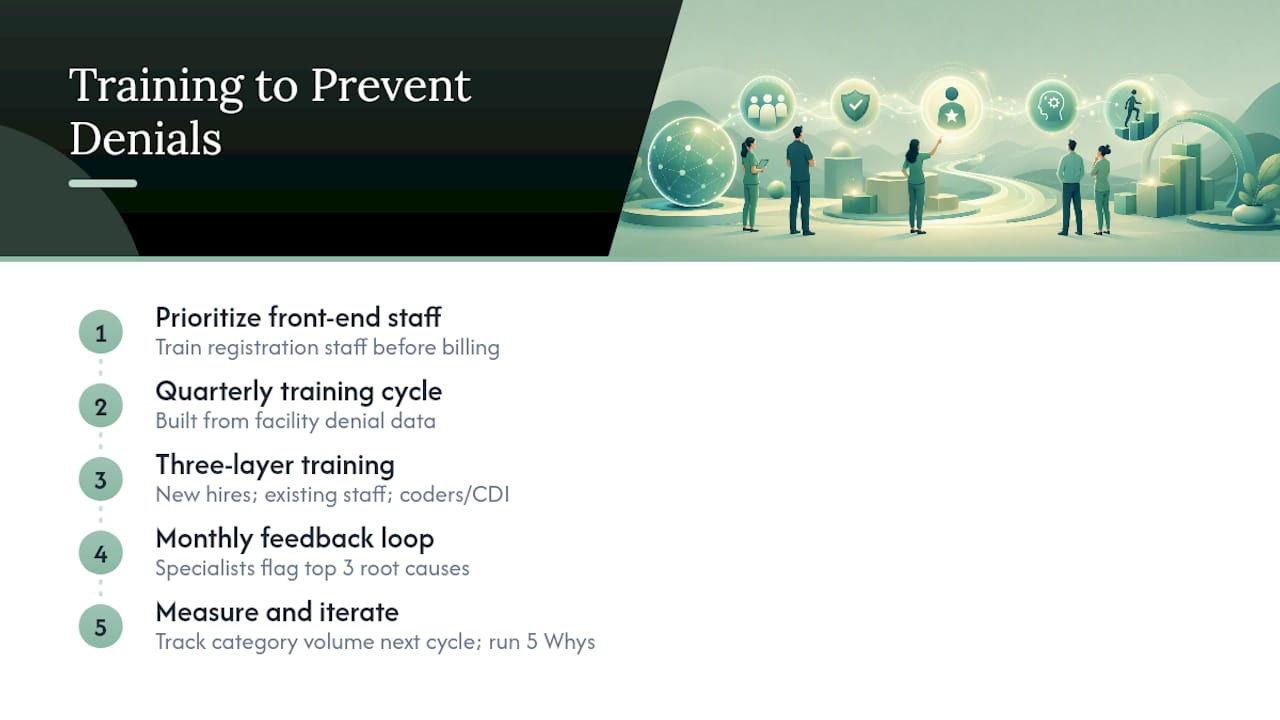
Most denials trace back to a process gap at registration or documentation, not a coding error buried deep in the claim. That means training pays off fastest when it targets front-end staff first, not billing staff last.
Build a recurring quarterly training cycle around your actual denial data rather than generic modules. Staff retain specifics from their own facility’s cases far better than abstract rules.
Structure training in three layers. New hires get a foundational session covering CARC/RARC basics, your intake checklist, and your escalation path. Existing staff get a shorter quarterly refresher tied to whatever denial category is trending upward. Coders and clinical documentation staff get a separate, deeper session on medical necessity language, since that category requires more nuance than a front-desk checklist can cover.
Make training bidirectional. Denial specialists see patterns registration staff never do, so a short monthly feedback loop, specialists flagging the top three recurring root causes to the registration team, closes the gap faster than a formal training calendar alone. Track whether training worked by watching whether that specific denial category’s volume actually drops in the following reporting cycle. If it doesn’t move, the training missed the real root cause, and it’s worth running the 5 Whys on the training itself.
What Do Successful Denials Management Programs Look Like in Practice?
The pattern across facilities that meaningfully cut denials rarely involves a single dramatic fix. It’s usually a combination of tighter front-end verification, a working crosswalk, and consistent follow-through on root-cause fixes.
A facility struggling with recurring authorization denials typically finds the same root cause repeated: the EHR wasn’t flagging auth requirements consistently across payer plans. Fixing that configuration gap, rather than just resubmitting each denied claim individually, is what drives the category down over subsequent quarters, not any one-time appeal win.
Facilities that centralize eligibility verification at intake, rather than leaving it to whichever staff member happens to be free, consistently report fewer downstream coverage-termination denials. The mechanism is straightforward: catching a lapsed policy before the service is rendered costs nothing, while catching it after the claim denies costs a specialist’s time and a 30 to 60 day recovery cycle at best.
The throughline in every recovery story is the same: teams that pair a documented crosswalk with a genuine root-cause habit, not just a faster appeals desk, are the ones whose denial rate actually trends downward quarter over quarter rather than plateauing. Faster appeals recover money. Root-cause fixes stop the bleeding.
Why Do Regular Audits Matter for Denial Prevention?
Denials that fall through in production often trace back to a systemic gap nobody caught until an audit surfaced it. Quarterly internal audits of a sample of paid and denied claims catch coding drift, documentation shortfalls, and authorization gaps before they compound into a bigger revenue problem.
Build your audit around the same categories driving your denials: pull a sample of claims from your highest-volume denial category and check whether the corrective action from last quarter’s root-cause work actually held. If authorization denials dropped after an EHR configuration fix, verify the fix is still in place. Payer rule updates and staff turnover both quietly erode fixes that worked six months ago.
Compliance checks serve a second purpose beyond revenue: they catch coding patterns that could trigger payer audits or recoupment requests if left unaddressed. A pattern of upcoding flagged internally and corrected is far less costly than the same pattern discovered by a payer’s own audit team. Document every audit finding and its corrective action the same way you document a denial crosswalk entry, with an owner and a follow-up date, so audits produce fixes rather than just findings that sit in a report nobody revisits.
This Quarter’s Priorities for Revenue Cycle Leaders
If you own the denials function this quarter, focus on three moves. First, stand up a formal triage process with named ownership, since ungoverned queues are where dollars quietly expire. Second, pilot a denial crosswalk on your top two denial categories to convert guesswork into a repeatable fix. Third, automate your highest-volume, lowest-complexity denial type first to free specialist time for appeals that actually need judgment.
Reduce Denials Before They Start With Smart Admissions
Most of the denial categories covered above, eligibility lapses, missing authorizations, incomplete documentation, start at intake, long before a claim ever reaches your billing team. Smartadmissions is built specifically for that front-end gap in skilled nursing, rehabilitation, and post-acute admissions workflows.
Real-time eligibility verification during the referral review catches coverage problems before admission rather than after a claim denies. Automated intake checklists flag missing authorizations and incomplete documentation before submission, closing the exact gap that caused the EHR configuration failure in the root-cause example above. Built-in analytics surface which denial drivers are costing your facility the most, so your team can target training and audits where they’ll actually move the needle.
If you’re evaluating a vendor to help with this, check for four things: real integration with your existing EMR and insurance portals, true real-time eligibility rather than batch verification, configurable checklists you can adjust as payer rules shift, and analytics you can hand to a manager without a data team. See how automated admissions compares to manual workflows and start a trial to see where your own referral pipeline is leaking documentation before it ever reaches billing.
Frequently Asked Questions
What is the denials management process in healthcare revenue cycle terms?
It’s the structured workflow of identifying, categorizing, correcting, appealing, and preventing denied claims to recover revenue and reduce future denial volume.
What’s the difference between a rejected claim and a denied claim?
A rejected claim never enters payer adjudication due to a formatting or data error. A denied claim was processed and formally refused, which requires the fuller denials management process to resolve.
How long do I have to appeal a denied claim?
Appeal windows vary by payer and typically range from 30 to 180 days from the denial notice date, so confirming the specific deadline immediately after logging is critical.
What’s a reasonable denial rate benchmark to target?
Facilities with strong pre-bill scrubbing often push initial denial rates from double digits down toward low single digits, though your realistic target depends on payer mix and case complexity.
Should small facilities build a dedicated denial specialist role?
Even a partial FTE dedicated to denials management typically pays for itself by recovering claims that would otherwise be written off, especially once volume exceeds a few hundred claims monthly.
Sources
- Claims Denials: A Step-by-Step Approach to Resolution
- Sage Guide to Claims Denial Resolution (Denial Crosswalk)
- Denial Management in Healthcare: A Complete Guide
- Denial Management in Medical Billing: 2026 Guide | Zedtreeo
- Denial Management Process: Step-by-Step Workflow | Revenue Synergy