
A compliant, speed-first patient screening workflow standardizes intake, runs clinical, financial, and operational checks in parallel, and enforces PASRR compliance while timestamping every handoff. That combination is what separates admissions teams that fill beds in hours from teams that lose referrals to silence.
The essential elements are consistent no matter your facility size: a standardized intake packet, parallel review lanes instead of a serial chain, documented decision rules (automatic fit, automatic no-go, or escalate), a named owner for every referral, and timestamps that let you measure where things actually stall.
- Standardized intake packet with required clinical, payer, and equipment fields
- Parallel review across clinical, financial, and bed operations
- Codified decision rules instead of case-by-case judgment calls
- Named owner and timestamp for every step
A patient screening workflow only works if delay is visible. If you can’t point to where a referral sat for six hours, you can’t fix it.
Pro Tip: If you fix one thing this week, fix the acknowledgment step. A referral that gets a timestamped “received” reply within 15 minutes rarely gets pulled by a competing facility before you finish your review.*
Key Takeaways
A patient screening workflow succeeds when standardized intake, parallel clinical/payer/operational review, and codified decision rules replace case-by-case judgment calls.
| Point | Details |
|---|---|
| Standardize the intake packet | Use one checklist with clinical, payer, and equipment fields for every referral. |
| Run reviews in parallel | Clinical, financial, and bed checks should happen simultaneously, not sequentially. |
| Codify triage rules | Split referrals into automatic fit, automatic no-go, and operator review to reduce variation. |
| Track time-to-first-response first | This single KPI predicts most downstream referral leakage. |
| Consider Smart Admissions for automation | The platform adds AI-assisted intake, EMR/payer integrations, and PASRR flagging to speed decisions. |
Table of Contents
- What Documents Does a Patient Intake Procedure Require?
- How Long Should Each Step Of Intake Take?
- What Are The Triage Rules For Accepting A Referral?
- Which KPIs Show Where Referrals Are Leaking?
- How Should Staffing Change With Referral Volume?
- How Does Automation Shorten The Screening Process?
- How Smart Admissions Supports A Faster Screening Workflow
- Sources
What Documents Does a Patient Intake Procedure Require?
Every referral your team touches should hit the same checklist before anyone makes a decision. Missing pieces are the single biggest cause of stalled reviews, and a standardized template is how you catch gaps in minutes instead of hours.
- Clinical summary and recent history and physical
- Current medication list and administration record
- Active physician orders, including therapy and diet orders
- Isolation or infection control status
- Durable medical equipment and mobility needs
- Payer information, authorization status, and financial responsibility
- Direct contact for the referring hospital’s discharge planner or clinician
For Medicaid-certified facilities, add one non-negotiable field: the PASRR Level I screen result. PASRR is a federal requirement, not a state option and it applies to every applicant regardless of how urgent the placement feels. If Level I flags possible serious mental illness or intellectual disability, a Level II evaluation must happen before admission proceeds.
Build your intake packet around one rule: no physician orders, no comprehensive assessment scheduling, no exceptions.
Keep this checklist as a fillable template your referral documentation team can attach to every incoming fax, portal upload, or phone referral.
How Long Should Each Step Of Intake Take?
A patient intake procedure only works if every step has an owner and a target time. Vague ownership (“someone will get to it”) is where referrals die quietly, and hospitals rarely call twice before moving to the next facility on their list.
- Receipt acknowledgment. The referral coordinator confirms receipt and logs the timestamp promptly.
- First clinical glance. A clinical reviewer scans for obvious red flags: acuity mismatch, missing orders, isolation status.
- Payer verification (run in parallel with step 2). The financial reviewer checks eligibility and authorization requirements.
- Operational/bed check (also parallel). The bed manager confirms bed type, equipment availability, and staffing fit.
- Final decision. All three reviewers converge; the coordinator communicates the decision in a timely manner.
| Step | Owner | Target Duration |
|---|---|---|
| Acknowledgment | Referral coordinator | 15 minutes |
| Clinical glance | Clinical reviewer | 1 hour |
| Payer check | Financial reviewer | 2 hours |
| Bed/operational check | Bed manager | 2 hours |
| Final decision | Coordinator + reviewers | 4 hours total |
Running these lanes in parallel rather than sequentially is the single biggest speed lever available to a screening process. Facilities that process clinical, payer, and bed checks one after another routinely see decision times stretch past a full day, and screening approaches vary widely across skilled nursing facilities partly because of exactly this kind of sequential bottleneck. Escalate to the admissions director or medical director when a referral passes its 4 hour mark, when required documents are still missing at hour 2, or when a clinical reviewer flags a behavioral or infection control concern that needs a second opinion.
What Are The Triage Rules For Accepting A Referral?
Consistent decisions depend on rules, not gut feel. Split every referral into one of three buckets before anyone debates the case individually.
- Automatic fit: in-network payer, diagnosis matches current staffing and equipment on hand, no PASRR flags, bed available in the right unit.
- Automatic no-go: equipment or staffing the facility genuinely cannot provide, active infection control risk with no isolation capacity, or payer type explicitly excluded by policy.
- Operator review required: everything in between, including PASRR Level I positives, complex behavioral health presentations, or ambiguous payer authorization.
Codifying these three buckets removes the guesswork that causes one reviewer to accept a case another would decline. Consistency is a compliance safeguard as much as an efficiency one.
Payer and diagnosis genuinely predict acceptance patterns. A retrospective study of 627 facilities found musculoskeletal diagnoses were denied least often, mental illness diagnoses most often, and privately insured patients faced fewer denials than Medicaid patients. Build that reality into your rules explicitly rather than letting it play out inconsistently shift to shift. A PASRR Level I positive never means automatic decline. It means the case moves to operator review while Level II is scheduled. Declining outright without completing that process is a compliance risk, not a shortcut.
Which KPIs Show Where Referrals Are Leaking?
You cannot fix what you don’t measure, and most leakage hides in gaps between steps rather than in any single bad decision.
| KPI | How to Calculate | What It Reveals |
|---|---|---|
| Time to first response | Timestamp of acknowledgment minus timestamp of receipt | Speed of initial engagement |
| Time to decision | Timestamp of final decision minus timestamp of receipt | Overall workflow efficiency |
| Referral acceptance rate | Accepted referrals divided by total referrals | Fit between referral sources and your case mix |
| Bed fill rate | Occupied beds divided by total licensed beds | Revenue capture |
- Track leakage by referral source and payer mix separately, not as one blended number.
- Instrument every timestamp automatically. Manual logging gets skipped under pressure.
- Watch time-to-first-response and documentation completeness first. Delays here predict most downstream leakage.
How Should Staffing Change With Referral Volume?
Not every facility should run the same screening process. Facilities with strong hospital relationships and high referral volume can afford to specialize, using licensed nurses and in-person liaisons to select preferred cases. Facilities with lower referral volume more often rely on marketing to fill beds and accept a broader, sometimes higher-acuity case mix to stay full.
- High-volume facilities: dedicate a nurse liaison to hospital-facing screening.
- Low-volume or rural facilities: centralize screening across a network rather than staffing it at every site.
- Rural administrators report more difficulty admitting patients with dementia, behavioral health needs, or high-acuity conditions, largely due to staffing and equipment constraints.
Pro Tip: If you’re a single rural facility, set fixed review windows twice a day instead of trying to staff real-time coverage. A predictable 10 a.m. and 3 p.m. review beats a promise of “immediate” response you can’t consistently keep.
How Does Automation Shorten The Screening Process?
Manual work is where most delay hides, and it’s the most fixable part of the entire process. A handful of automation steps consistently produce outsized gains.
- Automated document capture and summarization at intake, instead of a reviewer manually reading a 40 page fax.
- Automated eligibility and authorization checks run against payer portals in real time.
- Automated PASRR Level I flagging built directly into the intake form.
- Auto-routing referrals to the correct reviewer based on diagnosis or payer type.
- Auto-notifications the moment a required document is missing, rather than discovering it at hour 3.
EMR integration matters most for medication reconciliation and pulling a complete clinical picture without waiting on a callback. Incomplete handoff data at transfer is a documented driver of placement problems, and closing that gap is where EMR integration earns its keep fastest.
| Automation Step | What It Replaces | Expected Outcome |
|---|---|---|
| Document summarization | Manual chart review | Faster clinical glance |
| Eligibility checks | Phone calls to payer | Faster payer verification |
| PASRR flagging | Manual screen review | Fewer compliance gaps |
| Auto-routing | Manual assignment | Faster ownership |
Facilities piloting this kind of intake automation report meaningfully shorter time-to-decision and fewer referrals lost to silence, alongside a cleaner audit trail when regulators or corporate compliance teams come asking.
A director’s quick note on adoption
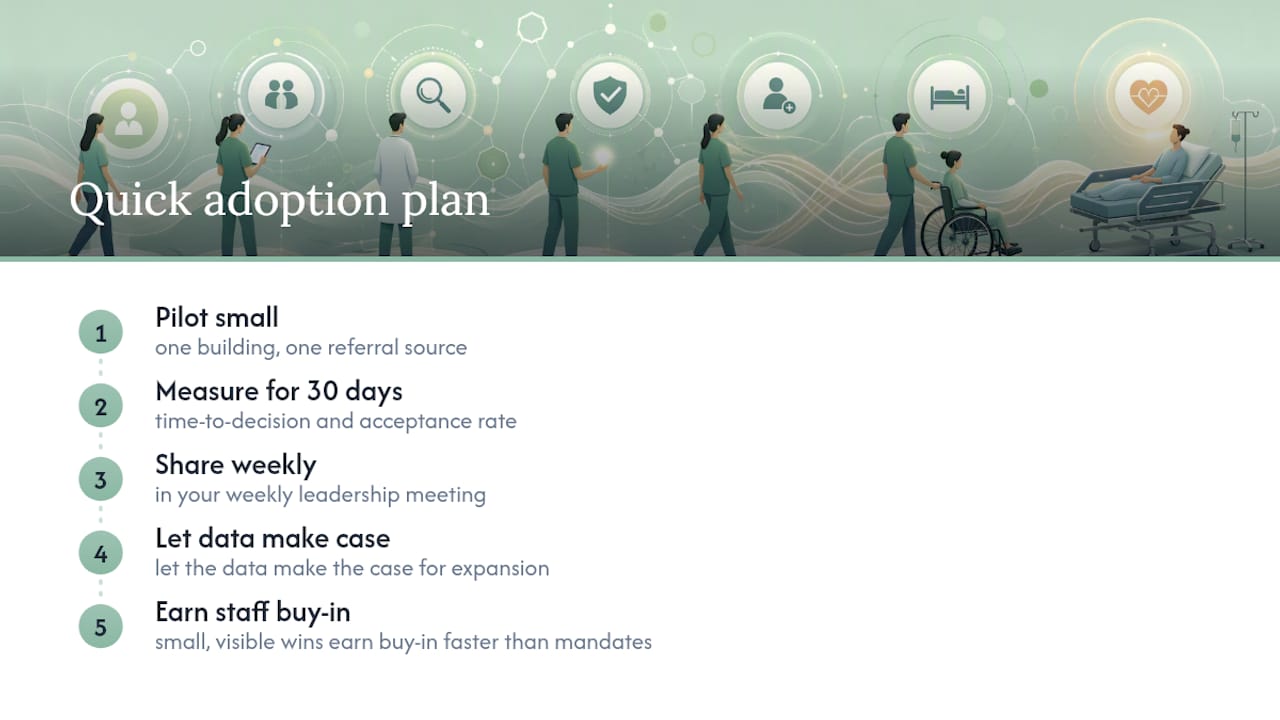
Pilot this in one building, with one referral source, before rolling it out network-wide. Measure time-to-decision and acceptance rate for 30 days, share the numbers in your weekly leadership meeting, and let the data make the case for expansion. Small, visible wins earn staff buy-in faster than any mandate.
How Smart Admissions Supports A Faster Screening Workflow
The steps above work whether you run them on paper or in software, but manual execution has a ceiling. Smart Admissions is built specifically to run the parallel review model this article describes, without adding headcount. It combines AI-assisted intake summarization, EMR and payer portal integrations, automated PASRR Level I flagging, and analytics dashboards that show exactly where each referral sits in your pipeline.

Compared with a paper checklist or a shared spreadsheet, the platform’s real advantage is speed with an audit trail: every timestamp, every decision reason, and every missing document gets logged automatically, which matters the next time a state surveyor or corporate compliance officer asks how a decision was made. Facilities using this kind of automated workflow typically see faster decision times, fewer referrals lost to silence, more consistent triage outcomes across shifts, and easier compliance reviews.
If you’re ready to see how a step-by-step admissions workflow built for this exact process runs in practice, start with a pilot in one building and one referral source, then expand once the numbers prove out.
Sources
- Retrospective study on referral acceptance and payer/diagnosis (2022)
- Medicaid
- Variability in skilled nursing facility screening and admission processes: implications for value-based purchasing – PMC