
Coordinating patient referrals across multiple healthcare systems often results in manual data entry, delayed insurance checks, and missed handoffs that strain admissions teams. Many patient referral management software options demand custom integrations, provide incomplete EHR connectivity, or hide essential automation features behind complex pricing and support agreements. This comparison covers automation, integration, support, and pricing details for the top five exponentialcare.ai alternatives so you can select a patient referral management tool that matches your facility workflow without hidden costs or technical surprises.
Table of Contents
- Smart Admissions
- Exacare AI
- Clinware
- Flax
- Olira
- Comparative Analysis of Referral Management Solutions
Smart Admissions
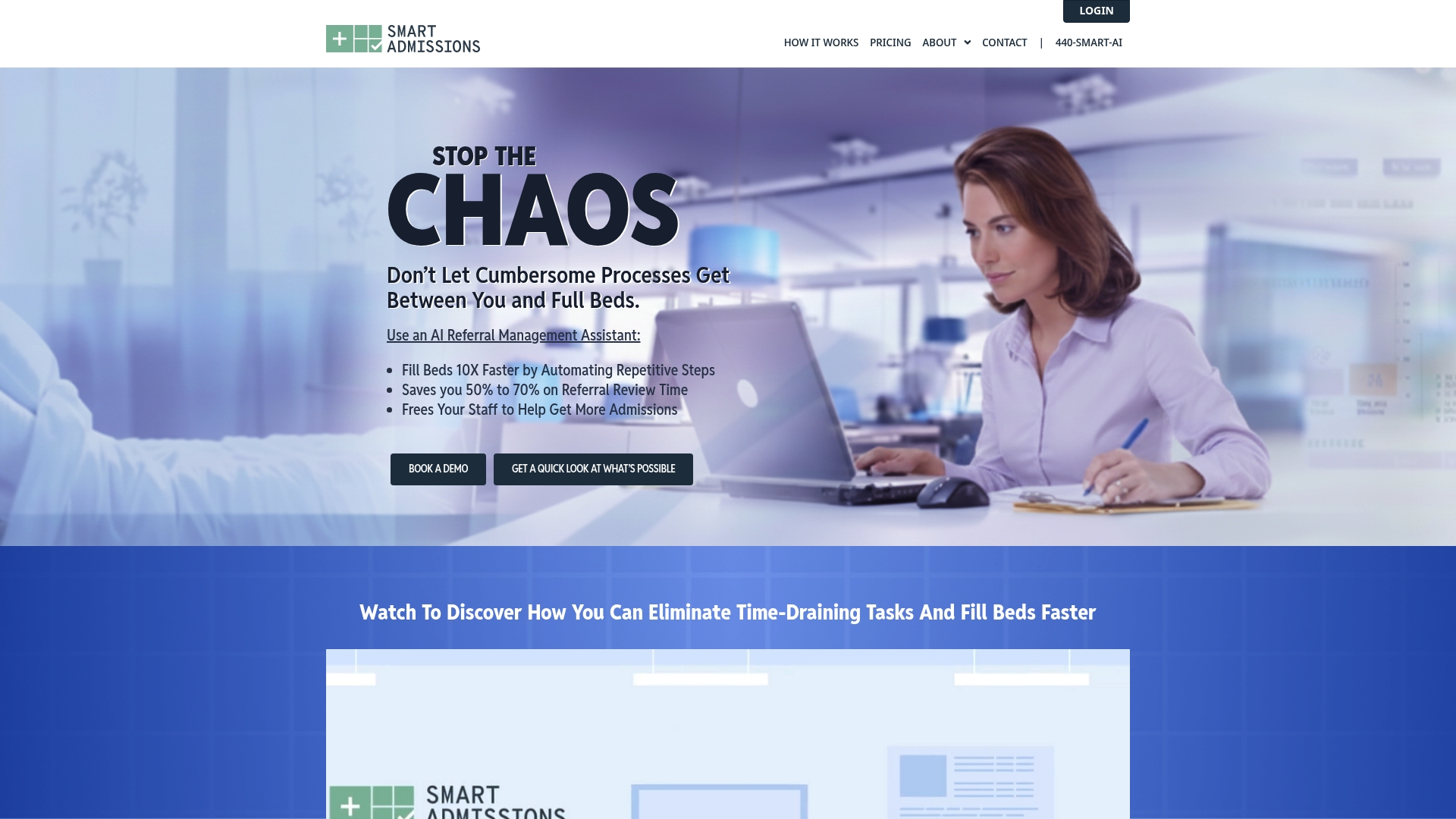
At a Glance
Smart Admissions reports referral review time can drop from 45 minutes to under 5 minutes. The vendor links that drop to automated referral routing, real-time eligibility checks, and a facility-specific decision engine that prioritizes likely admits.
Core Features
- Centralized referral intake and pipeline tracking that keeps every referral and document in one queue.
- Real-time insurance and eligibility verification to cut manual payer lookups and reduce denials.
- EHR integration with bi-directional data sync so clinical data flows both ways and reduces duplicate entry.
- Automated referral routing, status updates, and a facility-specific decision engine for acceptance recommendations.
Key Differentiator
Built specifically for healthcare providers, Smart Admissions pairs workflow automation with a facility-specific decision engine tuned for SNF admissions. That focus makes its rules and recommendations easier to map to your acceptance criteria than generic CRMs.
Pros
- Smart Admissions reports administrative hours can fall 30 to 70 percent per week, freeing nurses and admissions staff from repetitive paperwork. This is a vendor claim.
- The EHR sync reduces duplicate charting and speeds credential checks, which shortens time from referral to clinical review.
- Real-time eligibility checks reduce time spent chasing insurance details and lower the chance of unexpected coverage denials at intake.
- Audit readiness is improved because referral documentation and status history are centralized and searchable.
Cons
- Requires existing EHR or referral data integration, which can add setup costs and a modest configuration timeline for IT and vendors.
Notable Integrations
- EHR systems (example: PointClickCare) via bi-directional sync for clinical and demographic data exchange.
Who It’s For
Skilled nursing, rehabilitation, and post-acute care facilities that need to reduce manual referral work and speed bed placement. Best for organizations able to budget for EHR integration and staff training.
Unique Value Proposition
Bi-directional EHR sync combined with real-time eligibility checks drives faster, data-informed admission decisions. That technical pairing lets admissions staff act on a single verified patient record rather than toggling between faxed charts, phone calls, and separate payer portals. For facilities that measure bed fill velocity, this reduces handoffs, tightens audit trails, and shortens the time to revenue capture.
Real World Use Case
According to the vendor, one skilled nursing facility reduced referral review time from 45 minutes to under 5 minutes, began filling beds 3 to 5 days faster each month, and captured more than $75,000 in additional revenue by responding faster to referral sources. Those figures are vendor-reported.
Pricing
Monthly pricing starts at $597. Annual billing is $6,447, which reflects a 10 percent discount compared with monthly payments. Pricing covers referral management, insurance verification, EHR integration, automation, business intelligence, and compliance features.
Website: https://smartadmissions.ai
Exacare AI
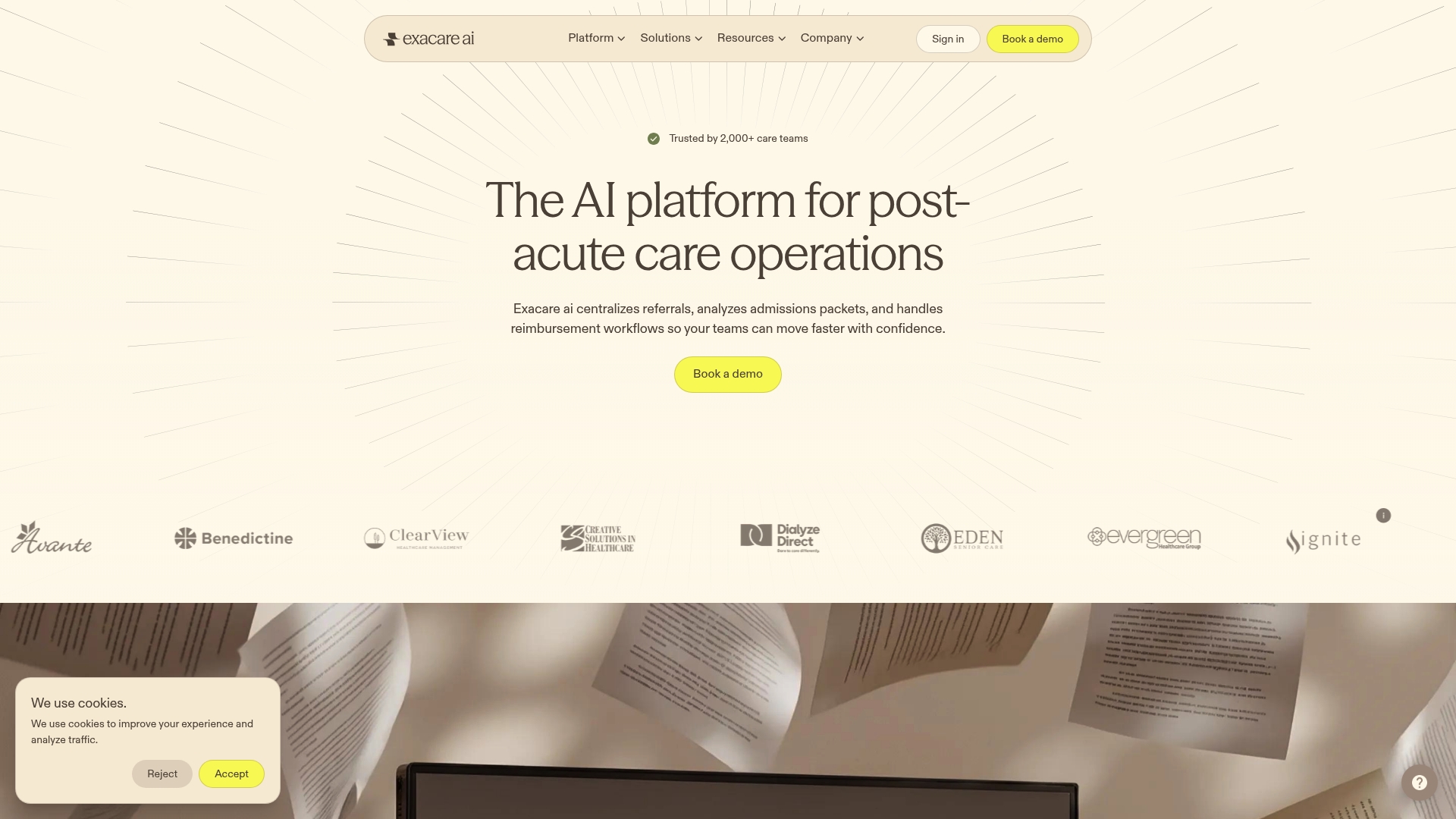
At a Glance
The vendor reports being trusted by over 2,000 care teams, a concrete adoption signal within post-acute operations. Exacare AI centralizes referrals, analyzes full admissions packets with machine learning, and automates reimbursement workflows to reduce manual review time.
The platform emphasizes deeper EHR and referral-platform connections and an on-shore support team for real-time help. That figure above frames its positioning: more integrations and support than many niche tools.
Core Features
- Centralizes incoming referrals and applies rules to automate admission decisions.
- AI-driven analysis of referral packets to surface clinical signals and risks beyond keyword matches.
- Connects with referral platforms, hospital systems, and electronic health records to reduce duplicate entry.
- Automates prior authorizations and concurrent review workflows to shorten back-and-forth with payers.
- Provides an on-shore support team for real-time, dedicated assistance during admission and reimbursement tasks.
Key Differentiator
Exacare AI’s focus on analyzing entire referral packets sets it apart. Rather than scanning keywords, it attempts to identify clinical patterns and risk indicators across notes, images, and structured fields — a deeper packet-level approach meant to flag admission issues earlier.
Pros
- Helps reduce manual packet review by routing higher-probability admits directly to admissions staff, which can free capacity and speed decision cycles.
- Deeper integrations expand connectivity to hospital systems and EHRs, cutting duplicate charting and entry errors.
- Dedicated on-shore support reduces time spent waiting for vendor responses during critical admissions windows.
- The platform reports revenue and capacity gains for customers who adopt its reimbursement automations, giving operational leaders figures to reference in ROI conversations.
Cons
- Limited third-party reviews make it hard to judge long-term user satisfaction beyond vendor claims.
- The vendor does not publish detailed compatibility matrices, so exact EHR or referral platform fit may require discovery calls.
- Some operational teams will need internal IT work to integrate legacy systems; the customization outline is not fully public.
When It May Not Fit
If your facility relies on rare or heavily customized EHR instances, Exacare AI may require more integration work than advertised. Also, teams that prioritize peer-reviewed customer outcomes over vendor-reported adoption figures should request references before committing.
Who It’s For
Care teams in skilled nursing, home health, or hospice organizations that need assistance handling high referral volumes and want AI help flagging clinical risks. Admission managers and reimbursement leads who value vendor support during the admission window will find the model appealing.
Real World Use Case
A skilled nursing facility routes all referrals through Exacare AI. The tool evaluates packets, verifies insurance prerequisites, and triggers prior authorization workflows. The facility reports faster bed placement and better capture of billable services after switching to packet-level review automation.
Pricing
Not applicable. Pricing information is not published in the provided materials and appears to be handled via sales conversations. Prospective buyers should expect a discussion of implementation and integration costs alongside subscription or license terms.
Website: https://exacare.com
Clinware
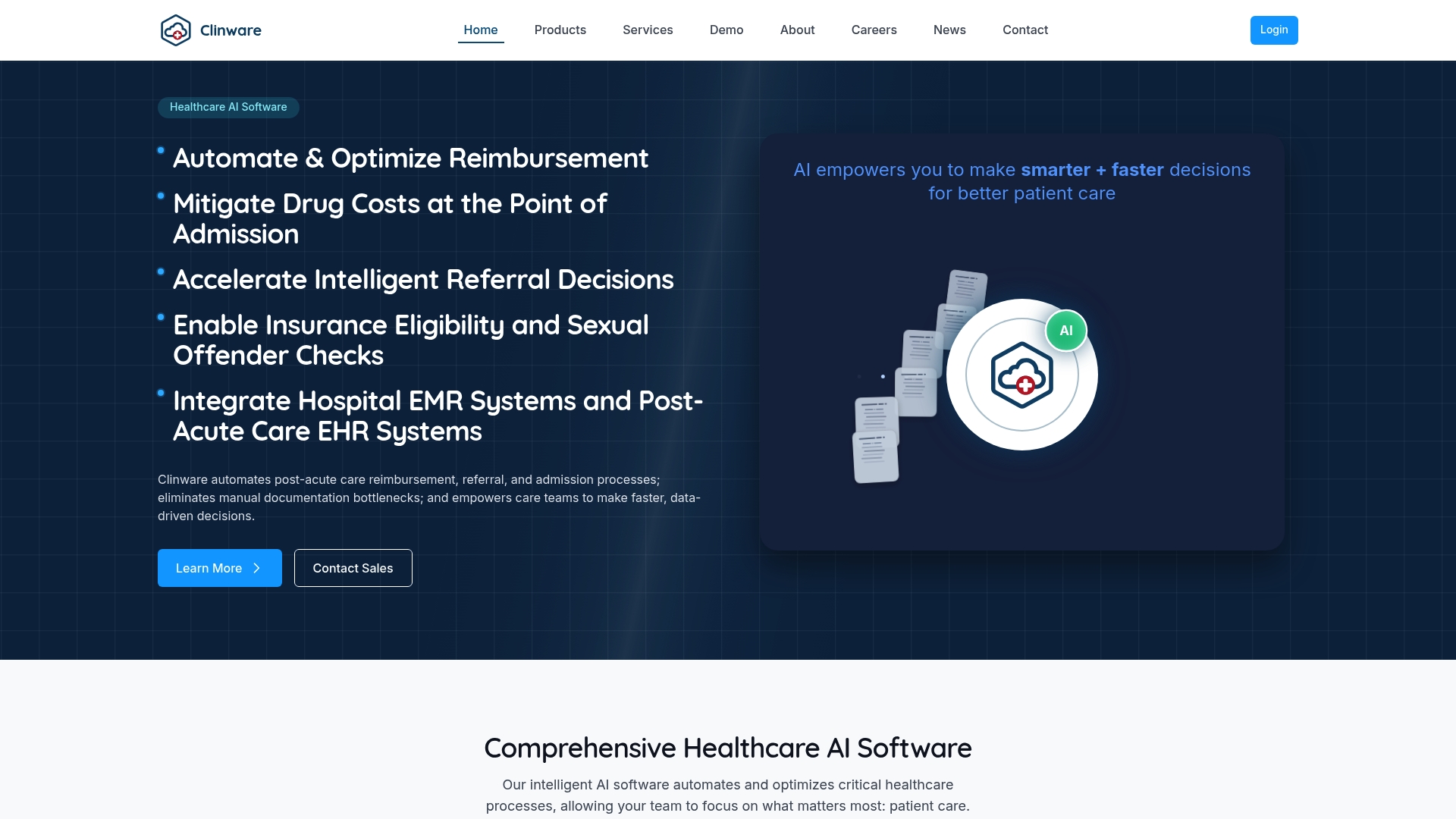
At a Glance
Clinware advertises direct integrations with Epic, Allscripts, MediTech, Matrix Care, Oracle Health, Point Click Care, and Veradigm — a broad EMR roster aimed at hospital-to-post-acute handoffs. The vendor’s marketing materials also state support for HIPAA and SOC 2 Type II compliance.
Clinware bundles AI-driven referral triage, documentation review, reimbursement optimization, and real-time dashboards into a single product aimed at clinical and administrative teams in post-acute settings.
Core Capabilities
- AI-powered referral processing and prioritization: automates intake triage and ranks referrals by clinical and administrative criteria.
- Automated clinical documentation analysis: highlights missing codes and documentation gaps to reduce denials.
- Coding suggestions tied to reimbursement outcomes: links documentation changes to potential financial impact.
- Real-time analytics dashboards: operational and financial views for admissions, denials, and length-of-stay trends.
- EMR connectivity with major hospital systems: intended to pull patient context directly from hospital records.
What Sets It Apart
Clinware’s pitch centers on combining clinical, administrative, and financial workflows with real-time reporting and the EMR connectivity listed above. That combination is positioned to reduce manual handoffs between hospital discharge and post-acute intake while keeping clinical context attached to each referral.
Strengths
- Strong customer support: users report helpful, responsive support that eases onboarding and troubleshooting.
- Cloud access for end users: cloud availability reduces the need for local installs and helps distributed admissions teams.
- Centralizes multiple functions so your admissions, documentation review, and reimbursement checks live in one place rather than in separate point tools.
- Robust integration posture with hospital systems helps avoid duplicate data entry when those connections are available.
Limitations
- The platform requires additional modules to unlock its full capabilities, which raises implementation complexity for smaller facilities.
- The user interface can feel glitchy during heavy data lookups, slowing intensive review sessions.
- Documentation editing features are functional but not as intuitive as some clinical charting tools.
- Importing tables and bulk data is clumsy compared with modern spreadsheet-style imports.
When It May Not Fit
If your admissions team wants a lightweight out-of-the-box product that needs no training, Clinware may feel too feature-rich and complex. Facilities without a dedicated implementation lead will struggle to enable all modules effectively.
Notable Integrations
- Epic
- Allscripts
- MediTech
- Matrix Care
- Oracle Health
- Point Click Care
- Veradigm
Who Should Evaluate This
Healthcare administrators and clinical operations leaders at skilled nursing, assisted living, and hospital post-acute programs that need AI assistance for referrals, documentation, and reimbursement workflows. Best when you have IT capacity to manage integrations and a trainer to onboard staff.
Real World Example
A skilled nursing facility used Clinware to automate documentation review and billing checks while connected to Epic. That workflow reduced claim denials in practice and freed clinical staff from repetitive chart searches during admissions.
Pricing
The vendor lists pricing as not applicable and marks the offering informational only; contact Clinware for custom licensing and deployment quotes.
Website: https://clinware.com
Flax
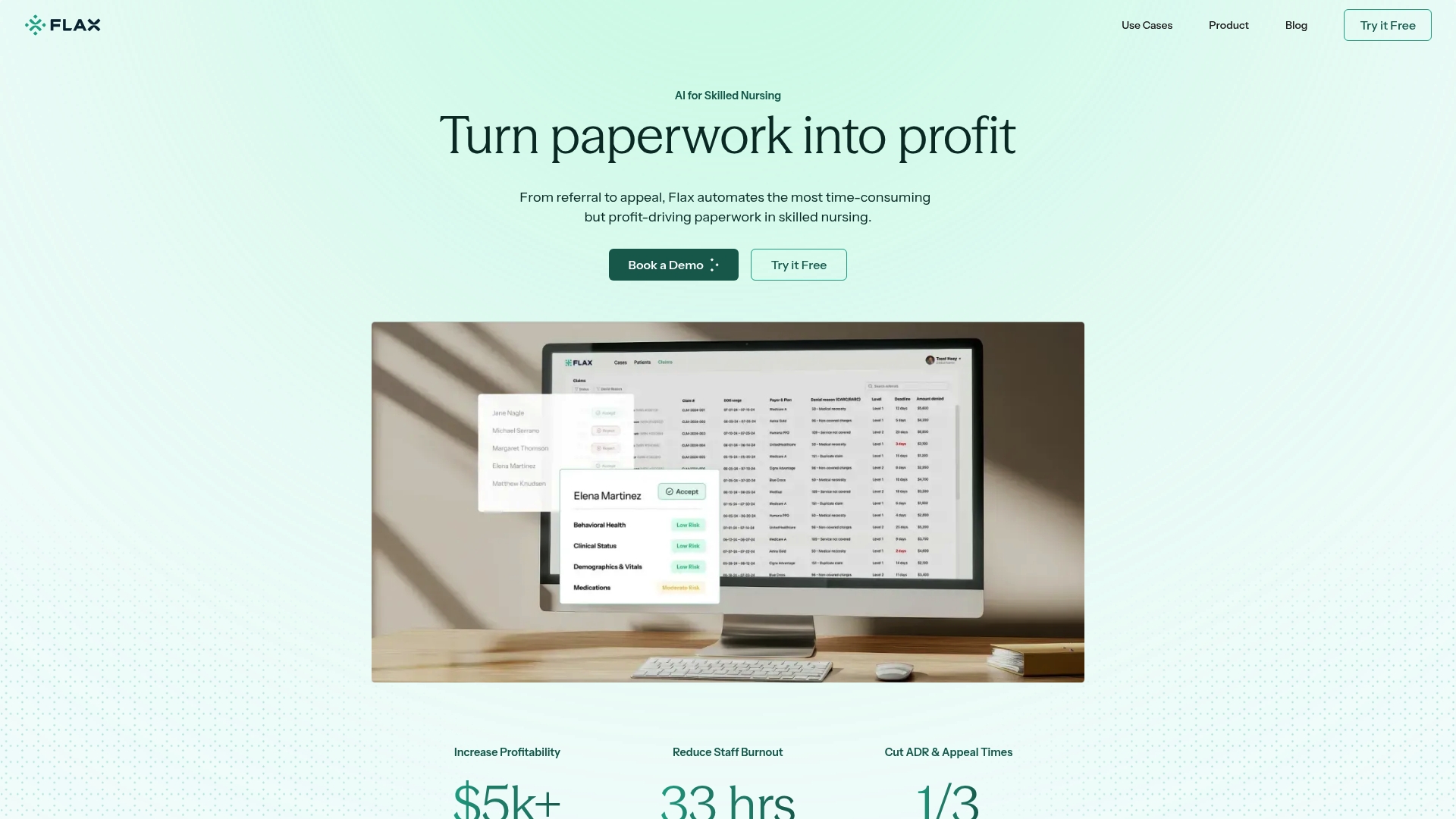
At a Glance
Flax’s marketing materials claim the platform automates paperwork for skilled nursing facilities, covering referrals, intake, billing, and appeals. User reviews posted on public sites, however, repeatedly report deceptive billing, hidden charges for AI features, and difficulty canceling subscriptions.
The mixed signals make Flax one of the more polarizing listings in this comparison set. Read the customer complaints side by side with the feature claims before shortlisting.
Core Features
- AI-driven automation for referral assessments, intake documentation, billing entries, and appeals drafting.
- Seamless integration with clinical data systems is claimed to let facility staff pull clinical notes into required forms.
- Automates document drafting and data extraction from notes to billing and regulatory forms.
- Improves administrative throughput and reimbursement processes according to the vendor.
Each item above comes from the vendor’s product description rather than independent validation.
Key Differentiator
What Flax advertises as its standout capability is broad automation across both clinical and administrative steps for skilled nursing facilities. That cross-function claim is the reason facilities often encounter Flax in vendor comparisons rather than point solutions focused only on referrals or billing.
Refer to the claim above when weighing integration complexity against potential labor reduction.
Pros
-
Offers a combined clinical and administrative listing that appeals to facilities wanting one consolidated solution rather than separate tools for referrals and billing.
-
The feature set targets tasks that consume large amounts of staff time such as appeals drafting and data extraction for forms. That focus can translate into measurable time savings if the integrations work as advertised.
-
A user testimonial included in vendor materials describes faster referral processing after rollout. The testimonial provides a practical example to discuss with your operations team during vendor evaluation.
-
Designed specifically for skilled nursing facilities, so the product language, templates, and workflows mirror common SNF paperwork and compliance needs.
Cons
-
Multiple user reports claim deceptive billing practices and hidden costs for core AI features. Those are complaints posted by customers and not vendor statements.
-
Several reviewers report significant friction when canceling subscriptions and difficulty obtaining refunds.
-
Customer support is described in reviews as unresponsive after the sale. That pattern raises risk for facilities with limited internal IT or vendor management bandwidth.
-
Transparency concerns make procurement teams likely to require tighter contract terms and stronger audit clauses than they would for established vendors.
When It May Not Fit
If your procurement policy forbids vendors with unresolved public complaints about billing or support, Flax may not be a shortlist candidate. Likewise, if your team lacks contract management resources, the reported cancellation and refund friction increases operational risk.
Facilities that require vendor references and documented refund policies before pilot rollout should treat Flax as higher risk until those items are verified in writing.
Who It’s For
The listing is aimed at skilled nursing facility administrators and clinical operations managers exploring consolidated automation. It fits teams looking to compare a single-vendor approach to replacing manual intake and appeals workflows, provided they plan a careful procurement check.
Real World Use Case
A facility wanting to reduce the hours spent on appeals might evaluate Flax to auto-generate appeals letters from denial notes and submit those drafts for clinical signoff. The vendor materials and one testimonial describe faster referral throughput, but the procurement team would want a short pilot and a written refund and cancellation clause before committing.
Website: https://flax.ai
Olira
At a Glance
Continuous, real-time patient state updates from EMRs, wearables, sensors, and records are compiled into a single queryable patient source. Olira emphasizes data provenance so every insight can be traced back to raw inputs and timestamps.
Core Features
- Continuous compilation of patient data across EMRs, wearables, sensors, and clinical records for up-to-date patient state.
- Typed SDKs that provide a single integration point for multiple data sources and allow developers to query typed records.
- Full data provenance tracking from raw inputs to derived outputs so every value has an audit trail.
- Pre-built, continuously updated views for workflow agents and AI systems rather than one-off snapshots.
Key Differentiator
Olira’s distinguishing feature is a single, queryable patient data source with provenance baked in, aimed squarely at teams building clinical AI. That focus makes it different from admissions or referral tools because Olira tackles data plumbing and auditability for models and decision support.
Pros
- Reduces development time for clinical AI projects by consolidating multiple data feeds behind one query interface, which shortens integration cycles.
- Gives care teams and models a single, queryable patient view instead of forcing engineers to stitch disparate exports during development.
- The provenance model supports audit and review by listing source records and timestamps for derived signals, useful for clinical validation workflows.
- The vendor’s marketing materials state compliance with HIPAA and SOC 2, which matters for production clinical use and vendor vetting.
- Accepts passive sensor and wearable inputs as well as traditional EMR records, making it easier to include continuous monitoring signals in decision logic.
Cons
- Public technical documentation appears limited; the product data notes API docs that return 404, which complicates early technical evaluation.
- There is little third-party review data available, so reliability and day-to-day operational experience are hard to verify without a pilot.
- If your required data sources are unsupported or your stack is tightly locked to a proprietary EMR SDK, adaptation may take extra engineering effort.
When It May Not Fit
If your priority is admissions workflow automation, referral triage, or front-line intake tasks, Olira’s data-centric approach is narrower than a full admissions product. Organizations that need out-of-the-box intake forms and referral routing will likely find Olira overengineered.
Not for every use case.
Who It’s For
Healthcare providers, health systems, and digital health companies building clinical decision support, population health models, or AI-native care delivery pipelines. Best for teams with engineering capacity that need provable data lineage for clinical models.
Real World Use Case
A digital health vendor connects EMRs, wearable streams, and home sensor feeds into Olira so clinicians and algorithms read the same, continuously updated patient record. The provenance trail lets a clinician review which device and timestamp produced a high-risk alert.
Pricing
No public pricing is listed; pricing is likely enterprise or custom and requires vendor engagement. Expect implementation planning and a pilot phase before a production contract.
Website: https://olira.ai
Comparative Analysis of Referral Management Solutions
Selecting the right solution for referral management in healthcare requires discerning key differences between available options. Here, we compare Smart Admissions, Exacare AI, and Clinware, focusing on their unique features and capabilities.
Workflow Automation and Customization
Smart Admissions excels in reducing referral review times through automated routing and real-time eligibility checks, significantly benefiting facilities aiming to accelerate placement processes. Meanwhile, Exacare AI offers a more integration framework, connecting to diverse hospital systems and enhancing existing EHR functionalities. Its focus on packet-level analysis highlights clinical signals effectively, but it may involve a steeper learning curve due to its extensive features. Clinware stands out by including analytics and real-time reporting tools, making it apt for data-driven operations but potentially overwhelming for teams requiring straightforward interfaces.
Integration Depth and Vendor Support
Exacare AI leads in providing broad and adaptive integration capabilities with hospital and referral systems, as well as a dedicated on-shore support team. This combination simplifies troubleshooting during implementation and daily use. Smart Admissions, with its targeted EHR integrations like PointClickCare, provides a streamlined setup tailored for skilled nursing and post-acute care facilities. Clinware, while offering extensive compatibility with well-known EMRs, may necessitate additional modules for functionality, which could deter smaller organizations.
Best Fit Recommendations
- Smart Admissions: Designed for organizations prioritizing reduced manual work and streamlined referral processes, particularly those with established EHR infrastructure.
- Exacare AI: Suitable for facilities managing high referral volumes that require deep packet analysis and strong integration support for diverse IT environments.
- Clinware: Best when analytics and decision support tools are critical to operations, and the facility has resources for thorough implementation.
Our Pick: Smart Admissions
Smart Admissions stands out for its specialized focus on expedited referral management in skilled nursing environments. Its integration with PointClickCare and real-time verification checks ensures efficiency without unnecessary complexity. However, clients with bespoke integration requirements or broader system interconnectivity needs might find Exacare AI a compelling alternative due to its adaptable range of integrations.
Patient Referral Management Software Comparison
Selecting the right patient referral management tool involves weighing factors such as feature set, implementation requirements, and specific use cases. The table below summarizes the key considerations for popular options.
| Product | Core Feature | Key Differentiator | Best For | Pricing | Notable Limitation |
|---|---|---|---|---|---|
| Smart Admissions | Automated referral routing and eligibility checks | Facility-specific decision engine | Skilled nursing organizations | Starting at $597/month | Requires EHR data integration for functionality |
| Exacare AI | ML-driven analysis of referral data | AI flags clinical risks via pattern recognition | Teams handling high referral volumes | Not disclosed | Lack of detailed compatibility information |
| Clinware | Integrated clinical and financial workflows | Extensive EMR connectivity for patient context | Operations with IT capacity for integration | Not disclosed | Can be overly complex for small facilities |
| Flax | Consolidated clinical and administrative automation | Combined referral and billing task handling | Facilities seeking end-to-end automation | Not disclosed | Reports of billing disputes and difficult cancellation |
| Olira | Continuous patient state updates from data feeds | Queryable patient data source with provenances | Organizations building clinical AI pipelines | Not disclosed | Limited public technical documentation available |
Discover Smartadmissions as a Reliable Exponentialcare.ai Alternative
If you find yourself overwhelmed by slow referral review times and fragmented workflows while exploring exponentialcare.ai alternatives, Smartadmissions was designed just for you. This platform dramatically cuts referral processing from 45 minutes to under 5 minutes by combining AI-powered referral management with real-time insurance eligibility checks and facility-specific decision engines. It helps healthcare providers like skilled nursing and post-acute care facilities reduce manual work and speed up bed occupancy without complicated setups.
Ready to stop guessing and start optimizing your admissions process? Visit Smartadmissions to explore how automated referral routing and bi-directional EHR integration can free nursing staff from paperwork and boost revenue. Act now to experience faster referral reviews and improved operational efficiency with solutions built for you.
Frequently Asked Questions
How does Smartadmissions improve referral review times compared to other platforms?
Smartadmissions can reduce referral review times from 45 minutes to under 5 minutes. This is achieved through automated referral routing, real-time eligibility checks, and a facility-specific decision engine designed for admissions. Facilities looking to speed up their admission processes will find this significant time savings beneficial.
What is the difference between Smartadmissions and Exacare AI?
Exacare AI excels in analyzing entire referral packets using AI to identify clinical risks and patterns, which is a strength for facilities focusing on comprehensive risk assessment. Meanwhile, Smartadmissions focuses on streamlining the referral intake process and automating documentation to significantly cut down administrative hours. Choose Smartadmissions if reducing manual referral work is your priority.
Can Clinware handle multiple EMR systems effectively?
Clinware offers direct integrations with major EMR systems like Epic, Allscripts, and Point Click Care, helping to facilitate smooth transitions between different platforms. This broad integration capability helps reduce manual data entry, making it a good choice for facilities with diverse systems. Keep in mind that effective implementation may require dedicated IT support to manage the integrations.
Does Smartadmissions provide real-time insurance eligibility verification?
Yes, Smartadmissions includes real-time insurance and eligibility verification to minimize the manual payer lookups that lead to denials. This feature helps prevent unexpected coverage issues at intake, which is crucial for facilities looking to streamline their admissions processes.
How does Flax compare in terms of user experience and transparency?
User experiences with Flax highlight concerns about deceptive billing practices and difficulty in canceling subscriptions, which can pose risks for facilities considering their services. In contrast, Smartadmissions supports facilities with clear pricing and transparent operations, making it a more reliable option for managing patient referrals.