
TL;DR:
- Skilled nursing facility admissions depend on a structured eligibility checklist that verifies clinical need, payer coverage, and compliance before bed assignment. Key steps include confirming a qualifying hospital stay, assessing skilled care necessity, completing PASRR screening, and verifying physician orders and payer status. Implementing a digital workflow reduces errors, speeds admissions, and ensures adherence to 2026 regulations, minimizing compliance risks.
Admissions professionals at skilled nursing facilities know the pressure well. A referral arrives, the clock starts ticking, and your team must simultaneously evaluate clinical need, verify payer coverage, and clear administrative requirements before a bed can be assigned. A structured patient eligibility checklist is what separates fast, defensible admissions decisions from costly delays and compliance gaps. This guide walks you through 10 specific steps built for 2026 workflows, covering Medicare criteria, Medicaid PASRR requirements, documentation standards, and operational best practices your team can apply starting today.
Table of Contents
- Key Takeaways
- 1. Use a patient eligibility checklist from the first referral call
- 2. Confirm the qualifying hospital stay for Medicare Part A
- 3. Assess clinical need for skilled care services
- 4. Distinguish skilled need from custodial care
- 5. Verify payer status and insurance eligibility before bed assignment
- 6. Complete PASRR screening for all Medicaid applicants
- 7. Review the admission agreement for federal compliance
- 8. Verify physician orders and hospital documentation
- 9. Map your workflow with a comparison table
- 10. Handle eligibility failures with a documented escalation process
- My honest take on why eligibility errors still happen
- How Smartadmissions helps your team apply this checklist at scale
- FAQ
Key Takeaways
| Point | Details |
|---|---|
| Clinical criteria come first | Confirm daily skilled care need and medical necessity before evaluating any payer coverage. |
| Medicare rules are specific in 2026 | A 3-day qualifying hospital stay and admission within 30 days are non-negotiable for Part A coverage. |
| PASRR is a legal requirement | Medicaid applicants require Level I screening before placement; skipping it creates compliance exposure. |
| Documentation drives reimbursement | Audit failures often trace back to poor documentation, not inappropriate admissions. |
| Automation reduces errors | Technology that integrates EMR and payer verification cuts delays and prevents eligibility oversights. |
1. Use a patient eligibility checklist from the first referral call
Your eligibility review should begin the moment a referral enters your system, not after a bed is tentatively assigned. A structured patient eligibility checklist applied at intake prevents your team from investing clinical and administrative time in patients who do not qualify. Build your checklist into your referral intake workflow as a gating mechanism with clear pass or fail criteria at each stage.
Most admission errors are not random. They cluster around the same missed steps: an unconfirmed hospital stay length, an unverified payer status, or a PASRR that nobody tracked to completion. Starting with a checklist from referral receipt means those gaps surface immediately, when they are still easy to resolve.
2. Confirm the qualifying hospital stay for Medicare Part A
Medicare Part A is the primary payer for most SNF admissions, and its qualifying conditions are specific. Medicare Part A covers SNF care up to 100 days per benefit period, but only when the patient has had a qualifying inpatient hospital stay of at least 3 days, is admitted to the SNF within 30 days of hospital discharge, and has Medicare Part A days remaining in the benefit period.
In 2026, the SNF deductible is $1,736, with full coverage for days 1 through 20 and coinsurance of $217 per day for days 21 through 100. Your admissions team needs to verify the exact admission and discharge dates from the hospital, confirm inpatient status rather than observation status, and check remaining benefit days before proceeding. Observation status does not count toward the 3-day qualifying stay, a distinction that catches many teams off guard.
3. Assess clinical need for skilled care services
Medicare eligibility for SNF care is not about functional limitations alone. SNF eligibility depends on need for daily skilled services performed or supervised by licensed professionals. A patient who needs help with bathing and dressing but does not require skilled nursing or therapy does not meet Medicare criteria, regardless of functional deficits.
Your clinical assessment should document the specific skilled services required, whether wound care, intravenous medication management, physical therapy, or skilled observation of a complex medical condition. The checklist items here include:
- Confirmation of daily skilled nursing or therapy requirement
- Link between skilled care need and the hospital-treated condition
- Physician orders supporting skilled care
- Documentation that skilled services cannot be provided safely in a lesser level of care
Pro Tip: When documenting clinical need, your notes should answer the question “Why does this patient need skilled care today?” with specificity. Stating “patient requires daily IV antibiotics for sepsis treated during hospitalization” is stronger than “patient needs nursing care.”
4. Distinguish skilled need from custodial care
This distinction is where many admissions decisions become contested at audit. Poor documentation often leads to audit failures despite clinical admission appropriateness. Custodial care, meaning assistance with activities of daily living, does not qualify under Medicare Part A regardless of the patient’s physical dependency level.
Your clinical review should specifically address whether the care required is skilled in nature. Physical therapy to restore function after a hip fracture qualifies. Ongoing supervision to prevent falls in a patient with stable dementia generally does not. Train your admissions nurses to document with this distinction in mind on every case, not just the borderline ones.
5. Verify payer status and insurance eligibility before bed assignment
Payer verification is a parallel step, not a follow-up task. A patient eligibility checklist should include payer reconciliation to verify Medicare days, Medicaid eligibility, or private-pay status before final bed assignment. Admitting a patient under the assumption that Medicare will cover the stay, without confirming benefit days, creates financial and operational problems that are difficult to reverse.
Your payer verification process should confirm:
- Medicare Part A eligibility and remaining benefit days
- Secondary insurance or Medigap coverage for cost-sharing
- Medicaid pending or active status for applicable patients
- Private-pay financial resources and family agreements where applicable
Pro Tip: Run your insurance eligibility form verification through your EMR or a connected payer portal rather than calling each payer manually. Real-time verification reduces errors and cuts average confirmation time from hours to minutes.
6. Complete PASRR screening for all Medicaid applicants
PASRR Level I screening is mandated for all Medicaid applicants seeking nursing facility placement. A positive screen on Level I triggers a Level II evaluation conducted by a state entity before placement can proceed. This is not an administrative formality. Facilities that skip or rush PASRR compliance face regulatory consequences and potential denial of Medicaid reimbursement.
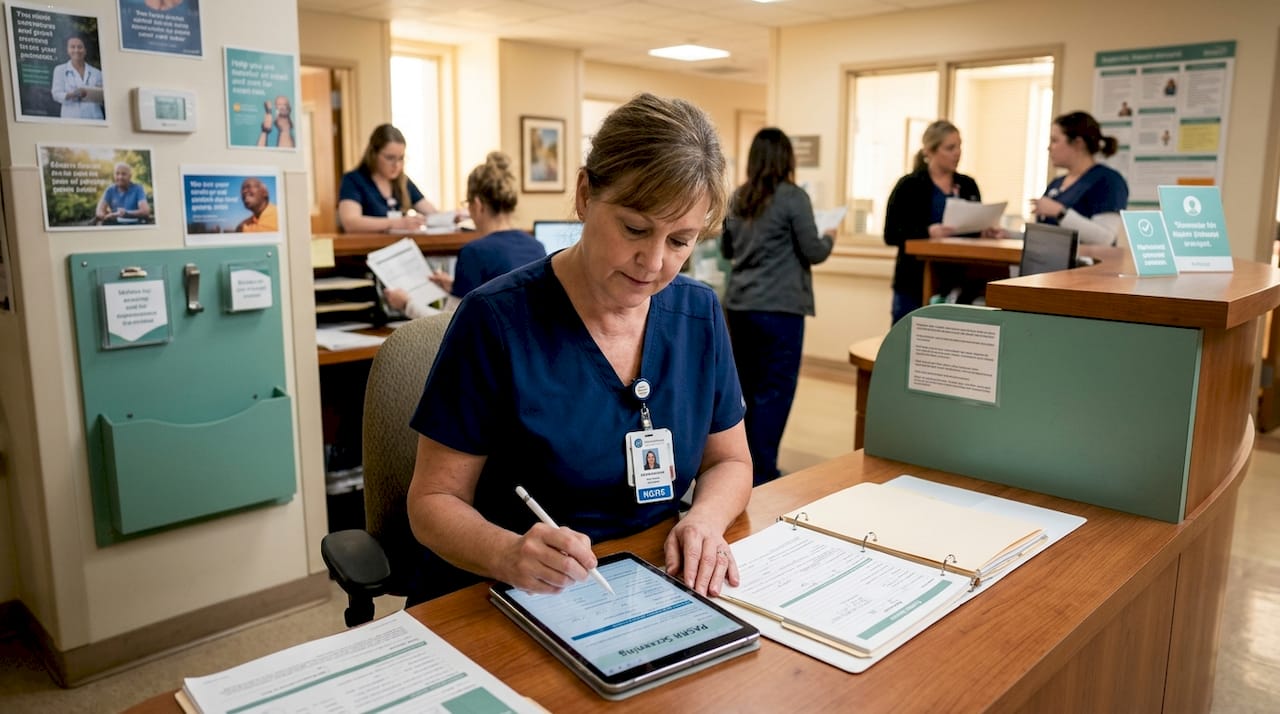
Your checklist must include a PASRR completion gate. Because Level II evaluations are conducted by state entities, your team cannot control the timeline entirely. What you can control is submitting Level I screenings promptly and tracking completion status proactively. Build a reminder system into your admissions workflow so no Medicaid applicant proceeds to final placement without documented PASRR clearance.
7. Review the admission agreement for federal compliance
Federal regulations under 42 CFR §483.15 govern the terms of nursing home admission agreements. A critical and frequently misunderstood rule is that facilities cannot require a third-party personal guarantor as a condition of admission. Family members or authorized representatives may sign admission documents without taking on personal financial liability for the resident’s care costs.
Your admissions team should review every agreement before signature to confirm it does not contain prohibited guarantor language. An authorized representative, such as someone holding power of attorney, can sign on behalf of the resident without assuming personal financial responsibility. Agreements containing prohibited clauses expose your facility to complaint investigations and legal liability, so annual legal review of your template documents is worth the investment.
8. Verify physician orders and hospital documentation
Clinical admissions require supporting physician orders tied to the hospital-treated condition. In utilization reviews, documentation must explicitly support the requirement for skilled nursing or therapy linked to the condition that drove hospitalization. Your admissions nurse should pull and review the hospital discharge summary, medication reconciliation, and attending physician orders before confirming acceptance.
The medical eligibility assessment at this step should cross-reference:
- Hospital diagnosis and primary reason for admission
- Physician certification of need for continued skilled care
- Functional assessment scores from occupational or physical therapy
- Medication orders requiring skilled nursing administration
A referral that arrives without a complete discharge summary is a red flag, not a minor inconvenience. Request missing documents before committing to an admission date.
9. Map your workflow with a comparison table
Effective eligibility determination requires clarity about who is responsible for each verification step and what confirms completion. The table below maps the core checklist items to verification methods and responsible parties.
| Checklist item | Verification method | Responsible party |
|---|---|---|
| 3-day qualifying hospital stay | Hospital records or discharge summary | Admissions coordinator |
| Medicare benefit days remaining | Real-time payer portal or EMR query | Billing or admissions staff |
| Skilled care medical necessity | Physician orders and clinical notes | Admissions nurse or clinical liaison |
| PASRR Level I and II completion | State PASRR tracking system | Admissions coordinator |
| Admission agreement compliance | Legal review of agreement template | Administrator or compliance officer |
| Payer reconciliation completed | Insurance verification report | Billing department |
Pro Tip: The most common delay in SNF admissions is waiting on hospital records. Designate a clinical liaison whose primary function is to request and track documentation from referring hospitals. This single change can reduce average intake time by several days.
For teams looking to reduce intake delays further, integrating your workflow into a digital admissions platform allows real-time tracking of every checklist item across your team.
10. Handle eligibility failures with a documented escalation process
Eligibility determinations are not always clean. A patient might meet functional needs but fail Medicare skilled care criteria, or clear clinical review but have exhausted Medicare days. Each failure type requires a different response, and your team needs a documented process for each scenario.
Common eligibility failure scenarios include:
- Exhausted Medicare days requiring transition to Medicaid or private pay
- Incomplete PASRR Level II delaying Medicaid placement
- Missing or inadequate physician documentation of skilled care need
- Observation status instead of inpatient status disqualifying the 3-day stay
- Payer coverage gaps discovered after clinical acceptance
For each of these, your checklist should specify the escalation path. Who contacts the family about private-pay options? Who contacts the hospital for amended physician orders? Defining these steps in advance means your team handles complications quickly rather than stalling.
My honest take on why eligibility errors still happen
I’ve reviewed enough admissions case files to recognize a pattern. Most eligibility errors do not happen because teams lack knowledge. They happen because the checklist lives in someone’s head rather than in a structured workflow, and the pace of referral volume means steps get assumed rather than confirmed.
The most persistent misconception I encounter is treating skilled care need and functional need as interchangeable. Admissions coordinators sometimes accept a referral because a patient clearly needs help and the family is motivated. But Medicare does not reimburse for need in the abstract. It reimburses for specific skilled services that licensed professionals must provide. That distinction, if not built into your intake assessment, will produce denials.
PASRR is the other consistent weak point. Teams treat it as a checkbox rather than a substantive gating step. A Level II evaluation that has not returned from the state is not a technicality. It is an incomplete admissions process. I have seen facilities absorb significant Medicaid clawbacks because placements proceeded without proper PASRR clearance.
My honest recommendation is to take your current admissions workflow and ask which steps are confirmed by documentation and which are confirmed by assumption. The ratio you find there will tell you where your risk actually lives.
— Harry
How Smartadmissions helps your team apply this checklist at scale
Managing a 10-point eligibility checklist manually across a high-volume referral pipeline creates pressure on your staff and introduces gaps. Smartadmissions is built specifically to address this.
The platform integrates directly with your EMR and insurance portals to provide real-time payer verification, automated PASRR tracking reminders, and clinical documentation review in a single workflow. Rather than tracking checklist items across spreadsheets and phone calls, your team works from a centralized admissions dashboard where every step is visible and accountable. Facilities using automated admissions tools see 20% faster bed occupancy compared to manual processes. Pair that with a structured admissions checklist workflow and your team spends less time chasing documents and more time on clinical decisions that actually require human judgment.
FAQ
What qualifies a patient for skilled nursing facility admission?
A patient qualifies for SNF admission under Medicare Part A by having a qualifying 3-day inpatient hospital stay, being admitted within 30 days, and requiring daily skilled nursing or therapy services linked to the hospital-treated condition.
What is a patient eligibility checklist for skilled nursing?
A patient eligibility checklist for skilled nursing is a structured verification tool that confirms clinical need, payer coverage, PASRR completion, physician documentation, and admission agreement compliance before finalizing placement.
Why does PASRR matter for SNF admissions?
PASRR Level I screening is legally required for all Medicaid applicants before nursing facility placement. A positive screen requires a state-conducted Level II evaluation, and skipping this step can result in denied Medicaid reimbursement.
How do observation status patients affect Medicare eligibility?
Patients admitted under hospital observation status do not accumulate qualifying inpatient days toward the 3-day Medicare requirement for SNF coverage, which means they cannot access Medicare Part A SNF benefits based on that stay.
What documents should your admissions team collect before accepting a referral?
Your team should collect the hospital discharge summary, physician orders certifying skilled care need, medication reconciliation, functional assessment scores, and payer verification confirmation before confirming acceptance.