
Skilled nursing facilities lose thousands of dollars daily when admissions stall. Studies show readmission rates hover around 25% in post-acute care, often due to operational failures rather than clinical issues. Administrators juggle fragmented intake systems, manual referral reviews, and discharge processes that fail to verify patient readiness. These bottlenecks delay bed occupancy, strain staff, and compromise patient outcomes. Healthcare workflow optimization offers a proven path to transform admissions processes through AI-powered automation, mobile solutions, and data-driven discharge planning. This guide explains how optimizing workflows can reduce delays, improve bed management, and enhance operational efficiency in skilled nursing and rehabilitation centers.
Table of Contents
- Understanding Healthcare Workflow Optimization
- How AI And Automation Transform Patient Intake And Bed Management
- Innovations Enhancing Patient Admission Efficiency: Mobile And Cloud Solutions
- Applying Workflow Optimization To Discharge Planning And Reducing Readmissions
- Explore Solutions To Optimize Your Healthcare Workflows
Key takeaways
| Point | Details |
|---|---|
| Workflow optimization reduces delays | Streamlining intake and discharge processes cuts admission cycles by 20-30% and minimizes errors. |
| AI accelerates admissions | AI-powered platforms optimize bed flow, reduce length of stay, and automate repetitive tasks. |
| Mobile solutions improve patient flow | Mobile admission processes cut turnaround time from 22.2 to 13.4 minutes on average. |
| Better discharge planning lowers readmissions | Verifying patient competency before discharge addresses operational failures causing costly readmissions. |
Understanding healthcare workflow optimization
Healthcare workflow optimization streamlines patient intake, referral management, and discharge processes to eliminate bottlenecks and manual inefficiencies. For skilled nursing and rehabilitation facilities, this means transforming how you review referrals, verify insurance eligibility, complete clinical assessments, and manage bed assignments. The core objective is simple: reduce manual steps, speed up admissions, maximize bed occupancy, and improve patient outcomes while supporting your clinical and administrative teams.
Modern workflow optimization relies on specific technologies that integrate seamlessly with your existing systems. AI-driven workflow automation streamlines referrals and reduces administrative load by handling repetitive tasks like data entry, eligibility checks, and documentation routing. Mobile admission applications let staff capture patient information at the point of care, eliminating paper forms and duplicate entry. Hybrid cloud frameworks enable real-time data sharing across EMR systems, insurance portals, and referral networks. Together, these tools create a connected ecosystem that supports faster decision-making and smoother patient transitions.
The benefits extend beyond speed. Optimized workflows dramatically reduce staff burnout by eliminating tedious manual tasks that consume hours each day. Admissions coordinators spend less time chasing down missing documents and more time engaging with patients and families. Clinical accuracy improves when systems automatically validate data against insurance requirements and medical necessity criteria. Facilities see measurable gains in bed fill rates, revenue cycle performance, and staff satisfaction. Understanding automated workflow benefits healthcare admissions helps you identify which processes to prioritize for optimization.
Key components of effective workflow optimization include:
- Real-time referral intake and routing to appropriate staff based on clinical criteria
- Automated insurance verification and eligibility checks integrated with payer portals
- Clinical assessment tools that flag potential issues before admission
- Centralized documentation management with version control and audit trails
- Predictive analytics for bed capacity planning and discharge forecasting
- Mobile-enabled data capture for flexibility and faster turnaround
These elements work together to create a responsive, efficient admissions operation. When you automate high-volume tasks and connect disparate systems, you free your team to focus on complex cases requiring human judgment. The result is faster patient placement, better resource utilization, and improved clinical outcomes across your facility.
How AI and automation transform patient intake and bed management
AI-powered platforms deliver measurable improvements in admissions speed and operational efficiency. Research shows AI platforms accelerate patient discharges, reduce average length of stay, and optimize bed flow management by analyzing patient data in real time. These systems identify discharge-ready patients earlier, predict bed availability with greater accuracy, and route referrals to the most appropriate units based on clinical needs and capacity constraints.

Workflow automation tackles the manual data entry burden that slows admissions and creates errors. Studies demonstrate automation reduces manual data entry by up to 80%, leading to faster admissions and fewer errors. When systems automatically populate patient demographics, insurance details, and clinical histories from referral sources, your staff can complete intake processes in a fraction of the time. Admission cycles shorten by 20-30% on average, meaning beds fill faster and revenue flows more consistently.
The impact becomes clear when you compare traditional manual processes with AI-enabled automation:
| Metric | Traditional Admissions | AI-Enabled Automated Intake |
|---|---|---|
| Average turnaround time | 48-72 hours | 24-36 hours |
| Data entry errors | 8-12% | 1-3% |
| Staff hours per admission | 3-4 hours | 1-1.5 hours |
| Referral review capacity | 20-30 per day | 50-70 per day |
| Bed occupancy rate | 82-87% | 91-95% |
These improvements translate directly to financial performance. Higher bed occupancy generates more revenue per available bed. Reduced staff hours per admission lower labor costs and allow teams to handle increased volume without proportional headcount growth. Fewer errors mean less rework, fewer denials, and smoother payer relationships. Learning about automation healthcare admissions efficiency reveals additional strategies for maximizing these gains.
AI also enhances clinical decision-making by surfacing relevant patient information at critical moments. Natural language processing extracts key details from referral notes, flagging potential complications or special care needs. Machine learning models predict which patients are most likely to experience extended stays or readmissions, allowing proactive care planning. Integration with EMR systems ensures clinical teams have complete, current information without switching between multiple applications. Exploring AI in healthcare admissions shows how these capabilities support better patient outcomes.
Pro Tip: Start by automating your highest-volume, most repetitive intake tasks like insurance verification and demographic data entry. These quick wins demonstrate value rapidly and build staff confidence in new systems before tackling more complex workflow changes.
The combination of speed, accuracy, and enhanced decision support makes AI and automation essential tools for competitive skilled nursing operations. Facilities that embrace these technologies consistently outperform peers in bed utilization, staff productivity, and patient satisfaction metrics.
Innovations enhancing patient admission efficiency: mobile and cloud solutions
Mobile admission processes represent a significant leap forward in patient flow management. Research shows mobile admission reduces turnaround time from an average of 22.2 minutes to 13.4 minutes compared to traditional walk-in methods. This nearly 40% reduction occurs because staff can capture patient information, verify insurance, and complete initial assessments at the bedside or in waiting areas using tablets or smartphones. The technology eliminates the bottleneck of patients waiting in line for a single registration desk.
Demographic factors influence mobile adoption success rates. Younger patients and those with higher digital literacy adapt more quickly to mobile check-in processes. However, facilities that provide staff-assisted mobile enrollment achieve high adoption across all age groups. The key is designing workflows that offer flexibility, allowing patients to choose their preferred method while staff guide those who need support. Understanding intake workflow improvement ideas for admissions helps tailor technology to your patient population.
Comparing mobile and walk-in admission methods reveals clear advantages:
| Factor | Walk-In Admission | Mobile Admission |
|---|---|---|
| Average time to complete | 22.2 minutes | 13.4 minutes |
| Patient satisfaction score | 3.8/5 | 4.4/5 |
| Data accuracy rate | 91% | 96% |
| Staff required | 2-3 per shift | 1-2 per shift |
Hybrid cloud frameworks complement mobile solutions by enabling seamless medical record sharing across organizations. Studies indicate hybrid cloud enhances patient admission efficiency by facilitating real-time access to patient histories, lab results, and treatment plans from referring hospitals and physician offices. This connectivity eliminates the wait time associated with faxing or mailing records, reduces duplicate testing, and ensures clinical teams have complete information for admission decisions.
Cloud-based systems also solve data fragmentation challenges common in post-acute care. When your facility uses multiple software platforms for referrals, billing, clinical documentation, and quality reporting, a hybrid cloud architecture creates a unified data layer. Information flows automatically between systems without manual transfers or reconciliation. Staff access current patient status from any device, whether they are at the facility, working remotely, or meeting with referral sources. Discovering how to integrate EMR with referrals provides practical implementation guidance.
The combination of mobile and cloud technologies creates a responsive, patient-centered admission experience. Patients spend less time in administrative processes and more time receiving care. Staff work more efficiently without being tethered to specific workstations or paper forms. Clinical leaders gain visibility into admission pipeline and capacity in real time, enabling proactive bed management and resource allocation.
Pro Tip: Assess your patient demographics and referral source preferences before selecting mobile and cloud solutions. Choose platforms that offer multiple enrollment pathways and integrate smoothly with the EMR systems your referring partners use most frequently.
These innovations position facilities to handle increasing admission volumes without proportional increases in administrative overhead. The efficiency gains free resources for patient care activities that directly impact outcomes and satisfaction.
Applying workflow optimization to discharge planning and reducing readmissions
Readmission rates in post-acute care remain stubbornly high, with approximately 25% of patients returning to hospitals within 30 days. Research reveals readmissions are often due to operational failures, not clinical failures, specifically the lack of competency carryover to the home environment. This finding shifts the focus from purely clinical interventions to workflow and process improvements that verify patient readiness before discharge.
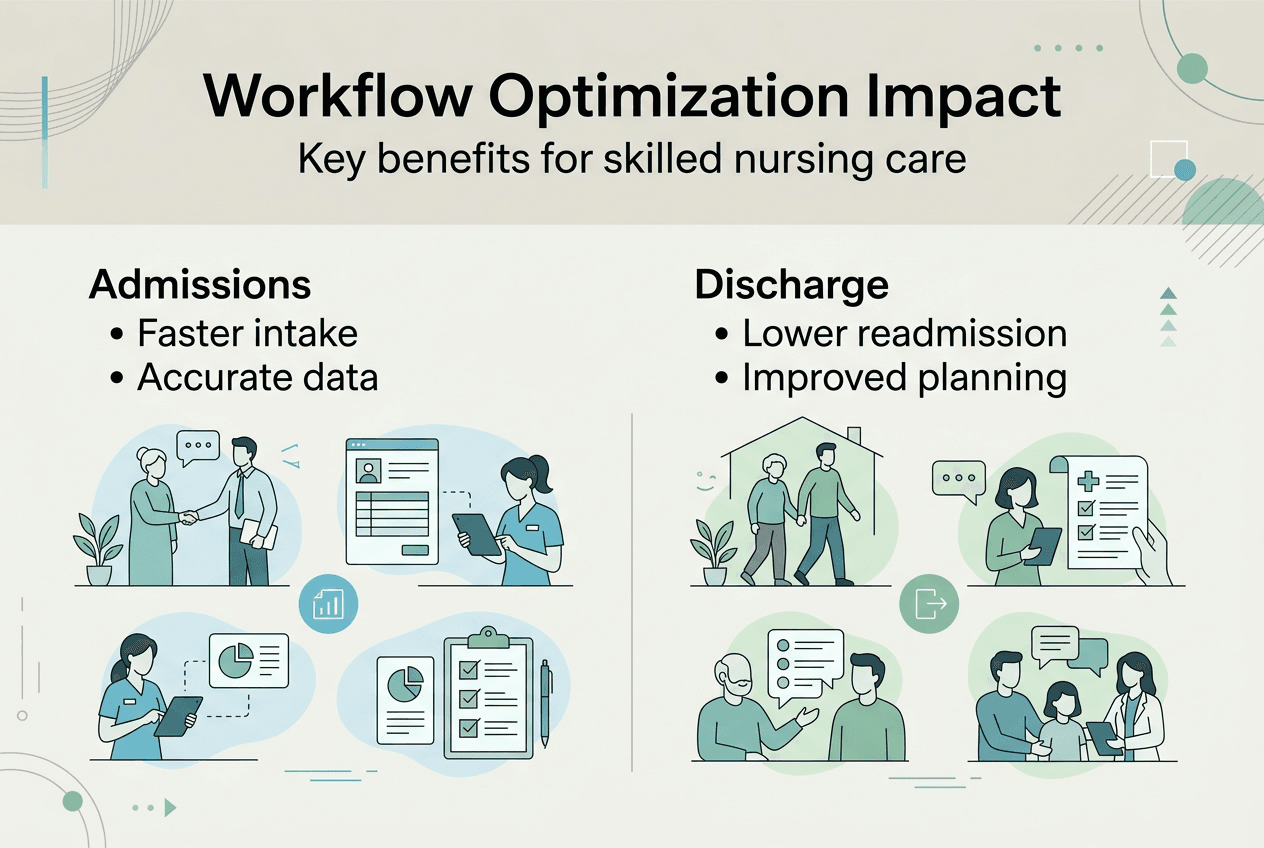
Current discharge education methods rely heavily on rushed conversations between nurses and patients, supplemented by generic printed handouts. Staff document that education occurred, but rarely verify that patients actually understand and can perform critical self-care tasks. A patient may nod along during a medication review but lack the competency to manage their prescriptions independently at home. This gap between documentation and actual competency creates the operational failure that drives readmissions.
Workflow optimization addresses this issue by mandating active verification of patient competency using objective data before discharge. Instead of checking a box that education was provided, optimized workflows require demonstration of skills, teach-back verification, and digital tracking of competency milestones. Systems flag patients who have not met discharge readiness criteria, preventing premature releases that lead to complications and hospital returns.
“Documentation alone is no longer enough. We must verify that patients can actually perform the skills needed to succeed at home, not just that we told them how to do it.”
Effective discharge workflow optimization strategies include:
- Comprehensive education programs with multiple touchpoints throughout the stay, not just at discharge
- Digital verification tools that require patients or caregivers to demonstrate competency in medication management, wound care, mobility aids, and other critical skills
- Clinical milestone tracking that identifies patients at risk of inadequate preparation early in their stay
- Automated data sharing with home health agencies, family caregivers, and primary care physicians to ensure continuity
- Post-discharge follow-up workflows that catch problems before they escalate to emergency department visits
These process improvements work because they close the competency gap that operational failures create. When you verify that a patient can correctly use their walker, manage their insulin, and recognize warning signs requiring medical attention, you dramatically reduce the likelihood of readmission. The workflow ensures nothing falls through the cracks during the hectic final days before discharge.
Integrating discharge planning with admission workflows creates even greater impact. When intake systems capture baseline competencies and care needs, clinical teams can develop individualized education plans from day one. Progress tracking throughout the stay identifies patients who need additional support or extended preparation time. This proactive approach prevents last-minute scrambles and ensures every patient leaves truly ready for the next care setting. Reviewing the intake documentation guide shows how to connect admission and discharge processes seamlessly.
The financial benefits are substantial. Preventing a single readmission saves thousands of dollars in penalties and lost revenue. Facilities with optimized discharge workflows consistently achieve readmission rates 5-8 percentage points lower than peers, translating to hundreds of thousands in annual savings for mid-sized operations. These resources can fund additional quality improvements, staff development, or capacity expansion.
Explore solutions to optimize your healthcare workflows
Transforming your admissions and discharge processes requires the right technology partner. Smart Admissions provides AI-powered workflow automation specifically designed for skilled nursing facilities, rehabilitation centers, and post-acute care providers. The platform integrates seamlessly with your existing EMR and insurance systems to deliver faster patient placement, improved bed management, and reduced administrative burden.
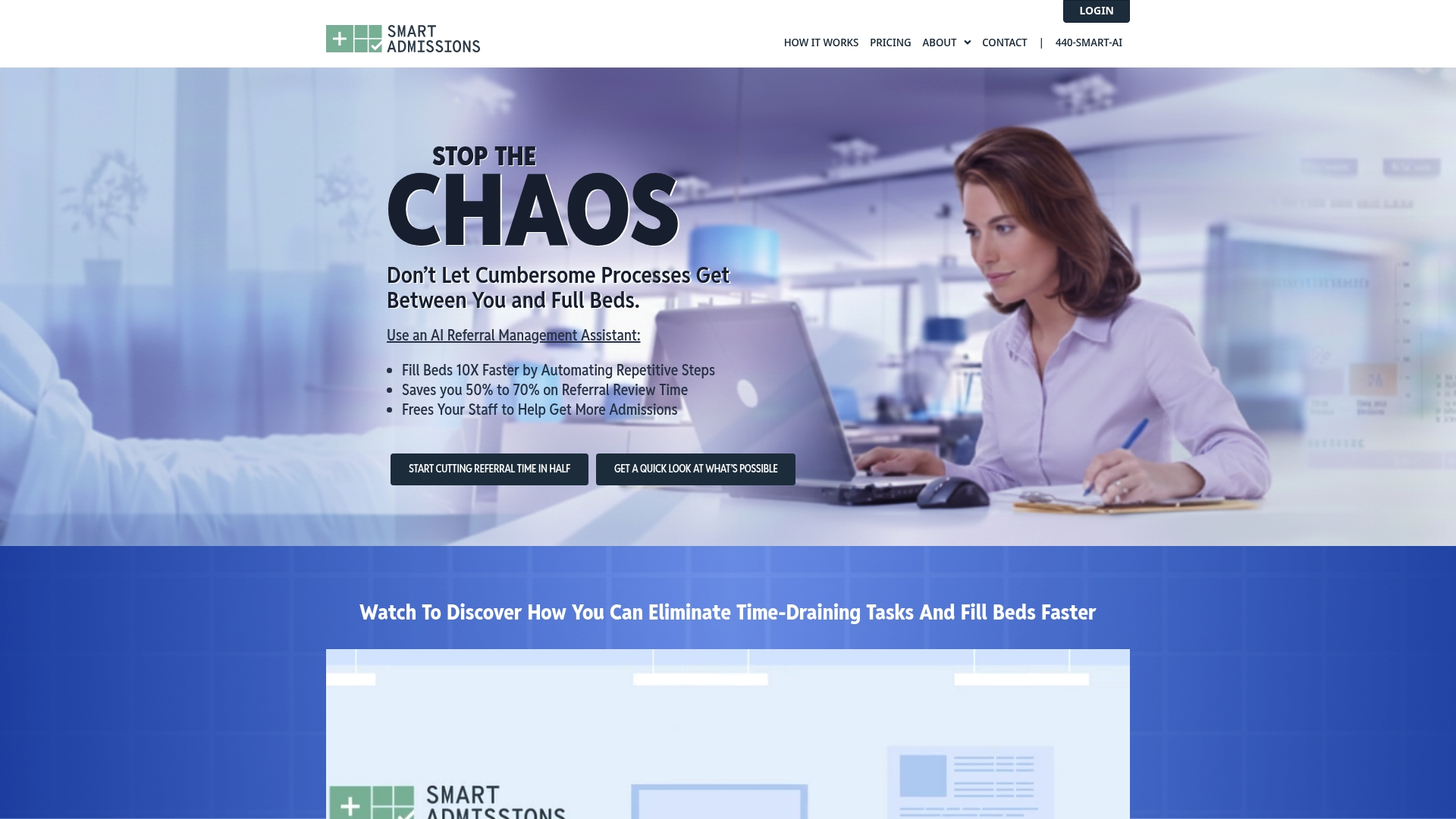
Facilities using Smart Admissions report significant gains in referral processing speed, admission accuracy, and staff productivity. The AI-powered referral management assistant handles routine verification tasks automatically, freeing your team to focus on complex cases and patient engagement. Real-time eligibility checks and clinical assessments accelerate decision-making, while centralized documentation eliminates the chaos of scattered spreadsheets and email chains. Explore automation healthcare admissions efficiency to see how leading facilities achieve operational excellence.
Whether you need comprehensive referral management systems examples or targeted intake automation healthcare admissions solutions, Smart Admissions offers customizable features that adapt to your specific workflows and volume. Responsive customer support and straightforward onboarding mean you can start realizing benefits quickly without extensive IT resources or technical expertise.
Frequently asked questions
What is healthcare workflow optimization?
Healthcare workflow optimization is the systematic improvement of patient intake, referral management, and discharge processes to eliminate inefficiencies and manual bottlenecks. It uses technology like AI, automation, and cloud-based systems to streamline administrative tasks, reduce errors, and accelerate patient flow. For skilled nursing facilities, optimization focuses on faster admissions, better bed management, and improved discharge planning that reduces readmissions.
How does AI improve patient admission workflow?
AI uses data-driven automation to speed admissions and reduce manual errors by handling repetitive tasks like insurance verification, eligibility checks, and documentation routing. AI-powered platforms accelerate patient discharges, reduce average length of stay, and optimize bed flow management through predictive analytics. The technology identifies discharge-ready patients earlier and routes referrals to appropriate units based on clinical needs and capacity, improving overall patient flow.
What are practical steps to implement workflow optimization in skilled nursing?
Start by identifying bottlenecks in your current admission and discharge processes, then automate the highest-volume repetitive tasks like data entry and insurance verification. Leverage mobile and cloud solutions for flexible data sharing and real-time access to patient information across teams. Train staff thoroughly on new systems, monitor key metrics like admission turnaround time and bed occupancy, and adjust workflows based on performance data to ensure continued gains.
How does workflow optimization reduce readmission rates?
Optimized workflows verify patient readiness and competency before discharge by requiring demonstration of critical self-care skills rather than just documenting that education occurred. Readmissions are often due to operational failures, not clinical failures, especially lack of competency carryover to the home environment. Better education programs, digital verification tools, and clinical milestone tracking ensure patients can actually perform necessary tasks independently, reducing costly readmissions by 5-8 percentage points.
What challenges might facilities face adopting new admission workflows?
Limited IT resources and staff adaptation to new technologies are typical hurdles when implementing workflow automation. Facilities with limited IT infrastructure may face challenges implementing advanced automation, so a phased approach is recommended. Start with simple automation of high-volume tasks to demonstrate value quickly, then gradually expand to more complex workflows as staff gain confidence and technical capabilities mature.