
Nearly half of the 100 million specialty referrals made annually in the U.S. never get completed, contributing to over $150 billion in losses. These failures stem from fragmented workflows, outdated communication methods, and manual processing that burden admissions teams. AI is rapidly changing this landscape by automating intake and referral tasks, reducing errors, and accelerating patient placement. This guide explains how AI transforms healthcare admissions, addresses common misconceptions, and provides a framework for selecting the right solutions.
Table of Contents
- Introduction To Ai In Healthcare Admissions
- How Ai Streamlines Patient Intake
- Ai In Referral Process Automation
- Balancing Ai And Human Oversight In Admissions
- Challenges In Current Referral Processes
- Financial Impact Of Inefficient Referrals
- Common Misconceptions About Ai In Admissions
- Framework For Implementing Ai In Healthcare Admissions
- Conclusion And Next Steps
- Enhance Your Admissions With Ai Solutions From Smart Admissions
- Frequently Asked Questions
Key takeaways
| Point | Details |
|---|---|
| AI cuts referral review times by over 50% | Automation extracts clinical data accurately and speeds patient placement decisions. |
| Human oversight ensures clinical accuracy | AI handles routine tasks while staff validate complex cases and maintain judgment. |
| Improved bed occupancy drives revenue growth | Faster admissions cycles increase facility capacity utilization and financial returns. |
| Addressing misconceptions increases adoption | Understanding AI augments rather than replaces staff reduces resistance. |
| Evaluation frameworks guide solution selection | Assessing EMR integration, compliance, and ROI helps choose effective AI tools. |
Introduction to AI in healthcare admissions
Manual patient intake and referral processes create significant delays and errors that frustrate admissions teams and delay patient care. Staff spend hours on phone calls, faxing documents, and manually entering data instead of focusing on clinical coordination. These inefficiencies not only slow admissions but also increase the risk of incomplete referrals and revenue loss.
Healthcare referral workflows remain fragmented and reliant on outdated technology. Despite widespread AI adoption in healthcare operational areas, institutional referral workflows remain heavily reliant on fax and phone communications, causing significant delays and inefficiencies. This creates bottlenecks that prevent facilities from maximizing bed occupancy and operational capacity.
AI adoption in healthcare is rapidly expanding but often misunderstood. Many administrators worry AI will replace their teams or prove too complex to implement. In reality, modern AI solutions augment human expertise by automating repetitive tasks, allowing staff to focus on higher-value activities that require clinical judgment.
This article focuses on patient intake and referral management as primary AI application areas. You’ll learn specific ways AI streamlines these workflows, the financial impact of automation, and how to evaluate solutions for your facility. Understanding benefits of AI in healthcare admin and exploring healthcare intake technology faster referrals 2026 can help you make informed decisions.
Key areas where AI transforms admissions include:
- Automated scheduling and appointment coordination
- Real-time insurance eligibility verification
- Clinical data extraction from referral documents
- Workflow alerts for missing information
- Predictive analytics for bed management
How AI streamlines patient intake
AI automates scheduling, reducing wait times by 40% compared to manual processes. Patients receive faster responses, appointments are coordinated efficiently, and staff avoid the endless phone tag that typically delays intake. This speed translates directly to improved patient satisfaction and faster bed fill rates.
Natural language processing speeds data extraction and validation. AI reads clinical documents, extracts relevant patient information, and populates intake forms automatically. This eliminates manual data entry errors and ensures consistency across systems. Staff then review and validate the extracted information rather than typing everything from scratch.

Real-time insurance verification minimizes errors and denials. AI reduces intake processing time by up to 70% with automation and improves insurance verification accuracy. Systems check coverage instantly, flag potential issues before admission, and reduce the administrative burden of post-admission claim rejections.
Intake automation cuts processing time significantly, enhancing throughput. What once took hours now happens in minutes, allowing facilities to accept more referrals without adding staff. This efficiency gain directly impacts revenue by enabling faster patient placement and reducing empty bed days.
Pro Tip: Start with one high-volume intake task like insurance verification to demonstrate quick wins and build staff confidence in AI tools before expanding to other processes.
Facilities that streamline administrative tasks healthcare through intake automation healthcare admissions report measurable improvements in both staff satisfaction and operational metrics.
Key intake functions AI automates:
- Patient demographic data capture and validation
- Insurance eligibility and benefits verification
- Medical history extraction from referral documents
- Appointment scheduling and confirmation
- Pre-admission documentation collection
AI in referral process automation
AI uses natural language processing to accurately extract clinical and referral data. Systems read physician notes, medication lists, diagnosis codes, and treatment plans from faxed or scanned documents. AI extracts critical patient data with high accuracy and cuts referral-to-appointment cycle times by over 50%. This precision reduces the manual review burden and minimizes transcription errors.
Real-time eligibility verification reduces insurance-related delays. AI connects to payer portals, checks coverage status, and identifies authorization requirements before admissions staff spend time on case review. This upfront validation prevents wasted effort on referrals that won’t be covered.
Referral cycle time reduced by at least half enables faster admissions. Facilities move from days of manual processing to hours of automated workflow. Faster cycles mean more patients placed, higher bed occupancy, and increased revenue.
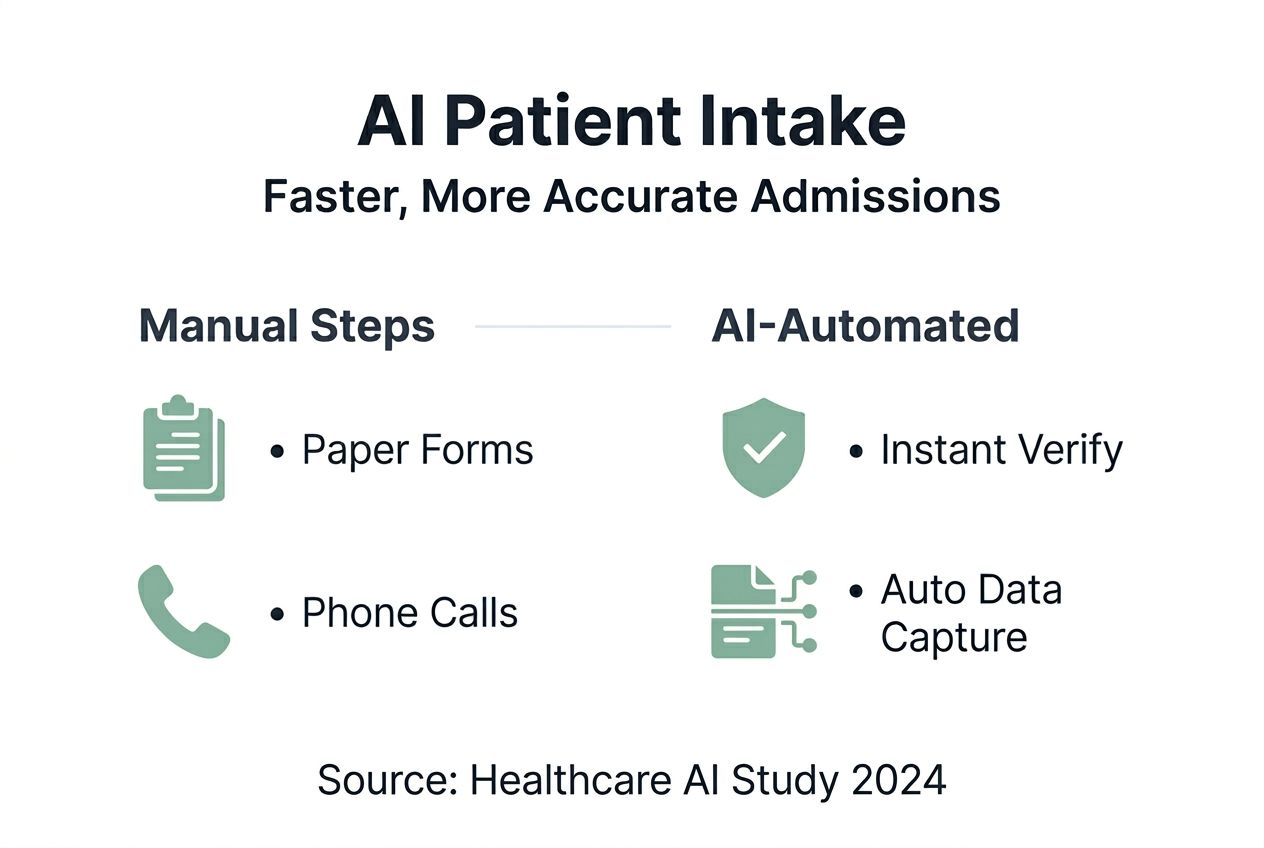
Automated alerts help staff track missing information and expedite processing. When documents are incomplete, AI flags specific gaps and prompts staff to request additional information. This proactive approach prevents referrals from stalling in review queues.
Pro Tip: Configure automated alerts to notify multiple team members simultaneously so coverage gaps don’t delay urgent referrals when primary staff are unavailable.
AI-powered assistants healthcare admissions integrate seamlessly with existing systems to provide these capabilities without disrupting established workflows.
| Referral Stage | Manual Process Time | AI-Automated Time | Time Savings |
|---|---|---|---|
| Document receipt and sorting | 30 minutes | 2 minutes | 93% |
| Clinical data extraction | 45 minutes | 5 minutes | 89% |
| Insurance verification | 60 minutes | 10 minutes | 83% |
| Staff review and decision | 30 minutes | 20 minutes | 33% |
| Total referral processing | 165 minutes | 37 minutes | 78% |
Balancing AI and human oversight in admissions
AI automates routine data entry, freeing staff for higher-level tasks. Admissions coordinators spend less time on paperwork and more time coordinating care, communicating with families, and making clinical placement decisions. This shift improves job satisfaction and reduces burnout.
Human validation catches edge cases and maintains clinical judgment. While AI handles standard referrals efficiently, complex cases with multiple comorbidities or unusual insurance situations still require experienced human review. This hybrid approach ensures accuracy without sacrificing efficiency.
The hybrid approach builds trust and improves accuracy. Staff see AI as a helpful tool rather than a threat when they maintain final decision authority. This partnership between technology and expertise delivers better outcomes than either could achieve alone.
Resistance stems from misconceptions about AI replacing staff rather than augmenting them, leading to resistance that can be mitigated by emphasizing human-in-the-loop models. Clear communication about AI’s supporting role reduces anxiety and accelerates adoption.
“AI in healthcare admissions works best when it handles the repetitive tasks that drain staff energy, while humans apply their judgment to complex clinical decisions that require experience and empathy.”
Facilities exploring why use AI admission tools should emphasize the collaborative nature of implementation to gain staff buy-in.
Critical tasks requiring human oversight:
- Final admission decisions for complex cases
- Communication with patients and families
- Resolution of insurance authorization disputes
- Clinical judgment on borderline eligibility cases
- Quality assurance and continuous improvement
Challenges in current referral processes
Over 50% of U.S. specialty referrals remain incomplete due to workflow inefficiencies. Patients get lost in the system, providers miss revenue opportunities, and continuity of care suffers. These failures reflect systemic issues rather than individual staff shortcomings.
Fax and phone communication cause delays and data loss. Critical patient information gets misplaced, messages don’t reach the right people, and follow-up becomes nearly impossible. This communication breakdown creates frustration for everyone involved in the referral process.
Referral leakages contribute to $150 billion in annual losses across healthcare. When referrals don’t convert to admissions, facilities lose revenue and patients experience delayed care. This financial impact affects smaller community providers especially hard.
Fragmented workflows and technology barriers limit automation. Many facilities use multiple disconnected systems that don’t communicate with each other. Staff manually transfer information between platforms, creating opportunities for errors and inefficiency.
Statistic: Clinicians make over 100 million specialty referrals annually in the U.S., with as many as half never completed, representing a massive opportunity for AI-driven improvement.
Facilities that streamline administrative tasks healthcare address these challenges systematically rather than accepting them as inevitable.
Common referral workflow bottlenecks:
- Incomplete referral documentation from sending providers
- Delays in insurance authorization processes
- Lack of real-time bed availability visibility
- Manual data entry between disparate systems
- Poor communication loops between facilities
Financial impact of inefficient referrals
Hospitals lose between $821K and $971K annually per physician due to referral leakage. This represents significant revenue that simply disappears due to process failures. For multi-physician facilities, these losses multiply quickly.
AI reduces denial rates and referral review times, improving financial returns. Faster processing means beds fill sooner, reducing costly empty bed days. Improved accuracy means fewer claim denials and rework. These efficiencies translate directly to improved margins.
Better bed occupancy from faster admissions increases facility revenue. Every day a bed sits empty costs money in fixed overhead without corresponding revenue. AI-powered admissions systems help facilities maintain optimal occupancy levels by accelerating the patient placement process.
Facilities exploring why automate admissions 20% faster bed occupancy can model the revenue impact specific to their size and case mix.
Statistic: AI-powered admissions can significantly reduce these losses and improve bed occupancy rates, delivering measurable ROI within the first year of implementation.
| Metric | Manual Process | AI-Automated Process | Financial Impact |
|---|---|---|---|
| Average referral processing time | 7 days | 3 days | 57% faster placement |
| Referral completion rate | 55% | 85% | 30% more admissions |
| Insurance denial rate | 12% | 4% | 67% fewer denials |
| Annual revenue per bed | $95,000 | $115,000 | 21% revenue increase |
| Staff overtime costs | $45,000 | $20,000 | $25,000 savings |
Common misconceptions about AI in admissions
AI does not replace admissions staff but automates routine tasks. Your team remains essential for clinical judgment, patient communication, and complex case management. AI simply removes the tedious data entry and verification tasks that consume valuable time.
Human judgment remains essential for clinical accuracy. AI is often mistaken as replacing staff rather than augmenting them, but evidence shows human-in-the-loop approaches reduce errors and improve workflow trust. The best outcomes happen when technology and expertise work together.
Smaller providers can adopt AI solutions tailored to their needs. Modern AI platforms offer flexible pricing and scalable features that work for facilities of all sizes. You don’t need a massive IT department or enterprise budget to benefit from automation.
AI systems comply with HIPAA and protect patient privacy. Reputable vendors build security and compliance into their platforms from the ground up. Patient data receives the same protection as in traditional systems, often with enhanced security features.
Understanding why use AI admission tools helps administrators make informed decisions based on facts rather than fears.
Key truths about AI in admissions:
- AI augments human capabilities rather than replacing them
- Implementation timelines are measured in weeks, not years
- Staff training requirements are minimal for user-friendly platforms
- ROI typically appears within 6 to 12 months
- Solutions integrate with existing EMR and insurance systems
Framework for implementing AI in healthcare admissions
Assess current workflows to identify bottlenecks. Document how long each step takes, where errors occur, and which tasks consume the most staff time. This baseline helps you measure improvement after implementation.
Evaluate AI platforms for integration with EMR and insurance portals. Seamless connections to existing systems are critical for avoiding duplicate data entry. Ask vendors for specific integration capabilities and implementation timelines.
Implement AI-powered intake and referral automation in phases. Start with one high-impact workflow like insurance verification, prove the value, then expand to other processes. This staged approach builds confidence and allows for adjustments.
Maintain human-in-the-loop validation checkpoints at critical decision points. Define which cases require staff review and which can be fully automated. Clear protocols ensure quality while maximizing efficiency gains.
Monitor key metrics post-deployment for continuous improvement. Track referral processing times, admission conversion rates, staff overtime, and bed occupancy. Use this data to refine workflows and demonstrate ROI to stakeholders.
Pro Tip: Involve frontline admissions staff in vendor selection and pilot testing to ensure the chosen solution actually addresses their daily pain points and gains their buy-in.
Facilities can reference the AI referral management checklist SNFs and learn to integrate EMR with referrals for detailed guidance.
Implementation steps:
- Conduct workflow assessment and identify automation opportunities
- Define success metrics and ROI targets
- Evaluate vendors based on integration, features, and support
- Run pilot program with one workflow or department
- Train staff and gather feedback for refinement
- Scale successful processes across the organization
- Monitor metrics and optimize continuously
Key evaluation criteria:
- EMR and insurance portal integration capabilities
- Human-in-the-loop workflow design
- Customization options for facility-specific needs
- HIPAA compliance and data security measures
- Vendor support and training resources
- Documented ROI from similar facilities
Conclusion and next steps
AI significantly improves admissions speed, accuracy, and financial outcomes for healthcare facilities. By automating routine tasks, AI allows your team to focus on clinical coordination and patient care while reducing errors and processing delays. The technology is proven, accessible, and delivering measurable results.
Balanced human-AI workflows yield the best results. Technology handles repetitive data tasks while your experienced staff apply judgment to complex cases. This partnership delivers efficiency without sacrificing the human touch that quality care requires.
Early adoption leads to measurable ROI and improved patient experience. Facilities implementing AI admissions tools report faster placement, higher bed occupancy, reduced staff burnout, and better financial performance. The competitive advantage goes to organizations that move quickly.
Explore success stories with AI admissions to see how similar facilities have transformed their operations. Start your assessment today to identify where AI can make the biggest impact in your admissions workflow.
Enhance your admissions with AI solutions from Smart Admissions
Ready to transform your referral and intake processes? Smart Admissions offers AI-powered tools designed specifically for healthcare facilities like yours.
Discover proven referral management systems that reduce processing times and improve accuracy. Learn how facilities automate admissions faster bed occupancy by 20% or more through intelligent workflow optimization. Explore comprehensive automation healthcare admissions efficiency solutions that integrate seamlessly with your existing EMR and insurance systems. Our platform delivers measurable ROI while reducing staff burden and improving patient placement speed.
Frequently asked questions
What is the main benefit of AI in healthcare admissions?
AI automates routine tasks like data entry and insurance verification, reducing referral processing times by over 50%. This leads to faster patient placement, improved bed occupancy rates, and reduced administrative burden on admissions staff. Facilities see measurable improvements in both efficiency and revenue within months of implementation.
How does AI improve referral management accuracy?
AI extracts clinical and insurance data from documents with high precision using natural language processing. Staff then verify edge cases and complex situations to maintain clinical judgment and compliance. This hybrid approach combines automation speed with human expertise for optimal accuracy.
Can smaller healthcare facilities implement AI admissions solutions?
Many AI platforms offer customizable features designed specifically for smaller facilities without extensive IT resources. Modern solutions provide flexible pricing, quick implementation timelines, and minimal training requirements. You don’t need enterprise scale to benefit from automation.
What role does human oversight play in AI-driven admissions?
Human review ensures accountability, maintains clinical judgment, and addresses exceptions AI cannot fully evaluate. Staff focus on complex cases, patient communication, and final placement decisions while AI handles routine data tasks. This partnership delivers better outcomes than either humans or AI could achieve alone.
How can I evaluate AI solutions for referral automation?
Evaluate AI platforms based on EMR integration capabilities, human-in-the-loop workflow design, customization flexibility, HIPAA compliance, and documented financial benefits from similar facilities. Request pilot programs to test solutions with your actual workflows before full implementation. Involve frontline staff in the evaluation to ensure the solution addresses real pain points.