
TL;DR:
- Effective onboarding aligns staff, workflows, and organizational goals to ensure technology reduces workload.
- Poor onboarding leads to workarounds, errors, burnout, and slower referrals, negating digital tool benefits.
- Continuous, role-specific onboarding and feedback are essential for sustained healthcare technology adoption and efficiency.
Digital tools promise efficiency, but installing new software in a skilled nursing home or rehabilitation center does not automatically reduce paperwork, speed up referrals, or fill beds faster. 80% of physicians report spending excessive time on administrative tasks, even in facilities that have already invested in technology. The gap between installing a system and actually using it well comes down to one factor that most organizations underestimate: onboarding. This article walks your team through what effective onboarding really looks like in the context of patient intake and referral management, what goes wrong without it, and how to build a program that produces real, measurable results.
Table of Contents
- Why onboarding matters for healthcare tech adoption
- Common onboarding pitfalls and how to avoid them
- Building an effective onboarding program: Key components
- How onboarding directly impacts admissions and referral management
- What most organizations miss about tech onboarding
- Start transforming your admissions onboarding today
- Frequently asked questions
Key Takeaways
| Point | Details |
|---|---|
| Onboarding is essential | A structured approach to onboarding is crucial for successful tech adoption in admissions and referral processes. |
| Avoid common pitfalls | Ignoring real workflow needs and staff feedback results in digital burden and inefficiency. |
| Program elements matter | Comprehensive, role-tailored training and support significantly increase staff confidence and process speed. |
| Results are measurable | Effective onboarding leads to faster, error-free admissions and higher staff satisfaction. |
| Ongoing investment pays off | Continual onboarding efforts prevent burnout and keep new technology adoption on track. |
Why onboarding matters for healthcare tech adoption
Onboarding is not simply a training session scheduled for the week a new platform goes live. In skilled nursing homes and rehabilitation centers, it is the process of aligning your staff, your workflows, and your organizational goals with the capabilities of the new system. When all three elements are in sync, technology actually reduces workload. When they are not, technology adds to it.
Clinician burnout and digital burden are among the most documented consequences of poor tech adoption, and both trace directly back to onboarding failures. Staff who do not understand how a system fits into their daily routines will create workarounds. Those workarounds become habits. Those habits become inefficiencies that no software update will fix.
Consider the admissions workflow at a typical skilled nursing facility. Referral coordinators receive clinical packets from hospitals, verify insurance eligibility, assess clinical suitability, and communicate bed availability, often across multiple systems and phone calls. A referral management platform can handle much of this automatically, but only if your team knows exactly how to use it within that specific workflow. Without proper onboarding, staff often revert to manual processes alongside the new system, doubling their workload rather than reducing it.
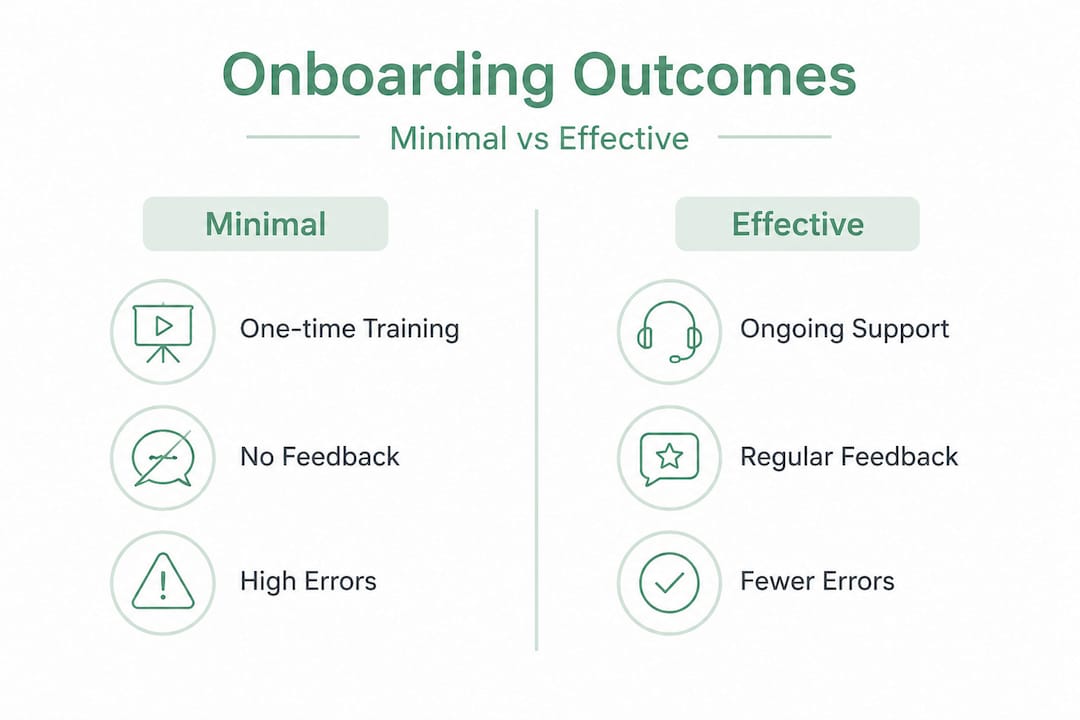
Here is what effective onboarding addresses, compared to what minimal onboarding typically delivers:
| Onboarding element | Minimal onboarding | Effective onboarding |
|---|---|---|
| System training | One-time group session | Role-specific, phased instruction |
| Workflow integration | General overview | Mapped to each staff member’s tasks |
| Feedback mechanisms | None or annual review | Ongoing check-ins and adjustment |
| Staff confidence | Low, leading to workarounds | High, leading to consistent adoption |
| Impact on admissions speed | Marginal or negative | Measurable reduction in review time |
| Burnout risk | Elevated | Reduced through workload clarity |
Understanding the workflow automation benefits of your new platform requires your team to first understand how automation fits their existing processes. That connection is built through onboarding, not through software features alone.
Effective onboarding also serves as an error-reduction tool. When staff understand which data fields drive insurance eligibility checks, or which document triggers a clinical review alert, they are less likely to submit incomplete referral packets. Fewer errors mean fewer delays. Fewer delays mean faster bed fill rates and better financial outcomes for your facility.
Common onboarding pitfalls and how to avoid them
Understanding onboarding’s importance leads us to examine what often goes wrong, and how to sidestep these issues. The most damaging onboarding mistakes are not usually technical. They are organizational. They stem from assumptions about how people learn and how they work.
Here are the five most common onboarding pitfalls in healthcare tech, and the practical steps to avoid each one:
- One-size-fits-all training. Delivering the same session to your intake coordinator, your director of nursing, and your billing specialist ignores the reality that each role interacts with the system differently. Break training into role-specific tracks so each team member learns what is directly relevant to their daily tasks.
- No clinician or staff input during design. Onboarding programs built entirely by administrators or IT vendors, without input from the people who will actually use the system, tend to miss critical workflow realities. Involve frontline staff early. Their input on pain points will shape a program that actually reduces friction rather than creating new forms of it.
- Treating onboarding as a one-time event. A single launch-week session is not sufficient for complex platforms that touch referral management, EMR integration, and insurance verification. Plan phased onboarding with scheduled refreshers, especially when new features roll out.
- Ignoring feedback during rollout. If your team is struggling with a specific feature or workflow step and nobody is collecting that information, the problem compounds quietly. Establish a clear feedback channel from day one and assign someone to review and act on it.
- Skipping documentation of new workflows. Staff turnover is a constant reality in skilled nursing and rehabilitation settings. Without written, role-specific workflow guides, every new hire starts from scratch. Document every process change that the new system introduces.
“Team-based documentation can reduce EHR time and burden, allowing clinical staff to focus on patient care rather than administrative overhead.”
This is particularly relevant for admissions teams. When your referral coordinator is spending hours manually entering clinical data that the system could pull automatically, the problem is rarely the software. It is usually that nobody showed them how to activate or use that specific function during onboarding.

Pro Tip: Schedule a 30-day post-launch review meeting with each role group, not just your department heads. Direct feedback from intake staff and clinical liaisons will surface usability issues that managers may not see in day-to-day operations.
Facilities that want to streamline administrative tasks in patient intake will find that the fastest path forward is fixing the onboarding process, not switching platforms. Many organizations upgrade their software every few years looking for efficiency gains, when the actual issue is that their team was never properly onboarded to the previous system. Compliance frameworks in adjacent areas, such as telehealth regulatory practices, reinforce a similar lesson: structured onboarding and compliance training go hand in hand for sustainable adoption.
Building an effective onboarding program: Key components
Knowing what to avoid, let’s see how to structure an onboarding plan that actually works for your admissions and referral management platform.
Workflow-tailored implementation with active clinician involvement is not optional. It is the foundation of any onboarding program that drives real adoption. Here is how to build it, broken into the key components your program must include:
Phase 1: Pre-launch preparation
- Map current workflows before the new system goes live. Document every step in your referral intake process, from the moment a referral arrives to the moment a bed is confirmed.
- Identify which tasks the new system will automate and which tasks will change for each role.
- Designate internal champions for each department who will support their peers during and after launch.
Phase 2: Role-specific training
- Develop training tracks for each role: intake coordinators, admissions directors, clinical liaisons, and billing staff.
- Use real referral scenarios from your facility rather than generic sample data. This grounds training in familiar territory and accelerates learning.
- Focus on the tasks staff perform most frequently. Do not spend the first two hours on features your team will use once a month.
Phase 3: Live workflow practice
- Allow staff to practice in a sandbox environment using actual referral types common to your facility.
- Pair each new user with an internal champion for their first week of live use.
- Track which features are being used and which are being avoided. Avoidance is a signal that more targeted training is needed.
Phase 4: Feedback and iteration
| Metric to track | Why it matters | How to measure it |
|---|---|---|
| Referral review time | Indicates whether automation is being used correctly | Compare pre- and post-launch average times |
| Error rate in referral packets | Shows whether staff understand data entry requirements | Review rejected or incomplete referrals |
| Feature utilization rate | Reveals which tools staff are adopting | Platform usage analytics |
| Staff satisfaction scores | Flags burnout risk early | Anonymous pulse surveys |
| Bed fill rate | Measures operational impact of the platform | Weekly census reports |
Understanding the automated workflow benefits of your referral management platform requires your team to move through all four phases before expecting consistent, measurable results. Facilities that skip straight to Phase 4 without completing Phases 1 through 3 consistently report lower satisfaction and slower adoption timelines.
Pro Tip: Build a short, searchable internal knowledge base with step-by-step guides for your top ten most-used system functions. Make it available on mobile so staff can reference it at the point of care, not just at their desks.
The intake technology advantages your facility gains from a referral management platform are fully realized only when your entire team knows how to leverage its core functions confidently and consistently.
How onboarding directly impacts admissions and referral management
With the framework in place, how does onboarding make an observable difference in your actual admissions and referral flows?
The answer is direct and measurable. When your admissions staff are well-onboarded, the following outcomes become achievable within the first 60 to 90 days after launch:
- Faster referral review. Staff who know how to use automated eligibility verification tools can process a referral in minutes rather than hours. The manual phone calls, fax follow-ups, and duplicate data entry steps disappear, because staff know the system will handle them.
- Higher referral conversion rates. When your team responds to hospital discharge planners faster and more accurately, your facility earns a reputation for reliability. Referral sources prioritize partners who are responsive. Better onboarding creates that responsiveness.
- Fewer documentation errors. Properly onboarded staff understand what information is required at each stage of the intake process. They know which fields trigger downstream actions, such as insurance pre-authorization requests or clinical review alerts. This knowledge reduces errors and prevents delays.
- Improved staff morale. When a platform genuinely removes tedious, repetitive tasks from your team’s day, morale improves. Staff who feel that technology supports their work rather than adding to it are more engaged and less likely to leave. In high-turnover environments like skilled nursing, this matters significantly.
- Stronger census numbers. Faster intake, higher conversion, and fewer errors combine to improve bed occupancy. An admissions coordinator who can process three times the referral volume in the same shift directly contributes to your facility’s financial performance.
80% of physicians cite administrative overload as a core challenge, but facilities that invest in structured onboarding consistently report that EHR and referral platform workloads become manageable, even in high-volume settings.
You can explore workflow automation examples that demonstrate exactly how these gains materialize in real admissions environments. The data consistently points to onboarding quality as the distinguishing factor between facilities that see results and those that do not.
What most organizations miss about tech onboarding
Here is the reality that most technology implementations get wrong: onboarding is treated as a project milestone rather than an ongoing operational investment.
Leadership signs off on a new referral management platform, schedules a training day, and marks onboarding complete. Six months later, staff are using about 40% of the system’s features. A year later, turnover has brought in new staff who received no formal onboarding at all. The organization eventually considers switching platforms, assuming the software is the problem.
The actual problem is that onboarding stopped.
In skilled nursing and rehabilitation settings, staff turnover rates are among the highest in all of healthcare. This means your onboarding program cannot be an event. It must be a standing operational function, as routine as scheduling or compliance training. Every new hire who joins your admissions team needs the same structured onboarding as the team members who were present at launch. Every platform update needs a brief re-onboarding cycle to ensure staff understand what changed and why.
Organizations that recognize this shift their internal language. Instead of asking “have we finished onboarding?” they ask “how is our onboarding program performing this quarter?” They track feature utilization, collect staff feedback regularly, and adjust training content as workflows evolve.
The facilities that sustain the highest adoption rates are not those with the most sophisticated platforms. They are the ones that built automation and onboarding into their operational culture. They treat technology adoption as a living process, not a completed project. This mindset produces lower burnout rates, higher staff retention, and more consistent admissions performance over time.
Start transforming your admissions onboarding today
After seeing the strategic and tangible value of onboarding, here is how you can translate these ideas into action for your team.
If your facility is ready to move beyond manual referral processes and build an admissions workflow that consistently fills beds faster, Smart Admissions gives you the platform and the onboarding support to do it. Start by reviewing what referral management means for facilities like yours, then see specifically why automating admissions can reduce bed occupancy timelines significantly.
Smart Admissions is built for skilled nursing homes, rehabilitation centers, and post-acute care providers who need a system that integrates with existing EMR platforms, handles real-time eligibility verification, and supports your team through a structured onboarding process from day one. When you are ready to see the difference that admissions automation efficiency makes in practice, our team is ready to walk you through it.
Frequently asked questions
What is onboarding in healthcare technology?
Onboarding in healthcare technology means training staff and integrating new systems into existing workflows so that every team member is equipped to use the platform efficiently and consistently from the start.
How can onboarding reduce clinician burnout?
Effective onboarding minimizes digital burden from poor adoption by customizing training and ongoing support around each role’s real workflow needs, so the platform reduces work rather than adding to it.
What’s the impact of onboarding on admissions speed?
Strong onboarding accelerates admissions by ensuring staff know how to use automation to reduce errors and process referrals faster, typically cutting review times significantly within the first 60 to 90 days.
What are the signs of poor onboarding?
Warning signs include workflow bottlenecks and staff frustration, consistent workarounds that bypass the new system, and significant portions of the platform’s features going unused months after launch.