
TL;DR:
- Skilled nursing admissions involve multiple coordinated phases from referral to care planning.
- Compliance checkpoints like PASRR and Medicare rules are critical to avoid funding issues.
- Automation tools optimize workflow, reduce errors, and improve staff efficiency and patient outcomes.
Patient admissions at skilled nursing homes and rehabilitation centers are rarely as simple as completing a form. Your team navigates a regulated, multi-phase process that directly shapes patient outcomes, regulatory standing, and financial performance. Every step, from initial referral screening to the first day of care, must meet CMS (Centers for Medicare and Medicaid Services) requirements and payer-specific rules. This article breaks down the full admission workflow, explains compliance checkpoints, covers payer differences, and shows how technology can help your facility run more efficiently at every stage.
Table of Contents
- What is an admission workflow in skilled nursing?
- Breaking down the phases: A step-by-step view
- Compliance and key regulatory checkpoints: PASRR, Medicare, Medicaid
- Payer differences and special scenarios in admission workflows
- Technology’s impact: Integrating automation into the admissions workflow
- Our take: Why optimizing admission workflows isn’t just a compliance task
- Streamline your admissions workflow with proven technology
- Frequently asked questions
Key Takeaways
| Point | Details |
|---|---|
| Admission workflow is multi-phase | It covers screening, assessment, financial checks, contracting, and care planning to meet regulatory and clinical needs. |
| Compliance details matter | PASRR for Medicaid and hospital stay rules for Medicare are critical checkpoints. |
| Workflows differ by payer type | Medicare, Medicaid, and private pay admissions have unique workflow and documentation needs. |
| Emergencies shift workflow steps | Emergency admissions use compressed, retrospective documentation but still require full compliance. |
| Automation boosts efficiency | Integrated digital tools streamline workflows, cut errors, and let staff focus on patient care. |
What is an admission workflow in skilled nursing?
The term “admission workflow” refers to the complete series of structured steps a skilled nursing facility (SNF) or rehabilitation center follows from the moment a referral is received until a patient is actively receiving care. This is not a single event. It is a sequential, multi-phase process that requires coordination across clinical, financial, and administrative teams.
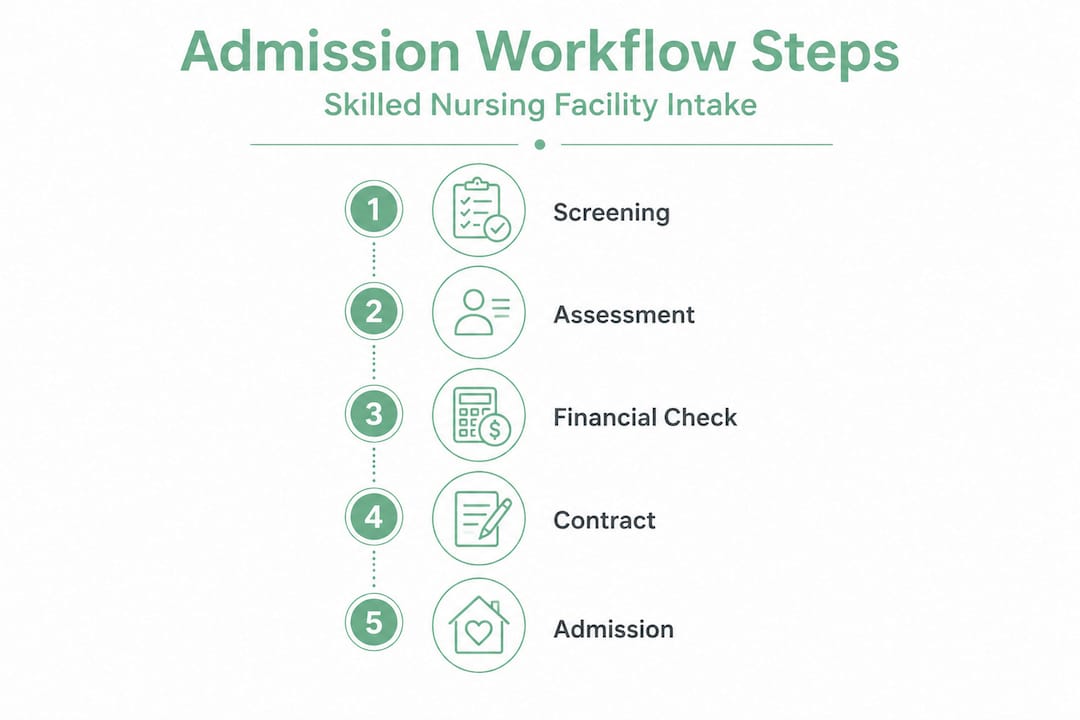
A structured admission process in SNFs involves pre-admission screening, clinical assessment using tools like the MDS (Minimum Data Set), financial and payer verification, contract execution, and initial care planning, all governed by federal regulations under 42 CFR Part 483. Understanding this framework is essential for your team before any optimization can begin.
The core phases of the workflow include:
- Pre-admission screening: Determining whether the patient clinically and financially fits your facility
- Clinical assessment: Using standardized tools like the MDS to evaluate care needs
- Financial and payer verification: Confirming insurance coverage, Medicaid eligibility, or private pay status
- Contract execution: Completing and signing admission agreements and required disclosures
- Initial care planning: Establishing the patient’s care goals and assigning staff responsibilities
Each phase depends on the one before it. If financial verification is delayed, contract execution stalls. If clinical assessment is incomplete, care planning cannot proceed safely. Supporting admission workflow automation at key steps can help your team maintain pace across all phases.
This is also why the hospice visit workflow in similar post-acute settings shares structural similarities with SNF admissions, since both require coordinated clinical documentation and regulatory sign-off before care can begin.
| Phase | Primary owner | Key output |
|---|---|---|
| Pre-admission screening | Admissions coordinator | Eligibility decision |
| Clinical assessment | Nursing/MDS coordinator | Completed MDS or equivalent |
| Financial verification | Business office | Payer authorization |
| Contract execution | Admissions/legal | Signed admission agreement |
| Initial care planning | Care team | Individualized care plan |
Breaking down the phases: A step-by-step view
Each phase in the admission workflow carries specific tasks, documentation requirements, and timeframes. Understanding what needs to happen at each step helps your admissions staff avoid costly delays.
- Pre-admission screening: Your team reviews referral documents, including hospital discharge summaries, physician orders, and insurance information, to determine whether the patient’s clinical needs align with your facility’s capabilities. This step filters out placements that would strain your staff or create compliance risks. A fast and thorough screening directly reduces bed turnaround time.
- Clinical assessment using the MDS: The MDS is a federally mandated assessment tool used in all Medicare and Medicaid certified SNFs. It captures clinical data across dozens of domains, including cognition, functional status, and clinical diagnoses. Your MDS coordinator must complete an initial assessment within the first 14 days of admission. This data also feeds into the PDPM (Patient-Driven Payment Model), which determines Medicare reimbursement rates.
- Financial and payer verification: Your business office team confirms active coverage, obtains authorization where required, verifies Medicare nursing home coverage eligibility, and reviews any Medicaid spend-down or look-back considerations. Errors at this phase often cause claim denials weeks or months after the patient has already been admitted.
- Contract and documentation collection: This phase involves presenting the admission agreement, resident rights documents, and facility policies to the patient or their authorized representative. State and federal law governs what must be disclosed in writing. Missing or incomplete signatures at this stage can create legal liability.
- Initial care planning and first-day coordination: Before the patient arrives, your interdisciplinary team should have a preliminary care plan in place. Room assignment, dietary orders, medication reconciliation, and therapy scheduling should all be confirmed. This preparation reduces confusion on the first day and demonstrates a high standard of care.
Pro Tip: For facilities handling high referral volume, streamlining admissions tasks at Phase 1 has the greatest downstream impact. A faster, more accurate pre-admission screening reduces the need to course-correct at later phases.
The nursing home admissions process also allows for retrospective documentation in emergency admissions. When a patient arrives urgently, your team can proceed with care and complete certain paperwork within a defined compliance window, provided the clinical need is documented clearly.
Facilities that treat the admission workflow as a clinical process, not just an administrative one, consistently achieve better patient outcomes and stronger regulatory standing.
Compliance and key regulatory checkpoints: PASRR, Medicare, Medicaid
Knowing the steps is one thing. Knowing where compliance failures are most likely to occur is what protects your facility’s funding and reputation.
PASRR requirements for Medicaid admissions
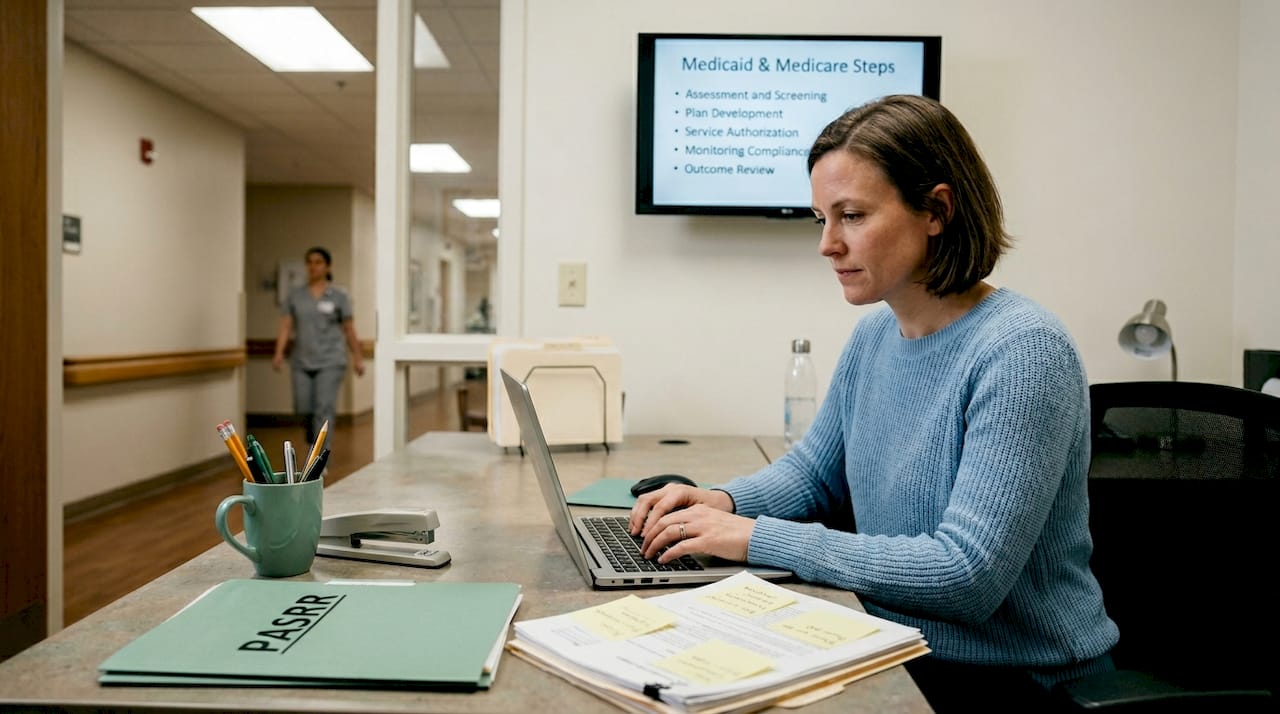
PASRR (Preadmission Screening and Resident Review) is a federal mandate that applies to all Medicaid-funded nursing facility admissions. PASRR Level I screening is required to identify patients with serious mental illness (SMI) or intellectual and developmental disabilities (ID/DD); if the screening is positive, a Level II evaluation is conducted by the state before admission is finalized. Skipping this step is one of the most common Medicaid compliance violations.
Medicare Part A admission criteria
Medicare Part A SNF coverage requires that the patient has a qualifying 3-day inpatient hospital stay, demonstrates ongoing skilled care needs such as physical therapy or wound care, and is admitted to the SNF within 30 days of hospital discharge. Custodial care, meaning assistance with daily living activities without skilled clinical need, does not qualify. Your admissions staff should verify all three criteria before accepting a Medicare referral.
You should also be aware of the Medicaid look-back period, which reviews five years of asset transfers to assess eligibility. Patients whose families have made recent asset transfers may face a penalty period that delays Medicaid coverage, affecting your facility’s cash flow.
Explore automated workflow examples to see how facilities are using digital tools to catch compliance errors before they become costly problems.
Comparison of payer compliance requirements
| Compliance requirement | Medicare | Medicaid | Private pay |
|---|---|---|---|
| 3-day qualifying hospital stay | Required | Not required | Not required |
| PASRR screening | Not required | Required | Not required |
| Prior authorization | Varies by plan | Required in many states | Depends on insurer |
| Skilled care documentation | Mandatory | Not always required | Not required |
| State agency oversight | Federal + state | State-administered | Minimal |
Pro Tip: Build a payer-specific compliance checklist into your intake process. A clear reference tool reduces errors during peak admission periods when staff may be managing multiple referrals simultaneously.
Key compliance risks your team should monitor:
- Missing or unsigned PASRR documentation for Medicaid patients
- Admissions where the 3-day hospital stay has not been confirmed in writing
- Incomplete financial authorization before care begins
- Failure to provide required written disclosures before contract signing
- Late MDS submission beyond the 14-day assessment window
Payer differences and special scenarios in admission workflows
Not every admission follows the same path. Your workflow must adapt based on payer type and situational factors, including emergencies and facility capacity constraints.
Medicare admissions are post-acute focused, typically involving patients who have recently been discharged from an acute care hospital. These admissions demand detailed clinical documentation tied to the patient’s DRG (Diagnosis-Related Group) from the hospital stay. Your clinical team needs to demonstrate ongoing skilled need throughout the stay to maintain Medicare coverage and justify PDPM reimbursement levels.
Medicaid admissions are typically for longer-term custodial care. In addition to PASRR, these admissions often involve coordinating with state Medicaid agencies for benefit confirmation and authorization. The administrative lead time is frequently longer than Medicare admissions, requiring your team to start Medicaid-specific verification earlier in the process.
Private pay and commercial insurance admissions carry fewer mandatory regulatory steps, but they are not without complexity. Commercial insurance policies vary widely in coverage scope, prior authorization requirements, and documentation standards. Your business office team needs to verify each plan individually rather than applying a standard checklist.
Edge cases in admission workflows include emergency or same-day admissions, where the standard multi-phase sequence is compressed and some documentation is completed retroactively with full compliance catch-up within a regulated timeframe. Facilities can also decline admissions if they cannot safely meet the patient’s care needs or if census is at capacity. Both scenarios must be documented carefully to protect the facility from discrimination allegations or regulatory scrutiny.
Your team should review customizable admissions workflows designed to flex across payer types and special scenarios, so your process stays structured even when circumstances are unpredictable.
Accepting an admission your facility cannot support safely is never the right answer. A clearly documented, clinically sound decline is always more defensible than a poorly managed admission.
Additional scenarios your workflow should account for:
- Patients with complex behavioral health needs that trigger PASRR Level II review
- Patients transitioning from assisted living who do not have recent hospital records
- Admissions where guardianship or power of attorney documentation is incomplete
- Readmissions for patients who were recently discharged from your facility
For a deeper look at how payment and data security considerations affect the intake process, particularly for facilities handling digital financial records, the standards used in other healthcare-adjacent sectors can serve as a useful reference point.
Technology’s impact: Integrating automation into the admissions workflow
After understanding the rules and the scenario-based variations, it becomes clear why manual, paper-based workflows create significant operational risk. Technology changes what your team is capable of at every phase.
Integrated AI platforms like Clinware and Flowtrics are shifting the industry away from siloed, decentralized workflows and toward systems that reduce denials, optimize PDPM reimbursement, and free staff to focus on patient care rather than administrative tasks. These platforms automate eligibility checks, flag compliance gaps in real time, and integrate directly with EMR (Electronic Medical Records) systems.
Key benefits of automation in the admissions workflow include:
- Real-time eligibility verification: Automated systems check insurance and Medicaid status instantly, reducing the lag between referral receipt and admission decision
- Clinical documentation prompts: AI-driven tools flag incomplete MDS sections or missing physician orders before they cause compliance issues
- PDPM optimization alerts: Platforms can identify documentation that supports higher acuity coding, improving reimbursement accuracy
- Denial reduction: Automated pre-screening against payer rules catches ineligible admissions before they generate denied claims
- Referral tracking dashboards: Your team gains visibility across all active referrals, reducing the chance that high-value admissions fall through the cracks
Pro Tip: When evaluating automation tools, prioritize platforms that integrate with your existing EMR system via FHIR (Fast Healthcare Interoperability Resources) or HL7 standards. Standalone tools that require manual data re-entry eliminate most of the efficiency gains you are trying to achieve.
The shift from manual to automated admissions also has a measurable impact on staff satisfaction. Admissions coordinators who spend less time on repetitive data entry and phone-based verification have more capacity for relationship-focused tasks, including referral partner communication and patient family support.
Explore how admission workflow automation benefits translate into measurable outcomes for SNFs and rehabilitation centers. For a practical example of what efficiency gains look like in a clinical setting, this look at streamlining clinical workflows demonstrates how structured process improvements reduce error rates across healthcare settings.
Our take: Why optimizing admission workflows isn’t just a compliance task
Most facilities approach admission workflow improvement as a compliance exercise. They identify a gap found in a survey, fix the specific documentation issue, and move on. This is a missed opportunity.
Regulatory compliance is the floor, not the ceiling. The admissions process framework set by CMS ensures appropriate placement and protects resident rights, but it does not require your team to be fast, efficient, or proactive. Meeting the minimum does not make your facility competitive.
The facilities that lead in census growth and staff retention are the ones that view the admission workflow as a continuous improvement process. Every phase, from the speed of your pre-admission screening to the quality of your first-day care plan, affects patient experience and referral partner confidence. Hospitals and discharge planners remember which facilities answer quickly and accept patients without unnecessary friction. That reputation directly drives referral volume.
Staff burnout in admissions is also a real operational risk. When coordinators are managing paper files, chasing authorizations by phone, and manually re-entering data across multiple systems, the error rate climbs and job satisfaction drops. Incremental digital improvements, even something as targeted as automating insurance verification, compound over time into significant workload reductions.
Workflow automation examples from comparable facilities show that small process changes, consistently applied, reduce cycle times and free staff to do the work that actually requires human judgment. The goal is not to automate everything. It is to automate the right things so your team can focus on the rest.
Facilities that build workflow excellence into their culture, not just their policy manuals, are the ones that consistently improve on all the metrics that matter: occupancy rates, survey outcomes, staff tenure, and patient satisfaction scores.
Streamline your admissions workflow with proven technology
Your admissions team manages one of the most regulated and time-sensitive processes in healthcare. Every phase carries compliance requirements, payer-specific rules, and documentation deadlines that leave little room for manual error.
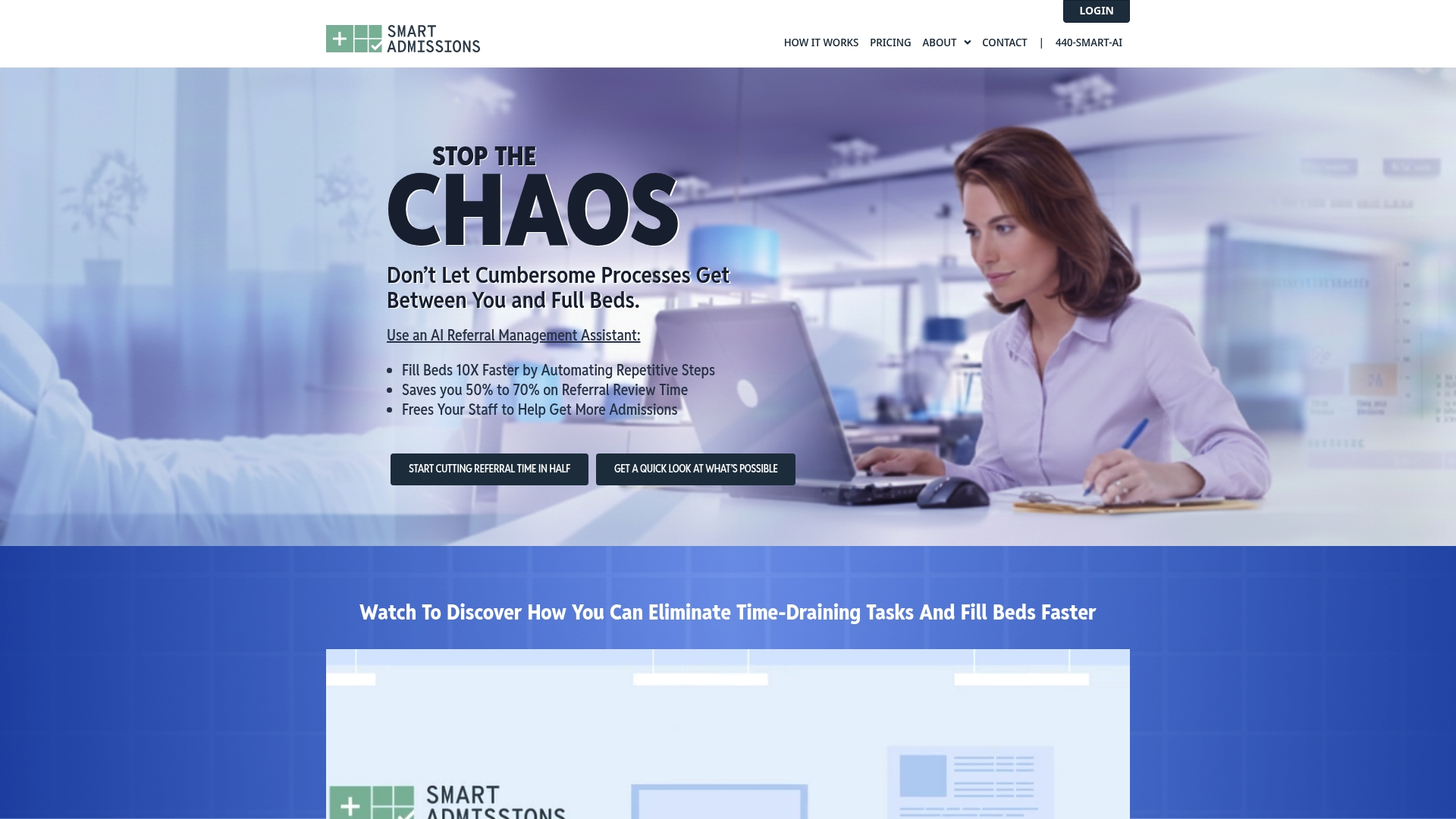
Smart Admissions is purpose-built to support every phase of your SNF or rehabilitation center intake workflow. From optimizing patient intake at the referral stage to automating financial verification and clinical documentation collection, the platform reduces cycle times without adding burden to your staff. Use it to manage referral workflows from a single dashboard, with real-time visibility across all active admissions. If you want a practical starting point, the step-by-step intake guide walks your team through exactly how to structure the process for maximum efficiency and compliance confidence.
Frequently asked questions
What are the essential phases of the admission workflow in skilled nursing?
The essential phases include pre-admission screening, clinical assessment using the MDS, financial and payer verification, contract execution, and initial care planning, each building on the previous step.
How does PASRR screening affect Medicaid admissions?
PASRR Level I must be completed before Medicaid admissions to screen for serious mental illness or intellectual disabilities; if the screening is positive, the state conducts a Level II evaluation before admission is approved.
What qualifies a patient for Medicare Part A admission to a SNF?
A qualifying patient must have a 3-day hospital stay, documented skilled care needs, and must be admitted to the SNF within 30 days of hospital discharge; custodial-only care does not qualify.
Can a facility decline an admission?
Yes, a facility can decline an admission if it lacks capacity or cannot safely provide the level of care the patient requires, provided the decision is properly documented.
How can technology improve the admission workflow?
Integrated AI platforms automate eligibility checks, flag compliance gaps, reduce claim denials, and free your admissions staff to focus on higher-value tasks like referral partner communication and patient family coordination.