
Three checks decide whether a Medicare Part A stay gets paid: confirmed Part A entitlement, a qualifying three-day inpatient hospital stay, and a physician order documenting daily skilled need. Observation and emergency department hours never count toward that three-day window, no matter how long the patient sat in a hospital bed. Before you accept any referral, pull the Medicare card and the hospital discharge summary and check both against these rules.
TL;DR:
- Verifying the patient’s active Part A entitlement and counting inpatient days from the discharge summary are essential before approving any referral.
- Observation and emergency department hours never count toward the three-day qualifying hospital stay, regardless of bed occupancy duration.
- Medicare covers up to 100 days of skilled nursing facility care per benefit period, with the first 20 days fully covered and subsequent days requiring coinsurance.
- For Medicare Advantage plans, verify specific rules directly with the payer, as they often waive the traditional three-day stay requirement.
- Automating eligibility checks through integrated systems can reduce verification time and minimize documentation-related denials.
Table of Contents
- Quick Intake Checklist for Medicare Eligibility Rules
- How Do You Count the Three-Day Qualifying Stay?
- What Counts as Skilled Care Under the Jimmo Standard?
- How Many Days Does Medicare Cover in a Benefit Period?
- Documentation, Certification Deadlines, and the SNF ABN
- Do Medicare Advantage Plans Follow the Same Rules?
- Building a Verification Workflow That Doesn’t Slow Down Admissions
- What Admissions Leaders Should Prioritize Operationally
- Smart Admissions: Verify Faster, Admit With Confidence
- Sources
- FAQ
Quick Intake Checklist for Medicare Eligibility Rules
Every referral that lands on your desk needs the same four documents before you say yes. Missing even one of these turns into a denial three weeks later, when the patient is already in a bed and the facility is stuck absorbing the cost.
- Medicare card (or MBI) confirming active Part A entitlement.
- Hospital discharge summary showing admission and discharge dates.
- A signed physician order for SNF-level skilled care.
- Therapy orders or evaluations, if physical, occupational, or speech therapy is expected.
Confirm the qualifying stay by counting inpatient days directly off the discharge summary, not the hospital’s internal billing code. Verify Part A entitlement and remaining benefit days through Medicare.gov or your standard payer portal. If the referral source is a Medicare Advantage plan, flag it immediately for a separate verification path since MA rules do not mirror traditional Medicare.
How Do You Count the Three-Day Qualifying Stay?
The math sounds simple until a case lands with mixed observation and inpatient time. Get the counting wrong and you either reject an eligible patient or admit one who will be denied.
- Count the admission day as day one, even if the patient arrived at 11:00 PM.
- Do not count the discharge day. A patient admitted Monday and discharged Thursday has three qualifying days, not four.
- Exclude any hours spent under observation status or in the emergency department, even if the patient was physically in a hospital bed the entire time, per Medicare.
- If the patient moved between two hospitals, the days generally still count as long as the transfer was direct and inpatient status was continuous.
- If no SNF bed was available at discharge, a physician can document ongoing inpatient necessity, which can preserve the qualifying stay while placement is arranged, per the Medicare Claims Processing Manual.
What Counts as Skilled Care Under the Jimmo Standard?
Skilled care has to be delivered or supervised by licensed professionals, not just performed under a doctor’s general instructions. That means registered nurses managing wound care or IV therapy, licensed therapists running a documented treatment plan, and any service that requires clinical judgment to perform safely.
- Skilled nursing procedures like tube feedings, catheter care, or injections requiring a licensed nurse.
- Physical, occupational, or speech therapy delivered under a written plan of care.
- Observation and assessment of a changing medical condition that requires skilled judgment.
- Patient and caregiver education on managing a new medical device or condition.
The Jimmo settlement changed the coverage test in one important way: Medicare pays for skilled care needed to maintain a patient’s condition or prevent decline, not only care tied to measurable improvement. Certification is due at admission or as soon as practicable, with the first recertification no later than day 14.
Pro Tip: Daily notes should describe the skilled intervention itself, not just the diagnosis. “Skilled nursing assessment of new dysphagia symptoms with modified diet initiated” holds up far better under review than “patient continues to have swallowing issues.”

How Many Days Does Medicare Cover in a Benefit Period?
A benefit period starts the day a patient is admitted as an inpatient to a hospital or SNF and ends after 60 consecutive days without inpatient care. Within that period, Medicare covers up to 100 days of SNF care total.
Benefit period breakdown: Days 1–20 are fully covered by Part A. Days 21–100 require a daily coinsurance payment, with the exact amount published annually by Medicare.gov. After day 100, the patient is responsible for the full cost until a new benefit period opens.
Readmissions matter here. If a patient is readmitted to a hospital and returns to the SNF within that 60-day window and meets the three-day rule again, remaining days in the same benefit period still apply. Track the discharge date closely. Sixty-one days without inpatient care resets the clock entirely.
Documentation, Certification Deadlines, and the SNF ABN
Missing a certification deadline is one of the fastest ways to turn a covered stay into an unpaid one. CMS requires:
- Admission certification at the time of admission or as soon as reasonably practicable.
- First recertification no later than the 14th day of SNF care.
- Subsequent recertifications at intervals of at least every 30 days, per the Medicare Benefit Policy Manual.
Keep these documents in the chart from day one:
- Hospital discharge summary with clear admission and discharge dates.
- Signed physician orders for skilled services.
- Therapy evaluation and plan of care.
- Daily skilled nursing or therapy notes tied directly to the certification.
Issue the SNF Advance Beneficiary Notice of Noncoverage (CMS-10055) whenever you expect care to stop being covered, whether because skilled need has ended or benefit days are exhausted. The patient has the right to request a demand bill and appeal the decision rather than accept your facility’s determination outright.
Do Medicare Advantage Plans Follow the Same Rules?
Not always, and this is where admissions teams get burned the most. Traditional Medicare’s three-day rule and benefit period math do not automatically apply to Medicare Advantage members.
- Many MA plans and some ACO arrangements waive the three-day qualifying stay entirely, sometimes admitting patients straight from an ER visit.
- Pull the patient’s Evidence of Coverage document or call the plan directly before assuming any rule applies.
- For non-network placements, get written confirmation of authorization before admission. A verbal “yes” from a call center rep is not enough if the claim is later audited.
- Watch for PACE enrollees, cost plan members, and any active public health emergency waivers, all of which can change standard eligibility criteria without warning.
Verifying MA plan rules directly, every single time, is the only way to avoid a multi-day placement delay caused by assumptions carried over from traditional Medicare.
Building a Verification Workflow That Doesn’t Slow Down Admissions
Here’s a six-step sequence that keeps your team moving without skipping a required check:
- Confirm active Part A entitlement through Medicare.gov or the payer portal.
- Pull the hospital discharge summary and count qualifying inpatient days.
- Verify the physician order documents daily skilled need, not just a diagnosis.
- Check benefit days remaining in the current benefit period.
- If MA or ACO, verify plan-specific rules and network status directly with the payer.
- Log certification dates so the day-14 recertification deadline never slips.
The most common bottleneck isn’t complicated rules. It’s a missing discharge summary or an admissions coordinator manually calling five different MA plans in one afternoon. Automation built specifically for this workflow, like the prebuilt eligibility checklist inside Smart Admissions’ AI referral assistant, pulls entitlement and benefit-day data directly from EMR and insurance portal integrations instead of leaving it to memory.
Pro Tip: Build your recertification deadlines into a shared calendar the day a patient is admitted, not the day before day 14 arrives. Facilities that track this reactively are the ones that lose reimbursement to a missed window.
What Admissions Leaders Should Prioritize Operationally
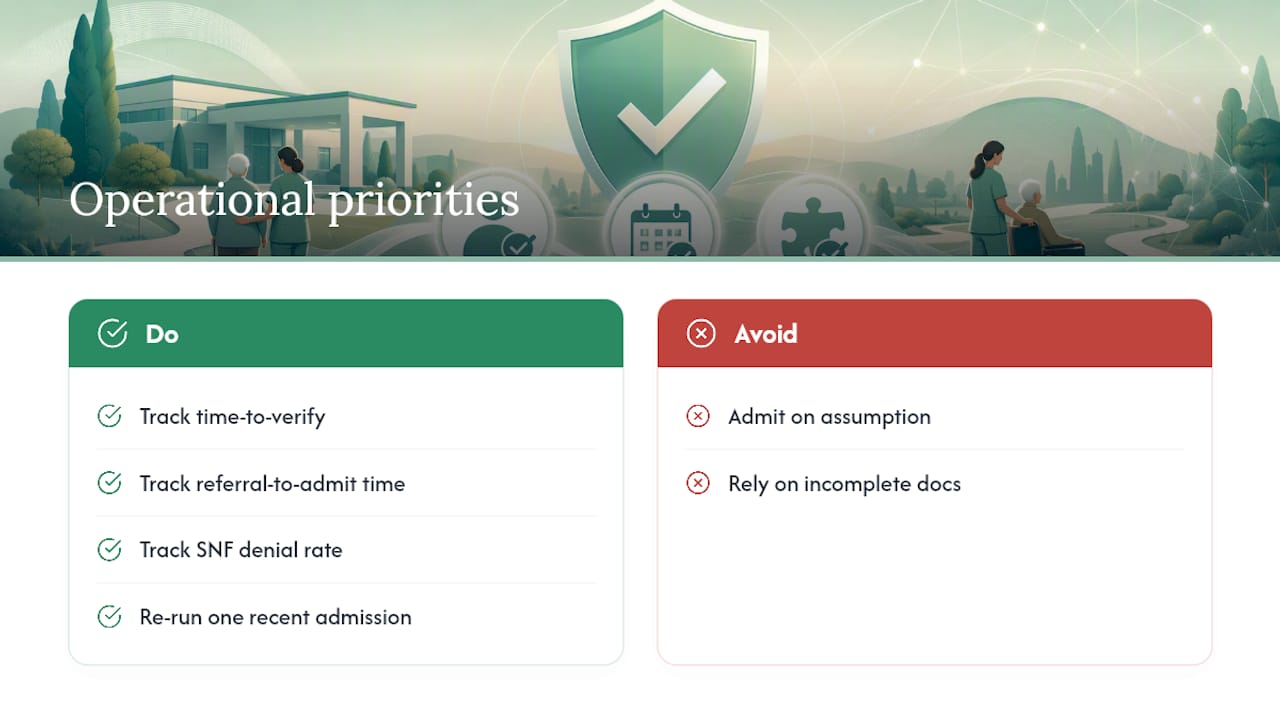
Speed matters, but a fast intake built on incomplete documentation just moves the denial further down the calendar. I’d rather see a facility take an extra hour verifying the three-day stay than admit on assumption and fight an appeal in 90 days.
Track three numbers: time-to-verify, referral-to-admit turnaround, and your SNF denial rate. Then pick one recent admission and run it back through this checklist. You’ll find the gap fast.
— Harry
Smart Admissions: Verify Faster, Admit With Confidence
Manually cross-checking Part A entitlement, counting qualifying days, and calling MA plans one by one is where admissions teams lose hours they don’t have. Smart Admissions automates the eligibility checks in this article directly: entitlement verification, payer lookups, and checklist enforcement, all pulled through EMR and insurance portal integrations rather than a phone tree.

Facilities using this kind of automated verification report faster bed fill and fewer denials tied to missed documentation, according to Smart Admissions. Onboarding takes under an hour, and the plans start at $597 per month or $6,447 annually. If you want to see how the workflow maps against your current process, review the documentation management guide or start a trial through the pricing page today.
Sources
FAQ
Does Observation Status Count Toward the Three-Day Rule?
No. Observation and emergency department time never count toward the three-day qualifying inpatient hospital stay, regardless of how long the patient occupied a hospital bed, according to Medicare.gov.
How Many Days Will Medicare Pay for SNF Care?
Medicare covers up to 100 days per benefit period, with days 1–20 fully covered and days 21–100 requiring daily coinsurance, per Medicare’s coverage booklet. A new benefit period only opens after 60 consecutive days without inpatient care.
When Should a Facility Issue the SNF ABN?
Issue the SNF Advance Beneficiary Notice of Noncoverage (CMS-10055) whenever skilled care is expected to become noncovered. The patient keeps the right to request a demand bill and appeal the decision before accepting financial responsibility.
Do Medicare Advantage Plans Follow the Three-Day Rule?
Not always. Many MA plans and some ACO arrangements waive the three-day qualifying stay, so admissions staff must verify rules directly with the plan rather than assuming traditional Medicare criteria apply.
Can Smart Admissions Verify Medicare Eligibility Automatically?
Yes. Smart Admissions integrates with EMR and insurance portals to verify Part A entitlement, count qualifying days, and enforce a standard eligibility checklist, with plans starting at $597 per month.