
We recommend a hybrid pipeline for OCR for referrals: optical character recognition paired with layout-aware document understanding, human review for low-confidence fields, and output mapped directly to FHIR and your EMR. Facilities that build it this way see shorter referral review times, smaller backlogs, and better referral-loop closure. A JAMA Network Open trial and ONC’s own interoperability guidance both support this approach, and we built Smart Admissions around it.
TL;DR:
- A hybrid OCR approach combining layout-aware models and rule-based normalization improves extraction accuracy by over 38% compared to models alone.
- Low-confidence fields must be routed to manual review with direct access to source images to maintain data quality and reduce errors.
- License agreements, encryption, role controls, and audit logs are essential for HIPAA compliance when using cloud OCR vendors handling protected health information.
- Effective referral OCR workflows require clear ownership, daily monitoring, and integration of extracted data into EMRs using structured standards like FHIR.
- Pilot programs should focus on high-volume, high-value referral sources, set measurable goals, and involve incremental scaling for reliable implementation.
Table of Contents
- What OCR for referrals actually does
- The end-to-end referral OCR workflow, from fax to EMR
- Choosing OCR engines and layout-aware models for referrals
- Mapping OCR output into FHIR ServiceRequest and your EMR
- Setting confidence thresholds and human review rules
- HIPAA, BAAs, and what to require from any OCR vendor
- When OCR for referrals pays off, and how to measure it
- Implementation checklist: 8 steps from pilot to production
- How Smart Admissions implements OCR for referrals
- Ownership, governance, and what actually closes the referral loop
- Evaluate Smart Admissions against your referral OCR checklist
- FAQ
- Sources
What OCR for referrals actually does
OCR for referrals takes unstructured referral documents, whatever shape they arrive in, and turns them into structured, usable data your intake team and your EMR can act on. The documents themselves come from everywhere: fax transmissions, scanned PDFs, email attachments, portal uploads, and attachments pulled directly from referring EHR systems.
Referral packets rarely arrive clean. Your team is likely sorting through faxed referral forms, physician order sheets, clinical progress notes, imaging orders, and insurance authorization paperwork, often stapled together in a single multi-page fax, with no clear separation between documents.
A properly built OCR system for referrals should produce:
- Standardized patient identifiers (name, date of birth, medical record number where available)
- The referring physician’s name and contact information
- The requested service or level of care
- A coded reason for referral using ICD or SNOMED terminology
- An urgency flag distinguishing routine from expedited cases
- Linked attachments and a preserved copy of the original scanned image for provenance
That last point matters more than it sounds. Clinicians and auditors need to trace any extracted field back to its source page, and that traceability is what separates a usable system from a glorified text dump.
The end-to-end referral OCR workflow, from fax to EMR
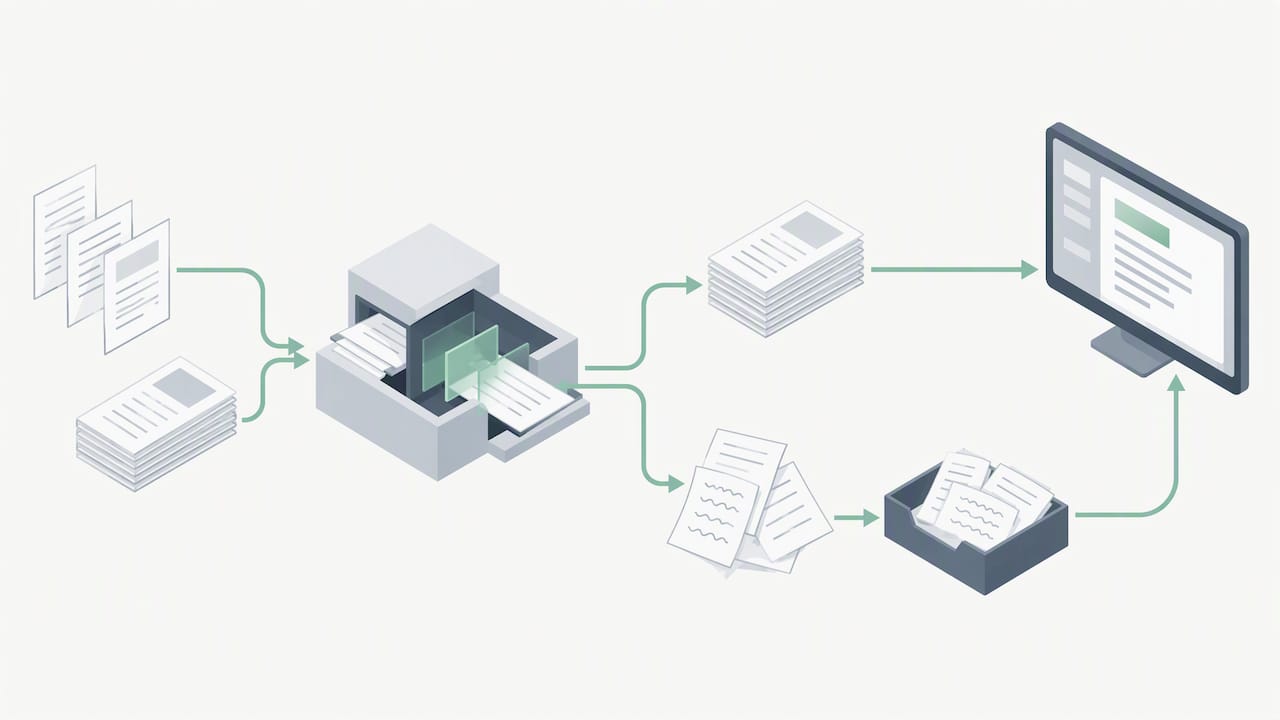
A referral OCR pipeline works best as a defined sequence rather than a single black-box step. Each stage has its own failure modes, and each is a place to add governance.
- Capture: ingest documents from fax servers, email inboxes, scanners, and portal uploads into one queue.
- Preprocess: deskew, denoise, and split multi-page packets into individual documents.
- OCR: run text recognition across every page, including handwritten and low-resolution sections.
- Layout parsing: group text into fields and sections based on document structure, not just raw character order.
- Classify: identify document type (referral form, clinical note, imaging order, insurance form).
- Extract and normalize: pull target fields and standardize formats (dates, identifiers, codes).
- Match: tie the referral to an existing patient record or flag it as new.
- Score: assign a confidence level to each extracted field.
- Human review: route low-confidence fields to a reviewer with the source image visible.
- EMR write: push validated data into the patient record and referral queue.
- Track: log the referral through to scheduling and report receipt for loop closure.
Log provenance at every step, not just at intake. Each extracted field should carry a timestamp, a source document reference, and a record of whether a human corrected it. That log becomes your audit trail and, over time, your training data for improving the model.
Handwriting and multi-page packets cause most of the headaches. A referral with a handwritten diagnosis or a packet where page order gets scrambled during faxing will defeat a text-only OCR engine every time. Routing those cases automatically to manual review, rather than letting a low-confidence guess slip through, protects data quality without stalling the whole queue.
Pro Tip: Build your failure-routing rules before you go live, not after the first bad extraction reaches a clinician.
Choosing OCR engines and layout-aware models for referrals
Not all OCR is built the same, and the differences matter a lot more for referral documents than for clean, typed forms. Baseline OCR engines read characters well on clean scans but struggle with skewed faxes, overlapping stamps, and handwriting. Cloud OCR services improve on that with better pre-trained models and scale, but still return raw text without understanding document structure. Layout-aware transformer models go a step further, reading position and visual structure alongside text, which matters when a referral form has fields scattered across a page rather than in neat rows.
Research on hybrid approaches shows why combining methods works. A layout-aware model study on arXiv found that pairing a layout-aware model (LayoutLMv3) with domain-specific rules increased extraction precision by about 38.5%, recall by about 10.06%, and F1 score by about 14.1% compared to the model alone. Deterministic rules catch the predictable patterns, like date formats and field labels, while the layout model handles the visual variation across referral sources.
When weighing options, consider:
- Accuracy on noisy inputs: how the engine performs on low-resolution faxes and handwriting, not just clean scans
- Latency and throughput: whether the pipeline can keep pace with your daily referral volume without creating a new bottleneck
- Cost per page: cloud OCR pricing scales with volume, so high-fax-volume facilities should model this carefully
- Maintenance effort: rule-based normalization layers need upkeep as referral sources and form templates change
Mapping OCR output into FHIR ServiceRequest and your EMR
Extracted text is only useful once it lands somewhere your systems can act on it. ONC’s interoperability guidance recommends mapping referral data into FHIR US Core ServiceRequest structures rather than leaving it as pasted text, specifically because structured, coded data is what lets referral-loop measures and downstream systems actually use it.
Practical mapping work includes:
- Populating required ServiceRequest fields: subject, requester, reason, and intent
- Coding the reason for referral using SNOMED CT rather than free text where possible
- Retaining a link back to the original scanned image for every mapped field, so staff can verify a value in seconds
- Preserving referring provider identifiers so authorization and scheduling teams aren’t searching separately
Integration patterns vary by EMR readiness. Some facilities can write directly through a FHIR API, others rely on HL7 message fallback where a direct API isn’t available, and smaller operations sometimes start with batch import while building toward real-time integration. Whichever pattern you choose, patient identity matching deserves its own attention: a referral with a mismatched or incomplete identifier should never silently create a duplicate record. Our guidance on referral data standards covers field-level mapping in more detail, and our FHIR workflow steps walk through the developer side of ServiceRequest implementation.
Setting confidence thresholds and human review rules
Every extracted field needs a confidence score, and every confidence score needs a rule attached to it. High-confidence fields, typically those above a threshold your team sets and tests, auto-populate the record. Anything below that threshold routes to a human reviewer rather than reaching a clinician unverified.
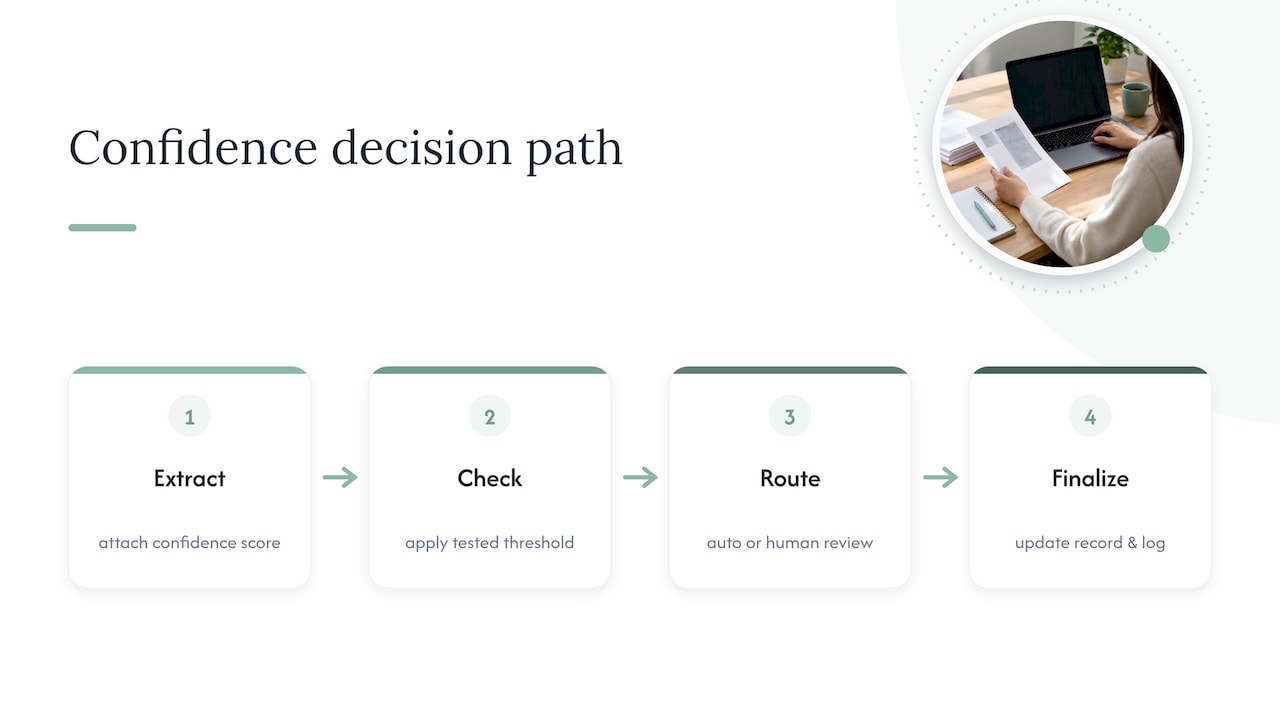
A clinician-facing evaluation found that an AI system organizing scanned patient records cut review time without reducing clinical accuracy, according to a JAMA Network Open study. That result held specifically because clinicians could see extracted fields next to the original document, not instead of it.
Track a small set of KPIs: entity-level precision and recall, average time-to-decision per referral, and backlog size over time. For the review interface itself, highlight extracted fields next to a clickable link to the source image, make corrections a one-click action, and log every correction automatically.
Pro Tip: Never let a reviewer approve a field without seeing the source image next to it, even when confidence scores are high.
HIPAA, BAAs, and what to require from any OCR vendor
Any cloud service that creates, receives, maintains, or transmits protected health information on your behalf generally qualifies as a business associate under HHS guidance, which means a signed BAA is not optional. Using a cloud OCR provider without one puts your facility at risk, regardless of how the vendor markets itself.
Before signing with any OCR vendor, confirm:
- A signed Business Associate Agreement covering the specific services used
- Encryption for data at rest and in transit
- Role-based access controls limiting who can view extracted referral data
- A documented breach notification process
- Data deletion and retention policies you can audit
- Logging sufficient to reconstruct who accessed or modified a record
On-premises deployment gives you more direct control but more infrastructure burden. HIPAA-ready cloud deployment shifts that burden to the vendor, provided the BAA and security terms are solid. Neither option removes your responsibility to verify compliance in writing.
When OCR for referrals pays off, and how to measure it
The return on a referral OCR investment depends on volume. A facility processing a handful of referrals per week will see a different payoff curve than one processing hundreds. The core drivers are referral volume, time spent per review, staffing cost tied to manual processing, and the downstream effect on bed fill speed.
CMS’s eCQI resource center frames closing the referral loop, meaning confirmed receipt of a specialist report, as a measurable quality goal in its CMS50FHIR measure. That gives facilities a ready-made framework for pilot KPIs rather than inventing metrics from scratch.
When sizing a pilot, track:
- Average time from referral receipt to review completion
- Backlog size at the start and end of the pilot period
- Percentage of referrals auto-extracted above your confidence threshold versus routed to manual review
- Referral-loop closure rate, tracked against the CMS measure definition
Start with a single high-volume referral source, such as imaging orders or specialty consult requests, rather than trying to cover every document type on day one. A narrow, well-measured pilot tells you more than a broad one that never gets fully validated. Our intake workflow improvement guide covers pairing OCR gains with broader throughput changes.
Implementation checklist: 8 steps from pilot to production
Rolling out OCR for referrals works best as a staged process with clear owners at each step.
- Audit your current inputs: list every referral source (fax lines, portals, EHR feeds) and who owns each one.
- Select a pilot source: pick one high-volume, high-value referral type to start.
- Define success metrics: set targets for review time, backlog reduction, and loop closure before you start.
- Choose pipeline components: decide on OCR engine, layout model, and normalization rules based on your document mix.
- Configure human-in-the-loop rules: set confidence thresholds and review routing before go-live.
- Integrate with your EMR: map outputs to FHIR ServiceRequest and confirm write access works end to end.
- Run the pilot and measure: track your defined KPIs weekly, not just at the end.
- Iterate and scale: expand to additional referral sources once accuracy and review time targets are consistently met.
Assign a named owner for the pilot queue, someone who checks it daily and escalates stuck cases, rather than leaving oversight diffuse across the team. Minimum acceptance criteria before scaling should include a stable auto-accept rate and a review time that beats your current manual baseline.
Common pitfalls include poor scan quality from older fax machines, identity matching failures when referral forms have incomplete patient identifiers, and missing metadata that breaks downstream FHIR mapping. Each of these is solvable with upfront rules rather than after-the-fact fixes.
Pro Tip: Run your pilot on real historical referrals, not sample documents, since production fax quality is rarely as clean as a demo set.
How Smart Admissions implements OCR for referrals
We built Smart Admissions around this exact pipeline, which is why it maps directly to the checklist above rather than requiring you to retrofit it. Our platform connects to existing EMR and insurance portals for real-time eligibility verification, pairs AI-assisted extraction with document management for incoming referral packets, and supports the governance layer, confidence routing, audit logging, and human review, that the workflow depends on.
Our onboarding process is designed to enable quick facility setup, with responsive support for admissions teams needing assistance without complex technical projects. We operate under appropriate agreements for handling protected health information through our platform, consistent with the HIPAA requirements outlined above. Our EMR integration guidance covers the technical side of connecting referral data to your existing systems in more depth.
Ownership, governance, and what actually closes the referral loop
The most common mistake we see in referral automation projects is treating OCR as the finish line instead of one stage in a process that still needs human ownership. A pipeline that extracts perfect data into a queue nobody monitors produces the same backlog it was supposed to fix, just with better-formatted entries sitting in it.
Closing the referral loop requires naming a queue owner who checks flagged cases daily, setting a service-level agreement for how long a referral can sit before escalation, and tying OCR performance metrics directly to loop-closure KPIs like the CMS50FHIR measure rather than treating them as separate dashboards. Scheduling confirmation and receipt-of-report tracking should feed into a weekly reporting cadence that someone actually reads, not just a report that gets generated and archived.
Technology accelerates a process; it does not replace the judgment calls around who owns a stuck referral or what counts as urgent enough to escalate. Facilities that pair the pipeline with clear roles see the gains. Facilities that bolt OCR onto an undefined process tend to see the same bottlenecks, just upstream of where they used to be.
— Harry
Evaluate Smart Admissions against your referral OCR checklist
If you’re weighing OCR for referrals against the checklist above, our platform matches the key requirements: EMR and insurance portal integration, AI-assisted extraction with human review built in. Our support team works directly with admissions staff, not just IT, which matters when the people reviewing flagged referrals are coordinators rather than developers.
- Review current pricing for Monthly and Annually plans to size a pilot against your referral volume
- See how automated intake compares to manual review in our manual versus automated admissions breakdown
- Check our guidance on handling referral documentation before you scope a pilot
We offer a guarantee designed to demonstrate that the platform can deliver a positive return within 30 days. If you’re ready to see how it fits your intake process, start by checking pricing and plan details for your facility.
FAQ
What does OCR stand for?
OCR stands for optical character recognition, the technology that converts images of text, such as a scanned or faxed document, into machine-readable text. In referral workflows, OCR is the first step before layout parsing and data extraction turn that raw text into structured fields.
What is the best OCR right now?
There is no single best OCR engine for every use case; for referral documents specifically, a hybrid approach combining layout-aware models with rule-based normalization outperforms OCR-only extraction. Research on this hybrid method found it improved extraction F1 by about 14.1% over model-only approaches on referral document datasets.
What does OCR stand for in healthcare?
In healthcare, OCR still stands for optical character recognition, but it’s commonly applied to referral forms, clinical notes, and insurance documents to extract patient and clinical data automatically. The goal is turning scanned or faxed paperwork into structured data that can flow into an EMR.
Is there a free OCR program?
Free and open-source OCR tools exist and can handle basic text extraction from clean documents, but they generally lack the layout-aware parsing, confidence scoring, and HIPAA-compliant handling that referral workflows require. Facilities processing protected health information need a vendor that signs a Business Associate Agreement, which free general-purpose OCR tools typically do not offer.
How accurate is OCR for processing medical referrals?
Accuracy varies significantly based on document quality and whether the system uses layout-aware models versus basic OCR; hybrid approaches combining both methods have shown meaningful precision and recall gains over model-only extraction in published research. Facilities should expect to route a portion of low-confidence extractions to human review rather than aiming for fully automated processing from day one.
Sources
- Development and Validation of an Artificial Intelligence System to Optimize Clinician Review of Patient Records | JAMA Network Open
- Hhs
- Hybrid layout-aware model to extract referral entities (arXiv)
- Closing the Referral Loop: Receipt of Specialist ReportFHIR | eCQI Resource Center