
TL;DR:
- Incomplete admissions documentation can lead to CMS violations, delayed reimbursements, and patient risks.
- A structured checklist ensures compliance, improves workflow, and reduces avoidable emergency transfers.
- Automating admission tasks enhances accuracy, speeds up bed occupancy, and supports continuous improvement.
Incomplete admissions documentation is not just an administrative inconvenience. It can trigger CMS compliance violations, delay reimbursement, and put patients at risk. Research shows that 14.1 to 22.6% of nursing home resident emergency department admissions are potentially avoidable, often tied to conditions that could have been managed on-site. A well-structured patient admission checklist gives your team a repeatable, reliable process to prevent these outcomes. This article walks you through the essential documents, common pitfalls, and step-by-step workflow your skilled nursing facility or rehabilitation center needs to run a compliant, efficient admissions operation.
Table of Contents
- Why an admission checklist matters
- The essentials: Admission requirements and preparation
- Step-by-step: The patient admission checklist in action
- Common pitfalls and how to troubleshoot
- Beyond the basics: What most checklists miss
- Smarter admissions: Next steps for your facility
- Frequently asked questions
Key Takeaways
| Point | Details |
|---|---|
| Comprehensive documentation | A complete checklist ensures compliance and faster patient admissions in skilled nursing and rehab centers. |
| Error prevention | Stepwise checklists help prevent avoidable mistakes, from missing documents to unnecessary hospital transfers. |
| Efficiency gains | Automation and workflow optimization reduce manual burden and expedite the admission process. |
| Continuous improvement | Iterative feedback from clinical staff strengthens the admission workflow and limits future compliance risks. |
Why an admission checklist matters
Every missed step in the admissions process carries real consequences. A forgotten physician order or an incomplete history and physical does not just slow things down. It can trigger a CMS audit, jeopardize a patient’s stay authorization, or result in a claim denial that takes weeks to resolve. For skilled nursing facilities and rehabilitation centers, the stakes are especially high because reimbursement is tightly tied to documentation accuracy.
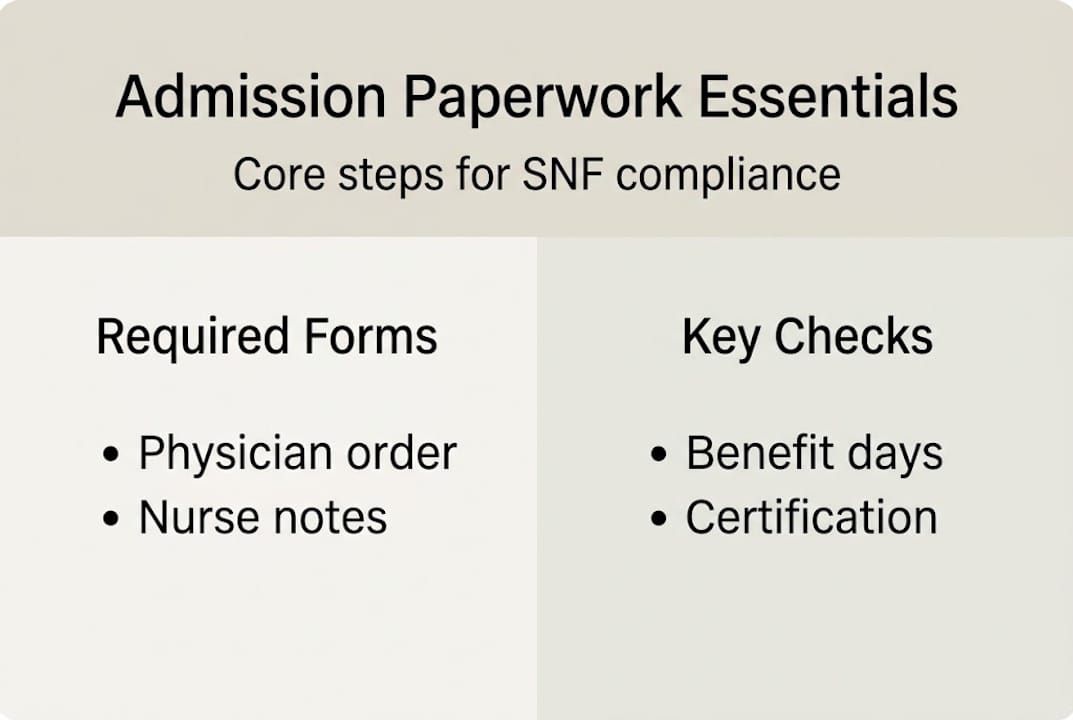
CMS regulations under 42 CFR Part 483 set strict requirements for SNF and rehab admission documentation. These include physician orders, a history and physical, nurse admission assessments, the Minimum Data Set (MDS), hospital records confirming a qualifying stay, and therapy evaluations. Missing any one of these can put your facility out of compliance before a patient has even settled into their room.
The key stakeholders in this process include clinical staff, admissions coordinators, compliance teams, and billing personnel. When each group operates in a silo, gaps appear. A structured checklist creates a shared standard that everyone follows, regardless of shift or staffing level.
Here is what a robust checklist addresses:
- Physician orders and certifications: Verified at intake and tracked through recertification cycles
- Insurance eligibility: Confirmed before or at admission to prevent billing surprises
- Clinical documentation: History and physical, nursing assessments, and therapy evaluations completed on time
- Advance directives: Collected and filed per patient rights requirements
- Hospital qualifying stay records: Confirmed for Medicare Part A coverage
“A checklist is not a bureaucratic formality. It is the operational backbone that keeps your facility compliant, your team aligned, and your patients safe from the moment they arrive.”
Facilities that treat the intake process steps as a structured workflow rather than a loose sequence of tasks consistently see fewer documentation errors and faster authorization turnaround. Reviewing your intake documentation guide is a practical starting point for building that structure into your daily operations.
The essentials: Admission requirements and preparation
Once your team understands what is required, you can build a reliable, repeatable intake process. Pre-admission preparation is where most facilities either gain or lose time. Getting the right documents before a patient arrives prevents last-minute scrambles and downstream delays.
Verification of SNF benefit days, physician certification and recertification, nursing notes, medication records, and rehabilitation logs with G-codes are all part of a complete documentation checklist. Each item has a specific purpose and a responsible party.
| Document | Purpose | Responsible party |
|---|---|---|
| Physician orders | Authorize care plan and medications | Admissions coordinator |
| History and physical (H&P) | Establish clinical baseline | Attending physician |
| Nurse admission assessment | Identify immediate care needs | Charge nurse |
| MDS (Minimum Data Set) | Drive reimbursement and care planning | MDS coordinator |
| Hospital qualifying stay records | Confirm Medicare Part A eligibility | Admissions coordinator |
| Therapy evaluations | Justify skilled care need | Therapy team |
| Insurance card and authorization | Verify coverage and benefit days | Billing team |
| Advance directives | Document patient care preferences | Social worker |
Real-time communication with the referring hospital is critical. Delays in receiving discharge summaries or medication reconciliation records are among the most common causes of admission bottlenecks. Establishing a direct contact protocol with hospital case managers can cut transfer time significantly.
Here are key pre-admission steps to complete before the patient arrives:
- Confirm the three-day qualifying hospital stay for Medicare Part A
- Verify remaining SNF benefit days through the Medicare eligibility portal
- Request and review the hospital discharge summary and medication list
- Obtain signed physician orders covering the initial care plan
- Confirm insurance authorization and any prior authorization requirements
Pro Tip: Assign a single point of contact for each incoming admission. This person owns the checklist from first contact to completed handoff, reducing the risk of items falling through the cracks during shift changes.
Supporting your team with a clear intake workflow optimization strategy ensures that preparation steps are completed consistently. Your admission documentation guide can also serve as a training resource for new admissions staff.

Step-by-step: The patient admission checklist in action
Here is how to execute the checklist from first contact to completed handoff, with built-in verification at each stage.
- Receive referral and gather initial information: Collect the patient’s diagnosis, insurance details, and anticipated level of care. Confirm bed availability and clinical appropriateness.
- Request and review hospital records: Obtain the discharge summary, medication reconciliation, and qualifying stay documentation. Flag any missing items immediately.
- Verify insurance eligibility and benefits: Confirm SNF benefit days, authorization requirements, and coverage limits in real time.
- Obtain physician orders: Secure signed orders for medications, diet, activity level, and any therapy services before or at admission.
- Complete the nurse admission assessment: Document the patient’s functional status, skin integrity, fall risk, and cognitive baseline within the required timeframe.
- Initiate the MDS: Begin the Minimum Data Set assessment to support care planning and accurate reimbursement coding.
- Collect advance directives and consent forms: Ensure the patient or their legal representative signs all required consent and rights documents.
- Conduct therapy evaluations: Physical, occupational, and speech therapy evaluations should be completed within 24 to 48 hours of admission.
- Complete the care plan: Integrate input from nursing, therapy, dietary, and social services into a unified, individualized care plan.
- Verify and close the checklist: A supervisor or charge nurse reviews all items before the admission is considered complete.
| Step | Manual process | Automated process |
|---|---|---|
| Insurance verification | 30 to 60 minutes per admission | Real-time, under 5 minutes |
| Document tracking | Paper logs, prone to loss | Digital audit trail, instant access |
| Physician order follow-up | Phone calls and faxes | Automated alerts and confirmations |
| MDS initiation | Manual scheduling | Triggered automatically at admission |
| Compliance review | End-of-day manual check | Continuous, real-time monitoring |
Consistent checklist use directly reduces avoidable ED transfers, since on-site management of common complaints depends on having complete clinical information at hand from day one. Facilities that standardize this process also see faster reimbursement cycles because documentation is complete and accurate at the time of billing.
Pro Tip: Review your workflow automation in admissions options early. Even partial automation of document tracking and eligibility verification can reduce per-admission processing time by a measurable margin.
Common pitfalls and how to troubleshoot
Even with a solid process in place, gaps appear. Knowing where they tend to occur gives your team the ability to correct course before a problem becomes a compliance issue.
Here are the most common pitfalls and how to address them:
- Missed physician certification or recertification: This is one of the most frequent causes of claim denial. Build recertification reminders into your scheduling system and assign ownership to a specific staff member.
- Incomplete SNF benefit day verification: Admitting a patient without confirming remaining benefit days can result in unexpected coverage gaps. Always verify through the Medicare portal before admission.
- Delayed or missing hospital records: Gaps in the transfer record, especially medication lists or discharge summaries, create clinical risk and documentation deficiencies. Establish a standard request protocol with referring facilities.
- Breakdowns in cross-team communication: When nursing, therapy, billing, and administration are not aligned, steps get duplicated or skipped. A shared checklist platform visible to all teams eliminates this confusion.
- Cutting corners on nights and weekends: Admissions that occur outside regular business hours are statistically more likely to have incomplete documentation. Designate an on-call admissions lead and ensure the checklist is accessible at all hours.
“The highest-risk admissions are the ones that happen at 11 p.m. on a Saturday. If your process only works during business hours, it is not a process. It is a preference.”
Research confirms that 14.1 to 22.6% of ED transfers from nursing homes are potentially avoidable. Many of these cases involve conditions that could have been managed on-site with the right clinical information and care protocols in place at admission. A complete checklist is your first line of defense.
For teams looking to reduce administrative burden while maintaining accuracy, streamlining admissions tasks through digital tools provides a practical path forward without requiring a full operational overhaul.
Beyond the basics: What most checklists miss
Most facilities treat their admissions checklist as a static form. It gets printed, signed, filed, and forgotten. That approach misses the most valuable function a checklist can serve: continuous improvement.
The facilities that consistently outperform their peers in compliance rates and admission efficiency are not just using better checklists. They are using checklists that feed back into their operations. When a step is missed, they track why. When a bottleneck appears, they adjust. This kind of dynamic, outcome-driven approach is only possible when your checklist is connected to real-time data.
Frontline clinicians often know exactly where the process breaks down, but that knowledge rarely reaches administrators. Building structured feedback loops, whether through brief post-admission reviews or digital flagging tools, surfaces those insights and turns them into process improvements.
Facilities that integrate healthcare workflow automation examples into their admissions operations are not just reducing errors. They are building a learning system that gets more accurate over time. A checklist that never changes is already falling behind.
Smarter admissions: Next steps for your facility
The checklist framework in this guide gives your team a strong foundation. But executing it consistently, across every shift, every admission, and every payer type, requires more than a printed form.
Smart Admissions automates the most time-consuming parts of the intake process, from real-time insurance eligibility checks to digital document tracking and automated physician order follow-up. Facilities using automated admissions solutions report up to 20% faster bed occupancy and significantly fewer documentation errors. Explore intake automation benefits to see how automation fits your current workflow. You can also review the full referral types guide to ensure your team is prepared for every referral scenario your facility encounters.
Frequently asked questions
What are the absolute must-have documents for patient admissions in SNFs or rehab centers?
Must-have documents include physician orders, history and physical, nurse assessments, MDS, therapy evaluations, and recent hospital records. These are required for CMS compliance in SNF and rehab admissions.
What compliance risks come from missing checklist steps during admissions?
Missing steps can cause CMS violations, delayed reimbursement, and potentially avoidable emergency room transfers. Research on avoidable ED admissions confirms that incomplete intake processes contribute directly to these outcomes.
How can using an automated checklist improve skilled nursing admissions?
Automation reduces manual errors, improves document tracking, and speeds up bed occupancy for new admissions. It also creates a real-time audit trail that supports compliance reviews.
What are common mistakes admissions staff should avoid?
Missing physician certification, failing to verify SNF benefit days, and incomplete record transfers are key pitfalls. Verification of SNF benefit days and physician certification are essential steps that should never be skipped.
How do checklists help reduce avoidable ED transfers?
They ensure on-site management of common issues and completeness at admission, reducing unnecessary hospital trips. Consistent checklist use supports the clinical readiness needed to manage avoidable post-admission issues without escalating to the emergency department.