
Collect five things before the patient arrives: the primary ICD-10 diagnosis, recent operative notes, comorbidity documentation for NTA and SLP scoring, feeding or airway status, and estimated functional evidence for Section GG. This information determines the initial HIPPS code your facility receives at the five-day scheduled PPS assessment, and gaps here translate directly into lost Medicare Part A reimbursement that is difficult to recover later.
TL;DR:
- Gathering operative notes from the past 30 days and obtaining precise ICD-10 diagnoses are crucial for maximizing classification accuracy and potential reimbursement.
- Missing or delayed documentation, especially operative notes, comorbidities, or functional evidence, leads to under-classification and revenue loss that is difficult to recover later.
- A streamlined 15-minute preadmission workflow relies on rapid, templated requests and escalation protocols for unresponsive hospitals to ensure critical data availability.
- An interim payment assessment should be filed when a patient’s clinical condition changes significantly after the initial five-day assessment, such as new wounds or ventilator weaning.
- Automating document collection and enforcing a strict evidence packet reduce errors, speed up admissions, and prevent under-coding that affects reimbursement and operational efficiency.
Table of Contents
- What Is PDPM Preadmission Screening and Why Does It Matter?
- What Documentation Should You Request Before Admission?
- How Do You Run a 15-Minute PDPM Preadmission Workflow?
- When Do You Need an Interim Payment Assessment?
- What Documentation Mistakes Put PDPM Revenue at Risk?
- Why Admissions Teams Need a Clinical-Evidence Mindset
- Automate Your PDPM Preadmission Checklist With Smartadmissions
- Sources
- FAQ
What Is PDPM Preadmission Screening and Why Does It Matter?
The Patient Driven Payment Model is the mandatory case-mix system Medicare uses to pay skilled nursing facilities under Part A, and CMS built it around five components: PT, OT, SLP, NTA, and Nursing. Each component has its own classification groups, and each carries a separate case-mix index that adds up to your daily rate.
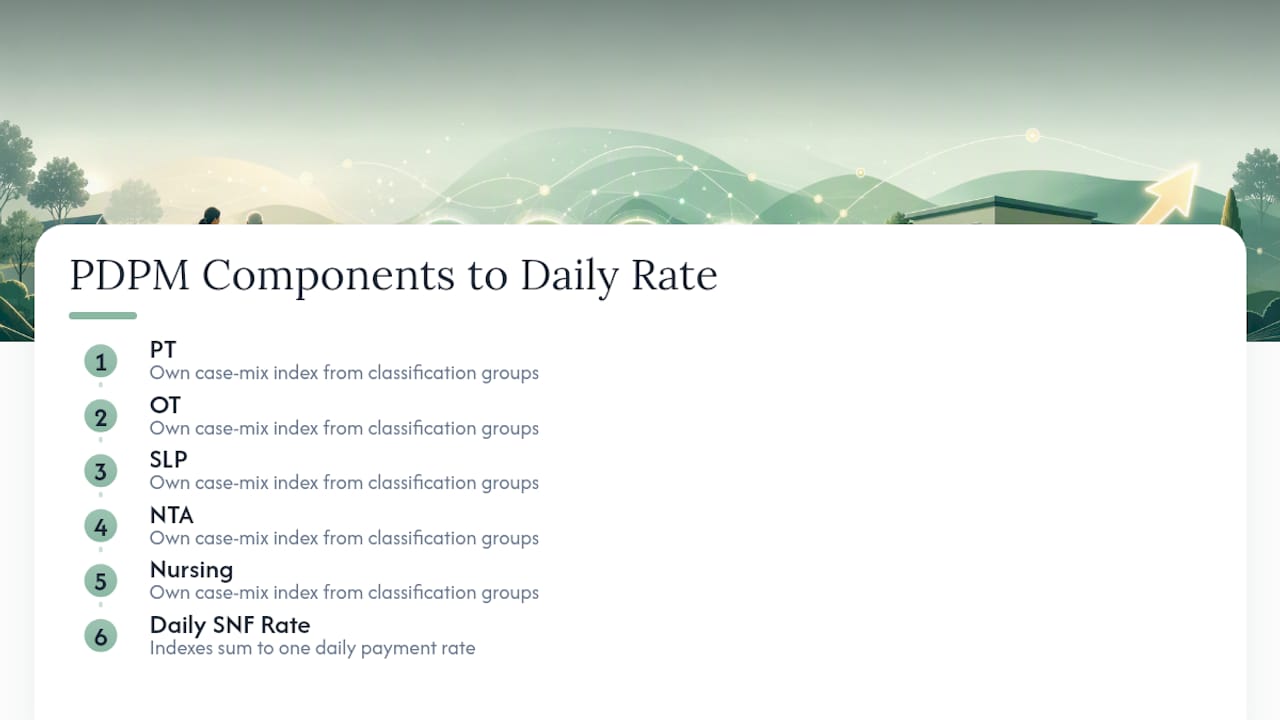
PDPM classification runs on clinical evidence, not therapy minutes. It depends on ICD-10 mapping, specific MDS items in Sections I, J, and GG, and documented comorbidities that most hospitals never volunteer without a direct request.
The five-day scheduled PPS assessment sets your initial HIPPS code and the payment trajectory for the entire stay. If your team hasn’t gathered the right preadmission evidence by then, you’re often locked into a lower-paying classification with limited ways to correct it after the assessment reference date passes.
What Documentation Should You Request Before Admission?
PDPM preadmission screening works only when your intake team knows exactly what to ask for, and asks for it before the ambulance leaves the hospital parking lot. AAPACN’s admission documentation request tool outlines the hospital records that most directly affect MDS coding accuracy, and your checklist should mirror it closely.
- Primary diagnosis and discharge summary. Get the exact ICD-10 code, not a verbal description, since it drives your PDPM clinical category mapping.
- Operative notes and procedure codes from the prior 30 days. Surgical history can shift a patient into a higher paying PDPM surgical clinical category, and this is one of the highest-impact items admissions teams routinely miss.
- Comorbidity evidence for NTA and SLP scoring. Ask specifically for conditions like diabetes with complications, morbid obesity, or chronic respiratory failure rather than a generic problem list.
- Feeding and airway status. Request swallowing evaluations, mechanically altered diet orders, and any tube feeding or ventilator documentation, since these items carry heavy weight in SLP and NTA classification.
- Section GG functional evidence. Recent therapy notes or nursing shift descriptions of mobility, transfers, and self-care support your functional scoring when the hospital hasn’t performed a formal GG assessment.
- Medications, wound documentation, imaging, and consult notes. These fill in NTA points that a bare diagnosis list will never capture.
Build a standard request template with required timestamps and an escalation path for records that don’t arrive promptly. Our documentation management guide walks through how to structure that packet so nothing falls through during a busy intake day.
How Do You Run a 15-Minute PDPM Preadmission Workflow?
You don’t need a two-hour intake process to protect your PDPM classification. You need a tight, repeatable sequence that your admissions coordinator can run on every referral, every time.
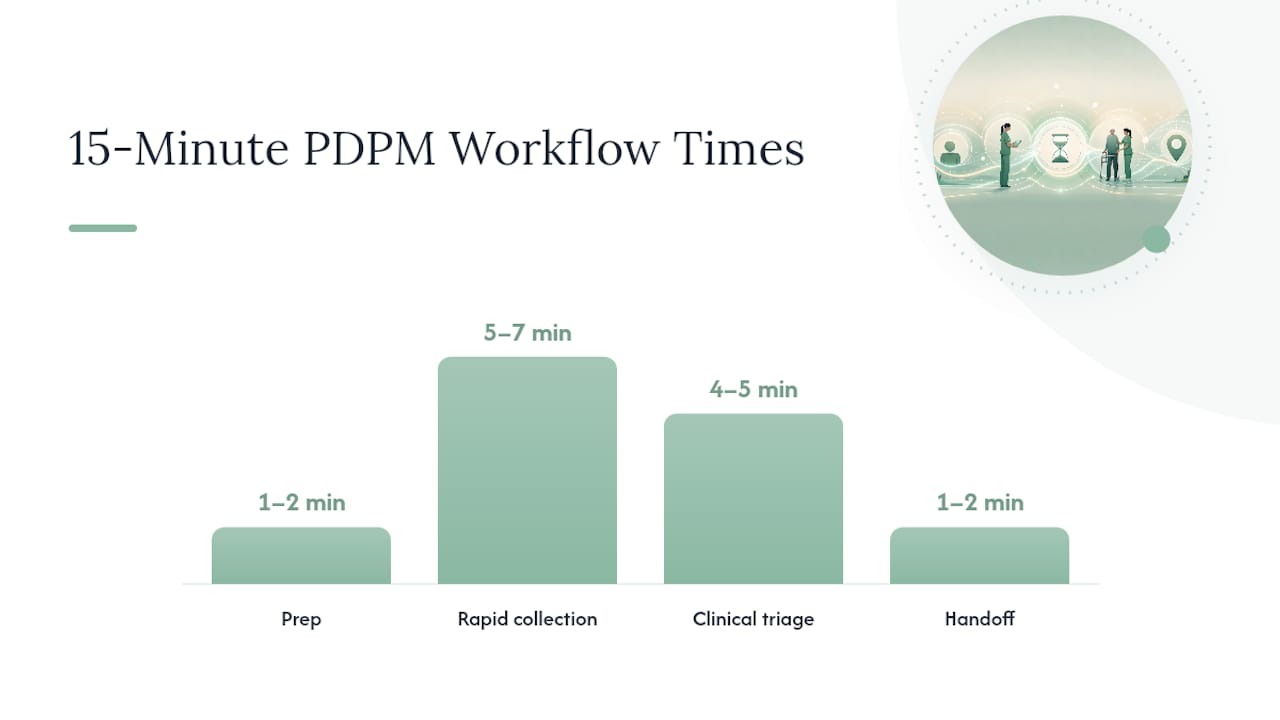
- Prep (1 to 2 minutes). Confirm the referral source, payer, and stated primary diagnosis, then fire off your templated document request immediately.
- Rapid collection (5 to 7 minutes). Call or message the hospital case manager for the discharge summary, operative notes, procedure codes, current medication list, and any lines, tubes, or airway devices in place.
- Clinical triage (4 to 5 minutes). Screen the chart for SLP cues, NTA flags, and the likely nursing group. If direct Section GG data isn’t available yet, record a proxied functional estimate from nursing or therapy notes so the MDS coordinator isn’t starting from zero.
- Handoff (1 to 2 minutes). Route the full packet to your MDS coordinator and therapy team, and log the time and source of each document for audit purposes.
Smartadmissions built its 15 Minute U.S. PDPM Admission Workflow around this exact sequence, using automated document requests to compress the collection step so clinical staff spend their time on triage rather than chasing paperwork.
Pro Tip: If a hospital hasn’t responded to your document request within 20 minutes, escalate to a phone call rather than a second email. Operative notes and comorbidity lists rarely arrive from a second automated request, but a direct call to the case manager usually works.
When Do You Need an Interim Payment Assessment?
An Interim Payment Assessment lets you reclassify a resident mid-stay when their clinical picture changes significantly from what the five-day assessment captured. Common triggers include ventilator weaning, a complex wound that develops after admission, or a rapid clinical decline that adds NTA points the original assessment missed.
Variable Per Diem adjustments compound the stakes here. PT, OT, and NTA components step down on a set schedule over the course of the stay, which means the earliest days of admission typically carry higher payment multipliers. Missing an accurate picture at intake doesn’t just risk a bad initial classification. It costs you the highest-value days of the stay before you ever get a chance to correct it.
Document the anticipated clinical trajectory at intake, secure the evidence you’ll need to justify an IPA before it’s requested, and log every assessment reference date decision your MDS coordinator makes.
What Documentation Mistakes Put PDPM Revenue at Risk?
Most PDPM revenue leakage traces back to the same handful of gaps, and they’re fixable with process changes rather than new hires.
- Missing operative notes that leave a surgical clinical category unclaimed.
- Thin or absent comorbidity documentation that undercounts NTA points.
- Weak Section GG support, especially when hospitals discharge patients without a functional assessment on file.
- Inconsistent ICD-10 capture, worsened by the 34 mapping changes CMS issued for FY 2026, which means outdated vendor software can misclassify a diagnosis you coded correctly.
Fix these with mandatory referral fields that block submission until key data is entered, a standard preadmission evidence packet, and a clear escalation rule when a hospital doesn’t respond. Keep timestamps on every document you collect. If an auditor questions a classification eighteen months from now, provenance is what defends it.
Why Admissions Teams Need a Clinical-Evidence Mindset
PDPM preadmission work only succeeds when your team stops thinking in therapy minutes and starts thinking in clinical evidence. That shift is cultural before it’s operational, and it’s the one most facilities underestimate.
Train staff on the intake checklist in a single afternoon, not a multi-week rollout. Enforce it on every referral, no exceptions, and let technology handle the repetitive document requests so your coordinators can focus on triage. Roll out a standard preadmission evidence packet this month, and audit every new admission against it weekly for the first 90 days. That short audit window tells you more about where your revenue is leaking than any annual review ever will.
— Harry
Automate Your PDPM Preadmission Checklist With Smartadmissions
Some platforms serve as a direct alternative to manually chasing hospital case managers for every discharge summary and operative note your team needs. They can connect to EMR and insurance portals to pull eligibility data and clinical documentation automatically, then route templated PDPM document requests the moment a referral lands.
That automation is what turns the 15-minute workflow into something your admissions coordinators can actually run on every case, not just the easy ones. Fewer missing operative notes and comorbidity lists mean fewer under-coded admissions, faster time-to-bed, and less end-of-shift scrambling for your staff. See how the referral management system fits your intake process, and start a trial to see your first PDPM preadmission packet assembled automatically.
Sources
FAQ
What Is PDPM Preadmission Screening?
It’s the process of gathering ICD-10 diagnosis codes, surgical history, comorbidities, and functional data before a resident arrives so your five-day assessment reflects their true clinical picture.
Which Documents Matter Most for PDPM Classification?
Operative notes from the prior 30 days and the primary ICD-10 diagnosis carry the most weight, since they determine clinical category placement and can unlock higher-paying surgical categories.
What Happens if Preadmission Documentation Is Incomplete?
Your five-day scheduled PPS assessment locks in a HIPPS code based on available evidence, so missing comorbidity or functional data typically results in under-classification and lower reimbursement for the entire variable per diem schedule.
How Long Should a PDPM Preadmission Workflow Take?
A focused workflow can run in about 15 minutes when your team uses a standard document request template and platforms like Smartadmissions to automate the collection step.
When Should a Facility File an Interim Payment Assessment?
File an IPA when a resident’s clinical status changes significantly after admission, such as ventilator weaning or a newly developed complex wound that adds NTA points beyond the initial assessment.