
A pre-admission clinical review must confirm medical and psychiatric stability, flag urgent risk factors, verify documentation and payer eligibility, and capture discharge needs before a bed is assigned. The immediate next step is expedited triage: screen every referral against red-flag criteria and route anything uncertain to a clinician for a same-day decision. Standards from the APA and evidence-based assessment principles, along with operational tools like Smart Admissions, give your team the structure to do this consistently.
TL;DR:
- Red flags such as unstable vitals, recent suicide attempts, or uncontrolled psychosis require immediate clinician escalation, not routine screening.
- A comprehensive pre-admission review must include medication reconciliation, recent clinical notes, labs, imaging, and mental health assessments per APA guidelines.
- Virtual assessments are suitable for low-risk referrals with reliable documentation, while high-risk or communication-challenged cases need in-person evaluation.
- Automating eligibility checks and documentation through integrated EMR systems significantly reduces delays and administrative errors.
- Implementing a structured risk matrix and decision rules improves consistency, especially when combined with clinician oversight and regular audits.
Table of Contents
- What Does a Pre-Admission Clinical Review Cover?
- Triage and Red Flags: When to Accept, Defer, or Escalate
- Building the Assessment: Interviews, Screens, and Records
- Virtual or In-Person? Setting the Right Timeline
- Documentation and Eligibility: The Real Denial-Reduction Levers
- Why Decision Rules Beat Gut Instinct Alone
- Getting Started: A 30 to 90 Day Playbook
- See How Smart Admissions Fits Your Intake Workflow
- Sources
- FAQ
What Does a Pre-Admission Clinical Review Cover?
A thorough pre-admission clinical review has four domains: medical stability, psychiatric screening, functional capacity, and discharge readiness. Miss one, and you risk an unsafe placement or a bounce-back within 72 hours. Social determinants belong here too. Housing instability, transportation gaps, and caregiver availability often decide whether a clinically appropriate admission actually works in practice.
Your admissions coordinators need a defined document set before they can make a sound decision, not a partial file they hope to fill in later. At minimum, that means:
- The referral or request for admission (RFA) with reason for transfer
- A completed patient health questionnaire covering mood, function, and pain
- An active medication list, reconciled against the most recent administration record
- Recent clinical and nursing notes, including the last 24 to 48 hours of vitals
- Relevant labs and imaging tied to the presenting condition
- Signed consent forms where the facility or state requires them
Psychiatric elements deserve particular rigor. The APA’s evaluation guidance calls for reviewing mood, anxiety, thought content, perception, cognition, trauma history, and prior psychiatric treatment as part of any initial evaluation. Skipping these on a “we’ll assess it after arrival” basis is how facilities end up with placements that fail within days. Discharge planning also starts here, not at day three. The perioperative toolkit guidance recommends identifying discharge barriers during the pre-admission window, not after the patient is already in a bed.
Triage and Red Flags: When to Accept, Defer, or Escalate
Not every referral needs a full clinician review before intake staff can move it forward, but certain findings should stop the process cold. Build your triage rules around a short, non-negotiable list.
- Unstable vitals or signs consistent with sepsis
- Active suicidal intent or a recent attempt
- Uncontrolled psychosis or agitation that threatens safety
- Significant anticoagulation or bleeding risk without a management plan
- Uncontrolled withdrawal symptoms from alcohol or another substance
Nurse screeners should catch these first, but the escalation path matters as much as the checklist. A finding on that list goes from screener to clinician within the hour, and to a consultant or medical director if the clinician can’t resolve it same-day. Document who was notified, when, and what decision followed. That record protects the patient and the facility if the case is ever reviewed later.
Routine referrals without red flags can move on a standard screening cadence. Anything flagged needs urgent clinician review, not next-week scheduling.
Pro Tip: Build your red-flag list into a dropdown or checkbox set in your intake form, not a narrative field. Screeners under time pressure catch discrete items far more reliably than they catch prose.
Building the Assessment: Interviews, Screens, and Records
A defensible pre-admission clinical review draws on more than one method. The Cogn-IQ overview of clinical assessment frames this as multimethod work: clinical interview, standardized screening tools, behavioral observation, self-report, and collateral records, each covering a gap the others miss. Core components for most facilities include:
- A structured clinical interview covering history and presenting complaint
- Medication reconciliation against the transferring facility’s most recent orders
- A mental status exam documenting orientation, mood, and thought process
- A validated screen such as PHQ-9 for depression or GAD-7 for anxiety
- Functional status measures (mobility, ADLs, cognitive baseline)
- Collateral information from family, prior providers, or case managers
Tool selection is not a matter of habit or convenience. Choose instruments based on reliability, validity, and incremental validity, meaning the tool actually adds information beyond what you’d learn from the interview alone. The Merck Manual’s overview of initial psychiatric assessment confirms PHQ-9 and GAD-7 as standard first-line screens precisely because they’re validated for this purpose.
A practical rule: a brief screen is sufficient when the referral is routine and collateral records are strong. Escalate to a fuller psychiatric interview when the screen flags significant pathology, when collateral information conflicts with the referral, or when the patient’s presentation doesn’t match the paperwork.
Virtual or In-Person? Setting the Right Timeline
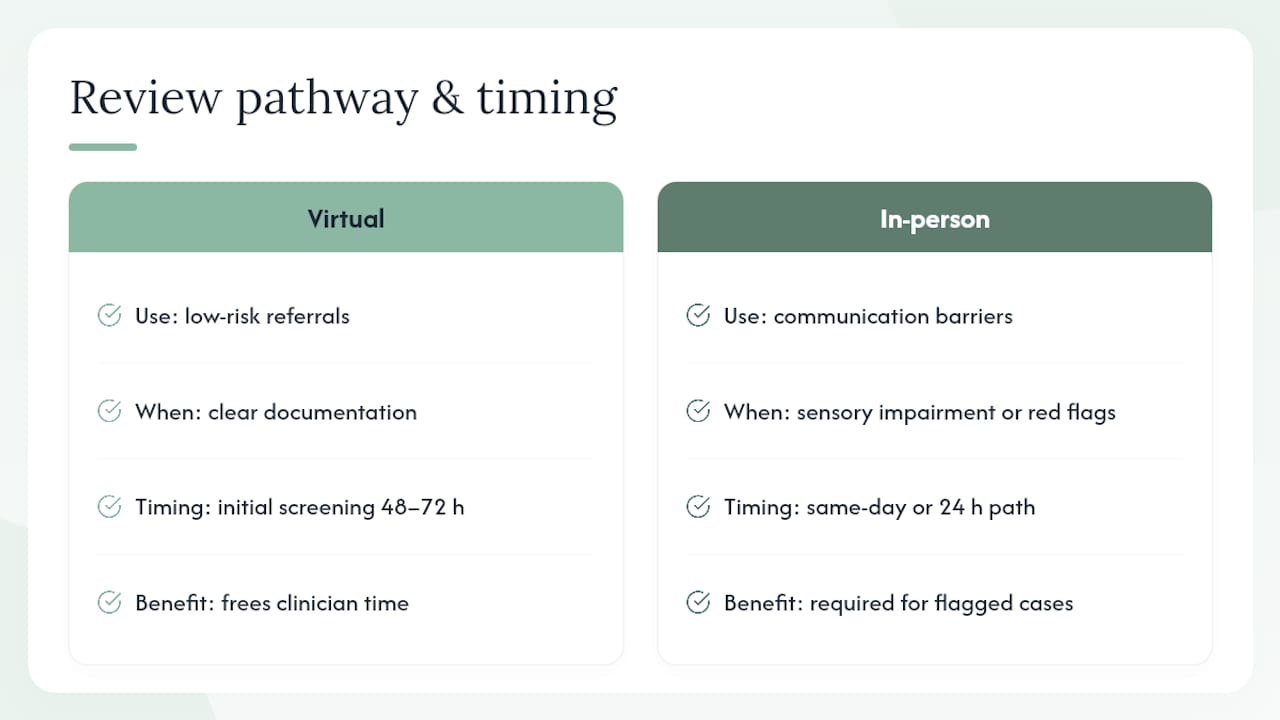
Virtual review works well for low-risk referrals with clear documentation and reliable collateral. Reserve in-person evaluation for cases involving communication barriers, sensory impairment, or any of the red-flag indicators above. The perioperative toolkit treats virtual screening as an accepted pathway precisely because it frees clinician time for the cases that actually need a face-to-face look.
Timing benchmarks matter as much as modality. Aim for initial screening within 48 to 72 hours of referral receipt. Elective admissions should complete triage two to four weeks out, giving time to chase down missing labs or consent forms. Time-sensitive cases need a same-day or 24-hour path, with no exceptions for missing paperwork that can be obtained after acceptance.
Documentation and Eligibility: The Real Denial-Reduction Levers
Denials rarely happen because a patient was clinically inappropriate. They happen because a document was missing, a date didn’t match, or eligibility wasn’t confirmed before intake. The core documentation set for admission should include the RFA, the completed patient health questionnaire, a reconciled medication list, recent clinical notes, labs and imaging, and a discharge planning form addressing barriers identified during screening.
Real-time EMR and payer integrations close the gap between “we think this patient is covered” and “we’ve confirmed it.” Automation platforms built for this workflow can reduce administrative delays and support faster bed fill rates when the integration is tightly aligned to clinical steps, not bolted on afterward. That operational gain shows up directly in fewer rework cycles for your admissions coordinators.
Whatever system you use, keep four things in every chart for auditability:
- Timestamp of each review step and decision
- Credentials of the reviewer who signed off
- The clinical rationale behind accept, defer, or escalate
- Follow-up actions assigned, with owner and due date
Facilities that treat this as a workflow to design, not a form to fill out, see fewer denials and faster placements. Smartadmissions’s own intake documentation guide walks through building that workflow step by step.
Why Decision Rules Beat Gut Instinct Alone
Clinical judgment matters, but it shouldn’t work alone. A substantial body of evidence, reviewed in this analysis of mechanical versus clinical judgment, shows that mechanically combining assessment data tends to match or outperform unaided clinical judgment in prediction tasks. That’s not an argument against clinicians. It’s an argument for giving them a structured starting point instead of a blank page.
A simple low, moderate, or high risk matrix, scored from your red-flag checklist and screening results, gives every reviewer a consistent starting point. Moderate or high scores trigger clinician review; low scores can move through an expedited path. Start the rule on a narrow, well-defined question, such as “does this referral need specialty review,” and validate it against real referrals before expanding its scope. Keep a clinician in the loop for every escalation, and audit a sample of decisions monthly to catch drift in how the rule gets applied.

Getting Started: A 30 to 90 Day Playbook
Tightening your pre-admission clinical review doesn’t require a system overhaul on day one. Assign clear ownership for triage, screening, and escalation in the first 30 days. Pick your validated screening tools next, favoring instruments with proven incremental value over whatever your team has always used. By day 60, connect basic EMR checks to reduce manual eligibility lookups. By day 90, pilot your risk matrix on a subset of referrals before rolling it facility-wide. Smart Admissions’ documentation templates and the patient intake checklist give teams a working starting point rather than a blank slate.
— Harry
See How Smart Admissions Fits Your Intake Workflow
Every step in this playbook, from red-flag triage to eligibility verification, runs faster when your systems talk to each other instead of requiring staff to re-key the same patient data three times. Smart Admissions connects to your existing EMR and insurance portals, giving admissions coordinators real-time eligibility checks and clinical documentation in one place instead of scattered across faxes and portals.

The platform’s plans run $597 per month or $6,447 annually, and onboarding is built to get your team live without a drawn-out IT project. Before you commit to any admissions platform, check three things: how long onboarding actually takes, whether it integrates with the EMR you already run, and what support looks like when something breaks at 6 p.m. on a Friday. Visit the pricing page to compare plans and see which fits your referral volume.
This article is general information, not a substitute for advice from a qualified doctor. Consult a qualified healthcare professional about your own circumstances before acting on anything here.
Sources
- Clinical assessment: methods and psychometric standards (Cogn-IQ)
- Mechanical vs clinical judgment evidence (PMC review)
- Initial psychiatric assessment overview (Merck Manual)
FAQ
What Is a Pre-Admission Clinical Review?
It’s the structured evaluation of a patient’s medical stability, psychiatric status, functional capacity, and discharge needs completed before a facility accepts a referral for admission.
What Are the Most Common Red Flags in a Clinical Intake Assessment?
Unstable vitals, active suicidal intent, uncontrolled psychosis, significant anticoagulation risk, and uncontrolled withdrawal symptoms are the findings that should trigger immediate clinician escalation.
How Long Should a Pre-Admission Clinical Review Take?
Initial screening should happen within 48 to 72 hours of referral receipt, with elective admissions triaged two to four weeks ahead and urgent cases handled within 24 hours.
Can a Pre-Surgery Evaluation Be Done Virtually?
Yes, virtual review works for low-risk referrals with clear documentation and reliable collateral information, while in-person evaluation is better reserved for high-risk or communication-barrier cases.
How Does Smart Admissions Support the Clinical Assessment Process?
Smart Admissions integrates with existing EMR and insurance systems to provide real-time eligibility verification and documentation management, reducing the manual rework that slows down admission health screening.
What Does Smart Admissions Cost?
Smart Admissions is priced at $597 per month or $6,447 per year; full plan details are available on the pricing page.