
TL;DR:
- Skilled nursing facilities can improve admissions by systematically tracking referral outcomes through reliable data methods and defined workflows. Using unique IDs, timestamped stages, and automation helps identify bottlenecks, reduce patient leakage, and optimize source performance. Implementing these strategies leads to measurable census growth and better referral relationships over time.
Referral outcome tracking is defined as the systematic process of recording, timestamping, and analyzing every stage of a patient referral from initial submission to final disposition, including admission, decline, or loss. Skilled nursing facilities that know how to track referral outcomes gain a direct operational advantage: they identify bottlenecks faster, reduce patient leakage, and convert more referrals into admissions. Platforms like WellSky CarePort and skyReferral have made this process measurable at scale, while tools like Smartadmissions bring AI-powered automation to intake workflows. This guide covers the five most effective referral tracking methods, the metrics that matter most, and a step-by-step workflow built specifically for SNF admissions teams.
How to track referral outcomes with the right methods
Referral outcome tracking relies on five core methods, each suited to different facility sizes and technology environments. Choosing the right combination determines whether your data is reliable or riddled with gaps.

| Method | Best for | Key limitation |
|---|---|---|
| Unique referral IDs with automated deduplication | Multi-channel intake (fax, EHR, portal) | Requires system integration |
| Status progression with timestamps | All facility sizes | Manual entry risks inaccuracy |
| CRM or EHR integration | Mid-to-large SNFs | Setup and training investment |
| Referral management software (e.g., skyReferral, CarePort) | SNFs prioritizing automation | Licensing cost |
| Spreadsheet tracking | Small facilities or early-stage programs | No automated alerts or audit trail |
Unique referral identifiers are the foundation of accurate tracking. Every referral entering your facility, whether by fax, secure email, or EHR portal, must receive a unique ID at the point of intake. This ID follows the referral through every stage and prevents duplicate records when the same patient is referred by multiple sources. Integrated intake and CRM workflows prevent loss of source data across channels, which is the most common cause of orphaned admissions where no one can trace which hospital or physician generated the placement.
Status progression with timestamps means every stage transition, from “submitted” to “under clinical review” to “accepted” or “declined,” is recorded with a date and time. Referral tracking systems must capture operational status progression with timestamps and final outcome recording to produce accurate reporting. Without timestamps, you cannot calculate time-to-response or identify which stage is causing delays.
CRM and EHR integration connects your referral data to patient records automatically. WellSky’s CarePort Referral Intake uses analytics to identify referral behavior patterns and measure placement outcomes, giving admissions directors a real-time view of pipeline health. skyReferral automates referral status tracking and alerts to prevent patient loss when referrals stall between stages.
Spreadsheets remain common in smaller facilities, but they carry serious risk. Spreadsheets often fail to provide consistent stage timestamps and ownership, which produces unreliable metrics over time. If your team is still using a shared Excel file, treat it as a temporary measure while you build toward a dedicated platform.
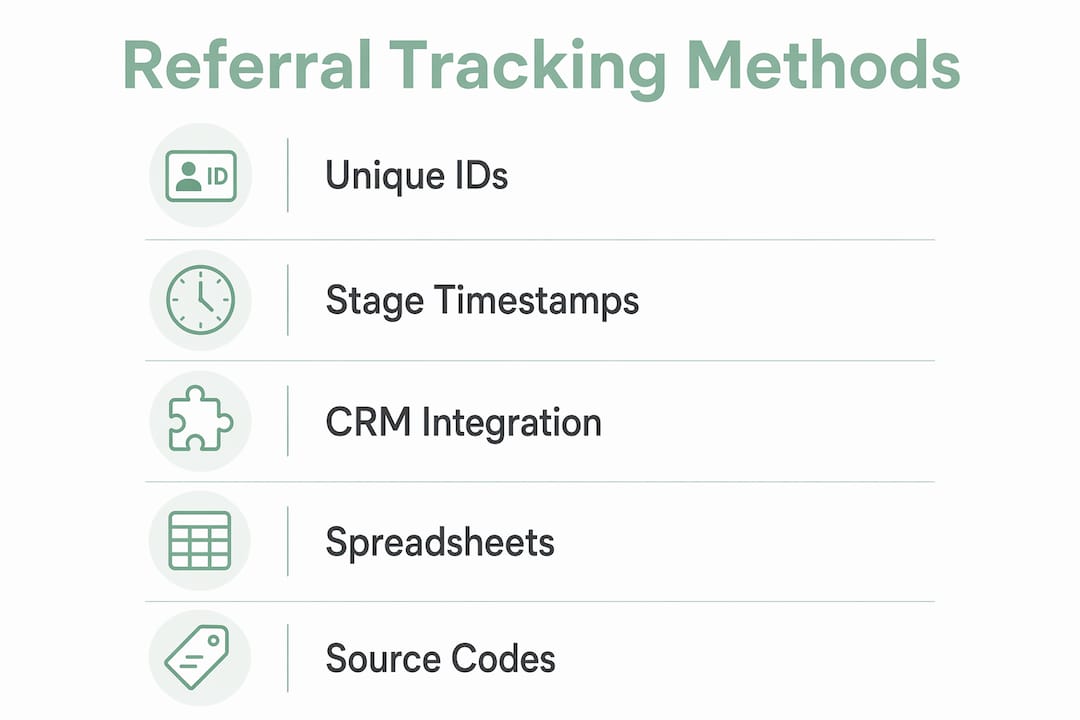
Pro Tip: Assign a unique referral source code to every referring hospital, physician group, or discharge planner. This code travels with the referral ID and makes source-level performance analysis possible without manual cross-referencing.
Which referral metrics should you monitor for accurate measurement?
Monitoring referral metrics means tracking specific, defined data points that reflect both volume and quality of your referral pipeline. The metrics below are the ones SNF admissions teams should review weekly.
- Referral volume by source: Total referrals received per week, segmented by referring hospital, physician, or care coordinator. Volume alone does not indicate quality, but it establishes your baseline.
- Time to first response: The elapsed time between referral receipt and your team’s first clinical or administrative response. Faster response directly correlates with higher acceptance rates.
- Acceptance rate: The percentage of received referrals your facility accepts. The average SNF acceptance rate was 23.6% in 2022 and rose to 32% in 2024, reflecting increased competition for post-acute placements. Knowing your facility’s rate against this benchmark tells you whether your clinical criteria or capacity are limiting growth.
- Admission conversion rate: The percentage of accepted referrals that result in an actual admission. High referral source acceptance rates alone can be misleading; true performance requires tracking accepted-to-admitted conversion and referral packet completeness.
- Referral leakage rate: The share of accepted referrals that never convert to admission because the patient chose another facility or the placement fell through. Tracking leakage weekly helps you detect which referral sources produce the most unreliable placements.
- Patient leakage: Patients who were referred, accepted, and then lost before admission due to incomplete documentation, delayed bed assignment, or family redirection.
- Payer mix by source: The insurance breakdown of referrals from each source. Some referring hospitals send a disproportionate share of Medicaid-only patients. Tracking payer mix by source helps your admissions director prioritize outreach to sources that align with your facility’s financial goals.
Analyzing time spent at each referral stage combined with outcome status reveals bottlenecks that are invisible if you only measure volume or acceptance. A facility might have a strong acceptance rate but a poor conversion rate because clinical documentation is consistently incomplete at the post-acceptance stage. That is a documentation problem, not a sourcing problem, and the two require entirely different fixes.
Pro Tip: Build a weekly dashboard that displays all seven metrics above in a single view. Reviewing them together, rather than in isolation, is what surfaces the patterns that drive real admissions growth.
How to implement an effective referral tracking workflow
A structured referral tracking workflow gives every team member a defined role and prevents referrals from stalling between stages. Follow these steps to build one that works in your facility.
-
Standardize intake documentation. Define exactly what information must be captured at the point of referral receipt: referring source name, source ID, patient demographics, payer information, clinical summary, and referral timestamp. Use a standardized intake form, whether digital or paper, so no field is left to interpretation.
-
Assign stage ownership. Assign operational owners like intake coordinator and admissions director to their respective stages. The intake coordinator owns stages one through three (receipt, deduplication, initial review). The clinical reviewer owns the clinical assessment stage. The admissions director owns the acceptance or decline decision and the final disposition record.
-
Define your status stages explicitly. Your facility needs at minimum six stages: Received, Under Review, Pending Documentation, Accepted, Admitted, and Closed (with sub-statuses of Lost, Declined, or Expired). Closed-won, closed-lost, or expired outcomes must be recorded to ensure accuracy in referral reporting.
-
Automate status updates and follow-up triggers. Configure your referral management platform to send automated alerts when a referral has not advanced within a defined time window. skyReferral and CarePort both support automated follow-up triggers that flag stalled referrals before they become lost patients.
-
Timestamp every stage transition. Record the date and time of every status change. Weekly metrics include total referral volume by source, time to first response, acceptance rates, and admission conversion rates, and none of these are calculable without reliable timestamps.
-
Conduct weekly reviews and quarterly audits. Review your seven core metrics every week with your admissions team. Conduct a full data audit quarterly to identify orphaned records, missing source IDs, and incomplete dispositions. Quarterly audits also reveal whether your stage definitions have drifted in practice from how they were originally defined.
-
Integrate with your EHR system. Linking referral source identifiers throughout multi-channel workflows avoids orphaned records and preserves outcome attribution. Your referral platform should write back to your EHR so that every admitted patient’s record carries the originating referral source.
What common challenges occur in referral tracking and how to fix them
Even well-designed referral tracking workflows break down in predictable ways. Recognizing these failure points early saves your team from compounding data errors over time.
- Stalled referrals with no owner: A referral sits in “Under Review” for four days because no one received an alert. Fix this by setting automated escalation triggers at 24 hours for clinical review and 48 hours for pending documentation.
- Inconsistent stage definitions: One intake coordinator marks a referral “Accepted” when the clinical review is still pending. Another waits until the bed is confirmed. This produces inaccurate acceptance rate data. Fix this by publishing a one-page stage definition guide and reviewing it during onboarding.
- Multiple intake channels without unified tracking: Referrals arrive by fax, phone, secure email, and EHR portal. Without a single intake point or deduplication logic, the same patient appears as three separate referrals. Fix this by routing all channels through one platform with automated deduplication.
- Incomplete documentation at post-acceptance: A referral is accepted but the clinical packet is never completed, causing the patient to choose another facility. Fix this by requiring documentation completion as a prerequisite for the “Accepted” status, not a follow-up task.
- Missing referral source attribution: An admitted patient’s EHR record shows no referring source because the source ID was not carried forward from the intake form. Fix this by making source ID a required field that cannot be left blank at intake.
Referral outcome reliability depends on recording every stage transition with timestamps and terminal statuses. A referral without a closed status is not a completed record. It is a data gap that distorts every metric your team uses to make decisions.
Key takeaways
Effective referral outcome tracking requires timestamps, defined stage ownership, and automated alerts working together to produce reliable conversion data.
| Point | Details |
|---|---|
| Use unique referral IDs | Assign a unique ID at intake to prevent duplicates and preserve source attribution across all channels. |
| Track 7 core metrics weekly | Monitor volume, response time, acceptance rate, conversion rate, leakage, patient leakage, and payer mix together. |
| Assign stage ownership | Each referral stage needs a named owner so no referral stalls without accountability. |
| Automate follow-up triggers | Configure alerts for stalled referrals at 24 to 48 hours to prevent patient loss. |
| Audit data quarterly | Review orphaned records and missing source IDs every quarter to maintain metric accuracy. |
Why referral tracking is the most underused tool in SNF admissions
I have worked with admissions teams that could tell you their census number to the decimal but had no idea which referring hospital was responsible for their last 20 admissions. That disconnect is more common than most administrators want to admit. The data exists somewhere, but it is scattered across fax logs, EHR notes, and a spreadsheet that one coordinator updates when she has time.
What I have seen consistently is that facilities which implement structured referral tracking, with real timestamps and defined stage owners, do not just improve their metrics. They change how their admissions directors have conversations with hospital discharge planners. Instead of relationship-based outreach (“we have beds available”), they bring data (“your referrals have a 68% conversion rate with us, higher than the regional average”). That shift in conversation changes the quality of the referral relationship entirely.
The other thing worth saying plainly: a high acceptance rate is not the goal. I have seen facilities with 45% acceptance rates and declining census because their accepted-to-admitted conversion was below 50%. The referral source performance that actually matters is the full chain from submission to occupied bed. Tracking only acceptance is like measuring a sales team by the number of proposals sent, not by closed revenue.
If your facility is still relying on manual tracking, the path forward does not require a full technology overhaul on day one. Start by standardizing your stage definitions and assigning ownership. Add timestamps manually if needed. Then build toward automation as your data discipline improves. The facilities that get this right see measurable census growth within two to three quarters, not because they found new referral sources, but because they stopped losing the ones they already had.
— Harry
How Smartadmissions helps you track and convert more referrals
Smartadmissions is built specifically for SNF admissions teams that need referral tracking to work without adding administrative burden. The platform automates intake from multiple channels, assigns unique referral IDs, timestamps every stage transition, and surfaces stalled referrals before they become lost patients.
Admissions directors get a live dashboard showing all seven core metrics, updated in real time, with payer mix breakdowns by referral source. Smartadmissions integrates with existing EHR systems to carry source attribution through to the patient record, eliminating orphaned admissions. If you want to see how leading SNF platforms handle this end to end, the referral management systems guide covers seven tools with direct feature comparisons. You can also explore how Smartadmissions approaches referral management for census growth to see the full picture.
FAQ
What does tracking referral outcomes mean in healthcare?
Referral outcome tracking is the process of recording every stage of a patient referral, from receipt to final disposition, with timestamps and status codes. It measures metrics like acceptance rate, conversion rate, and referral leakage to support operational decisions in skilled nursing facilities.
How do you measure referral program success in a skilled nursing facility?
Measure referral program success by tracking admission conversion rate, time to first response, and referral leakage by source each week. The average SNF acceptance rate reached 32% in 2024, making conversion rate the more meaningful performance indicator than acceptance rate alone.
What is referral leakage and why does it matter?
Referral leakage is the loss of accepted referrals before admission, caused by incomplete documentation, delayed bed assignment, or patient redirection to another facility. It directly reduces census and represents revenue that your facility already invested time to pursue.
How often should admissions teams review referral metrics?
Admissions teams should review core referral metrics weekly and conduct full data audits quarterly. Weekly reviews catch stalled referrals and conversion drops early, while quarterly audits identify orphaned records and missing source attribution that distort long-term reporting.
What tools are used to track referral outcomes in SNFs?
WellSky CarePort, skyReferral, and Smartadmissions are purpose-built platforms for SNF referral tracking. Each supports automated status updates, timestamping, and dashboard reporting. Facilities can also explore a detailed comparison of top referral management tools to find the right fit for their workflow.