
You've got a veteran ready to admit. The family is eager. The bed is available. And then everything grinds to a halt because something doesn't match up on the DD214.
Sound familiar?
If you're an admissions coordinator at a skilled nursing facility, you know the frustration of DD214 verification errors all too well. These mistakes don't just slow down your workflow: they delay care for veterans who deserve better and cost your facility time and money.
The thing is, most of these errors aren't the result of negligence. They happen because DD214 format variations make manual review incredibly difficult. Staff are doing their best with documents that span decades of different formats, typefaces, and data entry standards.
Let's break down the five most common DD214 verification errors we see and what you can do about them.
Error #1: Mismatched Personal Identifiers
This is the verification killer that trips up even experienced admissions coordinators.
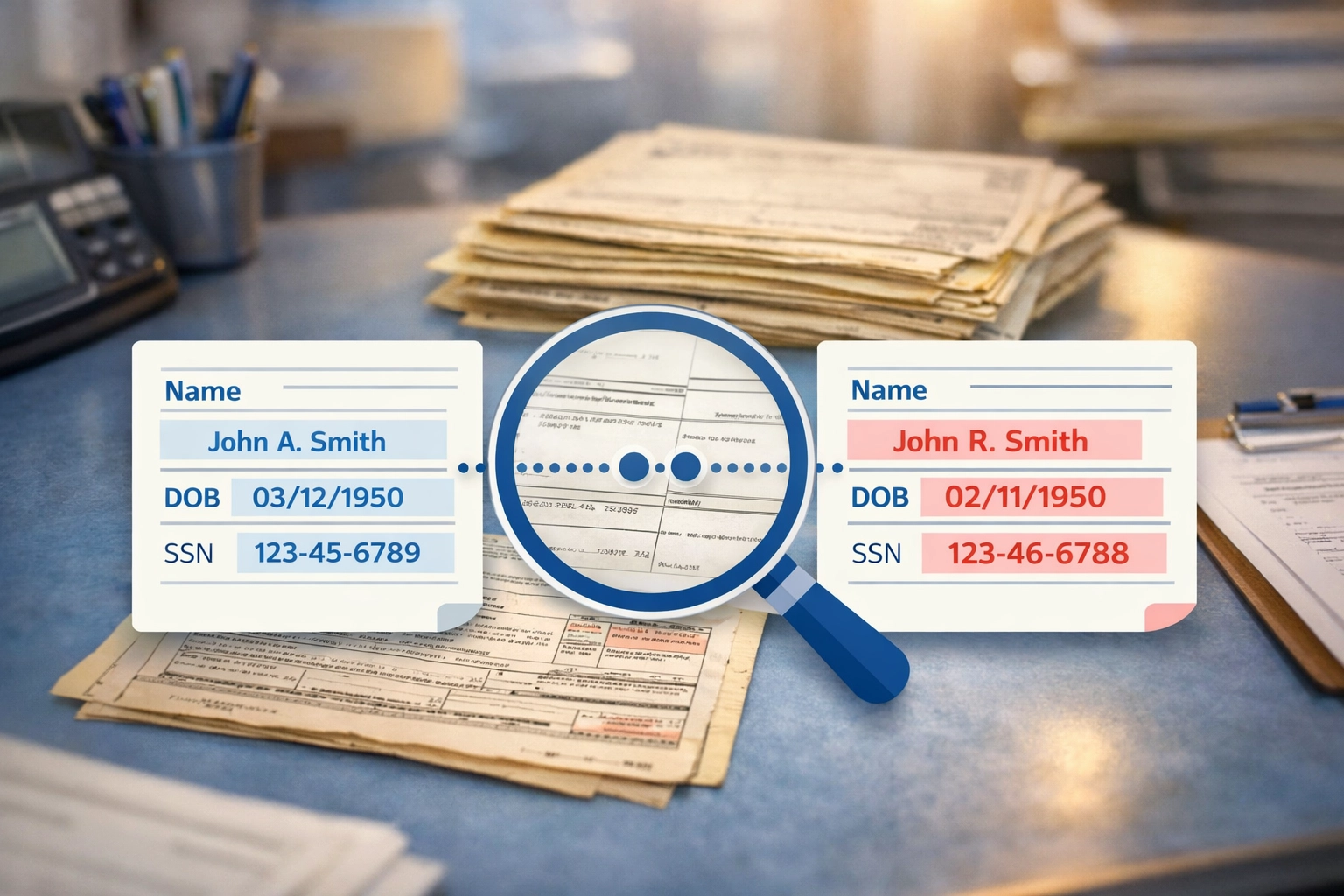
A name spelled slightly differently. A Social Security number with one transposed digit. A date of birth that doesn't quite match what's in your system. These small discrepancies can cause the entire verification process to fail.
Here's why this happens so often with manual review:
- Older DD214s may have names entered in different formats (middle name vs. middle initial)
- Handwritten documents from the pre-digital era are prone to transcription errors
- Married veterans may have had name changes not reflected on original documents
- Data entry mistakes made decades ago now live permanently on the form
When your admissions coordinator spots a mismatch, they face a choice: flag it and delay the admission while waiting for clarification, or make an assumption and risk compliance issues down the road.
Neither option is great. And when you're trying to verify DD214 eligibility quickly, these mismatches become a major bottleneck.
Error #2: Missing or Incorrect Character of Discharge
The character of discharge: sometimes called "character of service" or "character of separation": is one of the most critical fields on a DD214. It determines whether a veteran qualifies for VA benefits in the first place.
Yet it's also one of the most commonly missing or misread pieces of information.
Here's what makes this tricky:
- Different DD214 versions place this information in different locations on the form
- Faded documents may make the discharge type illegible
- Abbreviated codes can be misinterpreted by staff unfamiliar with military terminology
- Some forms use different terminology across eras
If this field is missing or incorrect, the veteran's entire benefits eligibility comes into question. Your team has to pause the admission process, request additional documentation (like a DD215 correction form), and wait for clarification.
For facilities processing high volumes of veteran admissions, these delays add up fast.
Error #3: Wrong Separation or Reenlistment Codes
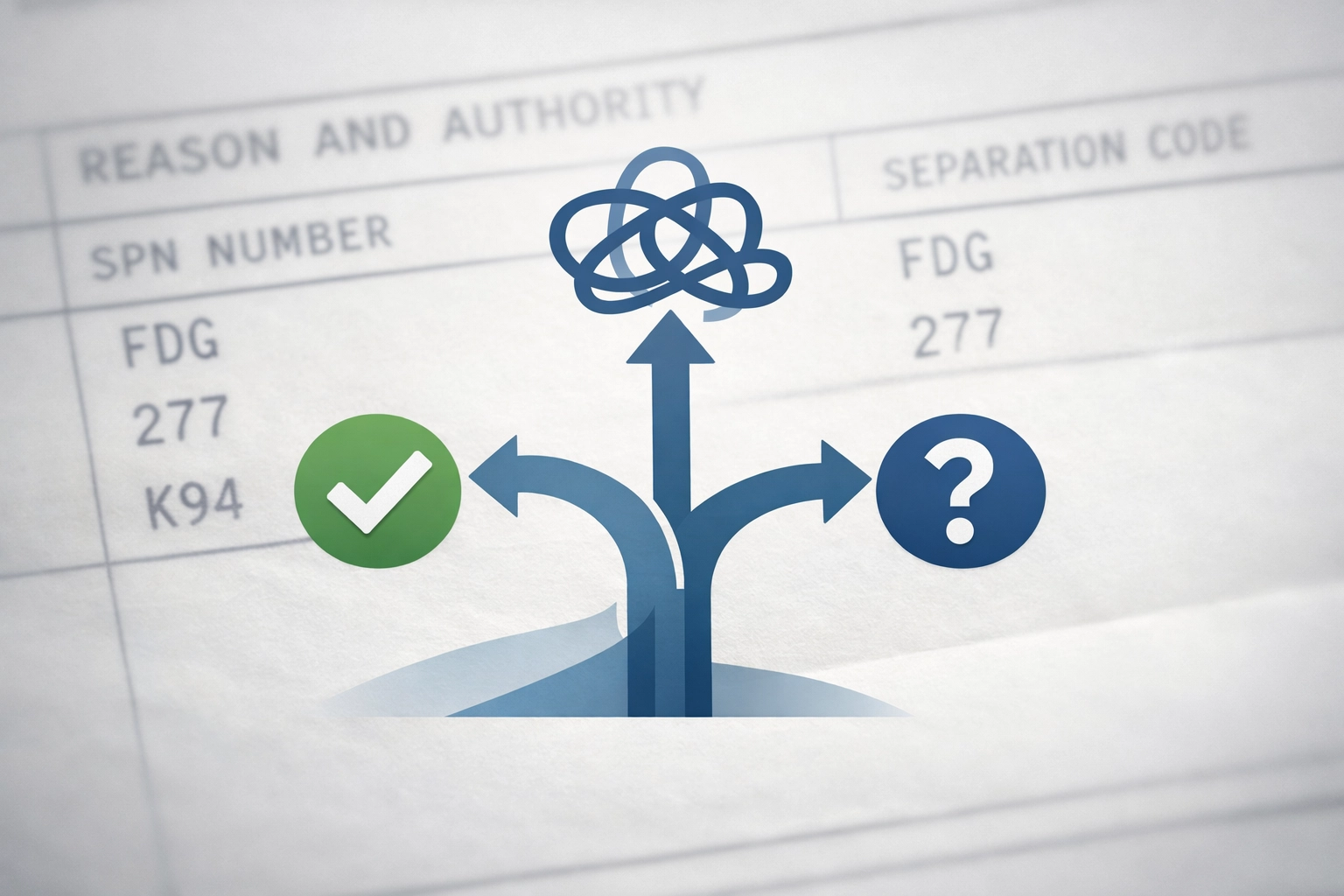
Separation codes and reenlistment (RE) codes are three-character alphanumeric codes that carry enormous weight in determining eligibility. Get them wrong, and you might incorrectly flag an eligible veteran as ineligible: or worse, admit someone whose benefits won't cover their care.
The problem? These codes are notoriously confusing.
- There are hundreds of separation codes that have changed over time
- RE codes determine future military service eligibility but also affect VA benefit access
- A single misread character (like confusing "1" with "I" or "0" with "O") changes the entire meaning
- Staff without military backgrounds often don't know what they're looking at
We've seen cases where admissions coordinators manually entered the wrong code because the original document used a typeface that made certain characters ambiguous. That single error led to weeks of back-and-forth with the VA.
This is exactly why manual verification is becoming nearly impossible as the veteran population ages and their documents become harder to read.
Error #4: Missing Awards and Decorations
You might think awards and decorations are just ceremonial: nice to have documented, but not critical for admissions. That assumption can cost your facility.
Certain veteran programs and benefits tiers require documentation of specific service awards. Missing medals, badges, or citations on a DD214 can:
- Block eligibility for enhanced care programs
- Delay benefits processing while the VA requests verification
- Require a DD215 correction before proceeding
The challenge with manual review is that awards sections vary dramatically across DD214 formats. Some list awards in a dedicated box. Others scatter them throughout the document. Older forms may use abbreviations that modern staff don't recognize.
When your admissions coordinator is reviewing a faded, decades-old document, it's easy to miss an award entry or misinterpret what's listed. And if that missing award was the key to unlocking a specific benefit, you're back to square one.
Error #5: Incomplete Deployment or Service Records
The fifth common error involves gaps in the service history documentation. Missing deployment orders, unrecorded duty station assignments, or incomplete travel documentation can all throw a wrench in verification.
Why does this matter for SNF admissions?
- Campaign medals and service-connected benefits require proof of specific deployments
- Certain VA programs have eligibility tied to length or location of service
- Missing records may require the veteran or their family to track down supporting documents
For admissions coordinators doing manual review, it's nearly impossible to know what should be on a DD214 versus what's actually there. You're reviewing the document in front of you without context about what might be missing.
This is where verification mistakes start costing facilities thousands: not through obvious errors, but through gaps that only become apparent after the admission is already in progress.
Why These Errors Keep Happening
Let's be real: your admissions staff aren't making these mistakes because they don't care. They're making them because the manual verification process is fundamentally broken.
Consider what you're asking them to do:
- Review documents that span 70+ years of format changes
- Interpret military codes and abbreviations they were never trained on
- Read faded, photocopied, or damaged documents with degraded text
- Cross-reference information against systems that don't talk to each other
- Do all of this quickly because there's a bed to fill and a family waiting
It's a recipe for errors. And when those errors happen, the consequences fall on everyone: delayed admissions, compliance headaches, frustrated families, and veterans who aren't getting the care they earned.
The comparison between manual and automated intake makes this clear. Manual processes simply can't keep up with the complexity of DD214 verification at scale.
A Better Approach to DD214 Verification
The good news? You don't have to accept verification errors as inevitable.
AI-powered verification tools can now read DD214s across all format variations, automatically extract the critical data points, and flag potential issues before they become admission-blocking problems. Instead of asking your staff to become experts in military documentation, you give them technology that handles the complexity for them.
The result:
- Faster admissions because verification happens in seconds, not hours
- Fewer errors because AI doesn't misread faded text or confuse similar characters
- Better compliance because every verification is documented and auditable
- Happier staff because they can focus on care coordination instead of paperwork
See It in Action
Want to see how automated DD214 verification can transform your admissions workflow?
Visit us at NASVH Booth #6 and we'll walk you through exactly how Smart Admissions handles the five errors we covered today: automatically.
Can't make it to the conference? Book a demo and we'll show you how facilities like yours are cutting verification time by up to 70% while eliminating the most common manual review mistakes.
Your veterans deserve faster admissions. Your staff deserves better tools. Let's make it happen.