
TL;DR:
- Poor documentation management causes high claim denial rates and significant financial losses in SNF facilities.
- Effective systems automate capture, indexing, and EHR integration to streamline admissions and ensure compliance.
- Moving to digital, structured documentation improves efficiency, reduces errors, and enhances patient safety.
Poor documentation is costing skilled nursing and rehabilitation facilities far more than most teams realize. Inefficient management costs nearly $20,000 per worker per year and contributes to more than 60% of claim denials across SNF settings. That is not a compliance problem. It is a revenue, staffing, and patient care problem. This guide breaks down what documentation management actually means for admissions teams, why it carries such high stakes in SNF and rehab settings, and what concrete steps your team can take to reduce errors, speed up intake, and protect your facility’s financial performance.
Table of Contents
- What is documentation management in healthcare?
- Why documentation management matters for SNF and rehab admissions
- Key features and workflows of effective documentation management systems
- Best practices and edge cases: Avoiding pitfalls in documentation
- A smarter path: Why digital-first, structured management is a game-changer
- Ready to streamline your admissions with smart documentation management?
- Frequently asked questions
Key Takeaways
| Point | Details |
|---|---|
| Documentation errors hurt revenue | Poor management drives 60%+ SNF claim denials and major time loss each year. |
| Digital systems reduce intake friction | Automated, integrated tools speed up admissions and enhance compliance. |
| Structured note frameworks protect reimbursement | Using SOAP, SBAR, and PIE makes skilled service documentation consistent and audit-ready. |
| Edge cases need adaptive workflows | Handle incomplete, multimodal docs with real-time auditing and specialized frameworks. |
What is documentation management in healthcare?
Let’s start by making sense of exactly what documentation management means for skilled nursing and rehab teams.
At its core, documentation management is the structured process of capturing, organizing, storing, retrieving, and governing both clinical and administrative records across their entire lifecycle. As defined in current industry guidance, documentation management involves secure systems to capture, index, store, retrieve, and govern documents for both clinical and administrative needs. For SNF and rehab providers, this spans everything from initial referral packets and physician orders to insurance authorizations, consent forms, and discharge summaries.
Documentation management is not simply about storing files. It is about controlling information at every stage so the right people have the right records at the right time.
The core tasks your team handles within a documentation management system (DMS) include:
- Capture: Scanning paper records, receiving e-faxes, and using optical character recognition (OCR) to convert handwritten or printed documents into searchable digital text
- Indexing: Tagging and categorizing documents so they can be retrieved quickly by patient name, date, document type, or payer
- Version control: Tracking edits and updates to clinical notes so your team always works from the most current record
- Secure storage: Maintaining encrypted repositories that limit unauthorized access
- Role-based access: Ensuring physicians, admissions coordinators, and billing staff each see only what their role requires
SNF and rehab admissions generate both structured data (fields in an EHR such as diagnoses or medication lists) and unstructured data (scanned referral forms, handwritten notes, PDF discharge packets). Effective documentation management handles both. Reviewing intake documentation basics can help your team understand where these two data types intersect during the referral process.
The regulatory layer adds further urgency. HIPAA requires audit trails for every document access event, and Centers for Medicare and Medicaid Services (CMS) rules mandate that skilled service documentation meet specific standards for reimbursement. A DMS built for healthcare enforces these requirements automatically rather than relying on manual tracking.
Why documentation management matters for SNF and rehab admissions
Understanding the definition sets the stage, but let’s see why it is mission-critical for SNF and rehab admissions.
The financial exposure is significant. 60.2% of SNF claim denials are due to insufficient documentation, and inefficient management costs $19,732 per worker per year. For a facility with five admissions coordinators, that translates to nearly $100,000 in annual productivity loss before a single denial appeal is filed.
| Documentation problem | Direct consequence | Financial impact |
|---|---|---|
| Missing physician orders | Admission delay or denial | Lost bed revenue |
| Incomplete referral packet | Payer rejection | Claim denial |
| No audit trail | Compliance exposure | CMS audit penalties |
| Slow document retrieval | Staff overtime | Increased labor cost |
Consider a realistic scenario your team may recognize. A hospital case manager sends a referral for a post-surgical patient on a Friday afternoon. Your admissions coordinator receives a faxed packet with 14 pages, three of which are illegible and two of which are missing entirely. Without a system to flag the gaps immediately, your team either delays the admission waiting for complete records or accepts the patient and risks a denial later. Neither outcome is acceptable.
Beyond billing, poor documentation drives staff burnout. When coordinators spend hours manually tracking down records, re-entering data into multiple systems, or reconstructing incomplete files, the cognitive load is unsustainable. Facilities that address admissions speed gains through better documentation infrastructure consistently report improved staff retention alongside revenue recovery.
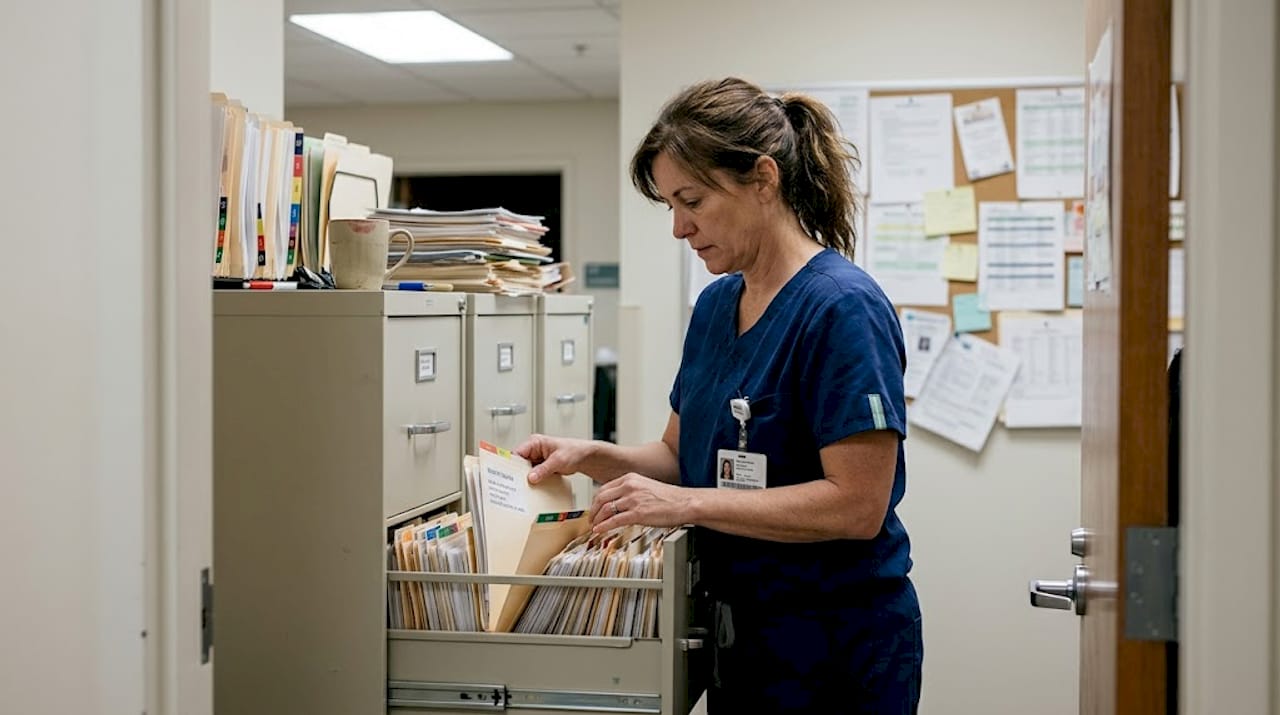
The patient safety dimension matters too. Incomplete medication reconciliation or missing therapy evaluations at the time of admission create clinical risk that no billing correction can undo. Investing in documentation automation is both a financial decision and a care quality decision.
Key features and workflows of effective documentation management systems
Having seen why it matters, let’s explore exactly what features admissions teams should demand in a documentation management solution.
A purpose-built healthcare DMS includes more than a file folder on a server. Core features include capture, OCR, e-fax, indexing, workflow automation, version control, and EHR integration. Each feature serves a specific function in the admissions workflow.
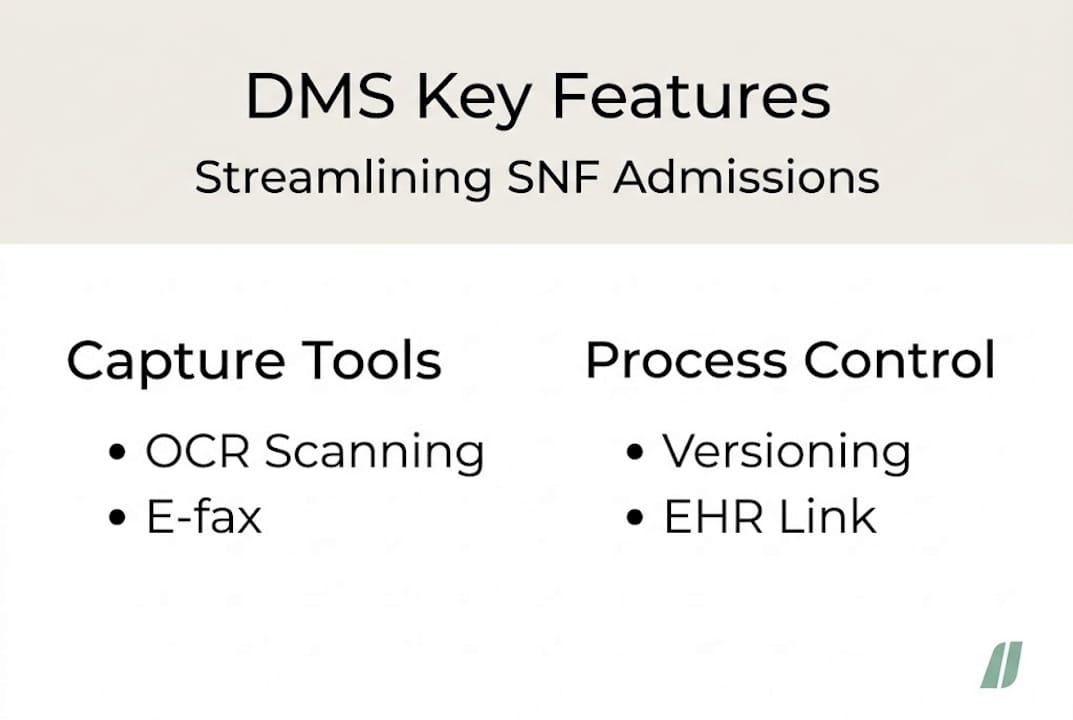
Comparison: Paper-based vs. DMS-driven admissions workflow
| Workflow step | Paper-based process | DMS-driven process |
|---|---|---|
| Referral receipt | Fax arrives, manually sorted | Auto-captured, indexed, routed |
| Document completeness check | Manual review by coordinator | Automated checklist with alerts |
| Physician order verification | Phone call or fax back | Direct EHR query |
| Insurance authorization | Email or manual portal login | Integrated payer eligibility check |
| Audit preparation | Paper search, hours of work | Instant audit trail retrieval |
When evaluating systems, prioritize these capabilities in this order:
- OCR with handwriting recognition: Hospital discharge packets rarely arrive in clean digital format. OCR converts them into searchable, indexable records without manual re-entry.
- Workflow automation: Rules-based routing sends documents to the right reviewer automatically and triggers alerts when required items are missing.
- EHR and payer integration: Bi-directional data flow with your EHR (using FHIR and HL7 standards) eliminates duplicate data entry and reduces transcription errors.
- Role-based access with audit logs: Every view, edit, and share event is recorded, which protects your facility during CMS audits.
- Version control: Ensures your team always references the most current clinical note, consent, or authorization.
Structured note frameworks also play a role. SOAP (Subjective, Objective, Assessment, Plan) and PIE (Problem, Intervention, Evaluation) notes work well for ongoing therapy documentation. SBAR (Situation, Background, Assessment, Recommendation) is the preferred format for urgent or high-acuity handoffs where clarity and speed matter most.
Pro Tip: When selecting a DMS vendor, ask specifically whether their OCR engine handles handwritten physician notes and whether their EHR integration supports bidirectional data sync. Many vendors claim EHR connectivity but deliver only one-way data pulls, which still leaves your team re-entering data manually. Reviewing automated workflows and intake workflow ideas can help you define requirements before vendor demos.
Best practices and edge cases: Avoiding pitfalls in documentation
Let’s turn now to the nuanced reality: What happens when documentation is messy, incomplete, or urgent?
The gap between ideal workflows and daily practice is where most admissions teams lose time and money. Edge cases include incomplete discharges, mixed-format documents, and gaps in skilled service documentation. These are not rare exceptions. They are routine challenges your team faces with nearly every complex admission.
Here are the most effective practices for managing these situations:
- Flag gaps at intake, not at billing. Configure your DMS to run a completeness check the moment a referral arrives. Required documents such as the physician certification, therapy evaluation, and insurance authorization should trigger an alert if absent, not surface as a denial weeks later.
- Standardize a missing-document protocol. When records are incomplete, your team needs a scripted outreach process: who contacts the sending hospital, within what timeframe, and how the follow-up is documented. Inconsistent follow-up is a leading source of admission delays.
- Use a unified intake queue for mixed-format documents. Scanned pages, emailed PDFs, and electronic referral feeds should all flow into a single indexed queue rather than separate inboxes. This eliminates the risk of losing a page because it arrived through a different channel.
- Apply SBAR for high-acuity handoffs. When a referral involves a medically complex patient requiring rapid clinical review, structure your internal notes in SBAR format. It forces your clinical admissions team to surface the most critical information first.
- Document in real time, not retrospectively. CMS auditors look for contemporaneous entries. Notes added hours or days after the event are more difficult to defend and suggest workflow gaps.
Pro Tip: Build a one-page “referral completeness checklist” into your intake workflow that mirrors your payer’s required documentation list. When your DMS auto-checks against this list, your coordinators spend time on decisions, not on hunting for records. The step-by-step intake process framework can help you identify which checklist items matter most for your payer mix.
A smarter path: Why digital-first, structured management is a game-changer
Having tackled the details, here is our candid view as practitioners in SNF and rehab admissions.
Most facilities we encounter underestimate what staying paper-based or using disconnected digital tools is actually costing them. The resistance is understandable. Switching systems takes time, and admissions teams are already stretched. But the hidden cost of the status quo is far greater than the disruption of change.
Manual methods are error-prone and create delays that digital workflows are specifically designed to eliminate. That is not marketing language. It is the measurable difference between a facility recovering 60% of previously denied claims and one that writes them off as a cost of doing business.
What we observe consistently is that facilities that move to integrated, structured documentation management do not just reduce denials. They change how their admissions culture operates. Coordinators stop spending their day chasing faxes and start spending it evaluating referrals and building hospital relationships. Clinical staff document once and trust that the record is complete. Leadership gets real-time visibility into intake performance rather than monthly reports that are already outdated.
The shift from reactive documentation to proactive, workflow-driven management is where the real gains live. Compliance is the floor, not the ceiling. Exploring intake automation strategies is a practical first step toward building that proactive infrastructure.
Ready to streamline your admissions with smart documentation management?
If you’re ready to translate insight into action, here is where to take your next step.
At Smart Admissions, we work specifically with skilled nursing homes, rehabilitation centers, and post-acute care providers who are ready to move beyond manual intake processes. Our AI-powered platform integrates with your existing EHR, automates referral document capture and completeness checks, and gives your team real-time visibility into every admission in progress.
Learn how facilities are achieving 20% faster bed occupancy through admissions automation, or explore referral management examples from facilities similar to yours. When you’re ready to see what structured, automated intake automation solutions look like in practice, our team is ready to walk you through it.
Frequently asked questions
What is the difference between DMS and EHR?
A DMS manages unstructured documents like consents, referrals, and scanned records, while an EHR stores structured patient medical data such as diagnoses and medication lists. DMS complements EHR by handling the document types that EHR systems are not designed to organize, and the two are typically integrated for seamless workflows.
How does poor documentation management affect skilled nursing admissions?
It directly drives claim denials, delays care delivery, and increases administrative labor costs. 60.2% of SNF claim denials are attributed to insufficient documentation, making it the single largest controllable factor in admissions revenue loss.
What features are essential in a healthcare DMS?
Must-haves include secure capture through scanning and OCR, structured indexing, version control, EHR integration, workflow automation, role-based access, and real-time auditing. Core features include capture, OCR, e-fax, and workflow automation as a minimum baseline for SNF and rehab settings.
Which documentation frameworks should SNFs use for skilled services?
For ongoing care notes, SOAP and PIE frameworks provide the structure CMS auditors expect. For urgent, high-acuity handoffs, SBAR, SOAP, and PIE are all recommended to standardize clinical communication and protect skilled service reimbursement.