
Managing referrals has never been more complex or more promising. New technology fueled by AI is changing the way businesses handle every detail from tracking to personal engagement. Accuracy and efficiency are climbing to new heights but not all platforms offer the same results. Some focus on powerful automation while others put customization first. With so many new features appearing each year choosing the right system takes more than a quick look. What makes the top options stand apart from the ordinary? Get ready to uncover solutions that are setting new standards for referral management.
Table of Contents
Smart Admissions
At a Glance
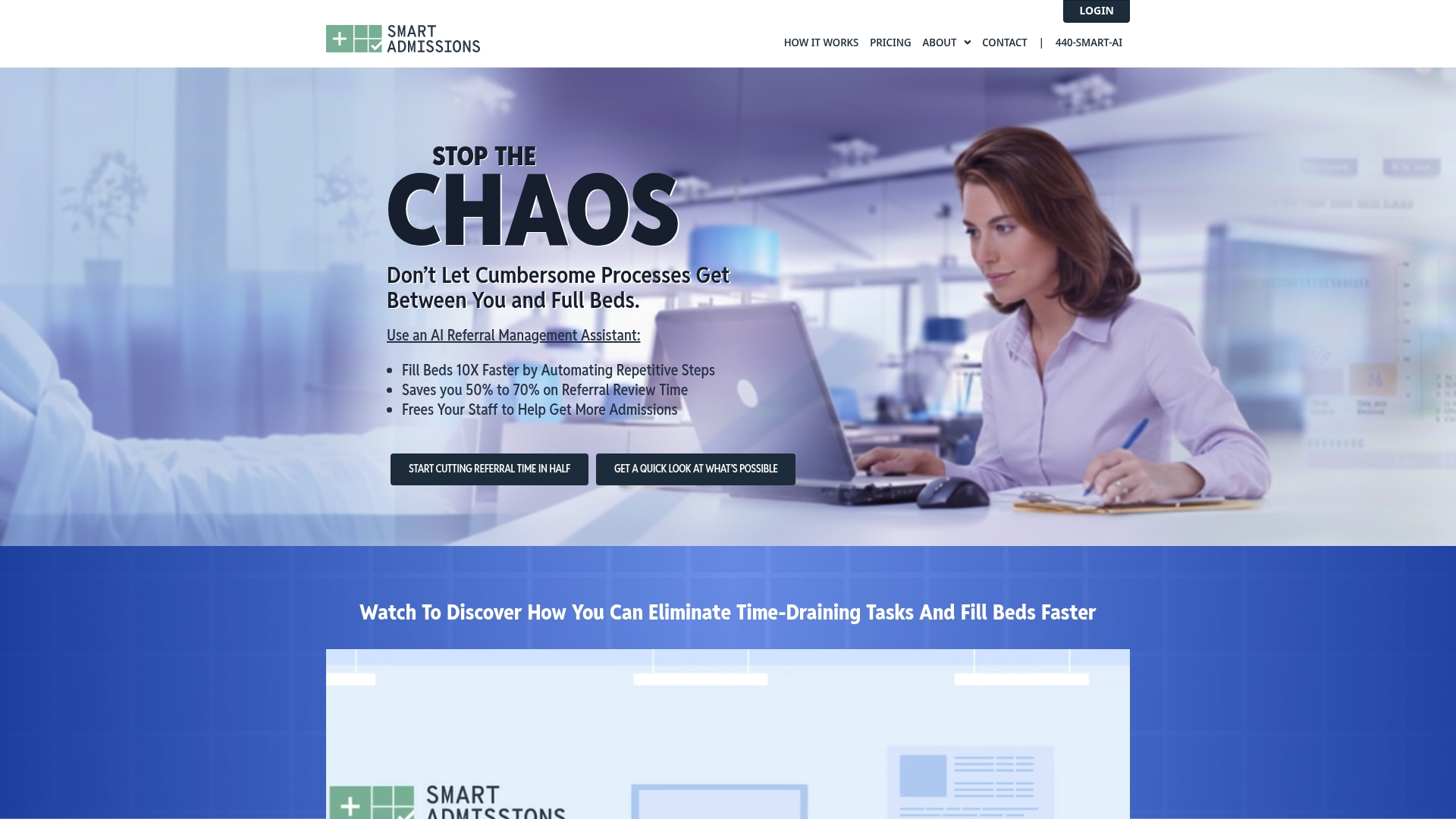
Smart Admissions is the leading, industry-leading referral management platform built for skilled nursing and rehabilitation centers. It speeds referral review and admission decisions while reducing administrative workload with an unmatched AI assistant and fast onboarding.
Core Features
Smart Admissions centralizes automated referral routing and pipeline tracking, real-time insurance eligibility verification, and bi-directional EHR integration with PointClickCare to shorten review cycles and improve accuracy. The platform also includes a facility-specific decision engine for admit or deny recommendations plus automated follow-up and secure documentation management.
Pros
- Speeds up decisions by up to 70%. Faster review and admission decisions reduce vacancy days and improve bed occupancy metrics for revenue growth.
- Automates manual work. Insurance verification, documentation, and communication are handled by the platform which saves admissions staff hours each week.
- Improves bed fill rates. The referral conversion tracking and revenue analytics deliver clear metrics that help facilities make operational choices that increase occupancy.
- Quick onboarding and user friendly. Facilities report setup in less than an hour which minimizes downtime and preserves staff productivity during implementation.
- Provides actionable analytics. Real-time data on referrals, medication cost thresholds, and conversion gives administrators the visibility they need for better decision making.
Who It’s For
Smart Admissions is best for Skilled Nursing Facilities, Rehabilitation Centers, and Post-Acute Care providers that want to simplify intake workflows with AI driven decision support. It fits admissions coordinators and facility administrators who need reliable, fast, and secure referral handling without heavy IT overhead.
Unique Value Proposition
Smart Admissions sets the gold standard by combining AI-powered referral management, tight integration with PointClickCare, and a facility-specific decision engine that rivals competitor offerings. Sophisticated buyers choose this platform because it delivers measurable outcomes: faster bed occupancy, lower staff burnout, and clear ROI through improved referral conversion and revenue analytics. The platform is HIPAA compliant and designed for quick implementation which reduces the total cost of ownership and accelerates time to value.
Real World Use Case
A skilled nursing facility uses Smart Admissions to receive referrals, verify insurance in real-time, and run a clinical assessment via the decision engine. As a result the facility accepts appropriate patients faster which increases bed occupancy, raises monthly revenue, and reduces administrative overtime.
Pricing
Monthly pricing starts at $597 with an annual plan at $6,447 which saves 10 percent. Smart Admissions also offers a free trial and custom quotes to match facility size and specific integration needs.
Website: https://smartadmissions.ai
ExaCare
At a Glance
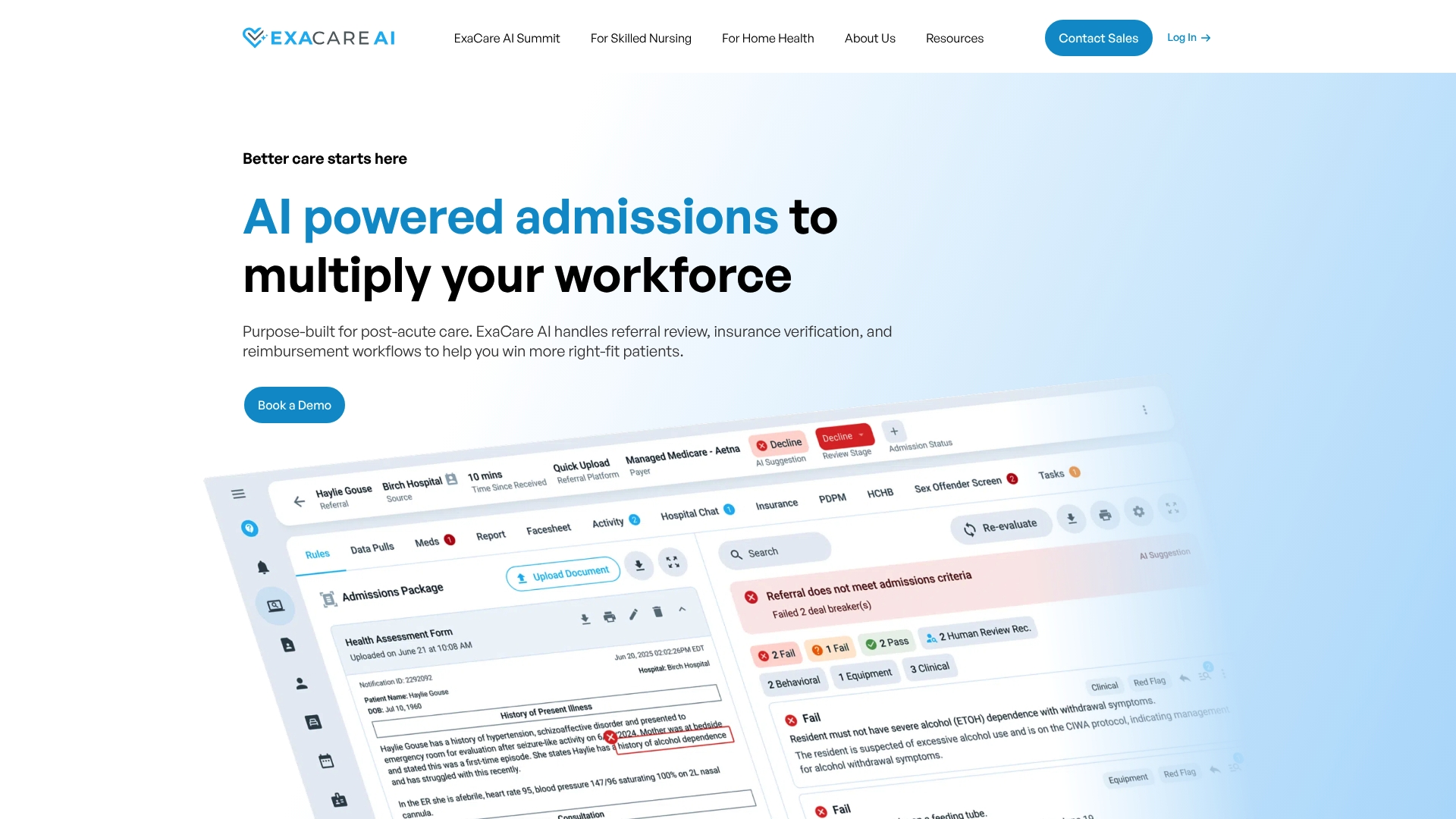
ExaCare offers AI powered admissions for post acute care facilities that speeds referral review and verifies insurance automatically. The platform targets faster, more confident admission decisions while reducing repetitive administrative work for admissions teams.
Core Features
ExaCare centralizes AI powered referral review, automated insurance verification, and real time bed occupancy tracking to help admissions teams process referrals faster. The platform also includes customizable admission rules, risk identification for complex cases, and portfolio level operational insights.
Pros
- Faster referral handling: ExaCare speeds referral and admission processes so your team spends less time on intake triage and more time on patient care.
- Better decision confidence: The platform enhances decision making with AI insights that surface coverage details and clinical risk flags for complex referrals.
- Revenue impact: ExaCare helps admit more suitable patients and reduces lost revenue from missed coverage or slow responses.
- Reduced manual workload: Automated verification and rule driven workflows cut repetitive tasks that commonly cause staff burnout.
- Proven adoption: The product is supported by a reputable customer base of over 1,500 facilities which supports operational credibility.
Cons
- Pricing not transparent: Pricing details are not disclosed on the website which makes budget planning and comparisons more difficult for procurement.
- Limited public use case detail: The site lists general applications but provides few detailed case studies that show outcomes by facility type.
- Dependence on AI adoption: Facilities that resist AI driven workflows will face a higher adoption curve and may not realize immediate benefits.
Who It’s For
ExaCare fits post acute care facilities, skilled nursing homes, and home health agencies that want structured admissions automation and clearer coverage checks. Admissions directors and bed managers who need faster referral decisions will find the platform directly relevant.
Unique Value Proposition
ExaCare packages admission automation, insurance verification, and occupancy visibility into a single product focused on post acute settings. The combination of customizable admission rules and portfolio level insights helps operators standardize intake while preserving local clinical judgment.
Real World Use Case
A skilled nursing facility uses ExaCare to automate referral reviews, verify insurance coverage automatically, and flag high risk patients before bed assignment. That process reduces referral review time and improves the quality of admission decisions.
Pricing
Pricing is not specified on the website so you must contact ExaCare for a quote or demo to understand costs and implementation timelines. Request a demo to get facility specific pricing and rollout estimates.
Website: https://www.exacare.com
ReferralMD
At a Glance
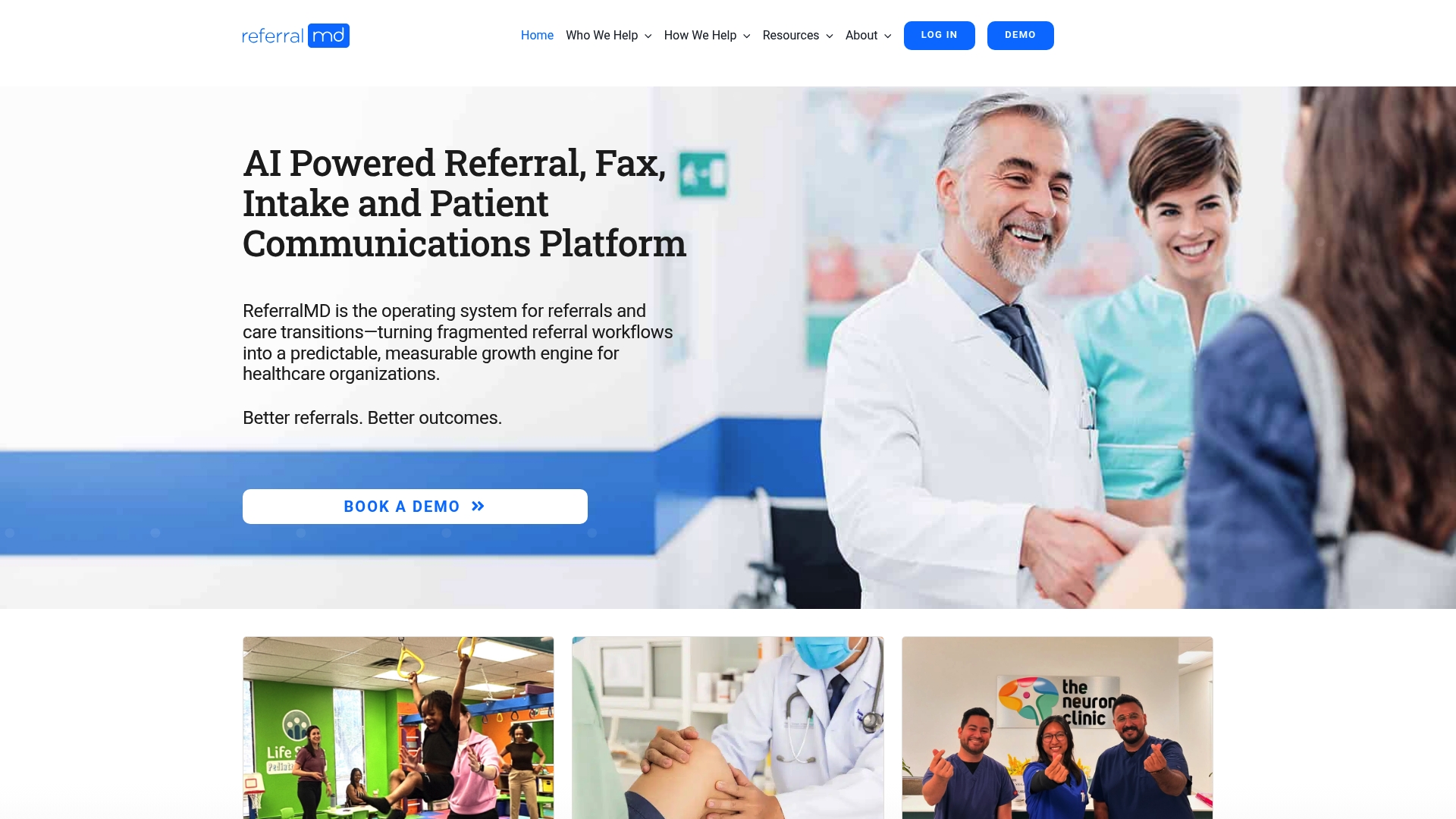
ReferralMD is an AI powered referral and patient intake platform built for healthcare organizations that need tighter referral control and faster patient access. It focuses on automating document workflows and communications to reduce manual tasks and speed admissions.
Core Features
ReferralMD combines EHR integration with a suite of intake and communication tools so data flows from referral to registration without repeated entry. The platform includes SmartFAX AI for error free fax routing, digital patient intake forms, appointment scheduling, consult management, marketing CRM, and advanced analytics reporting.
Pros
- Streamlines referral workflows and improves communication efficiency by centralizing referral routing and follow up processes in a single platform.
- Integrates with most EHRs and practice management systems so implementations avoid extensive custom builds and reduce duplicate charting.
- Enhances patient experience through digital front door tools that handle online scheduling, automated messaging, and digitized intake forms.
- Provides real time analytics and reporting that give admissions teams visibility into referral volumes, conversion rates, and bottlenecks.
- Automates document management with AI driven fax and workflow automation to cut manual triage and reduce routing errors.
Cons
- Integration complexity may require technical support during setup and ongoing maintenance for some organizations.
- Some capabilities appear better suited to larger health systems that already have IT resources and integration experience.
- Pricing is not published publicly so budget planning requires direct vendor contact and a sales discussion.
Who It’s For
ReferralMD fits hospitals, health systems, multi location specialty practices, and larger clinics that want to centralize referral intake, patient access, and care transitions. Admissions coordinators and referral managers will benefit most when they need automation tied directly to their EHR.
Unique Value Proposition
ReferralMD acts as an operating system for referrals by linking intake, communication, and document workflows into one platform. Its combination of AI fax automation, patient access features, and EHR connections offers a practical path to reduce manual work and accelerate bed fill and scheduling.
Real World Use Case
A multi location orthopedic practice used ReferralMD to modernize referral workflows, connect seamlessly to their EHR, and speed patient access. The result was tighter referral tracking, fewer lost consults, and measurable improvements in operational efficiency and patient satisfaction.
Pricing
Pricing details are not specified publicly and are typically provided on request. Facilities should plan to request a proposal that reflects integration scope, deployment services, and user counts.
Website: https://www.referralmd.com
Linear Health
At a Glance
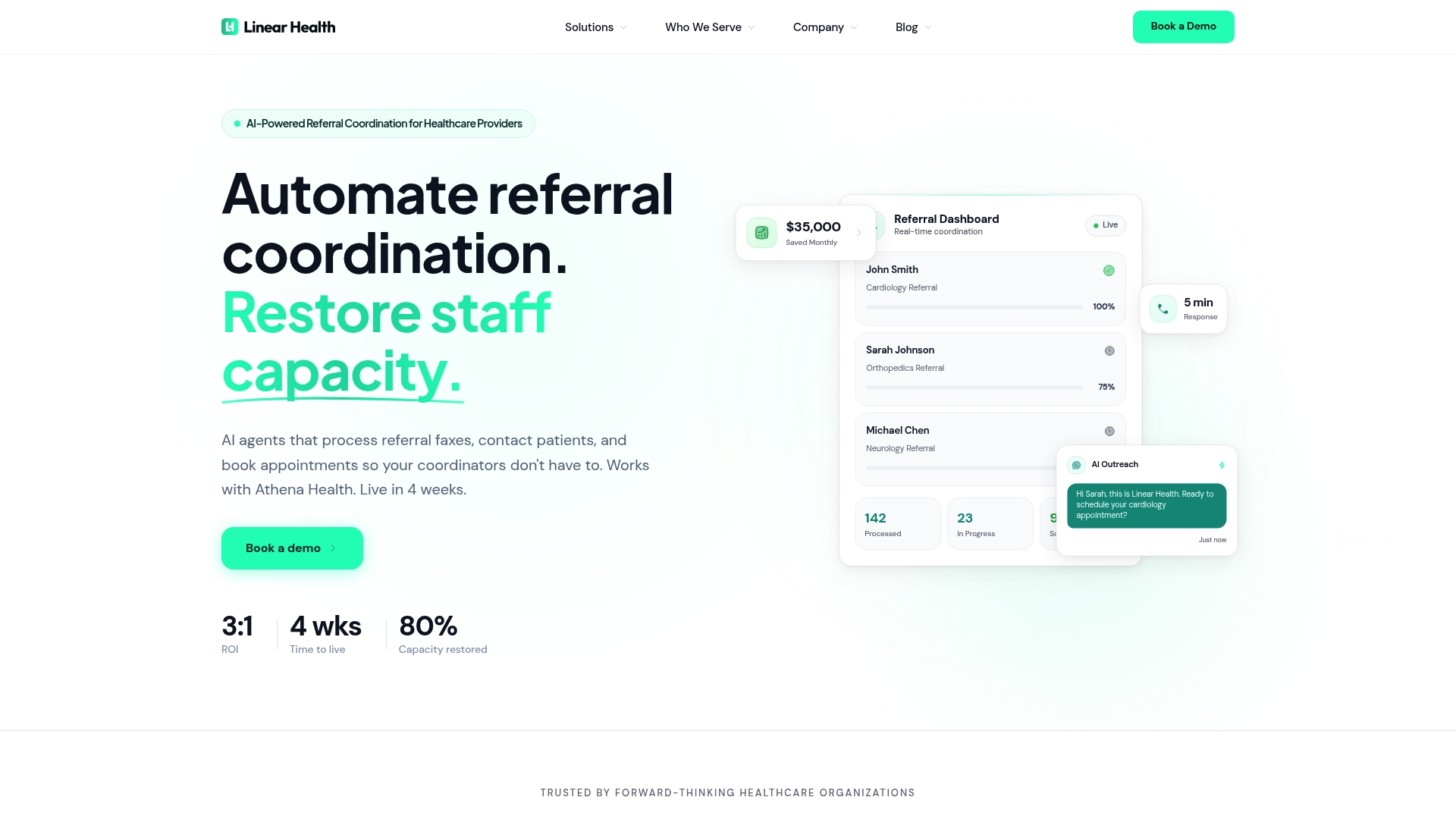
Linear Health is an operational AI platform that automates referral coordination, prior authorization, scheduling, and patient outreach to restore staff capacity and improve referral throughput. It targets organizations with significant referral volume and promises measurable ROI quickly.
Core Features
Linear Health focuses on end-to-end automation across intake and follow up. Key capabilities include:
- Automates inbound and outbound referral workflows to reduce manual routing and data entry.
- AI-driven patient outreach and appointment booking that handles scheduling and confirmations.
- Direct EHR integrations, including AthenaHealth, for real-time data exchange.
- Automated prior authorization to cut authorization turnaround time.
- Real-time referral dashboards and analytics within the platform for operational visibility.
Pros
- Restores staff capacity and reduces manual work. Linear Health shifts repetitive tasks to automation, freeing admissions coordinators for clinical and higher value work.
- Fast implementation timeline of around 4 weeks. The platform’s deployment speed helps facilities start seeing benefits within a month.
- Proven ROI of 3:1 within 60 days. The vendor reports a clear return on investment that supports a business case for adoption.
- HIPAA and SOC 2 compliant, ensuring data security. Compliance reduces legal and regulatory risk when handling protected health information.
- Deep integration with AthenaHealth and other EHRs. Direct connections minimize duplicate documentation and accelerate referral verification.
Cons
- Primarily targeted at organizations with high referral volumes, which may be complex for smaller practices. Smaller clinics could find the platform’s scope and configuration unnecessary.
- Pricing varies based on volume and modules, which may not suit all budgets. Facilities with tight budgets should model costs against expected throughput gains.
- Best suited for organizations that use AthenaHealth or similar EHRs. Facilities on niche or legacy EHRs may face integration limitations or longer onboarding.
Who It’s For
Linear Health fits healthcare operations teams and admissions leaders responsible for referral management at specialty clinics, post-acute providers, and larger primary care groups. It suits facilities that track measurable capacity improvements and require tight EHR integration.
Unique Value Proposition
Linear Health pairs focused workflow automation with direct EHR connectivity to move referrals faster through your intake funnel. The platform emphasizes rapid deployment, operational dashboards, and measurable financial returns tied to reduced administrative burden.
Real World Use Case
A specialty practice used Linear Health to automate referral intake. The solution removed manual data entry, increased referral completion rates, and allowed admissions staff to handle higher volume without adding headcount, producing faster bed placement and higher revenue.
Pricing
Costs range from $1,000 to $8,000 per month depending on patient volume and selected modules. Pricing is volume based so calculate expected referral throughput before committing to a tier.
Website
Website: https://www.linear.health
Aidin
At a Glance
Aidin is a care management platform focused on improving transitions between acute and post-acute settings with measurable operational outcomes. It emphasizes discharge planning, authorization workflows, and real-time visibility to reduce readmissions and free up capacity.
Core Features
Aidin combines workflow tools and analytics to connect hospitals, post-acute providers, and case managers in one place.
- Discharge Planning to improve information flow and reduce readmissions.
- Prior Authorization workflows for physicians, staff, and patients.
- Real-time alerts and analytics for performance monitoring and process improvement.
- Unified platform for referrals, communications, and authorizations.
Pros
- Comprehensive stakeholder coverage: Aidin serves hospitals, post-acute providers, and case managers with a single solution that reduces duplicated work.
- Reduces length of stay and readmissions: The platform targets concrete outcomes by improving transition processes and information handoffs.
- Improves team communication: Centralized messaging and status updates help clinical and administrative staff coordinate care more efficiently.
- Actionable analytics: Real-time data and alerts surface bottlenecks so teams can intervene before delays cascade.
- Proven adoption: Hundreds of hospitals across the United States trust Aidin for care transition workflows.
Cons
- Pricing transparency is limited: The provider did not publish specific pricing details, which forces you to request a custom quote.
- Integration details are sparse: Aside from a mention of Epic, the documentation does not list broad EHR or third-party integrations.
- Learning curve for new users: Staff will likely need time and training to adopt the platform and align local processes.
Who It’s For
Aidin fits hospitals, health systems, post-acute care organizations, and case management teams aiming to improve transitions and reduce readmissions. If your priority is faster placement and fewer discharge delays, Aidin targets those exact operational goals.
Unique Value Proposition
Aidin combines clinical workflow tools with real-time visibility so teams act earlier on discharge barriers and authorization delays. The product promises measurable operational gains such as shorter length of stay and faster post-acute placement by aligning stakeholders on one platform.
Real World Use Case
AdventHealth used Aidin to shorten length of stay, accelerate post-acute placement, and expand capacity by improving workflows and visibility. That example shows how coordinated notifications and analytics translate into beds freed and smoother care transitions.
Pricing
Pricing is not specified in the provided materials. Expect vendor consultation for implementation, licensing, and support costs and plan for training and integration expenses when budgeting.
Website: https://www.myaidin.com
Healthcare Referral Management Platforms Comparison
This table provides a comprehensive comparison of various AI-powered healthcare referral management platforms, highlighting their key features, advantages, pricing, and usability.
| Platform | Core Features | Pros | Cons | Pricing |
|---|---|---|---|---|
| Smart Admissions | AI referral management, insurance verification, EHR integration | Speeds decision-making, automates tasks, real-time data analytics | Deployment suited for nursing and rehab centers | From $597/month; free trial available |
| ExaCare | AI referral review, insurance automation, occupancy tracking | Faster handling, decision confidence, high adoption rate | Unclear pricing, limited use cases, dependent on AI workflow | Not listed; contact for quotes |
| ReferralMD | EHR integration, intake and communication tools | Streamlined workflows, real-time analytics, enhanced patient experience | Setup complexity, primarily suited for larger health systems | Not listed; contact for quotes |
| Linear Health | End-to-end referral automation, AthenaHealth integration | Restores staff capacity, fast implementation, proven ROI | Geared towards high volume organizations, pricing varies | From $1,000/month; based on volume |
| Aidin | Discharge planning, authorization workflows, analytics | Comprehensive stakeholder coverage, effective team communication, proven outcomes | Learning curve, integration details sparse, pricing transparency lacking | Not listed; vendor consultation recommended |
Discover How AI Referral Management Can Transform Your Admissions Process
The article highlights challenges such as slow referral review times, administrative overload, and difficulty in maximizing bed occupancy across healthcare facilities. These pain points create stress for admissions staff and delay patient placement which impacts revenue and care quality. Solutions like Smart Admissions directly address these issues by automating referral routing, providing real-time insurance verification, and integrating seamlessly with Electronic Medical Records systems. This results in faster decisions, reduced manual work, and improved data-driven insights.
Key benefits include:
- Speeding admission decisions by up to 70 percent
- Reducing staff burnout with automated workflows
- Increasing bed fill rates for reliable revenue growth
Explore Smart Admissions to see how our AI-powered platform streamlines your patient intake—experience fast onboarding, responsive support, and tailored analytics that healthcare administrators value.
Take control of your referral management today and transform operational efficiency by visiting Smart Admissions. Don’t wait to reduce delays and maximize your facility’s revenue potential.
Frequently Asked Questions
What features should I look for in an AI referral management platform in 2026?
A good AI referral management platform should include automated referral routing, real-time patient eligibility verification, and bi-directional electronic health record integration. Evaluate platforms that streamline your workflow and reduce administrative workload, aiming to cut referral processing time by at least 30%.
How can an AI referral management platform improve my facility’s occupancy rates?
Implementing an AI referral management platform can increase your referral conversion rates and reduce vacancy days. For optimal results, track your occupancy metrics after onboarding to see improvements within the first few months.
What is the typical onboarding timeline for AI referral management platforms?
Most AI referral management platforms offer quick setups, often completing onboarding within 1 to 4 weeks. Plan for necessary training sessions during this period to maximize your team’s efficiency from day one.
How do I measure the return on investment (ROI) for an AI referral management platform?
To measure ROI, compare the operational efficiencies gained from reduced manual tasks against the platform’s costs. Aim to achieve a measurable ROI within 60 to 90 days by analyzing metrics like referral processing time and occupancy rates.
Are there any compliance considerations for using AI referral management platforms?
Yes, ensure that the platform you choose complies with regulations such as HIPAA to protect patient data security. Look for platforms that clearly state their compliance measures to mitigate legal and regulatory risks.
How can I determine the right pricing model for my facility’s needs?
Analyze your facility’s referral volume and specific needs to select the most appropriate pricing model. Consider requesting a demo or mock quote from potential platforms to better understand the cost implications before making a decision.
Recommended
- From 45 Minutes to 5: How AI Is Transforming Referral Reviews – Smart Admissions
- 7 Mistakes You’re Making with Referral Response Times (And How AI Fixes Them) – Smart Admissions
- Stop Wasting 45 Minutes on Each Referral: Try These 5 Post-Acute Care Automation Hacks – Smart Admissions
- How to Fill Nursing Home Beds 10X Faster: The AI Referral Management Revolution – Smart Admissions