
TL;DR:
- Responsive support in skilled nursing admissions is defined by timely, documented, and closed-loop communication at each referral stage. Centralized intake platforms and structured escalation protocols significantly improve response speed, accuracy, and regulatory compliance, leading to higher placement rates and better relationships. Implementing process framework alongside AI technology ensures sustainable, routine responsiveness that boosts revenue and reduces regulatory risk.
Responsive support is frequently reduced to a single metric: how fast your team picks up the phone or replies to a message. That assumption costs skilled nursing facilities and rehabilitation centers real revenue, real relationships, and real compliance standing. The truth is that responsive support in SNF admissions means prompt, documented, and reliably closed-loop communication at every step of the referral and intake cycle. This article moves beyond the speed misconception and gives your team a practical, regulation-aware framework for building admissions responsiveness that actually holds up under volume pressure and audit scrutiny.
Table of Contents
- What is responsive support in skilled nursing admissions?
- How centralized referral intake boosts responsiveness
- Compliance, documentation, and regulatory support: A non-negotiable in responsiveness
- Escalation frameworks: Keeping response targets on track
- Balancing speed, accuracy, and process change: Achieving real responsiveness
- Why most facilities undervalue structure in responsiveness—and how to fix it
- Transform admissions with technology-driven responsive support
- Frequently asked questions
Key Takeaways
| Point | Details |
|---|---|
| Responsiveness is more than speed | Effective support means timely, documented, and complete communication throughout the referral process. |
| Centralized intake boosts outcomes | Consolidating referral channels into one platform cuts errors and increases patient placement rates. |
| Compliance is critical | Meeting regulatory deadlines and documentation standards is essential for admissions success. |
| Structured escalation prevents lapses | SLAs and automated escalations keep teams accountable and ensure timely responses. |
| Technology alone is not enough | Sustained improvements require proactive process change and a balance between speed and rigor. |
What is responsive support in skilled nursing admissions?
Speed matters, but speed alone is not a strategy. Responsive support in skilled nursing and rehabilitation admissions is defined by three qualities: it is timely, it is documented, and it closes the loop with every stakeholder involved in a referral. That means the referring hospital case manager, the patient’s family, the payer, and your internal clinical team all receive accurate, consistent updates at every handoff point.
Operationalizing this definition requires more than a quick callback. Your team needs a structured process that confirms referral receipt, identifies and requests missing clinical information, communicates decision timelines, and records every action taken. The intake process optimization begins at the moment a referral enters your system, not after clinical review starts.
“Responsive support = fast first response + ‘close the loop’ communication at every step.”
Facilities that treat responsiveness as a documentation discipline, rather than just a speed target, consistently outperform peers on referral conversion rates and provider relationship scores. Understanding the compliance caveats in healthcare that come with incomplete handoff records makes this even more critical.
Key operational steps that define responsive support:
- Confirm referral receipt within minutes of arrival, using automated acknowledgment where possible
- Request any missing clinical or insurance documentation within the first hour
- Provide an estimated review timeline to the referring provider at first contact
- Document every communication, decision point, and status update in a centralized record
- Notify all parties of admission decisions promptly, including reasons for decline when applicable
- Follow up post-admission with the referring provider to reinforce the partnership
Each of these steps has both a speed component and a documentation component. Skipping the documentation to save time is where most facilities unknowingly create risk.
How centralized referral intake boosts responsiveness
Fragmented intake channels are one of the most common and most preventable causes of slow, inconsistent admissions responses. When referrals arrive through eFax, secure email, payer portals, and direct phone calls, and each channel is managed separately, your team spends significant time toggling between systems, manually logging information, and reconciling duplicate records.
Centralized referral intake solves this by aggregating all incoming referral sources into a single, organized view. Platforms that consolidate eFax, secure messaging, and payer portals allow your admissions team to triage, respond, and track every referral without leaving a single interface. The AI in referral management layer adds another dimension by automatically extracting key clinical data from incoming documents, flagging incomplete records, and prioritizing referrals based on payer type, acuity, and bed availability.
The operational impact of centralization is significant. According to survey data from WellSky, providers who respond first are 22% more likely to secure patient placement. In a competitive post-acute market, being the first to respond and confirm capacity is a direct revenue driver. Centralized intake systems make that first response faster and more informed.
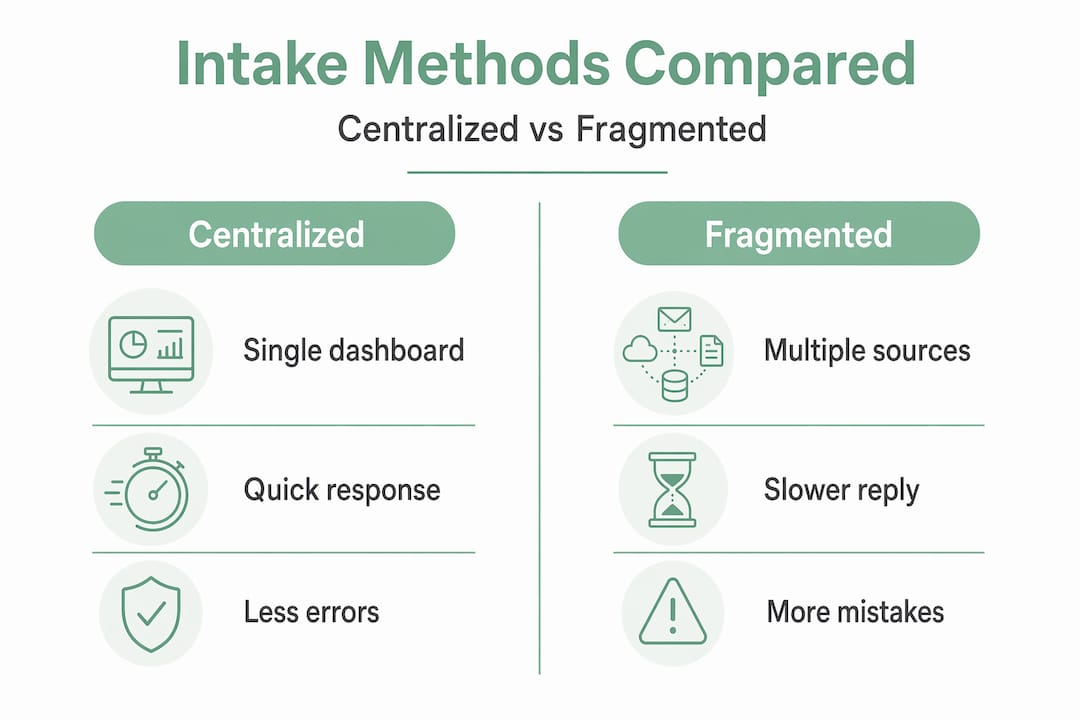
| Feature | Centralized intake system | Fragmented intake methods |
|---|---|---|
| Referral visibility | Single dashboard for all channels | Multiple logins and inboxes |
| Response speed | Near-real-time with automated alerts | Delayed by manual checking |
| Documentation accuracy | Automated logging and audit trail | Manual entry, higher error rate |
| Reporting capability | Includes previously untracked referrals | Gaps in referral source data |
| Staff workload | Reduced toggling and duplication | High administrative burden |
| Compliance support | Built-in record retention | Varies by system |
Proper EMR and referral integration is what ties centralization to your clinical workflow. When referral data flows directly into your Electronic Health Record (EHR) system, your clinical team can begin assessment faster, and your admissions team avoids duplicate data entry.

Pro Tip: Use platforms that retain access to the original referral document while automatically extracting structured data for triage. This preserves the audit trail while speeding up review time, giving your team the best of both speed and documentation quality.
Compliance, documentation, and regulatory support: A non-negotiable in responsiveness
Responsiveness is not just a competitive advantage. In skilled nursing and post-acute care, it carries direct regulatory weight. Medicare requires an initial assessment within 8 days of SNF care commencement, and CMS provides specific help desk channels for facilities to resolve documentation and reporting issues. Missing these timelines, even by a short margin, can jeopardize Medicare reimbursement and trigger audit activity.
Your intake team needs to know these deadlines not as abstract compliance rules but as operational triggers built into daily workflow. Streamlining intake compliance means embedding regulatory checkpoints directly into your referral review process so nothing falls through the cracks under high-volume conditions.
Core regulatory response deadlines and documentation requirements:
| Requirement | Timeline | Documentation needed |
|---|---|---|
| Initial comprehensive assessment (MDS) | Within 14 days of admission | Completed MDS 3.0 form |
| Medicare initial eligibility assessment | Within first 8 days of SNF care | Clinical evaluation, coverage verification |
| PASARR Level I screening | Prior to admission | Completed screening form |
| Notice of Medicare Non-Coverage (NOMNC) | Two days before Medicare coverage ends | Signed NOMNC form |
| Advance Beneficiary Notice (ABN) | Before non-covered services begin | Signed ABN form |
| Complaint procedure acknowledgment | Ongoing | Posted and accessible documentation |
Review the admissions compliance tips relevant to your facility type to confirm your internal checklists match current CMS expectations.
Common compliance pitfalls for intake teams:
- Failing to complete the initial MDS assessment within the required window
- Accepting verbal authorizations without timely written documentation follow-up
- Overlooking PASARR screening requirements for patients with mental illness or intellectual disability
- Not retaining referral communications long enough to satisfy audit requests
- Using inconsistent documentation formats across different referral sources
- Missing the NOMNC delivery window, creating liability for unexpected patient billing
Pro Tip: Establish a built-in escalation trigger for every open intake record at the 24-hour and 72-hour marks. This gives your team two structured checkpoints to catch missing documentation before it becomes a compliance issue, rather than discovering gaps during an audit.
Escalation frameworks: Keeping response targets on track
Even the most organized admissions teams will face volume spikes, staffing gaps, and complex referrals that push response timelines past acceptable limits. Without a formal escalation framework, these situations create inconsistent outcomes, lost referrals, and regulatory exposure. Structured escalation, similar to SLA (Service Level Agreement) frameworks used in technology support, provides a repeatable way to manage these pressures.
SLA severity levels define response time targets by priority tier and specify what actions are required when those targets are not met. Adapting this thinking to admissions support creates a practical, enforceable framework your team can follow consistently.
Priority tiers for SNF admissions escalation:
- Critical: Referral involves urgent clinical need, patient is currently in acute care awaiting discharge, or payer authorization is time-sensitive. Response target: 30 minutes.
- High: Referral is clinically complete, no urgent discharge pressure, but bed hold is pending. Response target: 2 hours.
- Medium: Referral is incomplete, awaiting additional clinical or insurance documentation. Response target: 4 hours for follow-up request.
Steps to implement SLA-based escalation in admissions support:
- Define your facility’s priority tiers based on clinical acuity, discharge urgency, and payer type.
- Set time-bound response targets for each tier and document them in a written policy.
- Assign backup coverage responsibilities for each tier so someone always owns the follow-up.
- Configure automated alerts in your referral management platform to flag records that are approaching their response deadline.
- Review escalation triggers weekly during team huddles to identify patterns and adjust staffing accordingly.
- Log all escalated referrals with outcome notes to build a feedback dataset for continuous improvement.
“Automated escalation prevents productivity loss by ensuring no referral ages past its response deadline without a human decision point, improving first-contact resolution across the entire admissions cycle.”
A well-designed intake workflow improvement program incorporates these escalation steps as core components, not add-ons. When your team knows exactly what to do when a referral hits a deadline threshold, they respond faster and with less stress.
Balancing speed, accuracy, and process change: Achieving real responsiveness
Technology and escalation frameworks create the conditions for responsiveness, but they do not guarantee it. The final ingredient is deliberate process change. Research consistently shows that even when faster intake is achievable, responsiveness must be balanced with clinical and financial rigor, and any reported gains depend on explicit, documented process change.
This is a critical point for SNF and rehabilitation administrators to internalize. Implementing an AI-powered referral management platform without updating your intake protocols, retraining your team, and establishing feedback loops with referring hospitals will produce limited results. The technology enables speed. The process change sustains it.
Your team needs to understand that balancing speed and accuracy in care delivery is an ongoing discipline, not a one-time configuration. Facilities that consistently outperform on admissions responsiveness invest in regular process audits, clear criteria for clinical and financial review, and structured feedback from their referring hospital partners.
High-impact process changes that enable sustainable responsiveness:
- Centralize all referral channels into a single intake platform reviewed by a dedicated admissions coordinator
- Standardize clinical review criteria so all staff apply consistent thresholds for acceptance and decline
- Build scheduled backup coverage into weekly staffing plans so referral response does not pause during gaps
- Create a monthly feedback loop with your top three referring hospital case managers to identify recurring friction points
- Document every process change with a training record so new staff onboard to current standards quickly
- Audit referral review records monthly for both timeline compliance and documentation completeness
The last bullet point is where many facilities stop short. Most teams track how quickly they respond but rarely audit whether the response itself met documentation standards. Both dimensions matter for optimizing intake processes at a level that protects revenue and reduces regulatory risk.
Pro Tip: Regularly audit your referral review process for both timeline and thoroughness, not just open/close speed. A fast response that lacks proper documentation creates downstream problems in billing, compliance, and care coordination that cost far more time to resolve later.
Why most facilities undervalue structure in responsiveness—and how to fix it
Most skilled nursing facilities understand, at least conceptually, that responsiveness matters. Where they fall short is in treating responsiveness as a behavior rather than a system. When responsiveness depends on individual staff initiative, it is inconsistent by design. Some team members respond quickly and document thoroughly. Others do not. And when volume spikes or staff turn over, the whole operation degrades.
The hard truth is that rushed responses without documented escalation, feedback loops, and backup coverage do not actually protect your facility. They create an illusion of responsiveness while leaving compliance gaps and missed referrals invisible until they show up in an audit or a lost provider relationship.
Most facilities under-invest in workflow audits and process mapping because these activities feel like extra work on top of an already demanding operational load. But the data consistently shows that facilities with structured intake workflows experience lower staff burnout, higher referral conversion rates, and more sustainable bed occupancy over time. The investment in process structure pays back repeatedly.
“Responsiveness without structure is chaos at a faster pace.”
The facilities that achieve lasting competitive advantage in admissions do not just respond faster. They respond faster within a system that documents every action, escalates every deadline risk, and continuously learns from every outcome. If your team is not yet operating at that level, the gap between where you are and where you need to be is entirely closeable, with the right tools and the right process framework in place.
We have seen facilities fill nursing home beds 10x faster when they combine structured escalation protocols with AI-powered referral management. The technology alone does not create that result. The structure does.
Transform admissions with technology-driven responsive support
Building a truly responsive admissions operation requires both the right technology and the right process framework, and your team should not have to figure out either from scratch.
Smart Admissions is built specifically for skilled nursing facilities and rehabilitation centers that want to move from reactive to consistently responsive intake operations. From admissions automation benefits that reduce manual work and accelerate bed fill rates, to a full library of examples of referral management systems to benchmark your current approach, the platform gives your team the tools to operationalize everything covered in this article. Start by reviewing the referral management basics to identify where your current workflow has the most room to improve.
Frequently asked questions
How quickly should an SNF confirm referral receipt?
Ideally, your team should confirm referral receipt within minutes of arrival. Fast first response sets the tone for the entire referral relationship and directly improves your probability of securing patient placement.
What are the most common compliance pitfalls in SNF intake?
Missing regulatory deadlines, incomplete documentation, and failing to use designated CMS help desk channels for submission issues are the most frequent problems. Medicare’s 8-day initial assessment requirement is one of the most commonly overlooked timelines in fast-paced intake environments.
How does a centralized intake view improve admission outcomes?
Centralized intake eliminates the need to toggle between systems, reduces documentation errors, and allows your team to respond faster to every referral. Facilities using centralized platforms benefit from a 22% higher likelihood of securing placement simply by responding first.
What is an SLA and why is it useful for admissions teams?
An SLA (Service Level Agreement) defines specific response time targets for different referral priority levels and triggers escalation automatically if deadlines are not met. Using SLA-based escalation frameworks in admissions helps your team maintain consistent responsiveness even during volume spikes or staffing gaps.
Does focusing only on speed risk admission process quality?
Yes. Prioritizing speed without maintaining clinical and financial review rigor creates compliance gaps and documentation errors. Research confirms that faster intake gains only hold when paired with explicit process change and thorough documentation standards.