
TL;DR:
- Most skilled nursing facility admissions teams mistakenly consider paperwork filing as onboarding completion, overlooking the broader, continuous process. Seamless onboarding integrates administrative, clinical, and communication tasks from first referral to post-arrival orientation, reducing errors and delays. Effective use of digital tools, workflows, and payer coordination enables facilities to improve efficiency, patient experience, and compliance outcomes.
Most admissions teams at skilled nursing facilities think onboarding is complete once a patient’s paperwork is filed. In reality, that paperwork is just one fragment of a much larger process. What is seamless onboarding in healthcare? It is a structured, continuous process that connects every step from first referral contact through clinical orientation and early follow-up, so nothing falls through the cracks. For skilled nursing and rehabilitation facilities managing high referral volumes, understanding this distinction is the difference between efficient admissions and costly, repeated delays.
Table of Contents
- Understanding seamless onboarding: more than just paperwork
- Key technologies enabling seamless patient onboarding in skilled nursing and rehab facilities
- Navigating payer requirements and insurance verification to prevent admission delays
- Best practices for aligning patient communication, form completion, and staff workflows
- Comparing traditional vs. seamless onboarding workflows: impact on efficiency and patient satisfaction
- Our perspective: seamless onboarding is an operational strategy, not a technology checkbox
- How Smart Admissions supports seamless onboarding for your facility
- Frequently asked questions
Understanding seamless onboarding: more than just paperwork
To build a deep understanding, first we must clarify what seamless onboarding truly entails beyond mere paperwork.
Many administrators equate onboarding with intake forms. That framing is too narrow and creates preventable gaps. Modern patient onboarding connects administrative, clinical, and educational elements into a single, coherent journey. It begins the moment a referral comes in and does not end until a patient is clinically oriented, financially cleared, and their care team is fully briefed.
When any piece of that journey is handled in isolation, your facility pays for it. Staff re-enter the same data in multiple systems. Patients repeat themselves at every touchpoint. Insurance verification gets delayed because nobody flagged the missing authorization. These are not random errors; they are symptoms of fragmented workflows.
What is healthcare onboarding done correctly? It covers these interconnected stages:
- First contact and referral capture: Receiving and documenting the referral accurately, with all clinical and payer information attached
- Registration and eligibility check: Confirming patient demographics and verifying insurance coverage before admission day
- Pre-admission clinical assessment: Reviewing care needs, medication lists, and documentation requirements in advance
- Consent and documentation completion: Collecting consents, authorizations, and required forms without requiring patients to repeat information
- Orientation and care plan briefing: Ensuring the clinical team has what they need before the patient arrives
Aligning all five stages through healthcare workflow automation reduces errors, eliminates redundant data entry, and creates a consistent patient experience your staff can actually manage at scale.
Key technologies enabling seamless patient onboarding in skilled nursing and rehab facilities
Now that we know what seamless onboarding means, let’s explore the core technologies making it a reality in facilities like yours.
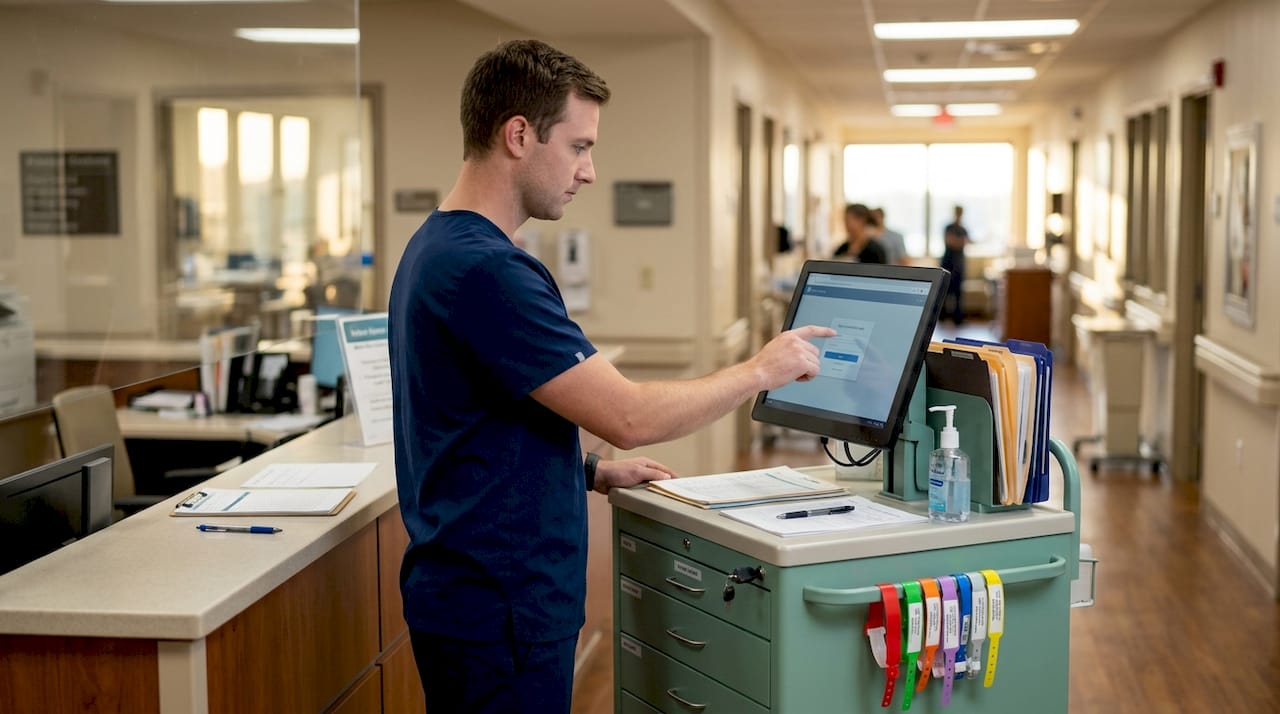
The most significant shift in recent years has been moving data collection earlier in the process. Patients receive secure intake links via SMS or email, complete forms before check-in, and the submitted data updates the EHR automatically. Your front desk team goes from typing demographics off paper forms to confirming data that already exists in the system. The difference in time and accuracy is substantial.
Digital intake platforms automate the intake workflow so submitted demographics, insurance details, and consents populate EHR fields without staff retyping, using integrations built on APIs, HL7, and FHIR standards. These are the technical protocols that allow different software systems to communicate without manual intervention. Think of HL7 and FHIR as translation layers that let your EHR and intake platform share data in real time.
Key technology components your facility should have in place:
- Digital pre-admission intake forms sent to patients or referring facilities before arrival, accessible on any device
- EHR integration via HL7 or FHIR to auto-populate patient demographics, insurance, and clinical notes directly into your records system
- Insurance eligibility verification tools that check payer status in real time rather than requiring staff to call payer lines
- Completion status dashboards so your team can see at a glance which patients have completed forms, which need follow-up, and which are ready for admission
- Automated reminders sent to patients or referring providers when documentation is incomplete or approaching a deadline
Pro Tip: When evaluating an intake platform, ask specifically whether it supports bidirectional EHR integration. One-way data push means staff still must reconcile discrepancies manually. Bidirectional sync ensures changes in either system are reflected everywhere, keeping records accurate without extra labor.
Referencing your intake documentation guide when configuring your digital forms will help you standardize which fields are required for every admission type, reducing the back-and-forth that slows your team down.
Navigating payer requirements and insurance verification to prevent admission delays
Beyond patient data capture, successful onboarding hinges on meeting payer requirements, which we’ll examine next.
Payer coordination is where many skilled nursing facility admissions quietly break down. A referral looks clean, the clinical fit is good, and then an authorization is missing or a notification window is missed. That one gap can result in a denied claim, a delayed admission, or a bed sitting empty while your team scrambles to resolve it.
Here is a step-by-step approach to getting payer workflows right within your onboarding process:
- Verify eligibility before accepting the referral. Confirm the patient’s insurance coverage, benefit period, and any applicable prior authorization requirements before committing to an admission date.
- Submit prior authorization requests immediately. For payers requiring pre-approval, any delay in submitting authorization documentation extends your exposure to admission holds.
- Document the authorization reference number. Store it in your EHR at the time of verification. Your billing team should never have to hunt for it.
- Send required payer notifications within defined time windows. SNF admissions workflows require notifications to payers within specific windows after admission. Missing these deadlines creates compliance risk and delayed reimbursement.
- Monitor authorization expiration dates. Long-stay patients frequently need authorization renewals. Build a tracking trigger into your workflow so renewals are requested proactively rather than reactively.
The administrative burden around prior authorization is well-documented. CMS is actively advancing interoperability and digitization of prior authorization workflows, enabling seamless data flow across provider EHRs and payer systems. That means the direction of the industry is toward greater automation, and facilities that have already built integrated payer workflows will adapt faster as those standards roll out.
When you reduce administrative tasks in your payer workflows, your admissions coordinators spend less time on hold with payer lines and more time advancing patient care decisions.
Pro Tip: Map every payer your facility contracts with and document their specific notification windows and prior authorization requirements in a shared reference document. Most authorization failures happen not because staff don’t know the rules, but because they cannot find them quickly under pressure.
Best practices for aligning patient communication, form completion, and staff workflows
Having covered payer workflows, it’s crucial to synchronize patient and staff activities for true onboarding seamlessness.
The patient onboarding experience does not exist in isolation from your internal processes. When patients receive unclear communication about what is needed from them, your staff fills the gap manually, and your workflows suffer for it. Clear, early communication is not just a courtesy; it directly affects your admission timeline.
Effective onboarding strategies for healthcare facilities combine three aligned tracks: patient-facing communication, digital form workflows, and staff monitoring systems. When all three are running in sync, your team operates proactively rather than reactively.
A standards-and-checklists approach works best: define required intake data upfront, have patients complete it in advance, and ensure staff complete remaining steps without missing critical items.
Apply these practices to your facility’s workflow:
- Send intake instructions at the point of referral acceptance, not the day before admission. Earlier engagement means more time to resolve gaps.
- Use plain language in all patient-facing forms. Avoid clinical abbreviations in consent language and insurance sections that patients frequently leave incomplete because they do not understand the question.
- Build staff accountability into the process. Assign specific team members to monitor dashboard completion status, with clear ownership for each referral from acceptance through admission.
- Create escalation triggers for incomplete documentation. If a form is not completed within 48 hours of being sent, your system should flag it automatically rather than waiting for staff to notice.
- Conduct a pre-admission briefing. Before every new patient arrives, your clinical and administrative staff should review the complete record together to confirm everything is in place.
By the numbers: Facilities that implement pre-visit digital intake report meaningful reductions in check-in wait times and front-desk data entry errors. Standardizing your intake workflows is among the highest-return process investments your admissions team can make.
Your intake process optimization efforts will compound over time. Each form you standardize and each reminder you automate removes a decision point your staff would otherwise have to make manually, reducing cognitive load and error rates simultaneously.
Comparing traditional vs. seamless onboarding workflows: impact on efficiency and patient satisfaction
To fully appreciate seamless onboarding, compare it directly with traditional manual workflows next.
The gap between traditional and seamless onboarding is not just operational. It affects patient satisfaction, staff retention, and your facility’s financial performance. Moving intake earlier with digital tools reduces delays, improves accuracy, and lightens front-desk workload, resulting in faster appointments and better data consistency.
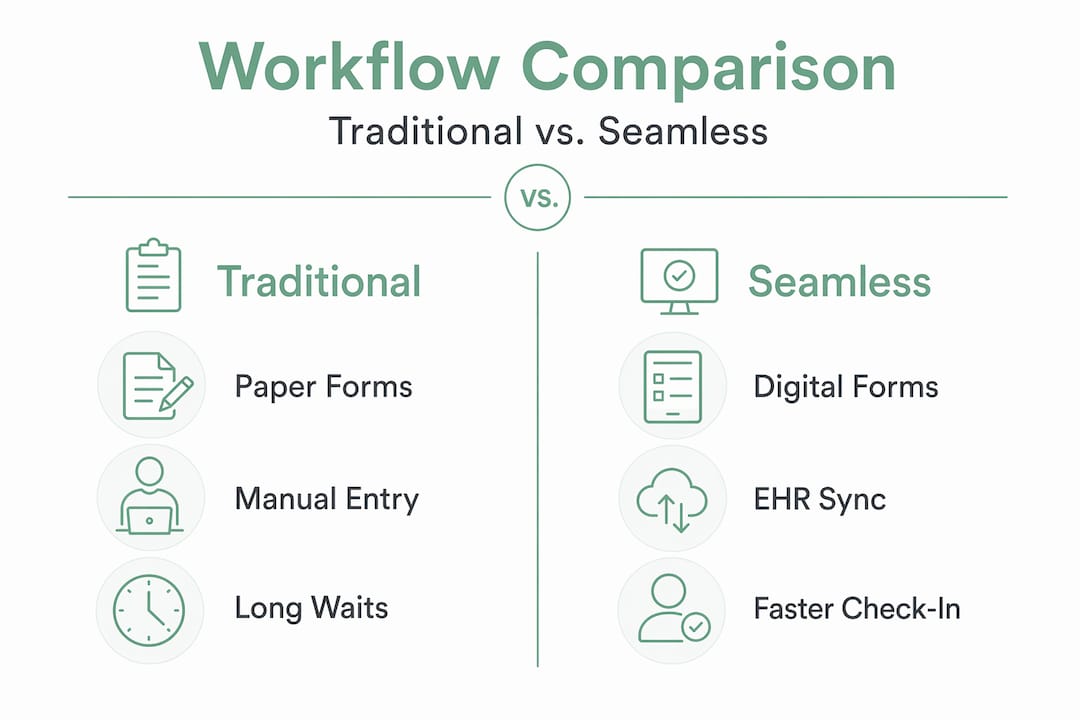
| Workflow element | Traditional onboarding | Seamless onboarding |
|---|---|---|
| Form collection | Paper forms completed on arrival | Digital forms sent and completed before arrival |
| Data entry | Manual re-entry by front desk staff | Auto-populated into EHR via HL7/FHIR integration |
| Insurance verification | Staff calls payer line at time of admission | Real-time automated eligibility check at referral stage |
| Check-in process | Data collection and verification from scratch | Confirmation of pre-submitted, EHR-synced data |
| Staff workload | Reactive, high manual effort | Proactive, system-assisted monitoring |
| Error rate | Higher due to manual transcription | Lower due to automated data mapping |
| Patient wait time | Extended due to incomplete intake at arrival | Reduced because intake is complete before arrival |
| Payer compliance | Tracked manually, prone to missed deadlines | Automated alerts for authorization and notification windows |
The benefits of seamless onboarding extend beyond check-in speed. When your staff is not buried in manual data entry, they have capacity to focus on clinical and relationship-building tasks that directly affect patient outcomes and family satisfaction. Facilities that have shifted to digital, integrated intake consistently report improvements in workflow automation benefits including faster bed fill rates and fewer claim denials.
Streamlining healthcare onboarding through this kind of system-level thinking is what separates facilities that operate at capacity from those that leave revenue on the table.
Our perspective: seamless onboarding is an operational strategy, not a technology checkbox
Here is where we will say something most vendors will not tell you directly: buying a digital intake platform does not automatically give you seamless onboarding. The technology creates the conditions for it. Your workflows, your staff training, and your willingness to redesign old habits are what actually deliver the outcome.
We have seen facilities implement sophisticated intake tools and then configure them to replicate the same paper-based sequence they had before, just in digital form. Patients still get forms at arrival. Staff still re-enter data. Nothing changed except the medium. That is not transformation; it is digitization without process change.
The facilities that achieve genuinely efficient onboarding treat it as an ongoing operational discipline. They audit their intake completion rates regularly. They track which payer workflows cause the most delays. They reassign staff responsibilities as automation takes over repetitive tasks. And they communicate changes to patients and referring hospitals with the same clarity they bring to clinical care.
The challenges of onboarding in healthcare are real: payer complexity, documentation volume, staff turnover, and rising referral expectations from hospital discharge planners. These pressures are not going away. But they are manageable when your systems and processes are designed to handle them together rather than separately.
Effective onboarding strategies for healthcare leaders are not built in a single implementation. They are built through repeated iteration, honest measurement, and the organizational commitment to fix what data reveals is broken.
How Smart Admissions supports seamless onboarding for your facility
If your admissions team is spending significant time on manual data entry, chasing down authorizations, or managing referrals through disconnected systems, the friction you are experiencing is measurable and fixable.
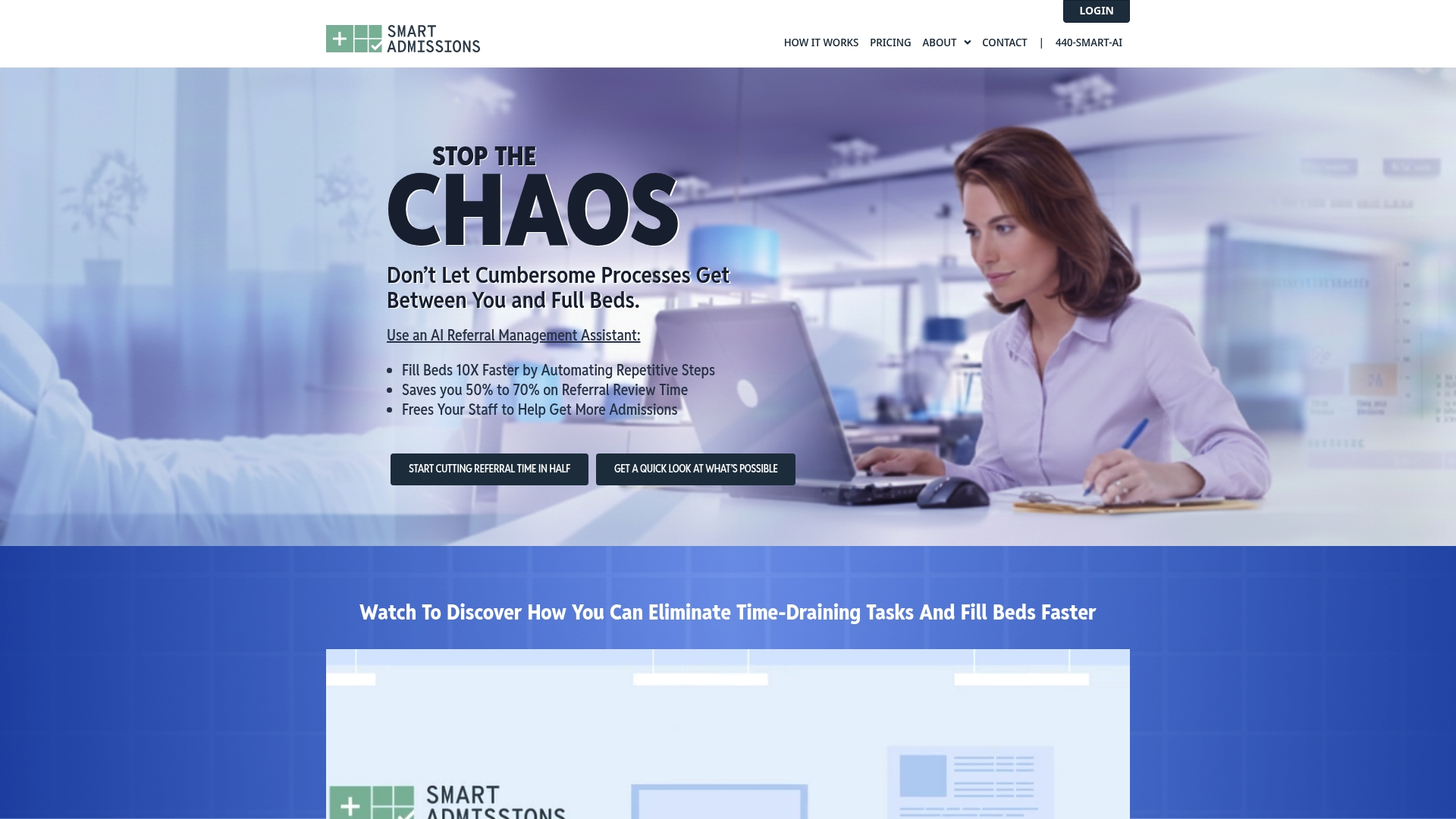
Smart Admissions is built specifically for skilled nursing homes, rehabilitation centers, and post-acute care providers. The platform integrates with your existing EHR and payer portals, automates eligibility verification, and gives your team a real-time dashboard to monitor every referral from first contact through admission. AI-powered tools reduce referral review times, flag documentation gaps before they become admission delays, and give you the analytics to continuously improve your intake process. If you want faster bed fill rates and less administrative strain on your team, explore what Smart Admissions can do for your facility today.
Frequently asked questions
What does seamless onboarding mean in healthcare?
Seamless onboarding in healthcare means coordinating every step of patient intake from first contact through initial visits using digital tools and integrated workflows, so the experience is continuous and free of paperwork delays. It combines administrative, clinical, and communication tasks into a single, managed process.
How do digital intake platforms improve patient onboarding?
Digital intake platforms allow patients to complete demographics, insurance, and consent forms before arrival, automatically populating EHR fields through HL7 or FHIR integrations, while giving staff dashboards to monitor submission status and follow up on gaps before admission day.
Why is payer coordination important in seamless onboarding?
Accurate and timely insurance verification and prior authorization prevent admission delays and claim denials. SNF admissions workflows require payer notifications within defined windows post-admission, and missing those deadlines creates both compliance risk and reimbursement delays.
What are common pitfalls to avoid in patient onboarding?
Treating intake as a single data collection event rather than a monitored workflow is the most common failure. Front-desk handoff failures typically happen because no one is tracking submission status before the patient arrives. Missing payer notification deadlines and failing to integrate digital form data into clinical workflows compound the problem further.