
TL;DR:
- Customer support in SaaS influences every stage of the subscription lifecycle, from onboarding to renewal, fostering long-term retention. High-quality support, combining AI and human efforts, provides proactive assistance, product feedback, and seamless omnichannel experiences, directly impacting customer satisfaction and growth. Effective alignment between support, customer success, and product teams transforms support into a strategic growth driver rather than a cost center.
Understanding the role of customer support in SaaS is one of the most underrated priorities in building a subscription business that actually grows. Most product managers treat support as a cost to minimize. That framing is costly. In SaaS, your customers pay repeatedly, and every interaction with your support team either reinforces or erodes their decision to renew. Support is not a reactive safety net. It is a continuous function that touches pre-purchase evaluation, onboarding, day-to-day usage, and renewal decisions. This article gives you a practical, experience-based view of how support directly shapes retention, product quality, and long-term customer satisfaction.
Table of Contents
- Key Takeaways
- Role of customer support in SaaS vs. traditional service
- How support quality affects retention and satisfaction
- How support generates product feedback and drives improvements
- Modern customer support strategies and tools
- Aligning support with customer success and product teams
- My perspective on support as a strategic growth lever
- How Smartadmissions supports your team’s operational goals
- FAQ
Key Takeaways
| Point | Details |
|---|---|
| Support spans the full lifecycle | SaaS support influences renewals at every stage, from onboarding through ongoing subscription use. |
| Support quality drives retention | 75% of customers spend more with companies that deliver excellent support experiences. |
| Feedback loop powers product improvement | Support tickets are structured product signals that, when routed correctly, reduce churn and drive feature prioritization. |
| Hybrid AI and human models perform best | AI handles volume and repetition; skilled human agents manage complex, trust-sensitive cases where customers need nuanced help. |
| Cross-team alignment multiplies impact | When support, customer success, and product teams share data and workflows, retention and expansion rates improve measurably. |
Role of customer support in SaaS vs. traditional service
Most definitions of customer service describe a department that resolves complaints after something goes wrong. In SaaS, that model is too narrow to be useful. SaaS support spans from the moment a prospect evaluates your product through every month of their subscription, affecting satisfaction and renewal decisions continuously.
The fundamental difference comes down to the subscription model itself. When a customer buys physical software once, the transaction is complete. In SaaS, your customer re-evaluates the purchase every billing cycle. That changes everything about how support must operate.
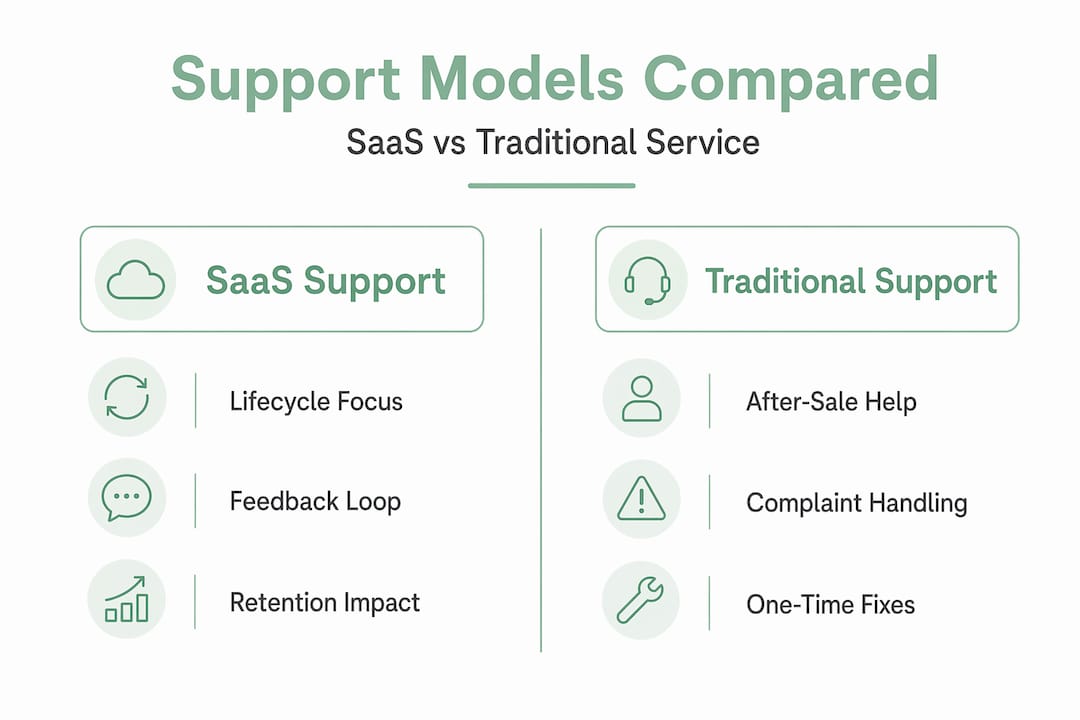
Here is how SaaS support differs from traditional customer service across key dimensions:
| Dimension | Traditional customer service | SaaS customer support |
|---|---|---|
| Engagement timing | Primarily post-purchase complaints | Pre-purchase through renewal and expansion |
| Business model context | One-time transaction | Recurring subscription with ongoing value delivery |
| Primary success metric | Resolution speed | Retention rate and customer health score |
| Team collaboration | Often siloed | Integrated with product and customer success |
| Support medium | Phone and email dominant | Omnichannel: chat, email, in-app, self-service |
Beyond the structural differences, SaaS support carries three core responsibilities that traditional service teams rarely own:
- Troubleshooting and issue resolution: Diagnosing technical problems, bugs, and integration failures that disrupt product use
- Customer education: Teaching users how to get more value from the product, particularly during onboarding and after feature releases
- Proactive assistance: Identifying patterns in usage data or ticket volume that signal confusion before customers escalate or churn
This last responsibility is where SaaS support teams create the most differentiated value. Support quality directly influences retention, not just because problems get fixed, but because customers feel genuinely helped rather than processed.
How support quality affects retention and satisfaction
The connection between support performance and customer retention in SaaS is direct and measurable. Research shows that customers are willing to spend more with companies offering excellent support, while poor service harms both retention rates and brand credibility. That is not a soft claim. It translates directly to renewal rates and expansion revenue.
To track the actual impact of support on your customer base, you need to measure the right indicators. Speed alone does not tell the full story. The metrics that matter most in SaaS support include:
- First Response Time (FRT): Benchmarks suggest under one hour for email and one to two minutes for live chat as performance targets
- First Contact Resolution (FCR): The percentage of tickets fully resolved in a single interaction, which strongly predicts customer satisfaction
- Customer Satisfaction Score (CSAT): Direct post-interaction feedback that captures the customer’s immediate experience
- Net Promoter Score (NPS): A broader signal of loyalty and likelihood to recommend, influenced over time by cumulative support experiences
- Churn correlation by ticket type: Segmenting which unresolved issue categories most frequently precede cancellations
A common and expensive mistake is tracking contact volume reduction as the primary sign of success. Measuring only volume misses the risk of fast but incomplete responses that leave the underlying problem unaddressed. A ticket closed in two minutes without an actual resolution creates churn risk. A ticket closed in 24 hours with a complete, clear answer builds trust.
Pro Tip: Set a rule in your support tooling that any ticket marked resolved without a substantive reply triggers a CSAT follow-up automatically. This catches false closures before they become silent churn.
For healthcare SaaS platforms like Smartadmissions, where admissions staff rely on the tool during high-pressure intake moments, responsive support is not optional. A delayed resolution during a referral review window has direct operational consequences for the facility and for your renewal conversation.

How support generates product feedback and drives improvements
Support teams sit closer to actual product usage than almost anyone else in your organization. Every ticket is a data point. Aggregated over weeks and months, ticket patterns reveal exactly where your product creates confusion, where documentation fails, and which feature gaps are costing you customers.
Support interactions serve as a vital feedback loop for product improvements by surfacing recurring issues and unmet expectations that internal teams often miss during development. The challenge is that most SaaS companies fail to formalize how this feedback reaches product management.
Here is a structured process for turning support data into product intelligence:
- Categorize every ticket by issue type and product area. Use consistent taxonomy so you can trend over time. Generic categories like “technical issue” do not give product managers enough signal.
- Set volume thresholds that trigger a product review. When the same issue appears in more than a defined number of tickets in a sprint cycle, it automatically goes onto the product team’s radar.
- Route high-impact feedback to a dedicated product-support channel. This should not be an email forward. Use a shared workspace where product managers can ask follow-up questions directly.
- Document the resolution path for every recurring issue. If your agents solve the same problem 20 times a week, that knowledge belongs in your product’s onboarding flow or tooltip layer, not just in agent notes.
- Close the loop with customers who surfaced issues that led to fixes. A brief notification that their feedback directly shaped a product update is one of the most effective and underused retention signals available to SaaS teams.
Pro Tip: Treat support tickets as structured “voice of customer” signals. Formal processes linking support data to product management prevent valuable insights from being lost in ticket queues.
Support teams possess the deepest practical product knowledge in SaaS organizations. When that knowledge is siloed inside the support queue and never reaches product or success teams, you are leaving your most direct source of churn prevention data unused.
Modern customer support strategies and tools
The best SaaS support operations in 2026 are built on three principles: unified customer context, a calibrated mix of AI and human capability, and measurement tied to retention outcomes rather than ticket throughput.
Omnichannel ticketing and customer context
Your customers contact support through email, live chat, in-app messages, and sometimes phone. If each channel creates a separate record, your agents are always working with incomplete information. An omnichannel ticketing system consolidates all interactions into a single customer timeline, so an agent responding to a chat already knows what the customer asked last week by email and what their account health score looks like.
Balancing AI automation with human expertise
AI tools can handle password resets, status checks, and common how-to questions at scale without human involvement. That efficiency is real. But 85% of service leaders are expanding human agent responsibilities despite AI adoption, because complex and emotionally charged cases require human judgment. Additionally, 54% of customers trust human agents more than AI recommendations when the stakes feel high.
The right model is hybrid. AI and human support together outperform AI-only approaches by combining scale with the nuanced resolution that builds customer trust. For SaaS platforms serving healthcare administrators, where decisions affect patient placement and regulatory compliance, that human layer carries even more weight. Platforms like Smartadmissions recognize this by pairing AI-powered automation with accessible, knowledgeable support staff.
Proactive support tactics
Rather than waiting for tickets to arrive, mature SaaS support teams use product usage data to anticipate friction. If a user has not completed a core workflow after two weeks, a targeted in-app message or proactive outreach from support reduces the likelihood of abandonment. This approach shifts the function from reactive to preventive, which is where the most impact on customer retention in SaaS actually occurs.
Aligning support with customer success and product teams
Support and customer success serve different but overlapping functions. Support resolves immediate problems. Customer success manages long-term health, adoption goals, and expansion opportunities. The most effective SaaS organizations build explicit workflows that connect these two roles rather than treating them as independent departments.
Practical alignment points include:
- Churn risk flagging: Support agents who notice a customer expressing frustration, reporting repeated failures, or submitting tickets at unusually high frequency should have a direct escalation path to the customer success manager for that account
- Renewal context: Customer success managers should review support ticket history before renewal conversations, since unresolved friction often explains hesitation that success teams interpret as a pricing objection
- Expansion signals: Support tickets that reveal a customer has outgrown current feature limits or is asking about capabilities that exist in higher-tier plans are expansion opportunities that belong in the customer success workflow
- Product feedback relay: Both teams should contribute to a shared product feedback repository, with support contributing volume-based signals and customer success contributing strategic account context
Support’s immediate help role and the insights it generates are most valuable when they are shared systematically with success teams. When that sharing happens through informal conversation rather than structured workflow, context gets lost and churn risks go unaddressed.
Building these workflows does not require expensive tooling. A shared Slack channel, a weekly 30-minute sync between support leads and customer success managers, and a consistent ticket tagging taxonomy are often enough to create measurable improvement in how early your team detects and acts on retention risk.
My perspective on support as a strategic growth lever
I’ve worked with enough SaaS teams to say this clearly: organizations that treat support as a cost center consistently underperform on retention compared to those that treat it as a growth function. The instinct to minimize support headcount and automate everything looks rational on a spreadsheet. In practice, it erodes the customer relationships that renewals and expansions depend on.
What I’ve learned is that the most damaging mistake is overemphasizing speed at the expense of resolution quality. Fast responses feel good in reports. Unresolved problems feel bad in churn data. Those are not the same thing, and your metrics need to reflect that distinction.
I also think the AI-versus-human debate in support is largely a distraction. The question is not which one to use. It is which problems each one handles best. AI earns its place on repetitive, low-stakes interactions. Human agents earn their place on anything that requires judgment, empathy, or technical depth. Getting that division right is more important than any single tool decision.
The organizations I’ve seen grow most consistently are the ones where support, product, and customer success share data and decision-making. That collaboration is not a nice-to-have. It is the mechanism by which your support function actually influences product-market fit over time.
— Harry
How Smartadmissions supports your team’s operational goals
If your team manages patient referrals and admissions in a skilled nursing or post-acute care facility, the principles in this article apply directly to how you evaluate the SaaS tools you rely on.
Smartadmissions combines AI-powered referral management with responsive, knowledgeable support that understands your operational workflows. The platform integrates with your existing EMR and insurance portals to reduce manual intake work, and the support team is built to help your admissions staff resolve issues without long delays or generic responses. Explore referral management system examples to see how automated workflows reduce administrative burden, or review the top referral management tools for 2026 to compare your options. Your team deserves both a capable platform and the support infrastructure to use it effectively.
FAQ
What is the role of customer support in SaaS?
The role of customer support in SaaS extends beyond resolving tickets. It spans the full subscription lifecycle, influencing onboarding success, ongoing product adoption, and renewal decisions through education and proactive assistance.
How does customer support affect retention in SaaS?
Support quality directly correlates with retention. Research shows that customers spend more with companies delivering excellent support, while unresolved issues are a leading driver of subscription cancellations.
What metrics should SaaS teams track for support performance?
Track First Response Time, First Contact Resolution rate, CSAT, and NPS alongside churn data segmented by ticket category. Tracking volume alone without resolution quality leads to misleading conclusions about support health.
How should support teams share feedback with product teams?
Use a formal routing process that categorizes tickets by product area, sets volume thresholds that trigger product review, and routes recurring issues to a dedicated product-support channel rather than informal forwarding.
Should SaaS companies use AI or human agents for support?
Both. Hybrid human-AI models consistently outperform AI-only approaches. AI handles repetitive, low-complexity requests at scale; human agents manage technically complex and emotionally sensitive cases where trust and judgment matter most.