
TL;DR:
- Effective referral prioritization classifies patient cases by urgency, streamlining admissions and improving outcomes. Automating key workflow steps significantly reduces processing time while safeguarding equity through clinical oversight and continuous monitoring. Building a workflow foundation before technology implementation ensures sustainable improvements and safe, equitable patient care.
The referral prioritization process is defined as the systematic classification and management of incoming patient referrals by clinical urgency, administrative readiness, and resource availability to optimize patient flow and admissions outcomes. Without a structured approach, nearly half of referrals never result in a completed visit, a failure rate that directly costs your facility revenue and harms patients awaiting care. Skilled nursing facilities, rehabilitation centers, and post-acute care providers that implement formal prioritization frameworks consistently reduce intake delays, improve bed fill rates, and lower staff workload. This guide covers the essential components, technology options, and step-by-step implementation strategies your admissions team needs to build or improve your referral evaluation process today.

What are the essential components of an effective referral prioritization process?

A well-built referral prioritization process rests on three urgency tiers: Emergency, Urgent, and Routine. Standardized intake workflows that categorize referrals into these levels reduce processing variability and give your clinical team a consistent framework for response. Emergency referrals trigger immediate notifications and expedited clinical review. Routine referrals follow standard templates to prevent backlog accumulation.
Beyond urgency tiers, your process requires five foundational components:
- Standardized intake criteria: Define the minimum clinical documentation required for each urgency level, including diagnosis codes, insurance verification status, and physician orders.
- Clear ownership: Assign a named coordinator or team to each referral category so accountability never falls into a gap between departments.
- Communication channels: Establish direct escalation paths between admissions staff, triage consultants, and referring physicians to reduce back-and-forth delays.
- Referral tracking metrics: Monitor acceptance rates, time-to-decision, and referral source quality using a centralized dashboard.
- Workflow integration: Connect your referral assessment criteria to your EHR system so clinical and administrative data move together, not in parallel silos.
The table below shows how urgency tiers map to response expectations and documentation requirements:
| Urgency level | Response target | Minimum documentation required |
|---|---|---|
| Emergency | Within 2 hours | Diagnosis, current medications, insurance ID |
| Urgent | Within 24 hours | Physician orders, clinical summary, insurance pre-auth |
| Routine | Within 72 hours | Full referral packet, functional assessment, payer details |
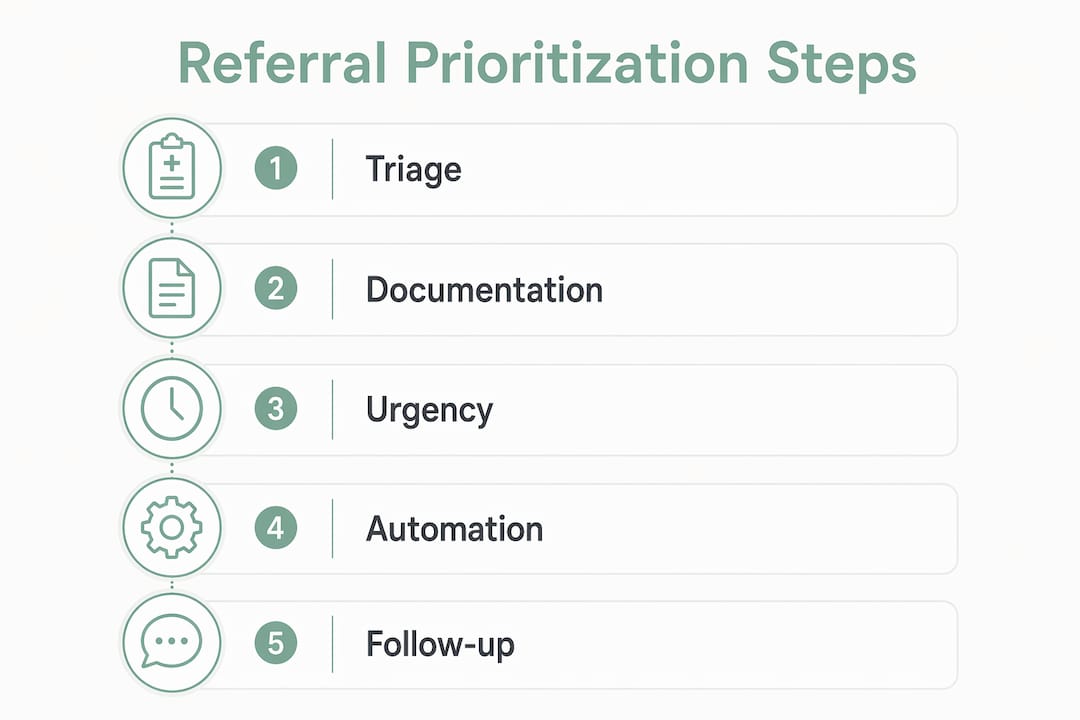
Separating emergency and routine referral systems with clear escalation timelines aligns your resources with actual clinical need rather than arrival order. This distinction alone prevents your highest-acuity patients from waiting behind lower-priority cases simply because their paperwork arrived first.
How can healthcare teams leverage automation and AI to enhance referral prioritization?
Automation addresses the most time-consuming steps in the patient referral workflow without removing clinical judgment from the equation. The referral management process involves 8 to 15 distinct workflow steps, and failure points at any one of them can stall an admission for days. Automating fax parsing and data extraction alone reduces per-referral processing time from 15 to 45 minutes down to 2 to 5 minutes.
Key automation applications for your admissions team include:
- Fax parsing and data extraction: Automated tools read incoming fax referrals, extract structured data, and populate intake forms without manual transcription.
- AI-assisted triage: AI models flag high-complexity or incomplete referrals for intensified human review rather than deprioritizing them. This approach reduces unsafe delays for vulnerable patients who might otherwise fall through the cracks.
- Multi-channel patient outreach: Automated systems contact patients via phone, text, and email to confirm appointments and gather missing information, cutting manual outreach time by 8 to 12 minutes per referral.
- Prior authorization automation: Connecting directly to insurance portals removes one of the most time-intensive manual steps in the process.
- Human-in-the-loop oversight: Every AI recommendation should carry a clear override mechanism so your clinical staff retains final authority on prioritization decisions.
Most organizations achieve a 70% or greater time reduction by automating just two or three key bottleneck steps. That figure matters because it means you do not need to overhaul your entire workflow at once. Targeting the right two steps delivers the majority of the efficiency gain.
Pro Tip: Before purchasing any referral management system, map your current workflow and identify where coordinators spend the most time. Research confirms that 70% of coordination time concentrates in two or three specific steps. Automate those first, and your ROI will be measurable within the first quarter.
You can explore how AI in patient intake identifies urgent needs that incomplete referral data would otherwise obscure.
What strategies ensure fair, safe, and effective prioritization?
Balancing clinical need with operational capacity requires more than a triage algorithm. The referral evaluation process must actively protect against the inequities that rigid, date-based ordering systems create. Sorting referrals purely by arrival date ignores clinical deterioration, social vulnerability, and the compounding risks that accumulate on a waitlist.
Effective triage requires clear referral criteria with sufficient clinical information and flexibility for complex cases. Triage consultants who act as clinical gatekeepers often face inflexible timelines and incomplete information, which makes direct communication with referring GPs and patients a non-negotiable part of the process. Teleconsultations and direct phone contact between triage staff and referring providers measurably improve referral quality and reduce rejection rates.
Your referral prioritization strategies list for equitable management should include:
- Periodic waitlist audits that track harms, complaints, and demographic disparities, not just average wait times. Waitlist prioritization is a safety and equity function, not an administrative convenience.
- Mandatory secondary reviews for any low-priority classification applied to patients in vulnerable populations, including elderly patients with multiple comorbidities.
- Flexible process pathways for complex or multi-morbid patients whose needs do not fit neatly into standard urgency categories.
- Collaborative communication protocols that loop in the referring physician before a final prioritization decision is made on ambiguous cases.
“AI-supported prioritization should operate as accountable human review with clear override authority to avoid downgrading complex or vulnerable cases.” — AI-Assisted Waitlist Prioritization in Community Care
Tracking referral conversion rates by patient population gives your team the data needed to spot disparities before they become systemic problems.
How to implement a referral prioritization workflow in 6 steps
Building or optimizing your patient referral workflow follows a logical sequence. Skipping the assessment phase and jumping straight to technology selection is the most common and costly mistake admissions teams make.
-
Map your current workflow. Document every step from referral receipt to admission decision. Identify where referrals stall, who touches each step, and how long each handoff takes. Research confirms that most referral delays occur during intake fax processing, patient outreach, and prior authorization.
-
Standardize intake forms and urgency criteria. Create a single intake template that captures the minimum data required for each urgency tier. Incomplete referrals are the leading cause of processing delays, and a standardized form eliminates ambiguity about what information is required at submission.
-
Select and configure your referral management technology. Choose a platform that integrates with your existing EHR system using FHIR or HL7 standards. Verify that it supports automated fax parsing, insurance portal connectivity, and real-time eligibility verification before committing.
-
Train admissions and clinical staff on prioritization protocols. Technology only works when your team understands the logic behind it. Train coordinators on urgency criteria, override procedures, and escalation paths. Run tabletop exercises using real referral scenarios to build confidence.
-
Monitor referral metrics continuously. Track time-to-decision, acceptance rate, referral source quality, and waitlist harm indicators on a weekly basis. Use your dashboard to identify new bottlenecks as they emerge rather than waiting for quarterly reviews.
-
Address common pitfalls proactively. Incomplete referrals, duplicate submissions, and communication gaps between departments are predictable failure points. Build exception-handling rules into your workflow so these cases are flagged automatically rather than discovered after a delay.
Pro Tip: When comparing referral management platforms, build a side-by-side comparison of how each handles your top two bottleneck steps specifically. A system that excels at fax parsing but lacks prior authorization automation may save time in one area while creating a new delay in another. Review referral management tools that address your specific workflow gaps before making a selection.
The table below compares manual versus automated approaches across key workflow steps:
| Workflow step | Manual processing time | Automated processing time |
|---|---|---|
| Fax parsing and data entry | 15 to 45 minutes | 2 to 5 minutes |
| Patient outreach | 8 to 12 minutes per referral | Under 2 minutes |
| Prior authorization | 20 to 40 minutes | 5 to 10 minutes |
| Insurance eligibility check | 10 to 20 minutes | Real-time |
For a deeper look at reducing intake delays, the healthcare intake efficiency resource covers waitlist prioritization as both a safety and equity workflow.
Key takeaways
A structured referral prioritization process built on urgency tiers, standardized criteria, and targeted automation is the most reliable path to faster admissions decisions and better patient outcomes.
| Point | Details |
|---|---|
| Use three urgency tiers | Classify all referrals as Emergency, Urgent, or Routine with defined response timelines for each. |
| Automate your top bottlenecks | Target fax parsing and patient outreach first to achieve 70%+ time reduction with minimal disruption. |
| Protect equity in prioritization | Audit waitlists for disparities and require secondary reviews for vulnerable populations flagged as low priority. |
| Integrate EHR and referral systems | Connect referral intake to your EHR using FHIR or HL7 standards to eliminate duplicate data entry. |
| Monitor metrics weekly | Track time-to-decision and acceptance rates continuously, not quarterly, to catch new bottlenecks early. |
Why I think most facilities are solving the wrong referral problem
After working closely with admissions teams across skilled nursing and post-acute care settings, the pattern I see most often is this: facilities invest in new technology before they understand where their actual time is going. They purchase a full referral management platform, configure it over several weeks, and then discover that the software addresses steps three through seven of their workflow while steps one and two, the ones consuming the most staff hours, remain entirely manual.
The uncomfortable truth is that a referral prioritization process is only as good as the bottleneck analysis that precedes it. I have seen facilities cut their average referral review time significantly not by replacing their entire system, but by automating a single fax-to-form conversion step that was consuming 30 minutes of coordinator time per referral.
The other issue I see consistently is over-reliance on urgency algorithms without building in structured override authority. AI triage tools are genuinely useful for flagging high-complexity cases, but a rigid algorithm that cannot accommodate a multi-morbid 84-year-old with an atypical presentation will produce unsafe outcomes. The human reviewer needs not just the ability to override, but a clear protocol for when and how to do it.
My advice: spend two weeks mapping your workflow before you evaluate any software. Count the minutes. Talk to your coordinators about where they feel the most friction. The answer to how to prioritize referrals effectively almost always starts with that conversation, not with a product demo.
— Harry
See how Smartadmissions handles referral prioritization for you
Smartadmissions is built specifically for skilled nursing facilities, rehabilitation centers, and post-acute care providers that need to move faster on referrals without adding staff. The platform automates fax parsing, real-time insurance eligibility verification, and clinical documentation management, all integrated with your existing EMR through FHIR and HL7 standards.
Facilities using Smartadmissions report measurably faster bed occupancy and reduced coordinator workload from day one of deployment. If your team is spending more than 15 minutes per referral on intake tasks, the platform is designed to address exactly that gap. Explore referral management system examples to see how other post-acute care teams have restructured their workflows, or review the case for automating admissions to understand the operational impact before your next planning cycle.
FAQ
What is a referral prioritization process in healthcare?
A referral prioritization process is the structured method by which admissions teams classify incoming patient referrals by clinical urgency, typically into Emergency, Urgent, and Routine tiers, to allocate resources and set response timelines appropriately.
How do you prioritize patient referrals effectively?
Effective prioritization combines standardized intake criteria, urgency-based classification, and direct communication with referring providers. Enhanced communication with GPs and patients during triage measurably improves referral quality and reduces rejected or delayed cases.
What referral assessment criteria should admissions teams use?
Admissions teams should assess each referral against clinical urgency, completeness of documentation, insurance eligibility status, and bed availability. Facilities that define minimum data requirements per urgency tier process referrals faster and with fewer follow-up requests.
How does automation improve the referral evaluation process?
Automation reduces fax parsing and outreach time from 15 to 45 minutes down to 2 to 5 minutes per referral, with most organizations achieving a 70% time reduction by targeting their two or three highest-volume bottleneck steps.
What is the biggest risk in automated referral prioritization?
The biggest risk is that rigid algorithms downgrade complex or vulnerable patients without triggering human review. AI-assisted prioritization should always include clear override authority and mandatory secondary review protocols for high-risk populations.
Recommended
- Stop Wasting 45 Minutes on Each Referral: Try These 5 Post-Acute Care Automation Hacks – Smart Admissions
- Top ways to reduce referral times for healthcare admissions
- The Busy Administrator’s Guide to Streamlining Referral Processes in Under an Hour – Smart Admissions
- How to Cut Referral Processing Time from 45 to 5 Minutes | AI Admissions Automation for Skilled Nursing Facilities