
TL;DR:
- Automated notifications in referral workflows significantly improve closure rates and reduce delays. They ensure timely alerts at each stage, build provider trust, and minimize silent stalls. Integrating these systems with EHRs and managing alert overload enhances overall referral management effectiveness.
Notifications in a referral workflow are defined as automated, event-triggered communications that alert clinical and administrative teams whenever a referral changes status, requires action, or risks falling through the cracks. The industry term for this function is “closed-loop referral management,” and notifications are its operational backbone. Manual referral processes result in 25–40% of referrals failing to convert to appointments due to lack of visibility. That failure rate is not a staffing problem. It is a communication problem, and the right notification system in referrals solves it directly. Smartadmissions builds this logic into its AI-powered referral management platform, designed specifically for skilled nursing facilities and post-acute care providers.
How does the role of notifications in referral workflow reduce delays?

Referral delays cluster at three predictable points: receipt confirmation, appointment scheduling, and report return. Without automated alerts at each stage, referrals stall silently. Your team has no signal that action is needed until a patient calls, a bed sits empty, or a referring provider stops sending cases.
Automated, closed-loop tracking systems increase referral closure rates above 70%, compared to 18–30% closure in manual workflows. That gap represents real revenue and real patients who did not receive timely care. Event-based triggers address this by firing a notification the moment a referral is received, when scheduling is pending beyond a set threshold, and when a consultation report has not been returned.
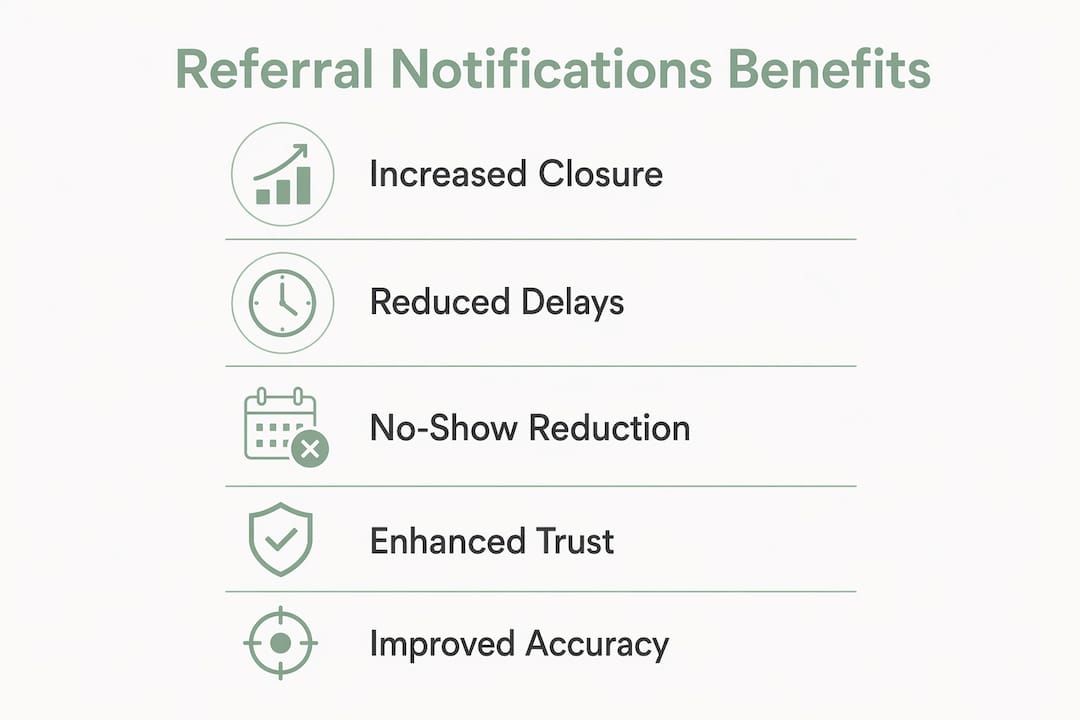
The impact on no-shows is equally direct. Modern referral management systems use event-based triggers to automate patient communications like appointment reminders, reducing no-shows and manual data entry. Fewer no-shows mean higher bed fill rates and less wasted clinical capacity.
The table below shows what referral outcomes look like with and without automated notifications:
| Referral stage | Without notifications | With automated notifications |
|---|---|---|
| Referral receipt confirmation | Manual check required | Instant alert to receiving team |
| Appointment scheduling | Phone follow-up by staff | Automated prompt if no action within threshold |
| Patient no-show rate | High without reminders | Reduced through automated reminders |
| Report return verification | Often missed or delayed | Alert triggered when report is overdue |
| Overall closure rate | 18–30% | Above 70% |
Only 50–60% of healthcare organizations currently achieve true closed-loop tracking. That means nearly half of all facilities are operating with significant blind spots in their referral process.
What are best practices for implementing effective notification systems?
Designing a notification system that works requires more than turning on alerts. The goal is clinical relevance at every touchpoint, not maximum volume.
Matching notification urgency to communication channels and grouping routine updates in daily digests prevents alert fatigue and improves user experience. High-urgency alerts belong on persistent, secure messaging channels. Routine status updates belong in digest format, delivered once or twice daily. This distinction alone reduces the cognitive load on your admissions team.
The following practices define a well-built notification system for referral workflows:
- Urgency-based routing: Send critical alerts (referral rejection, insurance denial, patient deterioration flag) through secure, real-time channels. Route low-priority updates through daily email digests.
- Channel selection: Use HIPAA-compliant secure messaging for clinical alerts, email for administrative updates, and SMS for patient-facing appointment reminders.
- Customization by role: Admissions coordinators need different alerts than clinical reviewers. Configure notification profiles by job function, not by facility-wide defaults.
- Threshold-based triggers: Set time limits for each referral stage. If scheduling is not confirmed within 24 hours, the system fires an escalation alert automatically.
- Closed-loop confirmation: Notifications should not stop at appointment confirmation. Closed-loop referral management requires verifying that consultation reports are actually received and filed. Build alerts for report return into your workflow.
Pro Tip: Review your notification logs monthly. If your team is dismissing more than 30% of alerts without acting on them, your urgency thresholds are miscalibrated. Tighten the criteria before adding new alert types.
Avoid these common pitfalls: sending the same alert to every team member regardless of role, using generic message text that requires staff to log in just to understand what action is needed, and failing to test notification delivery across channels before go-live.
How do automated notifications strengthen provider relationships?
Referring providers send cases to facilities they trust. Trust, in this context, is built through communication predictability, not through personal relationships alone. When a referring physician sends a patient and receives no status update for 48 hours, that silence reads as disorganization. Automated notifications eliminate that silence.
Proactive automated status notifications increase provider satisfaction and trust by eliminating manual follow-ups and phone calls. Your admissions staff spends less time on outbound status calls and more time on complex case review. That shift in focus directly improves the quality of your intake decisions.
Referring providers prefer consistent, succinct communications that build a reliable professional brand, increasing referral volume over time. An automated email confirming referral receipt, followed by a scheduling confirmation, followed by a report return acknowledgment, creates a communication loop that feels professional and dependable. That loop becomes your facility’s reputation.
The table below compares manual and automated communication approaches across key relationship metrics:
| Communication metric | Manual approach | Automated notification approach |
|---|---|---|
| Referral receipt acknowledgment | Delayed or inconsistent | Immediate, standardized |
| Status update frequency | On request only | Proactive at each workflow stage |
| Administrative staff time | High, repetitive outbound calls | Freed for complex case management |
| Referring provider satisfaction | Variable, relationship-dependent | Consistent, system-driven |
| Referral volume over time | Flat or declining without follow-up | Grows with communication reliability |
Automation enables staff to shift focus from manual communication tasks to complex exception handling and relationship-building, increasing overall referral workflow effectiveness. This is the operational case for investing in notification infrastructure.
What challenges exist with notification systems and how can they be overcome?
Alert fatigue is the most serious risk in any notification system. Notification overload causes cognitive disruption lasting about seven seconds per alert, which can reduce diagnostic accuracy among clinicians. Seven seconds sounds minor. Multiply it by dozens of alerts per shift, and the cumulative cognitive tax becomes a patient safety concern.
The solution is not fewer notifications. It is smarter categorization. Cognitive load from excessive notifications can impair clinician performance. Notification systems should alert only for clinically significant events, not every background system update.
Practical strategies for managing notification challenges include:
- Categorize before you configure: Separate notifications into three tiers: intervention required, awareness only, and digest-eligible. Only tier-one alerts should interrupt workflow in real time.
- Integrate with your EHR: Notifications disconnected from your Electronic Health Record system create data sync gaps. When a referral status updates in your referral platform but not in your EHR, staff receive conflicting information. Referral prioritization depends on accurate, unified data.
- Use intervention triggers, not just visibility alerts: Notification systems should trigger predefined interventions automatically when referrals stall, rather than only providing visibility. A notification that says “referral pending for 36 hours” is useful. A notification that automatically escalates the case to a supervisor is better.
- Audit and adjust regularly: Notification systems degrade over time as workflows change. Schedule quarterly reviews to retire obsolete alerts and add new triggers that match current referral patterns.
Pro Tip: When building your notification taxonomy, ask your admissions team to flag every alert they ignored last week and why. That list tells you exactly which alerts to recategorize or eliminate.
EHR integration is non-negotiable for accurate closed-loop tracking. Truly effective closed-loop referral management involves verification that specialist consultation notes are received and integrated back into the referring provider’s EHR, beyond just confirming appointments. Without that final step, your closure rate data is incomplete, and your providers do not receive the confirmation they need.
Key Takeaways
Automated notifications are the single most effective tool for closing the gap between referral receipt and confirmed patient placement in post-acute care settings.
| Point | Details |
|---|---|
| Notifications drive closure rates | Automated alerts push closure rates above 70%, compared to 18–30% in manual workflows. |
| Urgency-based routing prevents fatigue | Match alert urgency to channel type and group routine updates in daily digests. |
| Provider trust depends on consistency | Automated status loops build communication reliability that increases referral volume over time. |
| EHR integration is required | Notifications must sync with your EHR to deliver accurate, closed-loop referral confirmation. |
| Intervention triggers outperform visibility alerts | Systems that auto-escalate stalled referrals produce better outcomes than passive status updates. |
Notifications and the future of referral management: a practitioner’s view
What strikes me most about the evolution of referral notifications is how long facilities tolerated silence as a default. For years, the standard practice was to send a referral and wait. No confirmation, no status update, no escalation trigger. The referring provider called if they cared enough. The patient showed up or did not. That model was never acceptable. It just went unchallenged because the alternative required technology most facilities did not have.
What I see now, working with post-acute care teams, is a genuine shift in expectations. Referring physicians and hospital discharge planners expect real-time acknowledgment. They expect to know within hours, not days, whether a bed is available and whether their patient has been accepted. Facilities that cannot deliver that level of communication are losing referrals to those that can. The notification system is no longer a nice-to-have feature. It is the baseline for staying competitive.
The next development I watch closely is AI-driven predictive notifications. Rather than alerting teams after a referral stalls, predictive systems will flag referrals likely to stall based on payer type, diagnosis complexity, or historical patterns. That shift from reactive to predictive is where the real efficiency gains will come. The facilities that build notification infrastructure now will be positioned to adopt predictive alerting without rebuilding from scratch. The ones that wait will face a much steeper climb.
My honest recommendation: start with referral tracking improvements before adding complexity. Get your closure rate above 70% with basic automated alerts, then layer in predictive logic. Trying to implement everything at once is how facilities end up with alert fatigue and staff who ignore the system entirely.
— Harry
How Smartadmissions supports your referral notification system
Smartadmissions delivers automated referral status notifications built directly into its AI-powered intake platform, designed for skilled nursing facilities and post-acute care providers. The platform fires event-based alerts at every referral stage, from receipt confirmation through consultation report return, and integrates with existing EMR systems to keep data synchronized across your team.
Your admissions staff stops chasing status updates by phone and starts focusing on complex case decisions. Referring providers receive consistent, professional communication that builds the trust your facility needs to grow referral volume. Explore referral management system examples to see how notification-driven workflows perform in real post-acute care settings, or review the automated workflow benefits that facilities like yours are achieving with Smartadmissions.
FAQ
What is the role of notifications in referral workflow?
Notifications in a referral workflow are automated alerts that fire when a referral changes status, requires action, or risks stalling. They replace manual follow-up calls and keep all stakeholders informed at every stage of the referral process.
How do notifications improve referral closure rates?
Automated, closed-loop tracking systems increase referral closure rates above 70%, compared to 18–30% in manual workflows. Notifications eliminate the visibility gaps that cause referrals to fall through without action.
What is alert fatigue and how does it affect clinical teams?
Alert fatigue occurs when excessive notifications cause clinicians to ignore or dismiss alerts. Research shows notification overload causes cognitive disruption lasting about seven seconds per alert, which can reduce diagnostic accuracy over a full shift.
Which communication channels work best for referral notifications?
High-urgency alerts belong on HIPAA-compliant secure messaging platforms. Routine status updates work best as daily email digests. Patient-facing reminders are most effective via SMS, which reduces no-show rates without requiring patients to log into a portal.
How does EHR integration affect notification accuracy?
EHR integration ensures that referral status changes in your management platform are immediately reflected in your clinical records. Without this sync, staff receive conflicting data, and closed-loop confirmation of consultation report return becomes unreliable.