
TL;DR:
- A referral gap analysis compares actual referral outcomes to targets, identifying where patients are lost. Regular analysis helps improve workflow, patient care, and revenue by addressing specific breakdown points. Using key metrics and ownership-driven steps, facilities can close gaps effectively and sustain operational improvements.
A referral gap analysis is defined as the process of measuring the difference between your facility’s current referral outcomes and the outcomes you want to achieve. For healthcare administrators and admissions staff, this analysis identifies exactly where referrals break down, whether at the point of handoff, during scheduling, or at follow-up. It connects directly to financial performance, HEDIS quality measures, and Medicare Star Ratings. Facilities that run this analysis regularly gain a clear picture of where patients are lost and what it costs them in revenue and care quality.
What is a referral gap analysis and why does it matter?
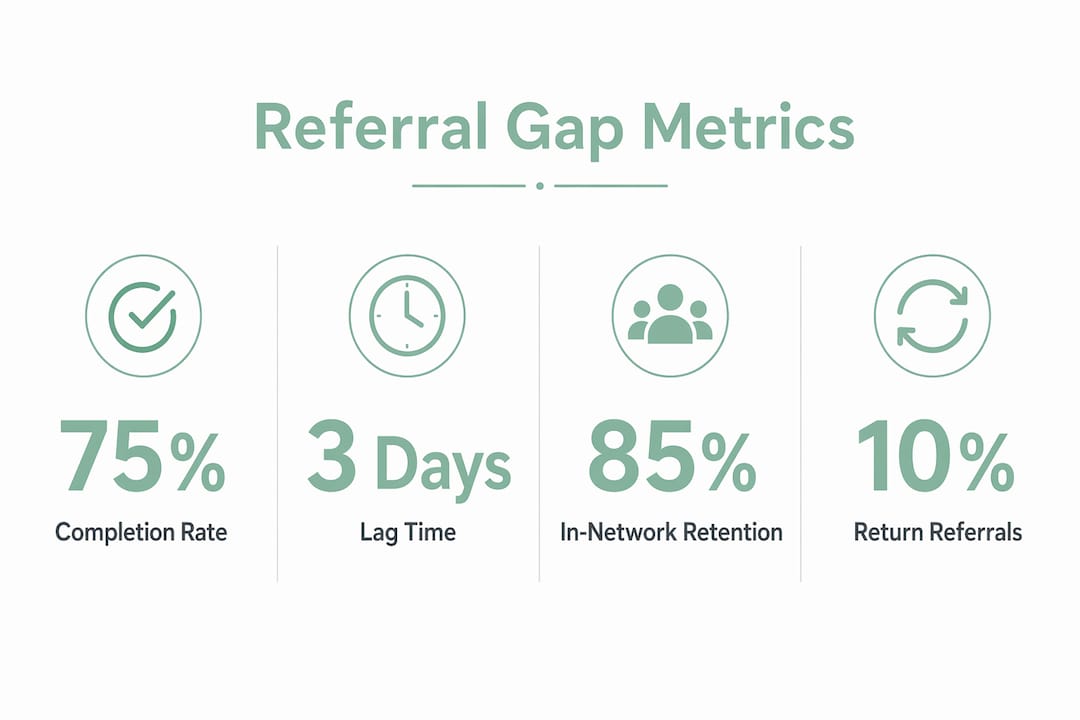
A referral gap analysis is the structured comparison of actual referral performance against defined benchmarks, using four core metrics: referral completion rate, average referral lag time, in-network retention rate, and return communication rate. Each metric tells a different part of the story. Together, they reveal whether your referral workflow is functioning as designed or quietly losing patients and revenue at multiple points.
Closing the referral loop is critical for both patient care quality and financial performance under value-based care models. Incomplete referrals directly affect HEDIS measures and Medicare Star Ratings, which in turn affect shared savings and bonus payments. That financial exposure makes gap analysis a revenue management tool, not just a quality exercise.
The industry term for this process is “referral loop closure analysis” in some clinical quality frameworks, but “referral gap analysis” is the operational term most widely used by admissions and care coordination teams. Both refer to the same core practice: identifying where referrals fail to reach their intended outcome and quantifying the size of that failure.
Pro Tip: Run your referral gap analysis at least quarterly. Annual reviews miss seasonal patterns in referral volume and payer mix shifts that can distort your benchmarks.
What metrics and data does a referral gap analysis use?
The four primary metrics in a referral gap analysis each measure a distinct failure point in the referral pathway.
| Metric | Definition | Typical Range |
|---|---|---|
| Referral completion rate | Percentage of referrals that result in a completed specialist visit | 25%–65% depending on specialty |
| Average referral lag time | Days between referral order and first specialist appointment | 7–30 days for most pathways |
| In-network retention rate | Percentage of referrals kept within your facility’s network | Varies by payer contract and geography |
| Return communication rate | Percentage of referrals where the specialist sends a report back to the referring provider | Often below 50% without active tracking |
Referral completion rates vary widely by pathway: primary care to common specialties runs approximately 55%–65%, behavioral health drops to 30%–40%, and post-discharge follow-ups fall to 25%–35%. Those numbers show that nearly half of all referrals in high-acuity pathways never reach completion. That is not a minor inefficiency. It is a systemic failure with direct consequences for patient outcomes and facility revenue.
Data for these metrics comes from three primary sources: your EMR system, insurance claims data, and your referral management platform. EMR data captures the referral order and any documented follow-up. Claims data confirms whether the specialist visit actually occurred. Referral management platforms, when integrated with your EMR, provide real-time status tracking across all four metrics simultaneously.
- Referral completion rate is your headline number. It tells you the scale of the problem.
- Referral lag time is your early warning signal. High lag time predicts future leakage before it shows up in completion data.
- In-network retention rate measures revenue leakage to out-of-network providers.
- Return communication rate reflects care coordination quality and affects HEDIS reporting directly.
Pro Tip: Lag time is often more predictive of referral leakage risk than raw completion rates. Track it weekly, not monthly, to catch problems before patients are lost.
How to conduct a referral gap analysis: step-by-step
The standard methodology for a referral gap analysis follows five steps, each building on the previous one to move from data to action.
-
Define your desired state. Set specific targets for each of the four core metrics. Use CMS quality benchmarks, MGMA practice operations data, or your own historical best performance as reference points. Vague goals produce vague results.
-
Benchmark your current data. Pull the last 90 days of referral data from your EMR and claims system. Calculate your actual completion rate, lag time, retention rate, and return communication rate. Segment this data by referral pathway and payer from the start.
-
Identify the gap size. Compare current performance to your targets. Quantify each gap in absolute terms. A 15-percentage-point gap in behavioral health completion is not the same problem as a 15-point gap in orthopedics, even if the numbers look identical.
-
Apply root cause analysis. Use the “5 Whys” technique on your largest gaps. Ask why the gap exists, then ask why again for each answer, repeating until you reach an operational root cause. For example: completion rate is low. Why? Patients are not scheduling. Why? Scheduling instructions are unclear in the referral packet. Why? The referral template does not include direct scheduling links. That is a fixable process problem, not a patient behavior problem.
-
Develop ownership-based action plans. Assign each gap a named owner, a specific intervention, and a review date. Gap analysis without ownership stays a static report. Ownership converts analysis into management accountability.
After completing these five steps, apply a SWOT framework to prioritize which gaps to close first. Gaps that are high-impact and operationally feasible to fix should move to the top of your action list. Gaps that require significant capital or external contracting changes should be scheduled for a later phase.
Pro Tip: Integrate your referral gap review into your existing monthly operations meeting. Attaching it to a standing agenda item prevents it from becoming an annual exercise that nobody acts on.

Common nuances and challenges in referral gap analysis
Referral gaps are not uniform, and treating them as a single number is the most common mistake administrators make. Each referral pathway requires a different intervention because the root causes differ by specialty, payer, and patient population.
- Orthopedics gaps typically stem from scheduling protocol failures. Patients receive a referral but cannot get an appointment within a reasonable window. The fix is often a direct scheduling agreement with the specialist group, not a patient outreach campaign.
- Behavioral health gaps require enhanced patient navigation. The 30%–40% completion rate in behavioral health reflects patient-side barriers: stigma, transportation, cost, and appointment wait times. Closing this gap requires active follow-up calls, not just referral tracking.
- Post-discharge follow-up gaps reflect care transition failures. Patients discharged from a skilled nursing facility or rehabilitation center often lose contact with the care coordination team within 48 hours. Automated follow-up protocols close this gap more reliably than manual outreach.
Average metrics also mask high-value failures. A facility with a 60% overall completion rate may have a 90% completion rate for routine primary care referrals and a 20% rate for high-acuity cardiology referrals. The average looks acceptable. The cardiology failure is a serious clinical and financial problem. Segmenting by pathway and payer reveals these hidden failures.
Payer mix adds another layer of complexity. Out-of-network leakage rates often differ significantly between commercial insurance and Medicare Advantage plans. Each payer contract defines network boundaries differently, which means your in-network retention strategy must account for payer-specific rules.
Referral handoffs represent the most common point of patient journey breakdown, with disproportionate impact on underserved populations. Facilities serving high proportions of Medicaid patients or patients with limited English proficiency need pathway-specific navigation support built into their gap closure plans.
How to use referral gap analysis to improve patient intake
Referral gap analysis translates directly into operational improvements when your team acts on the data rather than files it. The most immediate application is reducing referral lag time, which predicts patient loss even when eventual completion occurs. Reducing lag time frequently achieves more revenue retention than simply increasing referral volume.
- Reduce lag time by establishing direct scheduling protocols with your top 10 specialist referral destinations. A standing scheduling agreement cuts the average lag from 21 days to 7 days in most primary care to specialist pathways.
- Improve return communication rates by building automated follow-up requests into your referral workflow. When specialists know a follow-up report is expected within 5 business days, compliance rates rise significantly.
- Track network retention by payer and flag out-of-network referrals in real time. Your admissions team can intervene before the patient schedules with an out-of-network provider.
- Connect gap data to HEDIS reporting by mapping your referral completion metrics to the specific HEDIS measures your payer contracts require. Improved completion rates in targeted pathways directly improve your Star Ratings and shared savings performance.
Real-time referral dashboards integrating EMR data give your team visibility into referral status, no-shows, and specialty completion rates without manual data pulls. That visibility allows proactive intervention rather than retrospective reporting. Facilities using integrated dashboards close referral gaps faster because staff can act on a stalled referral the same day it stalls, not 30 days later when the monthly report arrives.
For skilled nursing facilities and post-acute care providers, analyzing referral data for bed occupancy patterns adds another layer of operational value. Referral gap analysis at the intake level directly affects bed fill rates and daily revenue.
AI-assisted referral management tools, including those discussed in guides on AI clinic inquiry handling, now automate status tracking and trigger alerts when referrals stall past defined thresholds. That automation removes the manual monitoring burden from your admissions staff and reduces the risk of referrals falling through the cracks.
Pro Tip: Assign a named staff member to own each high-priority referral pathway in your gap analysis. Shared ownership means no ownership. One person per pathway, with a weekly review cadence, produces measurable results within 60 days.
Key Takeaways
A referral gap analysis is the most direct tool healthcare administrators have for connecting referral workflow failures to financial and clinical outcomes.
| Point | Details |
|---|---|
| Four core metrics | Track completion rate, lag time, in-network retention, and return communication rate every quarter. |
| Segment by pathway | Behavioral health and post-discharge gaps need different fixes than orthopedics or primary care gaps. |
| Ownership drives results | Assign a named owner and review date to every gap or the analysis produces no change. |
| Lag time is the early signal | High referral lag time predicts patient loss before it shows up in completion rate data. |
| Connect to quality measures | Closing referral loops improves HEDIS scores and Medicare Star Ratings with direct financial impact. |
Why referral gap analysis is more than a reporting exercise
After working with healthcare admissions teams for years, the pattern I see most often is this: facilities run a referral gap analysis once, produce a detailed report, and then file it. Six months later, the same gaps exist. The report did not fail. The follow-through did.
The most valuable shift I have observed is when administrators treat gap analysis as a management rhythm rather than a one-time audit. Facilities that review referral metrics monthly, assign named owners to each gap, and tie performance to operational goals see sustained improvement. Those that treat it as an annual compliance exercise see the same numbers year after year.
The second pattern worth naming is the overreliance on aggregate data. A 58% completion rate sounds like a passing grade. But when you segment that number by pathway, you often find a 90% rate in low-acuity referrals masking a 25% rate in the pathways that matter most clinically and financially. The aggregate hides the failure.
Technology is changing what is possible here. AI-assisted tools that reduce clinic ghosting and automate referral follow-up are removing the manual burden that made continuous monitoring impractical for most teams. That shift makes the monthly review cadence achievable even for facilities with small admissions staff.
The facilities that will perform best under value-based care models are those that treat referral gap analysis as a core operational discipline, not a reporting task. Start with the four metrics. Assign owners. Review monthly. The results follow.
— Harry
Smartadmissions and your referral gap analysis
Referral gap analysis only produces results when your team has the data to act on it in real time.
Smartadmissions gives skilled nursing facilities, rehabilitation centers, and post-acute care providers an AI-powered platform that tracks referral completion rates, lag times, and in-network retention automatically. It integrates with your existing EMR and insurance portals to surface referral status without manual data pulls. Your admissions team gets the visibility to close gaps before patients are lost, not after the monthly report arrives. For facilities ready to move from static reports to live referral management, explore referral management systems built for post-acute care, or review how to track referral outcomes using proven SNF methods.
FAQ
What is a referral gap analysis in healthcare?
A referral gap analysis measures the difference between your current referral outcomes and defined performance targets across four metrics: completion rate, lag time, in-network retention, and return communication rate. It identifies where referrals fail and quantifies the clinical and financial cost of those failures.
How often should a referral gap analysis be conducted?
Quarterly analysis is the minimum for most facilities, with monthly reviews recommended for high-volume referral pathways. Annual reviews miss seasonal volume shifts and payer mix changes that distort benchmarks.
What causes low referral completion rates?
Low completion rates result from multiple causes depending on the pathway: scheduling delays in orthopedics, patient navigation barriers in behavioral health, and care transition failures in post-discharge follow-up. Segmenting data by pathway identifies the specific root cause for each gap.
How does referral lag time affect revenue?
High referral lag time predicts patient loss even when eventual completion occurs, making it a leading indicator of revenue leakage. Reducing lag time retains more revenue than simply increasing referral volume.
What tools support referral gap analysis?
EMR systems, insurance claims data, and integrated referral management platforms are the three primary data sources. Platforms that connect EMR data with real-time dashboards allow your team to monitor referral status and intervene before gaps widen.