
The fastest way to centralize patient records is to adopt a standards-first strategy built on FHIR R4 as your canonical exchange model, pair it with a Master Patient Index (MPI) to resolve patient identity across systems, and launch a scoped pilot before committing to enterprise rollout. Your immediate first action: run a source inventory that catalogs every system feeding patient data (EHRs, labs, imaging, RPM devices), documents formats and volumes, and defines the MPI scope. That inventory becomes the foundation for every technical and governance decision that follows.
Research on centralized healthcare databases confirms that the engineering and governance complexity is real, but manageable when you sequence the work correctly.
Key Takeaways
Centralizing patient records requires a standards-first architecture built on FHIR R4 and a Master Patient Index, deployed in a phased pilot before enterprise rollout, with HIPAA compliance controls and BAAs in place before any PHI flows.
| Point | Details |
|---|---|
| Start with a source inventory | Catalog every system, format, and data volume before selecting an architecture or vendor. |
| MPI is the first integration priority | Resolving patient identity across systems prevents duplicate records and protects patient safety from day one. |
| FHIR R4 as the canonical model | Adopting FHIR R4 for exchange and using converters for HL7 v2 sources minimizes rework as new sources connect. |
| BAAs and HIPAA controls before data flows | Execute Business Associate Agreements and complete a HIPAA risk analysis before any PHI enters the centralized environment. |
| Smartadmissions accelerates intake post-centralization | Smartadmissions connects to your EMR via HL7 and FHIR to automate referral intake, eligibility verification, and clinical assessment in one workflow. |
Table of Contents
- Why centralize patient records? The business case in measurable terms
- Which architecture model fits your facility’s needs?
- What standards and interoperability requirements should you plan for?
- How to centralize patient records: the 10-step implementation plan
- What HIPAA and U.S. compliance requirements apply to centralized records?
- Security best practices for a centralized patient record environment
- How does a Master Patient Index keep your records accurate?
- How do you prepare staff and clinicians for a centralized records system?
- What does a centralization project actually cost, and how long does it take?
- How automation and EMR integration accelerated centralization: an operational example
- What are your next steps to start centralizing records this quarter?
- What most teams get wrong when centralizing patient records
- Smartadmissions cuts the time from referral receipt to bed placement decision
- Sources
Why centralize patient records? The business case in measurable terms
Fragmented records cost your facility in ways that show up directly on the balance sheet. Clinicians log into three or four systems to assemble a complete chart, labs get ordered twice because prior results are invisible, and admissions teams manually reconcile referral packets that should arrive pre-populated. Centralizing patient data eliminates those redundancies at the source.
The CDC reports widespread EHR adoption among U.S. providers, which means the raw material for centralization already exists in most facilities. The gap is not data availability; it is data connectivity.
Direct benefits your team can track from day one:
- Care coordination: Clinicians see a complete longitudinal record, reducing handoff errors between acute, post-acute, and outpatient settings. Centralized data supports all five levels of care coordination when the record is complete and current.
- Fewer duplicate tests: A unified record surfaces prior imaging and lab results before a new order is placed.
- Faster admissions and intake: Pre-populated referral packets cut manual data entry and speed bed placement. Facilities that automate admissions workflows report measurably faster bed occupancy.
- Population health analytics: A central repository enables cohort queries, readmission risk scoring, and payer reporting that siloed systems cannot support.
KPIs worth tracking from go-live: referral turnaround time, duplicate record rate, average time to access a complete chart, and manual reconciliation steps per admission.
Which architecture model fits your facility’s needs?
Four patterns dominate U.S. healthcare centralization projects. Choosing the wrong one for your size and governance maturity is one of the most common causes of delayed timelines.
| Architecture | Best for | Key advantage | Main tradeoff |
|---|---|---|---|
| Centralized EHR / single repository | Single-vendor environments, small-to-mid networks | Lowest integration overhead; one system of record | Vendor lock-in; limited flexibility for multi-source networks |
| Federated HIE | Multi-organization networks with separate governance | Data stays at the source; lower data-sovereignty risk | Higher query latency; complex consent management |
| Enterprise Data Warehouse (EDW) + FHIR layer | Analytics-first use cases; population health programs | Powerful reporting; decoupled from operational systems | Not a real-time clinical record; requires a separate operational EHR |
| EMPI / MPI as integration backbone | Any multi-source environment | Resolves patient identity across all systems | Requires ongoing tuning; matching errors need human review |
Architecture design research shows that cloud-native and microservices-based repositories reduce costs and improve query performance when properly engineered, but only when the data model is standardized before ingestion begins.
For most skilled nursing and post-acute facilities, the practical answer is a centralized EHR with an MPI layer for identity resolution, plus an EDW for analytics. Facilities operating across multiple organizations should evaluate a federated HIE model, but expect higher governance complexity. Telehealth and RPM data should feed into the primary EHR so clinicians see a complete longitudinal view rather than a separate device-data silo.
What standards and interoperability requirements should you plan for?
ONC’s interoperability guidance is clear: standards-based exchange is the foundation of any durable centralization project. Adopting FHIR R4 as your canonical API model from the start minimizes rework as new sources arrive, because converters handle legacy formats rather than requiring you to rebuild the core model each time.
Primary standards to adopt:
- FHIR R4 — canonical API model for clinical data exchange; required for ONC certification and CMS interoperability rules
- HL7 v2 — still the dominant message format in source systems (ADT, ORU, ORM messages); requires per-source parser configuration
- CCD/CCDA — document exchange standard for transitions of care and referral packets
- DICOM — imaging metadata and study linking; connect DICOM metadata to the FHIR ImagingStudy resource
- X12 (EDI 837/835) — claims and eligibility transactions; relevant for insurance verification workflows
- IHE profiles — XDS, PIX/PDQ, and MHD profiles for document sharing and patient identity management
Terminology normalization is non-negotiable. Map all clinical codes to LOINC (lab observations), RxNorm (medications), SNOMED CT (clinical findings), and ICD-10-CM (diagnoses) before loading data into the central repository. Skipping this step means your analytics layer will query against inconsistent code sets and produce unreliable results.
Pro Tip: Adopt FHIR R4 as your system of record for exchange and use converters for legacy HL7 v2 sources. This approach, recommended by ONC’s implementation resources, prevents repeated rework each time a new source system connects.
Partner and vendor certification checklist before you sign a contract:
- FHIR R4 API conformance statement available
- HL7 v2 message types supported (ADT, ORU, ORM, MDM)
- DICOM WADO-RS endpoint for imaging retrieval
- Terminology service (LOINC, RxNorm, SNOMED CT) included or documented
- Healthcare interoperability standards alignment confirmed in writing
How to centralize patient records: the 10-step implementation plan
This phased plan moves your team from kickoff to pilot go-live in a structured sequence. Each phase has a defined output so you always know whether you are ready to advance.
- Source inventory — Catalog every system (EHRs, labs, imaging, RPM, billing) with format, message volume, and data owner. Output: a source registry spreadsheet.
- Stakeholder RASCI — Assign Responsible, Accountable, Supported, Consulted, and Informed roles for every workstream. Output: a signed RASCI matrix.
- MPI scope definition — Define patient identity attributes (name, DOB, SSN last 4, MRN, address), matching thresholds, and human-review escalation rules. Output: MPI policy document.
- Architecture selection — Choose your centralization model (centralized EHR, federated HIE, EDW + FHIR layer) based on the source inventory and governance constraints.
- Vendor evaluation and contracting — Score vendors against the standards checklist above; negotiate BAAs, SLAs, and subprocessor lists before signing.
- Ingestion and mapping — Configure per-source HL7 v2 parsers, build FHIR mapping pipelines, normalize terminology, and apply deduplication rules. The data engineering playbook from Nineleaps documents the real-world variability in HL7 v2 that requires source-by-source parser configuration.
- Data quality validation — Run automated match-rate reports, clinical SME chart reviews, and duplicate-record audits before loading production data.
- Security and compliance review — Complete HIPAA risk analysis, verify encryption, test access controls, and confirm BAAs are executed.
- Pilot go-live — Launch with one clinical site or one referral source. Define rollback criteria (e.g., match error rate above 2%, system downtime above 4 hours) before cutover.
- Incremental rollout — Onboard additional sources in waves, monitoring KPIs after each wave before proceeding.
Phased timeline guidance:
| Scope | Typical duration | Key variable |
|---|---|---|
| Single-site pilot | 3–6 months | Source system complexity |
| Multi-site enterprise rollout | 9–24 months | Number of source systems and governance complexity |
A patient records workflow built around these phases reduces manual steps at each transition and keeps the project on schedule.
What HIPAA and U.S. compliance requirements apply to centralized records?
Centralizing protected health information (PHI) concentrates your compliance exposure. HHS’s HIPAA framework requires covered entities and their business associates to apply specific controls whenever PHI is accessed, transmitted, or stored in a centralized system.
Core HIPAA obligations that directly affect your architecture:
- Minimum necessary standard — Access to PHI must be limited to what is required for the specific use. Attribute-based access control (ABAC) is the most scalable way to enforce this at the data level across a centralized repository.
- Audit trails — Every access, modification, and disclosure of PHI must be logged and retained. Your centralized system must produce audit logs that satisfy both HIPAA and state retention requirements.
- Breach notification — A centralized repository is a high-value target; your incident response plan must include breach notification timelines (60 days to HHS, without unreasonable delay to affected individuals).
- Patient access rights — Under HIPAA’s individual rights provisions, patients have the right to access, request copies of, and request amendments to their records. Your centralized system must support these workflows.
Business Associate Agreement (BAA) requirements — Every vendor that touches PHI in your centralized environment must sign a BAA before data flows. Require these items in every BAA:
- Encryption standards (AES-256 at rest, TLS 1.2+ in transit)
- Breach response SLA (notification within 24–48 hours of discovery)
- Subprocessor list with geographic restrictions
- Right to audit and penetration test results on request
The HITECH Act extended HIPAA obligations directly to business associates and increased civil penalties, so your BAA language must reflect current enforcement standards, not pre-2009 templates.
State law and consent: Several states impose stricter consent requirements than HIPAA for specific data categories (behavioral health, HIV status, substance use disorder records under 42 CFR Part 2). Map your patient population’s state laws before finalizing your consent management workflow, and build consent preferences into the access control layer so restrictions propagate automatically.
For detailed guidance on patient data security in admissions, including HIPAA controls specific to intake workflows, your privacy officer should review current HHS guidance alongside your facility’s state-specific obligations.
Security best practices for a centralized patient record environment
A centralized repository raises the stakes for every security control. A breach that would have exposed one system’s records now potentially exposes all of them.
Core technical controls:
- Encryption at rest (AES-256) and in transit (TLS 1.2 minimum, TLS 1.3 preferred)
- Identity and Access Management (IAM) with role-based provisioning and quarterly access reviews
- Multi-factor authentication (MFA) for all administrative and clinical users
- ABAC for fine-grained, data-level enforcement of minimum necessary access
- SIEM integration for centralized log aggregation, alerting, and anomaly detection
Operational controls:
- Break-glass design — Define a documented emergency access procedure for situations where normal access controls would delay urgent care; log every break-glass event for mandatory human review within 24 hours.
- Field-level auditing — Apply heightened audit controls to sensitive data categories: substance use disorder records (42 CFR Part 2), behavioral health notes, and HIV-related information.
- Human review workflows — Flag high-risk queries (bulk exports, after-hours access to sensitive categories) for security team review.
Pro Tip: Run a penetration test against your centralized repository before go-live and schedule quarterly vulnerability scans thereafter. Incident response playbooks should be tested with a tabletop exercise at least annually, covering both a ransomware scenario and a PHI exfiltration scenario.
How does a Master Patient Index keep your records accurate?
Patient identity resolution is the single most consequential data quality problem in centralization projects. A duplicate record means a clinician sees an incomplete chart. A false merge means two patients’ records are combined, which is a patient safety event.
Matching approaches:
- Deterministic matching — Exact-match rules on high-confidence attributes (SSN, MRN, DOB). Fast and precise but fails on data entry errors and name variations.
- Probabilistic matching (Fellegi-Sunter model) — Assigns weighted scores across multiple attributes; tolerates typographic errors and partial matches. More flexible but requires threshold calibration.
- Hybrid approach — Deterministic rules for high-confidence pairs, probabilistic scoring for uncertain pairs, and a human-review queue for low-confidence candidates. This is the recommended production pattern.
Modern MPI implementations add machine learning layers on top of Fellegi-Sunter to improve match rates on challenging populations (common surnames, frequent address changes). The Nineleaps data engineering playbook emphasizes that clinicians, not just data engineers, should set auto-link thresholds, because the consequences of a false merge are clinical, not just technical.
Normalization steps before matching:
- Standardize name formats (last, first, middle; handle suffixes and prefixes consistently)
- Normalize addresses against USPS standards
- Map all diagnosis codes to ICD-10-CM, lab codes to LOINC, and medication codes to RxNorm
MPI operational KPIs to track:
| KPI | Target threshold | Action if exceeded |
|---|---|---|
| Duplicate record rate | Below 2% | Trigger matching rule audit |
| Auto-link rate (high confidence) | Above 80% | Review blocking strategy |
| Human-review queue clearance time | Under 48 hours | Add reviewer capacity |

How do you prepare staff and clinicians for a centralized records system?
Technology alone does not produce better outcomes. Adoption does. A well-engineered centralized record that clinicians distrust or avoid reverts to the same fragmented workflows you started with.
Training plan structure:
- Role-based modules — Separate tracks for admissions coordinators, clinical staff, IT administrators, and privacy officers. Each track covers only the workflows relevant to that role.
- Superuser program — Identify one or two power users per department who receive advanced training before go-live. They become the first line of support for their peers.
- In-EHR micro-training — Embed short contextual tips at the point of workflow change (e.g., a tooltip when a user accesses a newly centralized lab result for the first time).
- Cutover runbook — Document every step of the transition from old to new workflows, with named owners and time estimates for each step.
- Go-live support staffing — Plan for dedicated support coverage during the first two weeks post-launch. This is not optional; go-live week is when adoption habits form.
Communication templates to prepare before go-live:
- Clinician announcement: what is changing, when, and who to contact for help
- Patient-facing notice: how their records are being managed and their access rights
- IT escalation path: tiered support contacts for system issues
Adoption metrics to track post-launch:
- Time-to-chart-complete (target: reduction from baseline within 60 days)
- User satisfaction score (quarterly survey, minimum 80% positive)
- Manual reconciliation steps per admission (target: reduction of at least 50% within 90 days)
What does a centralization project actually cost, and how long does it take?
Budget conversations go better when you name the cost drivers specifically rather than presenting a single number that no one trusts.
Primary cost drivers:
- Integration engineering — Per-source parser development, FHIR mapping, and testing. This is typically the largest line item, especially when HL7 v2 sources have significant local variation.
- MPI licensing or build costs — Commercial MPI solutions carry licensing fees; building in-house requires significant engineering time and ongoing maintenance.
- Cloud storage and egress — Centralized repositories accumulate data quickly; model storage growth over a 3-year horizon before selecting a cloud tier.
- Security and compliance validation — Penetration testing, HIPAA risk analysis, and legal review of BAAs add cost that teams frequently underestimate.
- Training and change management — Often budgeted at 10–15% of total project cost; cutting this line item is the most reliable way to produce a failed go-live.
Timeline bands:
- Small pilot (one site, few source systems): a few months
- Mid-size rollout (one organization, multiple source systems): several months
- Enterprise rollout (multi-site, many source systems): an extended period
Budgeting tips:
- Reuse your existing integration engine (Mirth Connect, Azure API for FHIR, AWS HealthLake) rather than purchasing a new one if it supports FHIR R4.
- Stage implementation by source system priority: start with the highest-volume, highest-impact sources first.
- Budget a 20% contingency for data cleanup. Legacy systems almost always contain more format inconsistencies than the initial inventory reveals.
How automation and EMR integration accelerated centralization: an operational example
A mid-size post-acute network operating across multiple skilled nursing facilities faced a common problem: referral packets arrived from hospital discharge planners in inconsistent formats, clinical staff manually re-entered data into the facility EHR, and insurance eligibility checks were completed separately after admission. The result was a referral review process that took longer than necessary and delayed bed placement decisions.
The facility implemented an automated intake workflow with direct EMR integration as the first phase of its centralization project. The integration steps included:
- Connecting the referral intake system to the facility EHR via HL7 v2 ADT and ORU message feeds
- Configuring an MPI to match incoming referral patients against existing facility records, eliminating duplicate chart creation
- Automating insurance eligibility verification against payer portals at the point of referral receipt
- Routing clinical assessment data directly into the EHR, eliminating manual re-entry
Measured outcomes from the pilot:
- Referral review time reduced significantly, with clinical staff spending less time on data assembly and more time on clinical decision-making
- Duplicate chart creation dropped to near zero after MPI matching was activated
- Bed placement decisions moved faster because eligibility and clinical data were available simultaneously rather than sequentially
The monitoring dashboard used during the pilot tracked referral volume, match rate, eligibility verification turnaround, and chart completion time. These four metrics gave the admissions director a daily view of whether the system was performing as expected.
What are your next steps to start centralizing records this quarter?
A 90-day plan converts this guide into a real project. Prioritize these actions in sequence:
- Days 1–30: Complete the source inventory (all systems, formats, volumes, data owners). Convene the kickoff team (IT lead, clinical lead, privacy officer, vendor lead). Draft the MPI scope document.
- Days 31–60: Select your architecture model. Issue RFPs or vendor evaluation scorecards. Begin BAA negotiations with shortlisted vendors. Complete a HIPAA risk analysis for the centralized environment.
- Days 61–90: Configure the MPI pilot with one source system. Run matching validation with clinical SME review. Identify the first clinical pilot site and define go-live criteria.
Go/no-go criteria before scaling from pilot to enterprise:
- Match error rate below 2%
- All BAAs executed and reviewed by legal
- Security controls validated (penetration test completed, SIEM active)
- Clinical staff satisfaction above 75% in post-pilot survey
- Rollback procedure documented and tested
Documents to gather for procurement and governance:
- Source inventory spreadsheet (systems, formats, volumes, data owners)
- RASCI matrix template
- Vendor evaluation scorecard (standards support, BAA terms, SLA, MPI approach)
- HIPAA risk analysis template (HHS provides a free Security Risk Assessment tool)
- State-specific consent requirement summary for your patient population
What most teams get wrong when centralizing patient records
The technical architecture is rarely where centralization projects fail. The failures happen in the details that teams treat as secondary until they become blockers.
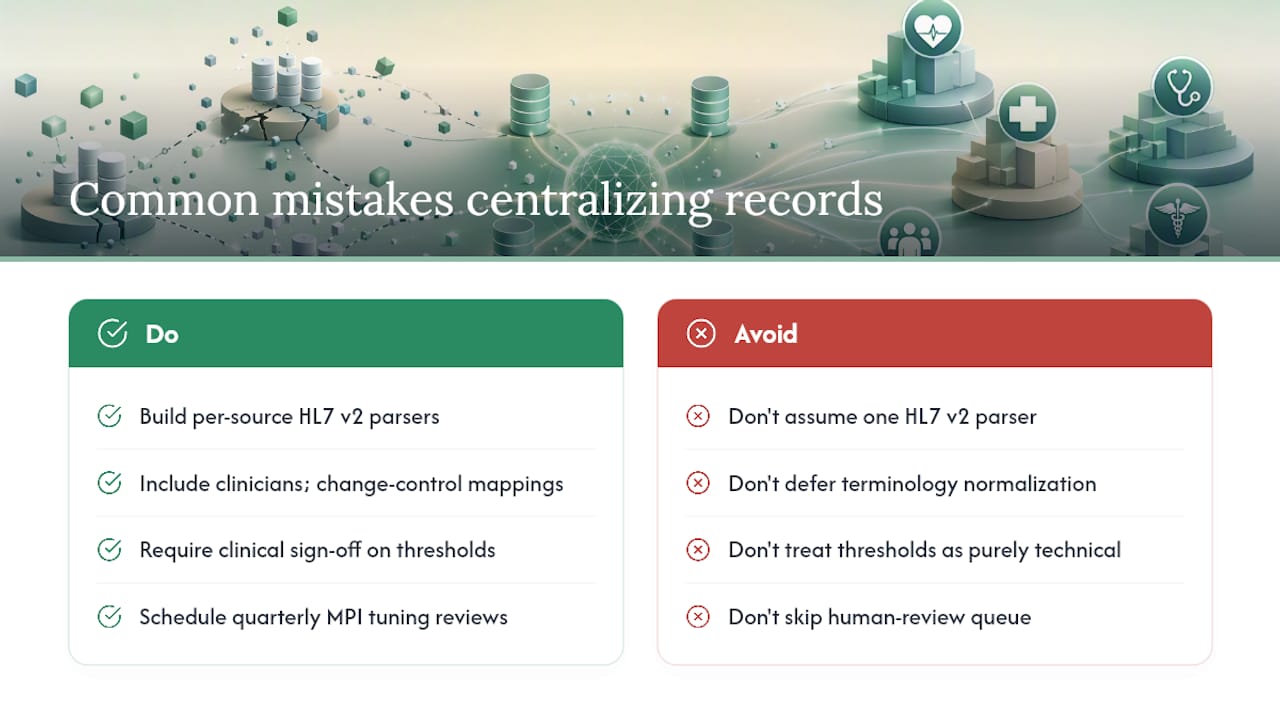
HL7 v2 variability is almost always underestimated. The standard allows significant local customization through Z-segments and optional fields, which means a parser that works perfectly for one hospital’s ADT feed will misread another’s. Build per-source parsers from the start rather than assuming a generic HL7 v2 handler will cover your source population. The engineering investment upfront is far smaller than the data quality remediation cost later.
Terminology normalization gets deferred and then becomes a crisis. Teams often plan to “clean up the codes later” and then discover that their analytics layer is querying against five different representations of the same diagnosis. Include clinical subject matter experts in the mapping process from day one. A data engineer can map syntax; only a clinician can confirm that a local code maps to the correct SNOMED CT concept.
Matching thresholds are treated as purely technical decisions. Setting an auto-link threshold at 0.85 probability sounds like a data science problem, but the consequences of a false merge are clinical. A patient safety officer and a clinical lead should review and sign off on every threshold before it goes into production. Build a human-review queue for scores between your auto-link and auto-reject thresholds, and staff it adequately.
For sustainable operations after go-live, schedule a quarterly tuning review for your MPI matching rules. Source system upgrades, address changes, and demographic data corrections all shift the distribution of match scores over time. A threshold that was well-calibrated at launch will drift without active maintenance. Change-control your terminology mappings the same way you change-control code: every update needs a documented rationale, a clinical review, and a rollback path.
Smartadmissions cuts the time from referral receipt to bed placement decision
Skilled nursing and post-acute facilities that have completed their centralization groundwork still face a specific bottleneck: the referral intake process itself. Assembling clinical documentation, verifying insurance eligibility, and completing a clinical assessment before a bed placement decision still takes hours when done manually, even when the underlying EHR is well-integrated.
Smartadmissions addresses that bottleneck directly. The platform connects to your existing EMR and insurance portals via HL7 and FHIR integrations, pulls referral documentation automatically, runs real-time eligibility verification, and surfaces a clinical assessment summary for your admissions team, all within a single workflow. There is no manual re-entry, no separate portal login for eligibility, and no waiting for a fax to arrive. For facilities evaluating referral management tools, Smartadmissions’s intake automation pairs directly with the centralized record infrastructure this guide describes.
The platform is built for admissions coordinators and directors at skilled nursing facilities and rehabilitation centers, with onboarding measured in days rather than months. If your facility is ready to move from a centralized record strategy to faster, more accurate admissions decisions, see how Smartadmissions integrates with your EMR and request a demo to see the workflow in action.
Sources
These government and standards-body resources are the primary references for any U.S. centralization project. Bookmark them for your compliance and technical teams.
- Centralized healthcare database for ensuring better … – PMC
- Healthit
- Hhs
- Cdc
- Unified Patient Records: A Data Engineering Playbook for Healthcare Interoperability – Nineleaps
This article is general information, not a substitute for advice from a qualified lawyer. Consult a qualified legal professional about your own circumstances before acting on anything here.