
Medicare will cover your skilled nursing facility stay only if you meet three tests at once: you have Part A with benefit days remaining, you had a qualifying inpatient hospital stay of at least 3 consecutive days, and a physician has ordered daily skilled nursing or rehabilitation services. Observation status doesn’t count toward that 3-day stay, and coverage tops out at 100 days per benefit period. Medicare Advantage plans can waive the 3-day rule entirely, so the answer depends partly on which plan you carry.
TL;DR:
- A hospital stay must include at least three consecutive days as an inpatient, excluding observation, ER, or outpatient recovery, to qualify for Medicare coverage.
- Skilled care provided must be daily and involve licensed professionals for services like wound care or therapy, with frequency being a key compliance factor.
- Medicare’s 100-day SNF limit resets with each benefit period, starting after 60 days without inpatient or SNF care, making multiple stays possible.
- Many Medicare Advantage plans can waive the three-day inpatient stay requirement, but verification of coverage and plan rules is essential before admission.
- Proper documentation, physician orders, and pre-admission verification dramatically reduce the risk of coverage denial, especially regarding inpatient status and benefit availability.
Table of Contents
- Medicare Part A Requirements and the Qualifying Hospital Stay Rule
- What Does “Skilled” Care Mean, and Why Does Frequency Matter?
- Benefit Periods, Readmissions, and the 100-Day Limit Explained
- Key Exceptions: Medicare Advantage, Observation Stays, and Denial Triggers
- Steps to Take at Hospital Discharge and Before SNF Admission
- Admissions Team Perspective: Verification and Documentation Best Practices
- An Admissions-Side View on What Actually Prevents Denials
- Sources
Medicare Part A Requirements and the Qualifying Hospital Stay Rule
Part A pays for skilled nursing facility care, but only when you still have benefit days available and you’ve cleared a specific hospital stay threshold first. This isn’t a formality. It’s the gate that determines whether your SNF bill is Medicare’s problem or yours.
The rule that trips up more families than any other: your hospital stay must include at least 3 consecutive calendar days as an admitted inpatient. Time spent under observation status, in the emergency department, or in outpatient surgical recovery does not count, even if you slept in a hospital bed for four nights. Medicare that observation stays and ER time don’t satisfy the 3-day requirement under Original Medicare. Hospitals aren’t always required to tell you your official status, which is why asking directly matters.
Once you clear that threshold, here’s what governs the rest of your stay:
- Medicare Part A covers up to a limited number of days of SNF care per benefit period.
- You generally must enter the SNF within 30 days of hospital discharge.
- A physician must certify that you need daily skilled care related to the hospital stay.
- You need remaining benefit days; a maxed-out benefit period means no coverage until a new one starts.
Quick fact: Medicare.gov confirms the 100-day cap and 3-day qualifying stay are baseline requirements for every beneficiary on Original Medicare, with no exceptions built into the standard program.
What Does “Skilled” Care Mean, and Why Does Frequency Matter?
Medicare draws a hard line between skilled care and custodial care, and that line decides your entire claim. Skilled services must be delivered or supervised by licensed professionals: registered nurses, licensed practical or vocational nurses, physical therapists, occupational therapists, or speech language pathologists. Wound care requiring sterile technique, IV medication administration, and post-stroke rehabilitation therapy all qualify. Help getting dressed or reminders to take medication does not.
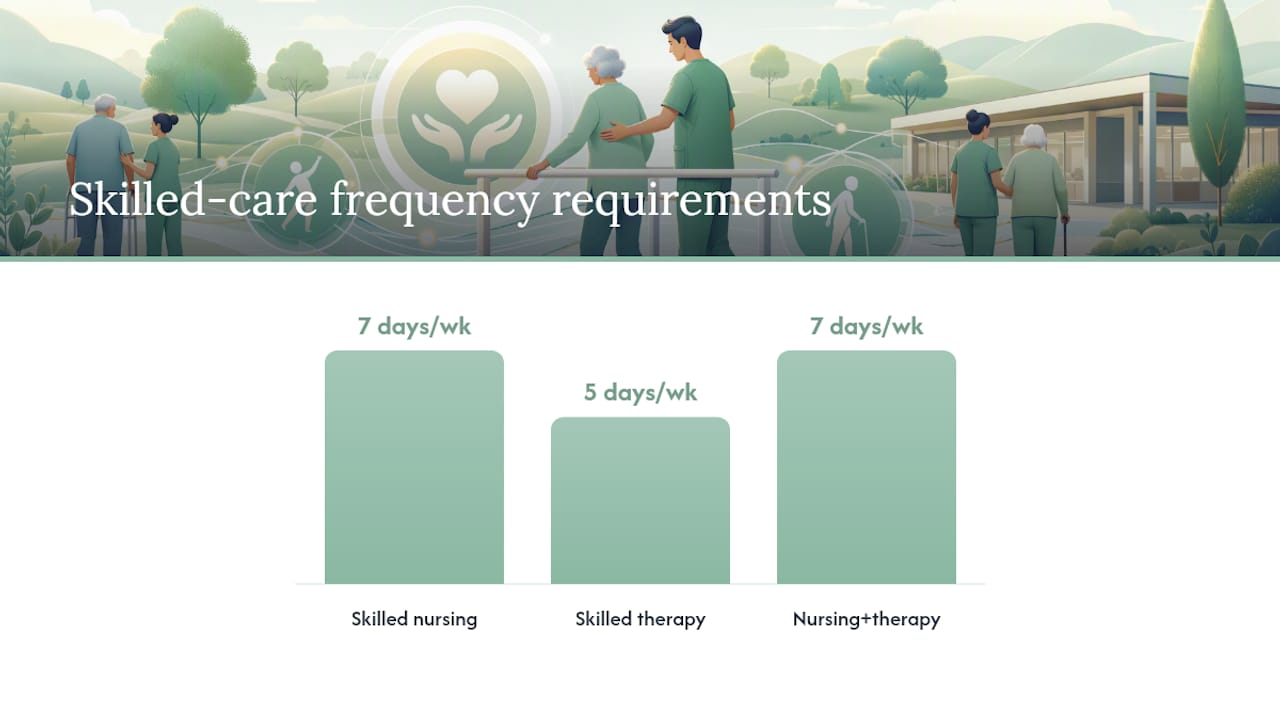
Frequency is where the regulation gets specific. Under 42 CFR §409.31, your need for skilled services generally has to be daily, meaning:
- Skilled nursing needed 7 days a week, or
- Skilled therapy needed at least 5 days a week, or
- A combination of nursing and therapy that adds up to a daily need
The practical test CMS applies: could this service realistically be provided anywhere other than an inpatient SNF setting? If a home health aide could do it, Medicare is less likely to cover it as SNF-level care.
Benefit Periods, Readmissions, and the 100-Day Limit Explained
A benefit period starts the day you’re admitted as a hospital inpatient and ends once you’ve gone 60 consecutive days without any inpatient hospital or SNF care. Every benefit period resets your coverage clock, which means the 100-day SNF limit applies separately to each one, not to your lifetime as a Medicare beneficiary.

This is good news for people who need multiple hospitalizations over the years, and it explains why two patients with similar diagnoses can have very different total coverage.
Readmission timing matters just as much as the initial stay. If you’re discharged from a SNF and need to resume skilled care within 30 days, you typically don’t need a fresh 3-day qualifying hospital stay. Medicare’s own guidance confirms that breaks in care under 60 days preserve your existing benefit period.
- Days 1 to 20: Medicare pays in full.
- Days 21 to 100: a daily coinsurance applies, and you’re responsible for that amount unless a supplemental policy covers it.
- Day 101 onward: Medicare pays nothing until a new benefit period begins.
You’ll also owe the Part A deductible if this hospitalization starts a new benefit period, separate from any SNF coinsurance.
Key Exceptions: Medicare Advantage, Observation Stays, and Denial Triggers
Standard Medicare rules aren’t the whole story once you factor in plan type and paperwork errors. Here’s where coverage gets misread most often:
- Medicare Advantage can waive the 3-day rule. Many MA plans, along with PACE programs and some ACO arrangements, don’t require the inpatient qualifying stay at all. Medicare.gov notes that MA plans must generally cover the same number of SNF days as Original Medicare, but the entry rules can differ significantly. Always check the plan’s Evidence of Coverage before assuming either way.
- Observation status is the single most common trap. A five-night hospital stay under observation orders provides zero progress toward the 3-day inpatient requirement, regardless of how sick the patient was.
- Transfers between hospitals count toward the 3 days as long as each stay was inpatient, but a discharge home followed by a new unrelated admission does not carry over prior days.
- Common denial triggers include care reclassified as custodial after admission, missing physician certification, therapy dropping below the required frequency, and gaps in care exceeding 60 days that quietly ended the benefit period.
Steps to Take at Hospital Discharge and Before SNF Admission
The gap between “Medicare should cover this” and “Medicare denied this” almost always comes down to paperwork collected in the 48 hours around discharge. Here’s what to gather before you sign anything at the SNF:
- Request a written copy of the inpatient admission order and discharge summary showing exact dates.
- Confirm remaining Part A benefit days directly with Medicare or your Medicare Advantage plan.
- Ask specifically whether the plan waives the 3-day rule, since Medicare Advantage rules vary by carrier.
- Get the physician’s order for skilled nursing or rehabilitation care in writing, not verbally.
- Request an Advance Beneficiary Notice if the facility flags any uncertainty about coverage.
Pro Tip: Call 1-800-MEDICARE or your local State Health Insurance Assistance Program (SHIP) counselor before admission, not after a denial arrives. Appeals are winnable, but they take weeks you don’t want to spend arguing instead of arranging care.
Admissions Team Perspective: Verification and Documentation Best Practices
Denials rarely come from bad clinical decisions. They come from timestamp errors, missing signatures, and eligibility checks done too late in the process. CMS billing guidance is clear that services must be reasonable, necessary, and physician-ordered. Admissions staff who verify all three at intake, rather than after the fact, catch problems while they’re still fixable.
A short checklist worth running on every referral:
- Confirm exact inpatient admission and discharge timestamps against hospital records.
- Verify the physician’s order specifically states daily skilled nursing or therapy needs.
- Run real-time insurance eligibility checks before finalizing the bed assignment.
- Log therapy frequency and plan Evidence of Coverage details for MA patients.
Pro Tip: Facilities that build a 10-step eligibility checklist into intake catch missing physician orders before admission, not during an appeal. Document handling also carries privacy obligations. Facilities managing paper referral files should review HIPAA-compliant recycling practices for anything containing protected health information.
Speeding up that verification step is exactly where automated tools help. Automating admissions eligibility checks through real-time insurance verification and EMR integration cuts the manual lookup time that causes documentation gaps in the first place, giving admissions teams a faster path from referral to occupied bed.
An Admissions-Side View on What Actually Prevents Denials
The three eligibility tests, Part A with days left, a genuine 3-day inpatient stay, and a physician order for daily skilled care, sound simple until you’re standing at a nursing station trying to prove them. The 100-day cap gets attention, but it rarely causes denials. Missing documentation does.
My recommendation is blunt: treat verification as the first task, not the last. Confirm inpatient status in writing before discharge, get the physician’s order on paper, and call your plan about MA waivers before assuming the 3-day rule applies. Everything else follows from getting that groundwork right.
— Harry
This article is general information, not a substitute for advice from a qualified doctor. Consult a qualified healthcare professional about your own circumstances before acting on anything here.
Sources
- Medicare
- § 409.31 — Level of care requirement (42 CFR) — govinfo
- Skilled Nursing Facility Billing Reference – MLN006846 — CMS