
Cerner referrals integration means your skilled nursing facility (SNF) receives referrals and clinical documents from hospitals that run Cerner (now Oracle Health) electronically, then sends back an accept or decline decision without re-keying data. In practice it is a mix of standards (HL7 v2, C-CDA, FHIR), a transport method, and a decision process on your side. This guide explains how the workflow runs, what the technology requires, what it costs, and how your admissions team can set it up in five steps.
TL;DR
- Cerner referrals integration moves referral orders and clinical documents from a hospital’s Cerner system to your facility, and carries your accept or decline decision back.
- The ONC-sponsored 360X specification uses C-CDA for clinical content and HL7 v2 messages for referral orders; Oracle’s own APIs use FHIR R4 with OAuth 2.0.
- Building a direct Oracle integration carries real fees and a timeline of weeks to months, so most SNFs benefit from a platform that already handles intake.
- Integration does not decide whether a patient fits. You still need clinical, staffing, payer, and bed criteria applied to every referral.
- Start with a referral audit, define your acceptance rules, then connect, test, and measure.
Table of Contents
- What Cerner referrals integration means for an SNF
- How the referral workflow runs
- What information can move from Cerner to your facility
- Integration methods and technical requirements
- What it costs and how long it takes
- Privacy, security, and data-quality planning
- Five steps to set up Cerner referrals integration
- Our perspective on Cerner referrals integration
- How Smart Admissions fits
- FAQ
- Sources
What Cerner referrals integration means for an SNF
Hospitals using Cerner Millennium generate a discharge plan, a referral order, and a set of clinical documents when a patient needs post-acute care. Integration is the path those items take to your admissions desk. Without it, the same information arrives by fax, portal login, or email, and someone on your team retypes it.
In one HIMSS case study of the Palomar network, Cerner sent discharge summaries, histories and physicals, facesheets, medications, treatment orders, and some lab results to the receiving entity. The same case shows the limit: referral transmissions inside the network were quasi-electronic, while outside providers generally relied on fax. Many SNFs sit outside any single hospital network, so a mixed intake stream is the norm, not the exception.
That is why integration is best thought of as two layers. The first is data exchange: getting the referral and records to you. The second is decision support: deciding quickly and defensibly whether to accept. Standards solve the first layer. Your own rules solve the second.
How the referral workflow runs
The clearest public description of the workflow is the 360X specification for acute-to-long-term-care transfers. It is a two-step exchange: the referring facility sends one request to several potential recipients, and each recipient must accept or decline.
For your team, the sequence looks like this:
- The hospital case manager selects SNFs and sends the referral with a clinical summary.
- Your admissions coordinator reviews the package against your capabilities.
- You respond with an accept or decline, ideally with a reason.
- If accepted, the hospital finishes the transfer plan.
- The loop closes when the complete discharge summary reaches the SNF with an indication that the transfer is complete.
Closed-loop tracking only works when both sides use matching identifiers. The ONC 360X presentation states that the initiator and recipient must use the same patient and referral identifiers so each message ties to the right patient and the right referral. Build identifier handling into your intake rules from day one.
Pre-placement requirements to expect
The 360X workflow calls out “pre-placement requirements,” sometimes called red flags. Examples include pain management, special equipment, and expensive medications, and they are meant to travel with the initial referral package. These are the items that most often decide whether an admission is safe and financially sound, so your review checklist should look for them first.
What information can move from Cerner to your facility
Clinical content in the 360X model travels as C-CDA documents. Oracle’s FHIR APIs expose related data as discrete resources. One of them is relevant to admissions: the Millennium Platform ServiceRequest resource returns referrals, including those generated by Referral Management.
The federal Interoperability Standards Platform also lists referral orders as a data element, noting that they support care coordination and are used to assess appropriate follow-up. That matters because it signals referral data is moving toward standardized exchange across vendors, not only Cerner.
What typically still needs a human:
- Reading narrative notes for behavioral, wound, or therapy details that are not coded.
- Confirming payer authorization and benefit days.
- Checking medication cost against your margin.
- Matching the patient to a specific bed, room, and care team.
Integration methods and technical requirements
There are three technical routes, and they are not mutually exclusive.
| Route | Standards | Best for | Main limit |
|---|---|---|---|
| 360X closed-loop referral | C-CDA, HL7 v2, Direct, XDM | Structured hospital-to-SNF handoffs | Requires both sides to support it |
| Oracle Health FHIR R4 APIs | FHIR R4, HTTPS, OAuth 2.0, SMART | Apps that read referral and clinical data | Requires Oracle enrollment and testing |
| Platform-level intake | Portal, fax, email, plus EHR connection | Facilities with mixed referral sources | Depends on the platform’s configuration |
The 360X presentation lists C-CDA for clinical content, Direct for transport, XDM for context, and HL7 v2 for referral workflow and tracking. On the Oracle side, the Soarian Clinicals documentation states its FHIR R4 APIs run over HTTPS, are secured with OAuth 2.0, and support SMART applications.
If you or your IT partner need bulk data, Oracle’s bulk export documentation says Group Export includes the resources required for USCDI V1. It also recommends using the _type parameter to filter resources, _since for date ranges, and exponential backoff when polling job status. For single-referral intake, bulk export is rarely the right tool; it is more useful for analytics.
For a deeper look at the developer side, see our guides on FHIR referral integration and shipping FHIR referral workflows. If your team is weighing a custom build, a scoping process such as compliant healthcare app development discovery can help you define Cerner API access and secure FHIR requirements before you commit budget.
What it costs and how long it takes
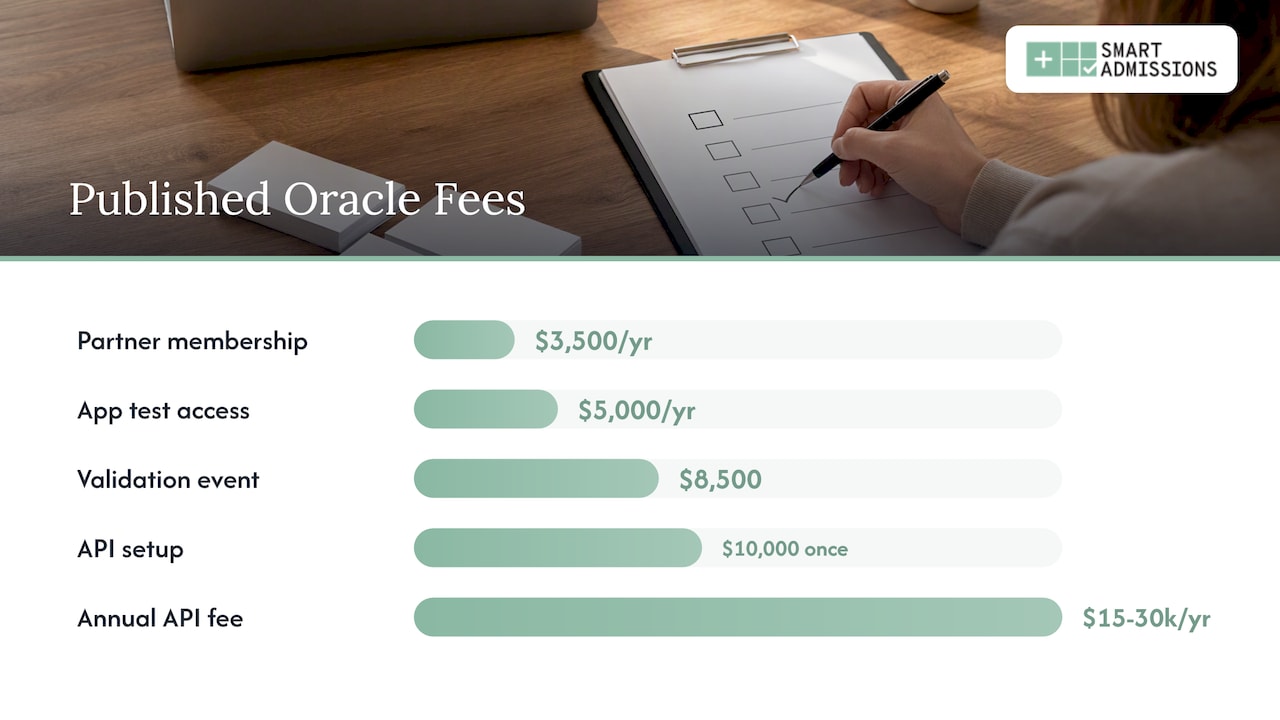
A direct build against Oracle Health is a real project. Oracle’s published partner path is to confirm the Millennium APIs support your use case, enroll in the healthcare program, build and test a SMART-on-FHIR app, and then pursue validation if needed. Its listed fees include $3,500 annually for partner-network and healthcare-track membership, $5,000 annually per app for development and test environment access, and $8,500 per validation event, with optional consulting excluded.
For certified Millennium APIs, Oracle lists a one-time $10,000 setup fee for one production and one nonproduction environment, and annual single-patient API fees from $15,000 to $30,000 for standalone environments, depending on the patient-record tier. These figures are Oracle’s published pricing and can change, so confirm them on the page before budgeting.
Timelines vary by vendor and project. One Cerner integration checklist from an Oracle Health Marketplace vendor estimates 40 to 60 hours over 8 to 10 weeks, and says project-manager assignment may take 10 to 12 weeks. A separate SMART-on-FHIR example reports a typical technical implementation of six to 10 weeks, affected by user count and organizational decision speed. Treat both as examples of what one vendor experienced, not as universal Cerner timelines.
The practical takeaway for an SNF: the technical connection is often the shorter part. Internal decisions, permissions, and staff training usually set the pace.
Privacy, security, and data-quality planning
Your facility is covered by the same interoperability rules as hospitals. ONC states that skilled nursing facilities are classified as health care providers under the Cures Act information blocking rules, so you share the responsibility to exchange data appropriately and not obstruct access.
Plan for these items before you connect anything:
- Access control: limit who can view referral packages, and log every view.
- Identity matching: agree on patient and referral identifiers with each sending hospital.
- Authentication: require OAuth 2.0 for API access, and consider hardware-backed multifactor sign-in for staff accounts.
- Data quality: decide how your team handles missing medication lists, outdated facesheets, and conflicting diagnoses.
- Retention: define where referral documents live once a referral is declined.
The 360X framework exists partly to reduce these problems. It aims to mitigate missing clinical information, unnecessary delays, and inefficiency when selecting and transferring a patient to an SNF. It does not remove the need for your own review.
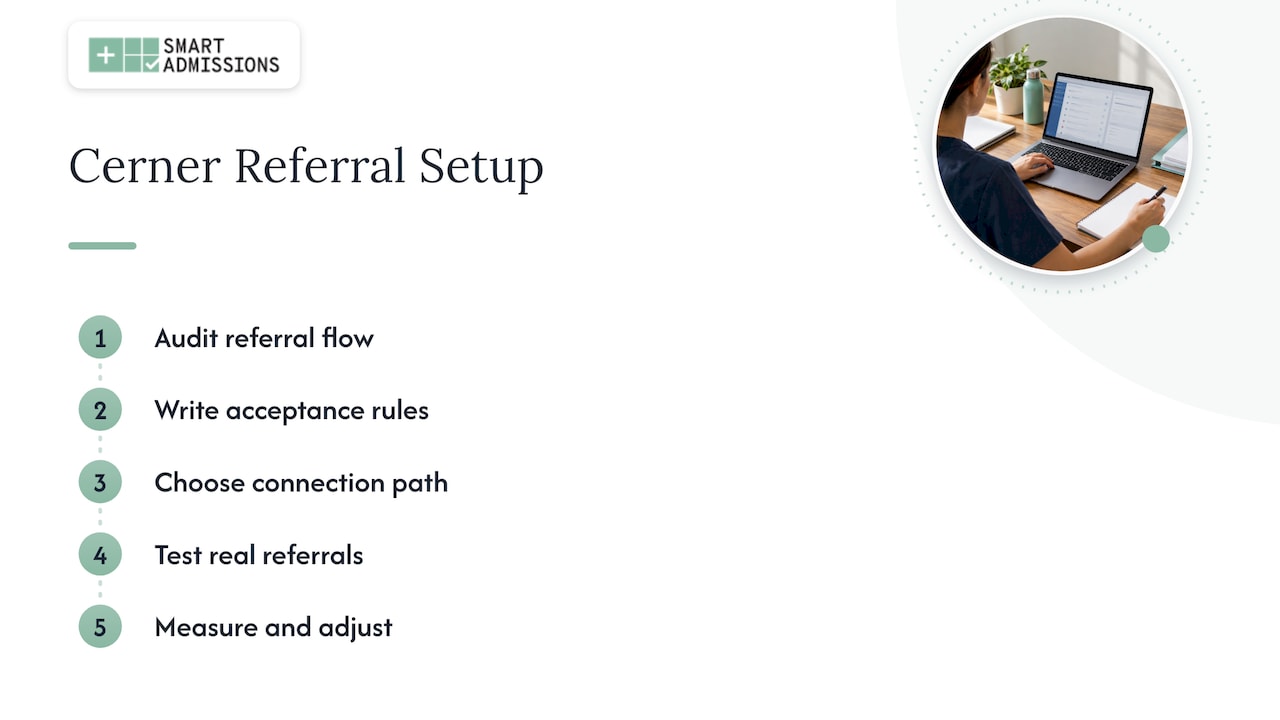
Five steps to set up Cerner referrals integration
Step 1: Audit your current referral flow
Count referrals by channel (portal, fax, email, direct EHR message), measure response time, and record why you decline. Our referral audit checklist gives a six-step structure for this, and the post-acute referral process guide shows where delays typically appear.
Step 2: Write your acceptance rules
Researchers studying Cerner Millennium Care Pathways concluded that referral tools must be aligned with local staffing, workflows, service agreements, practice patterns, and facility capabilities. The same applies to you. Document what you can clinically support, which payers and PDPM case-mix groups work for your finances, and which medications you cannot absorb.
Step 3: Choose the connection path
If your hospital partners support 360X or FHIR exchange, ask their IT teams which route they prefer. If your referrals come from many hospitals on different systems, a platform that reads every channel is usually faster to deploy than a custom Oracle build. Our EMR integration walkthrough explains how to connect referrals to your record system.
Step 4: Test with real referrals
Run a pilot with one or two referral sources. Check identifier matching, document completeness, and the accept or decline loop. Log every case where staff had to retype or call.
Step 5: Measure and adjust
Track response time, acceptance rate, lost referrals, and referral source mix. The referral dashboard design guide outlines four elements worth showing leadership. Faster answers also strengthen hospital relationships, as covered in why response times matter in skilled nursing.
Our perspective on Cerner referrals integration
We see integration as necessary but not sufficient. A clean feed from a hospital system gets the referral to your desk faster, yet your admissions director still has to answer one question: can we care for this patient, and can we afford to?
That is why Smart Admissions is built as a facility-specific decision engine rather than a pipe. It reads referrals however they arrive, whether through a hospital portal, fax, or email, then evaluates each one against your clinical capabilities, staffing, payer mix, PDPM reimbursement, and bed availability. Each referral is summarized and scored, and med cost alerts flag high-cost drugs before acceptance. The platform is EHR-independent and integrates with PointClickCare, so accepted referrals flow into existing workflows without duplicate entry.
Our team has worked in admissions, MDS, and reimbursement, so we build around the reality that a yes must be confident and a no must be defensible. Integration should shorten the path to that decision, not replace the judgment behind it.
— Harry
How Smart Admissions fits
If your referrals come from Cerner hospitals and many other sources, you can evaluate all of them in one place. Smart Admissions is a subscription platform priced at $597 per month or $6,447 per year, as published on our pricing page. You can see the workflow on how it works or start with the free trial to test it on your own referrals.
FAQ
Does Cerner have a built-in referral feature for SNFs?
Cerner Millennium includes referral ordering and care pathway tools, and Oracle’s FHIR ServiceRequest resource can return referrals, including those from Referral Management. How a given hospital configures and sends them to outside SNFs varies. Ask each hospital partner which route and format it uses.
Do I need FHIR or HL7 to receive Cerner referrals?
Not always. Many SNFs still receive referrals by portal, fax, or email. HL7 v2 and C-CDA appear in the 360X specification, and FHIR R4 is Oracle’s API standard. Your choice depends on what your hospital partners support and how much you want to automate.
How long does a Cerner integration take?
Published vendor examples range from about six to 10 weeks for technical implementation, and one checklist notes project-manager assignment may take 10 to 12 weeks. These are individual vendor estimates, so your timeline depends on scope, approvals, and staff availability.
Does integration decide which patients I should accept?
No. Integration delivers the referral and its documents. You still need rules for clinical fit, staffing, payer mix, medication cost, and bed availability, and a way to apply them consistently to every referral.
Sources
- 360X and Long Term Care Transfers, ONC
- 360X Closed-Loop Transitions of Care presentation, HealthIT.gov
- Sharing Data Across the Care Continuum, HIMSS
- ServiceRequest API, Oracle Health Millennium Platform
- Referral Order, Interoperability Standards Platform
- R4 Overview, Oracle Soarian Clinicals APIs
- FHIR R4 Bulk Export, Oracle Health
- Integrated with Oracle Health Millennium Platform API
- Certified Health IT, Oracle Health
- Cerner integration checklist, Oracle Health Marketplace
- Cerner SMART-on-FHIR implementation overview
- Information Blocking Actors, ONC
- Cerner Millennium’s Care Pathways for Specialty Care Referrals, PMC