
The case mix index SNF teams track is a number that describes how much care a resident is expected to need, and it directly shapes what Medicare pays for that stay. Federal regulation defines it as a scale measuring the relative difference in resource intensity among groups in the SNF resident classification system. A higher index means higher expected resource use. Under the Patient Driven Payment Model (PDPM), that index is attached to each resident’s payment groups, so every admission decision and every MDS assessment moves it.
This guide explains what the SNF case mix index is, how it works under PDPM, what it does and does not tell you, and five steps your team can take to keep it accurate and useful.
TL;DR
- The case mix index SNF providers use is a relative weight for resident resource needs. Under PDPM, each resident lands in a payment group per component, and each group carries its own CMI.
- PDPM has five case-mix adjusted components: PT, OT, SLP, NTA and nursing. Accurate MDS 3.0 coding decides which groups a resident falls into.
- A facility’s CMI is an average. It supports staffing, care planning and financial review, but it never replaces individual assessment.
- Admissions is where CMI starts: the referral you accept sets the clinical profile your MDS team will code and your clinical team will care for.
- Five steps keep CMI accurate: screen referrals for clinical fit, document diagnoses fully, code on time, review trends monthly, and compare acuity with staffing and cost.
Table of Contents
- What case mix index means for a skilled nursing facility
- How the case mix index SNF payment system works under PDPM
- How CMI affects Medicare reimbursement
- Five steps to keep your SNF case mix index accurate
- Common mistakes that distort the index
- Our perspective: CMI starts at the referral
- Put referral data behind your CMI decisions
- FAQ
- Sources
What case mix index means for a skilled nursing facility
Case mix is the mix of resident types in your building, described by their needs rather than by who pays for them. An early CMS study of nursing home payment described facility case mix as an amalgamation of measures of the types of residents or their needs. The index turns that idea into a number.
The same CMS research describes a group’s index as its resource use relative to a base level. In the RUG-II methodology it cited, the base was the average resource use across all groups. So an index above the base signals a resident group expected to cost more to care for, and an index below it signals a group expected to cost less.
Two points matter for daily work:
- The index belongs to a classification group, not to a person’s worth or a facility’s quality. It is a payment and resource-planning tool.
- A facility-level CMI is an average across residents. One complex admission can move it, and a building with many short stays can swing quickly.
Case mix index vs. hospital CMI vs. payer mix
These three terms get mixed up in admissions meetings, and the search results for this keyword mix them too.
| Term | What it measures | Where it is used |
|---|---|---|
| SNF case mix index | Relative resource intensity of resident classification groups | SNF Medicare payment under PDPM |
| Hospital CMI | Average relative DRG weight of a hospital’s inpatient discharges | Hospital reimbursement and reporting, based on MS-DRGs |
| Payer mix | The share of your days or revenue by payer, such as Medicare, Medicaid or managed care | Census and margin planning |
DRGs are a hospital case-mix system, while nursing home case mix can be measured from resident-level characteristics and needs. Payer mix is a facility characteristic. A building can have a high CMI and a weak payer mix, or the reverse, which is why we look at both. For the payer side, see our guide to payer mix analysis and the KPIs finance leaders track.
How the case mix index SNF payment system works under PDPM
PDPM is the Medicare Part A SNF classification model, in use since October 1, 2019. It replaced a system that leaned heavily on therapy minutes. The Acumen report prepared for CMS explains that the change aimed to base payment on resident characteristics and resource use rather than on the volume of therapy delivered.
The five components and their groups
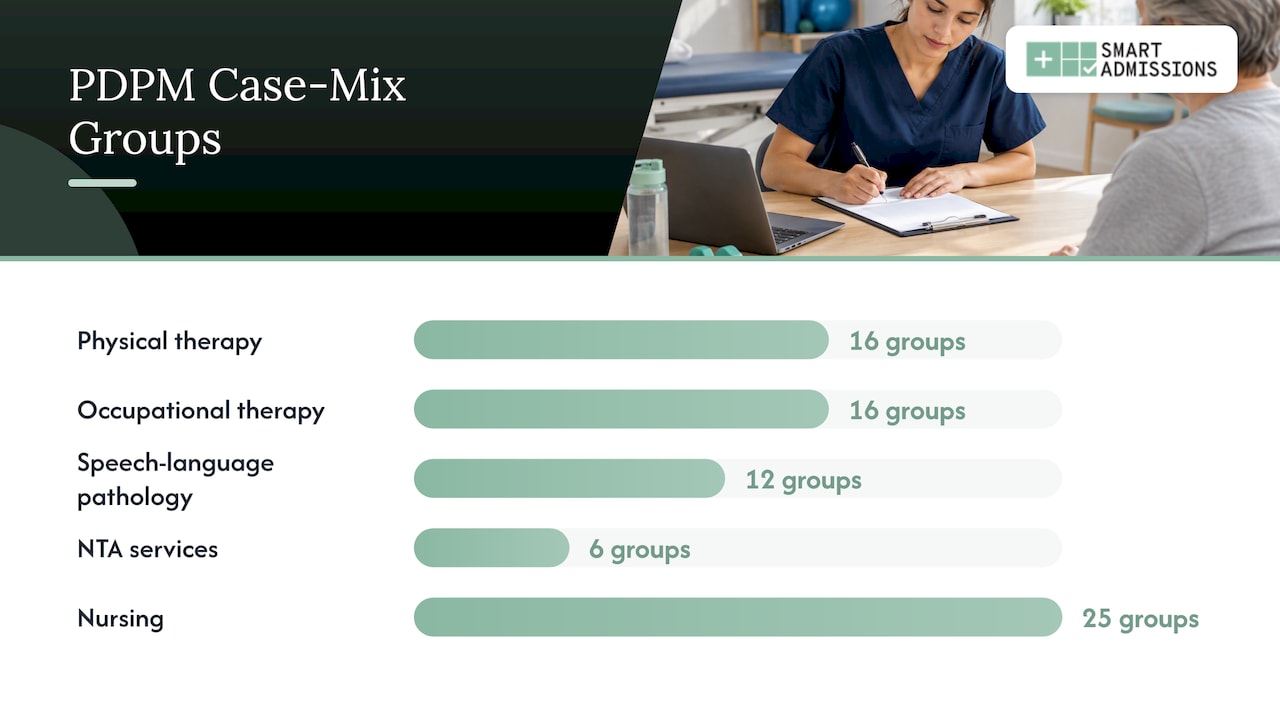
PDPM sorts each resident into payment groups across five case-mix adjusted components: physical therapy, occupational therapy, speech-language pathology, non-therapy ancillary (NTA) services and nursing. According to the CMS PDPM calculation worksheet, each patient is classified into one group per component using the relevant MDS 3.0 data, and each group has an associated CMI and base rate.
The AHCA PDPM FAQ lists 16 PT, 16 OT, 12 SLP, 6 NTA and 25 nursing case-mix groups, each with its own index and base rate. The same worksheet notes that variable per diem adjustments apply to PT, OT and NTA over the length of the stay.
A simple way to picture the math
For a case-mix component, the payment idea is the component’s base rate multiplied by the CMI of the resident’s group. The numbers below are illustrative only, not real CMS rates or indexes:
- Component base rate: $100 (illustrative)
- Resident A, group CMI 1.0: $100 for that component
- Resident B, group CMI 1.5: $150 for that component
Repeat that across all five components, add the non-case-mix portion, adjust for wage index, and you have the daily rate. Real base rates and CMIs are published by CMS each fiscal year, so always pull the current tables from the official SNF PPS page.
How CMI affects Medicare reimbursement
Under the SNF PPS, payment rates are adjusted for case mix and geographic wage variation, and they are meant to cover all costs of furnishing covered SNF services. CMS updates them annually with a market basket index. The federal regulation states that the federal rate is adjusted for facility case mix using the resident classification system and the resident assessment instrument SNFs complete.
In practice, that creates a chain your team controls:
- The referral you accept determines the clinical profile of the resident.
- The MDS assessment records that profile.
- The coded MDS places the resident into PDPM groups.
- The groups carry the CMIs that adjust your per diem.
If a link in that chain is weak, the payment does not reflect the care you provide. A missed diagnosis on the MDS lowers the group. A late assessment can disrupt the payment tied to it. And an admission that was never a clinical or financial fit creates cost no index can offset.
Five steps to keep your SNF case mix index accurate
These steps are designed for admissions directors, MDS coordinators and administrators working together. None of them involves inflating acuity. The goal is that your CMI describes the residents you really have.
Step 1: Screen referrals for clinical and financial fit
CMI starts before the resident arrives. CMS researchers found that clinical characteristics, ADL assistance levels and skilled services such as IV medication were among the most reliable predictors of SNF resident resource costs. Those are the same details sitting in a hospital referral packet.
Build a pre-admission review that reads for:
- Primary and secondary diagnoses, and which ones affect PDPM groups
- Expected therapy needs and discharge goals
- High-cost medications and IV therapies
- Functional status and cognitive or behavioral needs
- Whether your staffing and clinical capabilities can safely support the resident
Our 15-minute PDPM pre-admission checklist walks through the revenue-relevant items, and the PDPM admission workflow shows how to sequence them.
Step 2: Confirm eligibility before you accept
An accurate CMI does not help if the stay is denied. Verify the qualifying hospital stay, skilled need and benefit days up front. Our guides to the three tests for Medicare SNF eligibility and the 10-step patient eligibility checklist give your team a repeatable process. Do not skip PASRR requirements, which can delay payment when they are missed.
Step 3: Capture the complete clinical picture on the MDS
Facilities assess residents with the Resident Assessment Instrument (RAI) and must code it as CMS specifies, within the time periods CMS sets. The Minnesota Department of Health explains that PDPM assessments record ADL scores, diagnoses, medical treatments and cognitive and behavioral status.
A few habits help:
- Ask the hospital for complete discharge records, not just the summary.
- Have the MDS coordinator review the admission packet on day one.
- Query physicians when a documented condition lacks supporting diagnosis detail.
- Code only what is documented and clinically supported.
Good documentation protects you in two directions. It supports appropriate payment, and it holds up in an audit.
Step 4: Hold a monthly CMI review
Treat CMI like any other operating metric. Once a month, bring MDS, nursing, therapy, finance and admissions together and look at:
- Facility average CMI by component, and the trend over several months
- Outliers: residents whose groups look unexpectedly low or high
- Referral sources that send higher or lower acuity residents
- Referrals you declined and why
Ask whether a lower index reflects a real change in your residents or a documentation gap. Ask the reverse when it rises.
Step 5: Connect CMI to staffing, care planning and cost
CMS research describes case-mix information as useful beyond payment: relating resident mix to facility service capacity, costs, revenues and quality-assurance monitoring. A 2025 guide published in the Journal of the American Geriatrics Society uses resident case mix to link resident needs to expected nurse staffing and to support facility staffing assessments.
Leaders can use the index to:
- Forecast workload and capacity by unit
- Translate aggregate acuity into scheduling needs
- Compare expected resource needs with cost and revenue
- Plan which referral types fit the beds you will have open
Keep the limits in view. CMI is an average and a resource signal. It cannot substitute for individualized assessment, accurate documentation or applicable staffing rules.
Common mistakes that distort the index
Most CMI problems are process problems, not math problems. Watch for these:
- Reading only the referral summary. Key diagnoses and treatments often sit deeper in the packet.
- Accepting first, reviewing later. The resident’s profile is set at acceptance, so the review has to come before it.
- Ignoring medication cost. A high-cost drug can erase the margin from a strong payment group.
- Treating CMI as a goal. It is a reflection of your residents. Chasing the number instead of fit and quality leads to poor decisions.
- Working in silos. Admissions, MDS and finance each hold part of the picture.
Our perspective: CMI starts at the referral
We built Smart Admissions because we have worked in admissions, MDS and reimbursement, and we have seen how often the case mix index is treated as an MDS problem when it begins as an admissions decision.
By the time an assessment is coded, the clinical profile is already set. The referral you said yes to decides what your clinicians will manage and what your PDPM groups will look like. That makes the first ten minutes of referral review the most valuable minutes in the revenue cycle.
Speed is table stakes, because hospitals expect answers fast. What matters is whether the answer is right for your facility. That is why our platform acts as a facility-specific decision engine. It reads each referral, whether it arrives by portal, fax or email, and evaluates it against your clinical capabilities, staffing, payer mix, PDPM reimbursement and bed availability. Each referral is summarized and scored, so your team can give a confident yes or a defensible no.
Med cost alerts flag high-cost medications before acceptance, and PDPM-aware scoring shows the reimbursement picture up front. Leadership can then see referral sources, response times, acceptance rates and lost opportunities, which gives your monthly CMI review real context.
More right admissions means fewer costly mistakes. That is the outcome we design for.
Harry
Put referral data behind your CMI decisions
If your team reviews referrals by hand, the details that drive CMI, payer mix and medication cost are easy to miss under time pressure. Smart Admissions is EHR-independent and integrates with PointClickCare, so accepted referrals flow into existing workflows without duplicate entry. You can see how the platform works or review the pricing page: the plan is $597 per month, or $6,447 per year when billed annually.
For related reading, see our overview of data-driven admissions decisions for skilled nursing facilities and our guide to reducing admission denials.
FAQ
What is a good case mix index for a SNF?
There is no single target, because the index depends on the resident groups you serve, your services and your market. A facility with a strong short-stay rehab program will look different from one focused on long-term care. Compare your own trend over time and against your documented resident acuity rather than chasing an outside number.
How is the SNF case mix index calculated?
Under PDPM, CMS classifies each resident into one group for each of five components using MDS 3.0 data. Each group has an assigned CMI, and it is applied to that component’s base rate. The facility average is a summary of those resident-level groups.
Does a higher CMI mean better care?
No. A higher index indicates higher expected resource use, not higher quality. Quality is measured separately, and the index does not replace individualized assessment or documentation of the care a resident actually needs.
How is SNF CMI different from payer mix?
CMI describes resident needs and expected resource intensity. Payer mix describes who pays for your days. You need both: acuity that your staff can serve, and a payer mix that sustains the building.
Can admissions teams influence CMI?
Yes, through which referrals they accept and how complete the clinical information is at intake. They cannot, and should not, change what residents need. Their influence is in fit: matching clinical capability, staffing, medication cost and bed availability to each referral before saying yes.
Sources
- eCFR: 42 CFR Part 413 Subpart J, Prospective Payment for SNFs
- CMS: Case Mix for Nursing Home Payment, Resource Utilization Groups
- CMS: Patient Driven Payment Model
- CMS: SNF PDPM Technical Report (Acumen)
- CMS: PDPM Calculation Worksheet for SNFs
- CMS: Skilled Nursing Facility PPS
- AHCA: Patient Driven Payment Model FAQ
- Minnesota Department of Health: What is Case Mix?
- Journal of the American Geriatrics Society: Nursing Home Guide to Adjusting Nurse Staffing for Resident Case Mix