
Your admissions coordinator just spent 45 minutes squinting at a faded DD214 from 1978. She's cross-referencing service codes, trying to confirm veteran eligibility, and she's not even sure she's reading it correctly. Meanwhile, three other referrals are sitting in the queue. The hospital discharge planner is calling for an update. And your competitor down the street? They already said yes to a referral you haven't even opened yet.
This scene plays out in SNFs across the country every single day. And while nobody's tracking it on a spreadsheet, those minutes add up to thousands of dollars in hidden staff time that's quietly bleeding from your bottom line.
Let's break down exactly what manual DD214 checks are really costing you, and why the math makes automation a no-brainer.
The Time Sink Nobody Talks About
Here's the thing about manual DD214 verification: it looks simple on paper. Pull the document, check the boxes, confirm eligibility. Easy, right?
Not even close.
The reality is that DD214 format variations span seven decades of military history. Your staff might be looking at a crisp digital scan from 2020 or a barely legible carbon copy from the Vietnam era. Each version has different layouts, different terminology, and different locations for critical eligibility information.
A typical manual DD214 check involves:
- Locating the document in a referral packet (often buried in dozens of pages)
- Identifying the DD214 version and finding where key fields are located
- Deciphering faded text or poor-quality scans
- Cross-referencing service codes against eligibility requirements
- Verifying discharge status and character of service
- Documenting findings for compliance purposes
- Following up on incomplete or illegible documents
Conservative estimates put this process at 15-25 minutes per veteran referral when everything goes smoothly. When the document is damaged, faded, or an unfamiliar format? You're looking at 45 minutes or more, plus the time spent tracking down a clearer copy.

Let's Do the Math (It's Not Pretty)
Time to get specific about what this really costs your facility.
The baseline calculation:
- Average admissions coordinator salary: $22-28/hour (let's use $25)
- Average time per manual DD214 check: 20 minutes
- Cost per verification: ~$8.33
Seems manageable, right? Now let's scale it up.
Monthly volume scenario:
If your facility processes 50 veteran referrals per month:
- 50 referrals × 20 minutes = 16.7 hours of staff time
- 16.7 hours × $25/hour = $417/month just on DD214 verification
But here's where it gets worse. That 20-minute average assumes your staff finds what they need on the first try. It doesn't account for:
- Re-work when documents are illegible (add 15-30 minutes per incident)
- Phone calls to families requesting clearer copies (15+ minutes each)
- Supervisor involvement for unfamiliar formats or edge cases
- Corrections when verification errors are caught later
- Compliance documentation time for audit trails
When you factor in these hidden time drains, that 20-minute average often balloons to 35-40 minutes per referral. Suddenly, your monthly cost doubles.
The real monthly cost: $700-900+ for a facility processing 50 veteran referrals
And we haven't even talked about the opportunity cost yet.
The Opportunity Cost Nobody Calculates
While your admissions coordinator is deciphering a 1972 DD214, she's not doing other critical tasks:
- Responding to new referrals
- Following up with discharge planners
- Processing insurance verifications
- Building relationships with referral sources
In competitive markets, speed wins. The facility that responds to a referral in 5 minutes has a massive advantage over the one that takes 45 minutes. Every minute your staff spends on manual DD214 checks is a minute they're not capturing new admissions.
Let's say that delayed response time costs you just two admissions per month. At an average daily rate of $300-400 and an average length of stay of 25 days, that's:
- 2 admissions × 25 days × $350 = $17,500 in lost revenue per month
Now the $700 in direct staff costs looks like pocket change compared to the beds you're not filling.

Why Format Variations Make Everything Worse
The DD214 hasn't stayed consistent over the decades. Far from it.
As we detailed in our deep-dive on DD214 format variations, your admissions team might encounter:
- Pre-1950 formats with completely different layouts
- Vietnam-era carbons that have faded to near-illegibility
- Multiple DD214 versions (Member-1 vs. Member-4) with different information included
- Handwritten entries that require interpretation
- Alphanumeric service codes that have changed meaning over time
Each variation requires specialized knowledge to verify correctly. Most admissions staff aren't military records experts, they're healthcare professionals trying to fill beds. Asking them to become experts in 70+ years of military documentation formats is unrealistic and inefficient.
This knowledge gap leads to:
- Verification errors that create compliance issues down the line
- Unnecessary rejections of eligible veterans due to misread documents
- Delays while staff research unfamiliar formats
- Inconsistent processes depending on who handles the referral
The result? More time, more errors, and more money walking out the door.
The Automation ROI Is Impossible to Ignore
Here's where the math flips in your favor.
Automated DD214 verification using AI-powered document recognition can:
- Process documents in seconds instead of 20-45 minutes
- Accurately read faded or damaged text that humans struggle with
- Recognize all format variations without staff training
- Create automatic audit trails for compliance
- Flag potential issues before they become problems
When you reduce referral review time from 45 minutes to 5, the savings stack up fast:
Direct time savings:
- 50 referrals × 35 minutes saved = 29 hours/month
- 29 hours × $25/hour = $725/month in direct staff cost savings
Productivity gains:
- Staff redirected to revenue-generating activities
- Faster response times to new referrals
- Reduced re-work and error correction
Revenue capture:
- Faster admissions decisions mean more accepted referrals
- Fewer eligible veterans incorrectly rejected
- Stronger relationships with discharge planners who value speed
For most facilities, the ROI on automated DD214 verification pays for itself within the first month, and keeps paying dividends every month after.
What This Looks Like in Practice
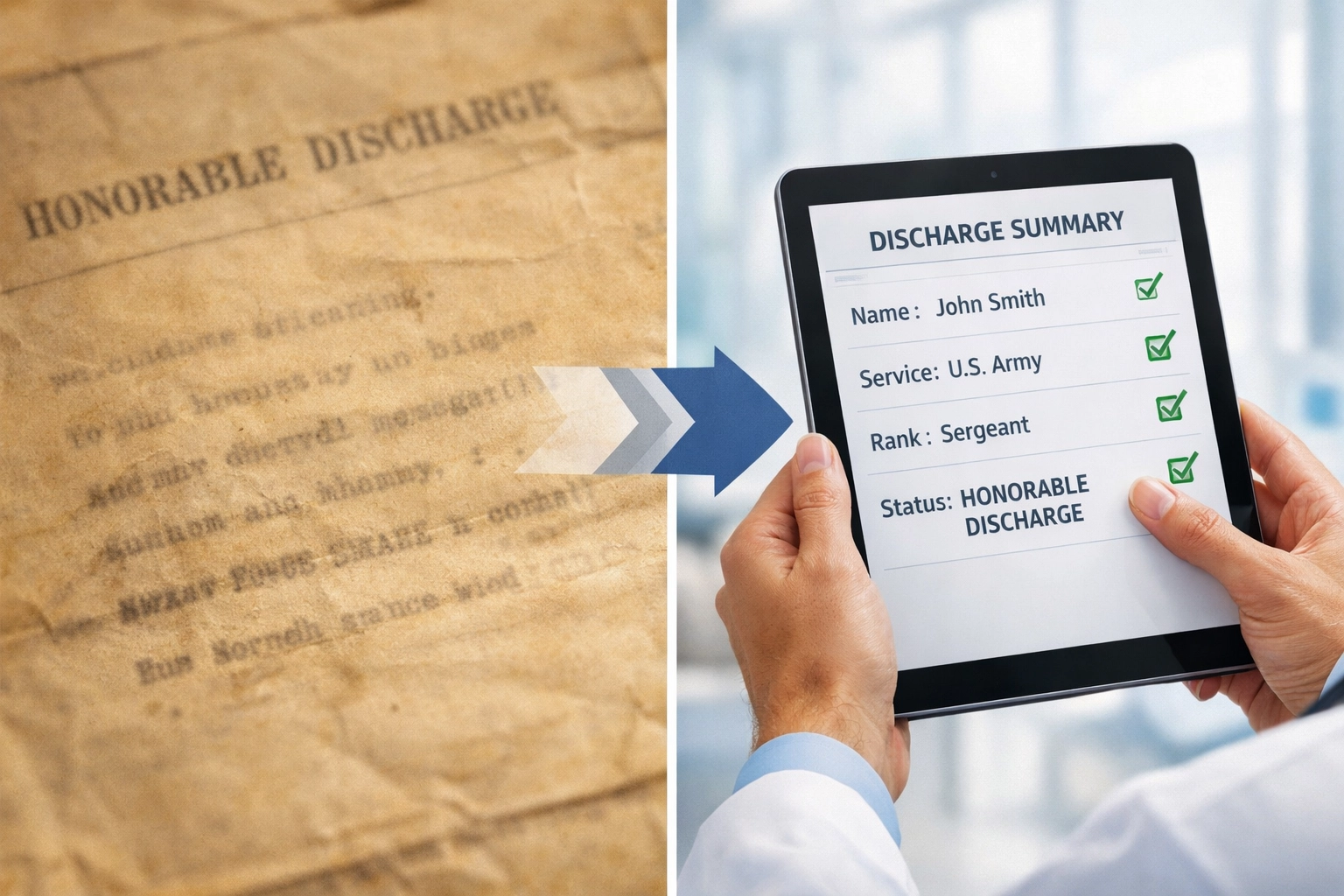
Imagine your admissions coordinator receives a veteran referral at 2:15 PM. Instead of pulling the DD214 and spending the next half hour trying to decipher it, she uploads the document to an automated system.
By 2:16 PM, she has:
- Confirmed veteran status
- Verified eligibility for VA benefits
- Flagged the service dates and discharge status
- Generated a compliance-ready audit trail
She picks up the phone, calls the discharge planner, and accepts the referral before 2:20 PM. The bed is filled. The competitor never had a chance.
That's the difference between manual vs. automated patient intake. It's not just about saving staff time, it's about transforming how quickly your facility can say "yes" to the right referrals.
Stop Bleeding Money on Manual Processes
The thousands of dollars you're losing to manual DD214 checks aren't showing up on any budget line item. They're hidden in staff overtime, lost referrals, compliance corrections, and missed opportunities. But they're real, and they're adding up every single day.
The good news? This is a solvable problem. Automated DD214 verification isn't futuristic technology: it's available right now, and facilities across the country are already using it to verify eligibility in seconds instead of minutes.
Ready to see what automation can do for your facility? Visit us at NASVH Booth #6, or book a demo to see exactly how much time and money you can save.
Your staff has better things to do than squint at faded military documents. Let's fix that.