
Managing admissions without clear visibility into bed availability can lead to frustrating delays, stressed staff, and missed opportunities for better patient care. For admissions coordinators at skilled nursing facilities, efficient bed management is more than a logistical task—it is essential to smooth patient transitions and facility performance. This article explores proven strategies and the latest automated solutions that help reduce manual workload, enhance communication, and keep every bed working at its highest value.
Table of Contents
- Defining Bed Management In Healthcare
- Types And Key Processes Of Bed Management
- The Role Of Technology And Automation
- Benefits For Patient Care And Facility Revenue
- Common Challenges And Mistakes To Avoid
Key Takeaways
| Point | Details |
|---|---|
| Effective Bed Management | Optimizes patient flow and resource allocation, improving both patient care and operational efficiency. |
| Technological Integration | Leverage advanced software and automation to track real-time bed availability and enhance communication across departments. |
| Proactive Approach | Shift from reactive logistics to a strategic, data-driven management strategy that anticipates patient needs and optimizes resource utilization. |
| Continuous Improvement | Implement performance metrics and regular interdepartmental reviews to identify and address inefficiencies in bed management processes. |
Defining Bed Management in Healthcare
Bed management is a strategic operational process that healthcare facilities use to optimize patient flow, bed allocation, and overall facility efficiency. At its core, this discipline involves carefully coordinating patient admissions, transfers, and discharges to ensure maximum utilization of limited hospital resources.
Healthcare organizations implement bed management strategies to address complex challenges in patient care delivery. Critical operational practices include:
- Coordinating patient admissions and discharges
- Tracking real-time bed availability
- Managing patient unit assignments
- Minimizing wait times and potential bottlenecks
- Balancing patient needs with institutional capacity
The fundamental goal of bed management goes beyond simple logistics. It represents a holistic approach to healthcare operations that directly impacts patient experiences, organizational efficiency, and financial performance. Effective bed management requires sophisticated coordination between multiple departments, including nursing, administration, patient intake, and clinical teams.
Bed management is not just about moving patients around – it’s about creating a seamless, responsive healthcare ecosystem that prioritizes patient care and operational excellence.
Technological solutions have become increasingly critical in modern bed management strategies. Advanced software platforms now enable real-time tracking, predictive analytics, and automated workflow management to streamline complex patient placement processes.
Pro tip: Implement a centralized bed management system that provides real-time visibility across all hospital units to reduce patient wait times and improve overall operational efficiency.
Types and Key Processes of Bed Management
Healthcare facilities employ multiple sophisticated bed management strategies designed to optimize patient flow and resource allocation. Tactical bed management processes involve complex methodologies that balance institutional needs with patient care requirements.
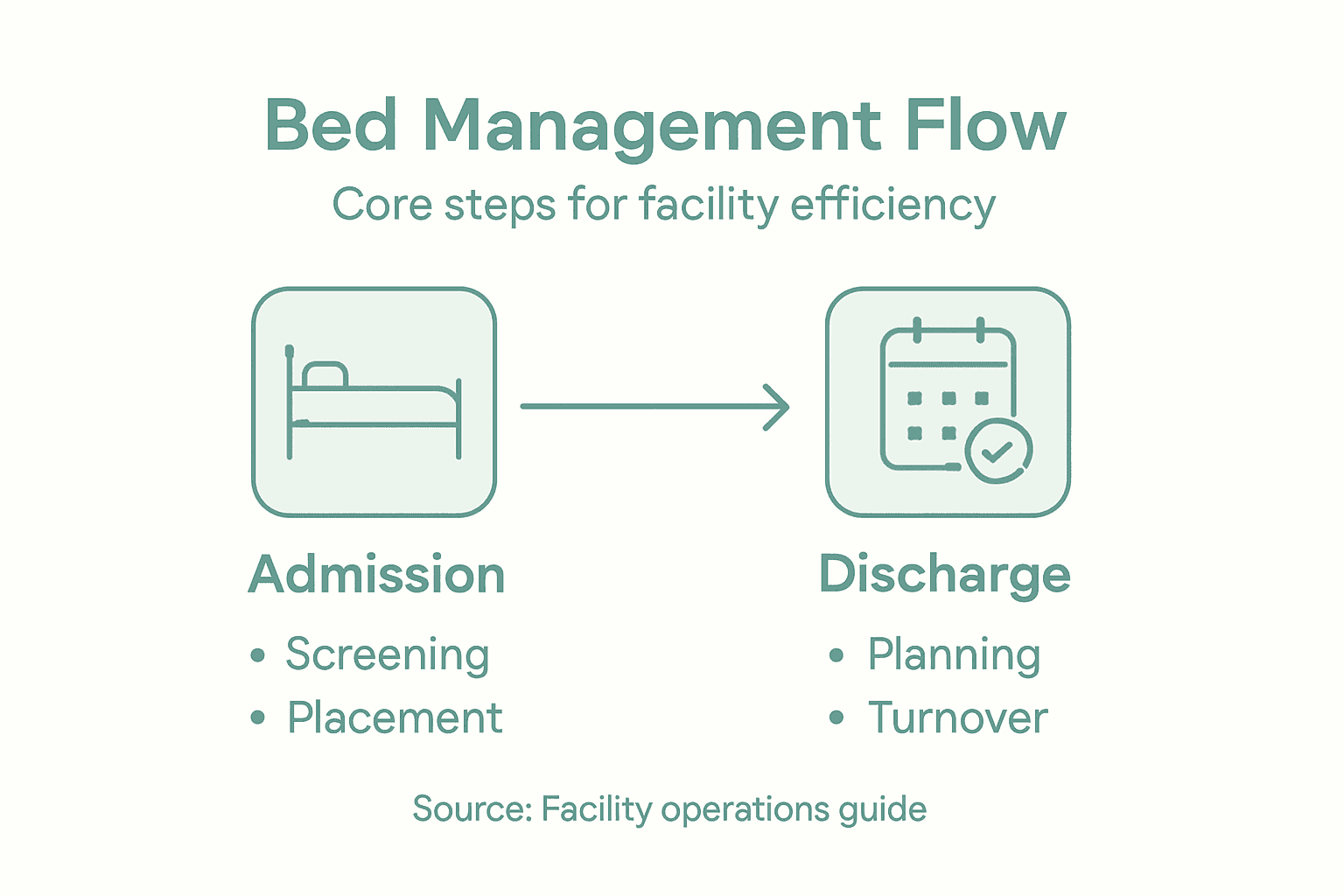
The primary types of bed management strategies include:
Here’s a comparison of key bed management strategies and their optimal use cases:
| Strategy Type | Ideal Use Case | Resource Flexibility |
|---|---|---|
| Pooled Bed Management | Multi-unit hospitals with variable demand | High |
| Focused Bed Management | Specialty units like ICU or maternity | Moderate |
| Flexible Bed Allocation | Facilities with unpredictable admission | Maximum |
| Service-Specific Clustering | Hospitals with multiple specialties | Selective |
- Pooled Bed Management: Centralizing bed resources across multiple units
- Focused Bed Management: Dedicating beds to specific clinical specialties
- Flexible Bed Allocation: Dynamic reassignment of beds based on real-time demand
- Service-Specific Clustering: Grouping beds according to clinical service requirements
Key operational processes in bed management encompass several critical functions. These typically involve:
- Admission control and screening
- Patient placement optimization
- Discharge planning coordination
- Real-time bed tracking
- Demand forecasting and capacity planning
Effective bed management transforms hospital logistics from a reactive process to a proactive, data-driven strategic function.
Technological advancements have dramatically enhanced bed management capabilities. Modern healthcare facilities now leverage advanced algorithms, predictive analytics, and integrated software platforms to streamline patient placement and maximize institutional efficiency.

Pro tip: Develop a centralized bed management dashboard that provides real-time visibility into bed availability, patient status, and potential bottlenecks across all hospital units.
The Role of Technology and Automation
Healthcare technology has revolutionized bed management by transforming traditional manual processes into intelligent, data-driven systems. Advanced decision support systems now enable real-time tracking and optimization of patient flow across healthcare facilities.
Key technological capabilities in bed management include:
- Automated patient tracking and status updates
- Real-time bed availability monitoring
- Predictive analytics for patient admission and discharge
- Integrated communication platforms
- Intelligent workflow routing
The integration of automation technologies addresses several critical challenges in healthcare operations:
This table summarizes how technology impacts bed management efficiency and patient care:
| Tech Capability | Impact on Operations | Effect on Patient Experience |
|---|---|---|
| Real-time bed tracking | Reduces manual errors | Decreases wait times |
| Automated workflow routing | Speeds up patient assignment | Improves care coordination |
| Predictive analytics | Optimizes capacity planning | Enables timely interventions |
| Integrated communication | Minimizes information delays | Enhances satisfaction |
- Reducing manual administrative tasks
- Minimizing communication delays
- Improving resource allocation efficiency
- Enhancing patient placement accuracy
- Supporting faster clinical decision-making
Technological automation transforms bed management from a reactive administrative function to a strategic, data-driven operational process.
Modern healthcare facilities are increasingly adopting sophisticated software platforms that leverage artificial intelligence and machine learning to predict bed availability, optimize patient placement, and streamline interdepartmental coordination. These intelligent systems can analyze historical data, current patient census, and predictive models to recommend the most efficient bed allocation strategies.
Pro tip: Select a bed management technology solution that offers seamless integration with existing electronic medical record systems and provides comprehensive real-time analytics.
Benefits for Patient Care and Facility Revenue
Effective bed management delivers transformative advantages for both patient experiences and healthcare facility performance. Strategic patient throughput optimization enables healthcare providers to dramatically improve clinical outcomes while simultaneously enhancing financial sustainability.
Key benefits for patient care include:
- Reduced wait times for admission
- More timely and coordinated medical interventions
- Enhanced patient satisfaction and comfort
- Improved continuity of care
- Faster access to specialized treatment units
For healthcare facilities, the revenue and operational benefits are equally compelling:
- Increased bed occupancy rates
- Minimized administrative overhead
- Optimized resource allocation
- Reduced operational costs
- Enhanced competitive positioning
Efficient bed management transforms patient care from a reactive process to a proactive, patient-centered approach that benefits both individuals and institutions.
By implementing intelligent bed management strategies, healthcare facilities can create a more responsive and adaptive care environment. This approach not only improves patient experiences but also generates significant financial advantages through more efficient resource utilization and streamlined operational processes.
Pro tip: Develop comprehensive performance metrics that track both patient flow efficiency and financial impact to continuously optimize your bed management strategy.
Common Challenges and Mistakes to Avoid
Healthcare facilities frequently encounter complex obstacles in bed management that can significantly impact patient care and operational efficiency. Critical communication gaps between departments often create systemic challenges that undermine effective bed utilization strategies.
Common challenges in bed management include:
- Inconsistent interdepartmental communication
- Manual tracking and reporting errors
- Delayed bed status updates
- Inadequate discharge planning processes
- Poor coordination between clinical and support staff
Most frequent mistakes healthcare facilities make involve:
- Unnecessary bed blocking
- Overestimating or underestimating bed capacity
- Neglecting real-time tracking systems
- Failing to implement standardized protocols
- Overlooking patient flow dynamics
Successful bed management requires a holistic approach that integrates technology, communication, and strategic planning across all hospital departments.
Addressing these challenges demands a comprehensive strategy that combines technological solutions, clear communication protocols, and continuous staff training. Healthcare leaders must develop adaptive systems that can quickly respond to changing patient needs and optimize resource allocation.
Pro tip: Conduct monthly interdepartmental reviews to identify and systematically address bed management inefficiencies before they escalate into significant operational problems.
Unlock Seamless Bed Management with Smart Admissions
The article highlights the critical challenges of modern bed management including reducing patient wait times, improving real-time bed tracking, and enhancing communication across hospital departments. If your healthcare facility struggles with manual tasks and fragmented workflows that slow admissions and patient placement, these pain points could be undermining your operational efficiency and patient satisfaction. Embracing smart automation and AI-driven solutions is essential to transform these complex processes into streamlined, proactive strategies.
Experience how Smart Admissions, a SaaS platform tailored for skilled nursing homes, rehabilitation centers, and post-acute care providers, addresses these exact challenges by automating referral management and accelerating bed occupancy. Our platform integrates seamlessly with existing Electronic Medical Records and insurance portals to provide real-time patient eligibility verification, clinical assessments, and documentation management. Improve your facility’s bed utilization and reduce staffing burnout by simplifying intake workflows with Smart Admissions. Begin enhancing your facility’s operational performance today by exploring more at https://smartadmissions.ai and take the first step toward smarter bed management.
Frequently Asked Questions
What is bed management in healthcare?
Bed management is an operational process used by healthcare facilities to optimize patient flow, bed allocation, and overall efficiency by coordinating admissions, transfers, and discharges.
How does technology enhance bed management in healthcare?
Technology enhances bed management by providing real-time tracking, predictive analytics, and automated workflow management, allowing for improved patient placement and resource allocation.
What are some key processes involved in effective bed management?
Key processes include admission control and screening, patient placement optimization, discharge planning coordination, real-time bed tracking, and demand forecasting.
What benefits does effective bed management provide for patient care?
Effective bed management reduces wait times, enables timely interventions, enhances patient satisfaction, improves continuity of care, and facilitates faster access to specialized treatment units.
Recommended
- How to Analyze Referral Data for Better Bed Occupancy
- Why Your Competitors Are Filling Beds Faster (And How to Catch Up) – Smart Admissions
- How to Cut Referral Processing Time from 45 to 5 Minutes | AI Admissions Automation for Skilled Nursing Facilities
- What Top-Performing SNFs Do Differently in Their Admissions Process – Smart Admissions
- Pete Ketchum | Organizational Psychologist & Author
- Site Layout Plan | 3D Cityplanner