
Managing admissions often feels like juggling endless paperwork and navigating bottlenecks that slow down patient care. For Healthcare admissions coordinators, tackling these frustrations is more than a daily challenge—it directly impacts efficiency and patient outcomes. By focusing on structured assessment methods and integrating modern automation, you can uncover hidden workflow barriers and lay the groundwork for faster, more accurate referrals. Discover practical steps that transform admissions from a manual grind into a seamless, data-driven process.
Table of Contents
- Step 1: Assess Current Administrative Workflows
- Step 2: Integrate AI-Powered Referral Management
- Step 3: Automate Eligibility and Documentation Processes
- Step 4: Verify Improved Workflow Efficiency
Quick Summary
| Main Insight | Explanation |
|---|---|
| 1. Assess Current Workflows Thoroughly | Document every task in the admissions process to identify inefficiencies and bottlenecks that hinder performance. |
| 2. Leverage AI for Efficiency | Introduce AI tools to automate repetitive tasks, improving speed and accuracy in the admissions process significantly. |
| 3. Automate Eligibility Verification | Set up systems for real-time eligibility checks to decrease delays caused by insurance issues during admissions. |
| 4. Monitor Workflow Efficiency Regularly | Continuously measure key metrics against baseline data to ensure that your improvements are achieving the desired outcomes. |
| 5. Foster Team Involvement in Automation | Engage admissions staff in the transition to automation to enhance their focus on patient care rather than routine tasks. |
Step 1: Assess Current Administrative Workflows
Assessing your current workflows is the foundation for meaningful change. You cannot improve what you don’t understand, so this step involves taking an honest look at how admissions work right now in your facility.
Start by mapping out every task that happens when a referral arrives. Track the journey from initial contact through completed admission. Document who handles each step, what tools they use, and how long each task takes. Include activities like insurance verification, clinical assessments, document collection, and bed assignment.
Key activities to document:
- Time spent on each task (actual hours, not estimates)
- Handoffs between staff members
- Bottlenecks where work gets stuck or delayed
- Manual data entry points and redundant steps
- Systems where information is entered more than once
- Decision points requiring manager approval
Involve your admissions team directly. They know where the pain points are better than anyone. Your coordinators can identify tasks that take longer than they should or duplicate efforts that slow things down.
Here’s a summary of common workflow obstacles and their potential impact on admissions:
| Workflow Obstacle | Example Scenario | Potential Impact |
|---|---|---|
| Staff handoffs | Referral passed between nurses | Delays in admission decision |
| Redundant data entry | Entering info in two systems | Increased error rate, lost time |
| Bottlenecks | Waiting for manager approval | Extended processing times |
| Manual insurance checks | Calling carriers repeatedly | Delayed bed assignment and frustration |
| Incomplete documentation | Missing physician note | Referral remains pending, lower throughput |
Research shows that using structured assessment methods to evaluate high-frequency processes leads to meaningful workflow improvements. Organizations that systematically monitor and measure administrative procedures see significant reductions in processing times.
Quantify everything with data. Count how many referrals arrive weekly, measure the average time from referral to admission decision, and note how many admissions are delayed due to incomplete documentation. Numbers make problems visible and help you track progress later.
Your baseline measurements become the yardstick for measuring success. Without them, you cannot prove that improvements actually happened.
Consider involving your IT staff or a workflow consultant to validate what you find. Sometimes staff miss inefficiencies they see as normal, while healthcare workflow efficiency improvements require fresh perspectives to identify obvious solutions.
Create a visual map of your current state. Use flowcharts, swimlane diagrams, or process maps to show how admissions flow through your facility. This becomes your baseline document.
Pro tip: Focus your initial assessment on the top five highest-volume tasks or the ones causing the most delays, not every single process. Quick wins in these areas will demonstrate the value of your streamlining efforts to leadership and build team momentum.
Step 2: Integrate AI-Powered Referral Management
Now that you understand your current workflows, it’s time to introduce AI-powered tools that automate repetitive tasks and accelerate decision-making. This step involves selecting the right platform and preparing your team for the transition.

Start by identifying which tasks consume the most staff time and create the biggest bottlenecks. Insurance verification, eligibility checks, clinical assessments, and documentation review are prime candidates for AI automation. These tasks follow predictable patterns that AI systems excel at handling.
Evaluate AI referral management solutions based on your specific needs. Look for platforms that integrate seamlessly with your existing Electronic Health Records (EHR) and insurance portals. The system should handle real-time eligibility verification, predictive alerts for missing documentation, and automated clinical assessments without requiring extensive manual intervention.
Key capabilities to prioritize:
- Real-time patient eligibility verification across multiple insurance carriers
- Automated extraction of clinical information from referrals and medical records
- Intelligent alerts when documentation is incomplete or missing
- Integration with your current EHR system and admission workflows
- Customizable rules that reflect your facility’s specific policies
- Analytics dashboards showing admissions metrics and bottleneck identification
Understanding how AI transforms referral reviews helps you set realistic expectations for speed improvements and staff productivity gains. Many facilities see dramatic reductions in review time once AI systems are properly configured.
Work with your IT team and the AI platform vendor to ensure proper system configuration. Map your current admission rules and decision criteria into the AI system so it can replicate your clinical judgment and operational policies. This customization step is critical for successful implementation.
Prepare your admissions staff for the transition. The goal is not to replace your team but to free them from repetitive data entry and basic eligibility checks. Your staff will focus on complex cases, relationship building with referral sources, and ensuring patient satisfaction.
AI handles the routine work so your team can handle the human work. Speed improves, but so does job satisfaction.
Plan a phased rollout rather than switching everything at once. Start with one high-volume referral source or one type of admission. This approach lets your team adjust gradually and helps you identify configuration issues before full deployment.
Set clear success metrics before launch. You might measure average referral-to-admission time, staff hours saved per week, or percentage of admissions processed without manual intervention. Track these metrics weekly for the first month, then monthly thereafter.
Pro tip: Schedule weekly check-in meetings with your admissions team during the first month of AI integration to address concerns, share quick wins, and make necessary adjustments to system settings before problems compound.
Step 3: Automate Eligibility and Documentation Processes
This step focuses on setting up automated systems to handle eligibility verification and document management. These two processes create the most friction in your admissions workflow, so automating them delivers immediate benefits.
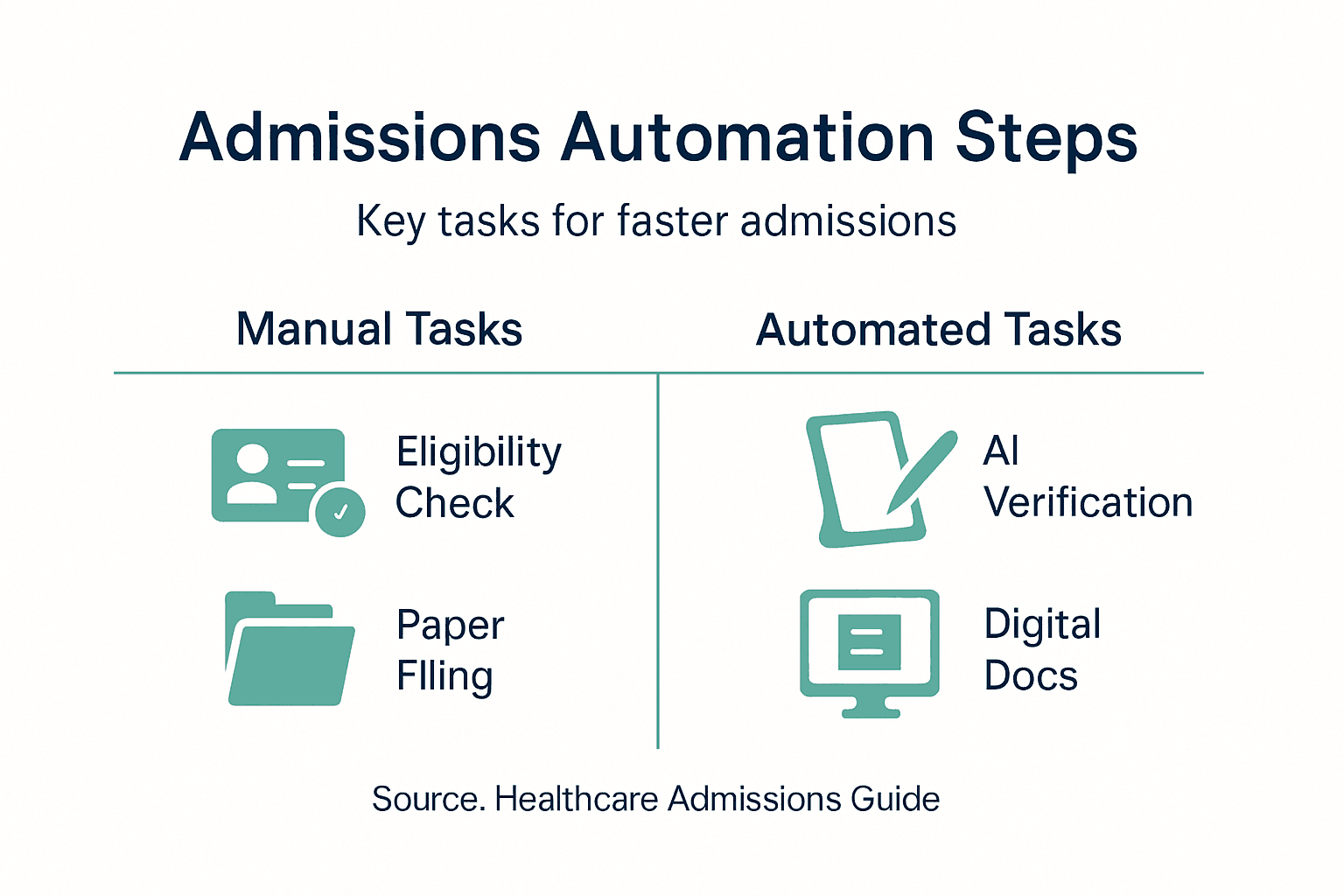
Start with eligibility verification. Your AI system should connect directly to insurance carrier portals and verify patient coverage in real time. The system checks deductibles, copayments, prior authorization requirements, and coverage limitations without staff manually calling insurers or logging into multiple portals.
Configure the system to flag insurance issues automatically. If a patient lacks coverage, has exceeded benefits, or requires prior authorization, the AI alerts your team immediately so they can contact the referring physician before admission. This prevents bed holds and delays caused by insurance complications.
Automation priorities for eligibility:
- Real-time verification across multiple insurance carriers simultaneously
- Automatic flagging of coverage gaps or authorization requirements
- Integration with your facility’s bed management system
- Alerts sent to appropriate staff based on issue type
- Documentation of all verification attempts for compliance
Next, tackle documentation processing. Automated document processing replaces manual data entry with AI-driven optical character recognition and intelligent classification. The system extracts key information from referral letters, medical records, and clinical assessments automatically.
Set up intelligent document routing. When documents arrive, the AI classifies them and routes them to the correct department. Missing documents trigger automatic alerts so staff can request them from referring physicians before admission reviews begin.
Configure your system to track document completeness. AI-powered systems automate patient eligibility checks and document verification, reducing the manual effort coordinators spend hunting for missing information. Your team receives a dashboard showing which admissions are documentation-ready and which need attention.
When documents flow automatically and eligibility verifies instantly, your team moves from data collection to patient care coordination.
Test automation rules with your clinical and compliance teams. Ensure the system captures all information your facility needs for admissions decisions and regulatory compliance. HIPAA requirements, state regulations, and your facility’s clinical protocols must all be embedded in the automation logic.
Start measuring the impact immediately. Track how many admissions are processed without manual eligibility verification, how many hours staff saves weekly, and how quickly documentation completeness improves. These metrics demonstrate value and build momentum for broader automation.
Pro tip: Run a parallel testing phase where staff manually verify eligibility and documents while the AI system does the same, comparing results for two weeks before full automation. This builds staff confidence and catches configuration errors before they impact patient care.
Step 4: Verify Improved Workflow Efficiency
Now that your automated systems are running, you need to measure whether they’re actually delivering the improvements you expected. Verification isn’t a one-time check but an ongoing process that confirms your workflows are working as designed.
Start by comparing your current metrics to the baseline you established in Step 1. Measure the time it takes from referral arrival to admission decision, track how many staff hours your team saves weekly, and count how many admissions flow through without manual intervention. These concrete numbers prove your investment is working.
This table compares manual versus AI-powered admissions processes:
| Process Aspect | Manual Workflow | AI-Powered Workflow |
|---|---|---|
| Eligibility Verification | Phone calls and portal logins | Real-time, automated checks |
| Document Routing | Staff sorting and scanning | Automatic classification and routing |
| Data Entry | Manual, repetitive typing | Automated extraction from records |
| Bottleneck Resolution | Requires supervisor review | Predictive alerts and instant escalation |
| Performance Monitoring | Monthly reports, delayed feedback | Real-time dashboards and analytics |
Create a simple dashboard that tracks key performance indicators in real time. Your team should see daily updates on admissions processed, average review time, documentation completeness rate, and insurance verification success rate. Visible metrics keep momentum alive and help staff see the impact of their work.
Core metrics to monitor:
- Average referral-to-admission decision time (target 24 hours or less)
- Percentage of admissions processed without manual eligibility verification
- Staff hours saved per week compared to baseline
- Documentation completeness rate on first submission
- Insurance denial or hold rate
- Patient satisfaction scores
Use workflow automation to enhance processing times and reduce manual errors. Real-time monitoring lets you spot problems before they cascade. If documentation completeness drops below your target, you know immediately that referring physicians need education or your system configuration needs adjustment.
Conduct weekly check-ins with your admissions team during the first month. Ask what’s working, what feels clunky, and where they still encounter friction. Your staff will identify configuration issues and improvement opportunities that dashboards won’t reveal.
Document case studies of admissions that benefited most from automation. Did AI catch a missed insurance requirement before admission? Did automated document routing cut review time in half? These stories demonstrate value and build buy-in across your facility.
Advancing automation helps healthcare organizations monitor performance continuously and adapt dynamically, ensuring your systems stay optimized as your volume and needs change. Set monthly reviews to evaluate whether automation settings still match your current referral patterns and clinical requirements.
Measurement transforms automation from a project into a sustainable practice. What you measure, you manage.
Adjust your system configuration based on what the data tells you. If certain referral sources consistently have incomplete documentation, set up targeted alerts or templates for those sources. If insurance verifications fail for specific carriers, investigate integration issues with those portals.
Pro tip: Share monthly efficiency reports with your entire facility leadership, highlighting staff time saved, admissions processed faster, and revenue impact from reduced bed hold delays. This visibility keeps automation as a priority and opens doors for expanding automation to other departments.
Speed Up Healthcare Admissions with Smart Admissions
The article highlights the tough challenge healthcare providers face in managing time-consuming administrative tasks like eligibility verification, document processing, and referral reviews. These repetitive manual workflows often lead to delays, staffing burnout, and lost revenue from empty beds. If you want to transform your admissions process and reduce referral review times while improving staff satisfaction, it is essential to automate these key bottlenecks using AI-powered solutions designed for healthcare settings.
Smart Admissions is a SaaS platform built specifically for skilled nursing homes, rehabilitation centers, and post-acute care providers to streamline patient intake. Our platform automates eligibility verification across multiple insurance carriers in real time, extracts clinical data, and manages documentation efficiently by integrating seamlessly with your existing Electronic Medical Records and insurance portals. By shifting routine work to intelligent technology, your admissions team spends less time on manual data entry and more time delivering compassionate care.
Ready to reduce admission delays and boost bed occupancy with proven AI-powered automation? Visit Smart Admissions now to explore how you can simplify your referral workflows, cut staff burnout, and enhance operational efficiency today. Learn more about our platform and see why healthcare providers are choosing Smart Admissions to advance their administrative processes. The time to modernize your admissions is now.
Frequently Asked Questions
How can I assess my current administrative workflows in healthcare admissions?
To assess your current workflows, start by mapping out each task involved when a referral arrives, from initial contact to completed admission. Document who handles each step, the tools they use, and how long each task takes, focusing on bottlenecks or redundancies that slow down the process.
What automated tasks should I consider for integration in healthcare admissions?
Focus on automating tasks that consume the most staff time, such as insurance verification and document processing. Identifying these high-impact tasks can lead to significant efficiency gains, allowing your team to focus more on patient care and less on repetitive data entry.
How do I choose the right AI-powered referral management system?
Select an AI-powered referral management system that seamlessly integrates with your existing Electronic Health Records (EHR) and can perform real-time eligibility verification and automated clinical assessments. Evaluate options based on their capabilities to meet your facility’s specific needs, ensuring sufficient customization.
What metrics should I track after implementing automated systems?
Monitor key performance indicators such as average referral-to-admission time, staff hours saved weekly, and documentation completeness rates. Regularly tracking these metrics provides insights into the effectiveness of your streamlined workflows and identifies areas for further improvement.
How can I ensure staff is prepared for the transition to automated workflows?
Prepare your admissions staff by involving them in the transition process and addressing their concerns in weekly check-in meetings. Provide training that emphasizes how automation can improve their workflows, allowing them to focus on more complex cases and enhancing overall job satisfaction.
What steps should I take to verify improved workflow efficiency?
Regularly compare your current metrics to the baseline measurements established during the assessment phase. Analyzing changes in processing times and staff productivity will help you determine if the automation is delivering the expected results and where additional adjustments may be needed.