
Healthcare administrators and admissions staff face constant pressure from lengthy referral review processes that stretch beyond 48 hours, directly impacting bed occupancy rates and staff morale. Manual workflows create bottlenecks that slow patient placement, inflate operational costs, and contribute to high burnout among intake teams. This guide delivers practical, technology-driven strategies that skilled nursing homes and rehabilitation centers can implement immediately to cut referral review times and optimize admissions efficiency.
Table of Contents
- Prerequisites And Planning For Referral Review Improvement
- Implement Ai-Powered Referral Management
- Optimize Workflows And Roles In Referral Review
- Common Mistakes And Troubleshooting In Referral Review Improvement
- Monitoring Progress And Continuous Improvement
- Expected Outcomes And Benchmarks In Reducing Referral Review Time
- Explore Smart Admissions Solutions To Streamline Referral Reviews
- Frequently Asked Questions
Key takeaways
| Point | Details |
|---|---|
| AI automation impact | AI-powered tools can reduce referral review time by up to 40% while improving accuracy |
| Workflow standardization | Standardizing documentation and processes decreases errors by 25% and speeds processing |
| Staff development | Comprehensive training and continuous monitoring are essential for sustained efficiency gains |
| Operational benefits | Successful implementation improves bed occupancy by 10-15% and reduces staff burnout by 30% |
| Long-term gains | Continuous process improvements deliver annual efficiency increases of approximately 15% |
Prerequisites and planning for referral review improvement
Successful referral review optimization requires solid groundwork before deploying new systems or workflows. Begin by mapping your current referral process from initial contact through final admission decision. Document every touchpoint, handoff, and approval step to identify where delays accumulate.
Your IT infrastructure needs careful assessment before implementing advanced solutions. Check whether your existing EMR system supports API integrations and whether your insurance portal access allows automated eligibility verification. Many facilities discover that EMR and insurance portal integration capabilities determine which automation strategies work best for their specific environment.
Stakeholder alignment prevents implementation failures. Schedule working sessions with admissions staff, clinical directors, IT personnel, and finance teams to review proposed changes. Staff who understand why changes matter and how they benefit day-to-day work adopt new systems faster and provide valuable feedback during rollout.
Define baseline metrics before making any changes. Track your current average referral review time, error rates requiring rework, staff hours spent on manual tasks, and bed occupancy percentages. These numbers become your benchmark for measuring improvement and justifying continued investment in optimization efforts.
Pre-implementation checklist
- Map complete referral workflow with all stakeholders
- Document current average review times and error rates
- Verify EMR API capabilities and portal access permissions
- Identify staff champions for training and feedback collection
- Set specific, measurable goals for time reduction and accuracy
| Assessment Area | Key Questions | Success Indicator |
|---|---|---|
| Technology readiness | Does EMR support integration? | API documentation available |
| Workflow complexity | How many approval steps exist? | Clear process map created |
| Staff capacity | Can team absorb training time? | Dedicated training hours scheduled |
| Data quality | How accurate is current referral data? | Error rate baseline established |
Pro Tip: Create a pilot program with one referral source or unit before facility-wide rollout. This limited scope lets you test workflows, identify unexpected issues, and build internal success stories that drive broader adoption.
Understanding the role of AI in patient intake helps you set realistic expectations about what automation can achieve. Focus preparation efforts on areas where technology delivers the highest impact while maintaining clinical judgment for complex cases.
Implement AI-powered referral management
AI-driven referral management transforms how facilities process incoming referrals by automating repetitive verification tasks and flagging issues that require human review. Select platforms that offer customizable workflows matching your facility’s specific admission criteria and payer mix. The best solutions integrate directly with your existing systems rather than creating additional data entry burdens.
Real-time clinical eligibility assessments represent the most powerful automation opportunity. Implementing AI for clinical eligibility can reduce referral review times by 20% within three months by automatically checking insurance coverage, bed availability, and clinical appropriateness against your facility’s capabilities. This immediate validation eliminates the back-and-forth communication that traditionally extends review cycles.
Seamless integration with EMR and insurance portals eliminates duplicate data entry while ensuring accuracy. Configure your AI system to pull patient demographics, clinical summaries, and insurance details directly from referral sources. Automated payer verification checks coverage status and authorization requirements without staff manually logging into multiple portals.
Dashboards provide visibility into referral pipeline health and bottleneck locations. Real-time monitoring shows which referrals are stalled, which staff members need support, and which referral sources generate the highest-quality leads. This transparency enables proactive management rather than reactive problem-solving.
AI implementation priorities
- Configure automated insurance eligibility verification
- Set up clinical screening rules based on facility capabilities
- Integrate EMR data extraction to eliminate manual entry
- Establish automated alerts for high-priority referrals
- Create role-based dashboards for different team members
Pro Tip: Start with automating the most time-consuming manual tasks first, typically insurance verification and basic clinical screening. These deliver quick wins that build staff confidence in the technology and demonstrate ROI to leadership.
Explore comprehensive AI referral management benefits to understand how automation improves not just speed but also decision quality. The technology works best when it handles routine verification while freeing clinical staff to focus on complex cases requiring professional judgment. Learning more about AI in healthcare admissions reveals additional optimization opportunities beyond referral review.
Optimize workflows and roles in referral review
Standardized documentation eliminates confusion and reduces errors that cause rework delays. Healthcare facilities implementing standardized referral checklists cut errors by 25%, directly reducing the time wasted on correcting incomplete or inaccurate submissions. Create templates for common referral types that capture all necessary clinical, financial, and logistical information upfront.
Clear role assignments prevent bottlenecks caused by unclear responsibility. Define who handles initial screening, clinical review, insurance verification, and final approval. Document escalation paths for complex cases and specify maximum response times for each stage. This clarity eliminates the “I thought someone else was handling it” delays.
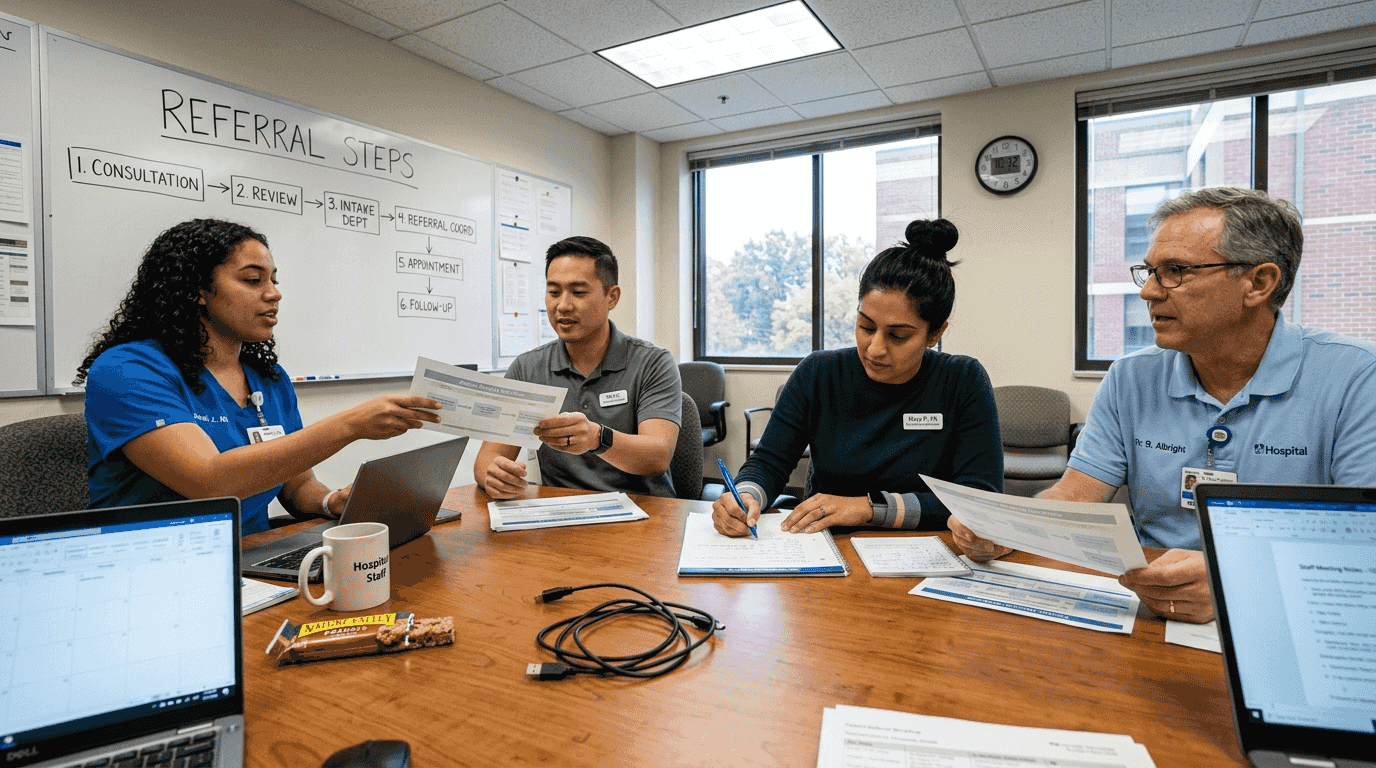
Automation reduces staff burnout by eliminating repetitive manual tasks. Facilities report 30% reductions in burnout when AI handles routine verification, leaving staff to focus on relationship building and complex clinical assessments. This shift improves both job satisfaction and referral quality.
Compare your options for achieving automation based on facility size and resources. Larger organizations may benefit from in-house AI implementation with dedicated IT support, while smaller facilities often find vendor-managed solutions more cost-effective.
| Approach | Best For | Pros | Cons |
|---|---|---|---|
| In-house AI automation | Large facilities with IT staff | Full customization and control | Higher upfront cost and maintenance |
| Vendor-managed platform | Small to mid-size facilities | Quick deployment and ongoing support | Less customization flexibility |
| Hybrid model | Multi-facility organizations | Balance of control and support | Requires coordination across sites |
Workflow optimization checklist
- Create standardized intake forms for each referral type
- Assign clear ownership for each review stage
- Set maximum turnaround times with automated escalation
- Implement parallel processing for independent tasks
- Schedule regular workflow review sessions with staff
Pro Tip: Map referral workflows visually using flowcharts that show decision points, responsible parties, and time targets. Share these diagrams with all staff so everyone understands the complete process and their role within it.
Understanding what is referral review in depth helps you identify which workflow steps add value versus which exist only due to historical practice. Question every handoff and approval layer to eliminate unnecessary delays while maintaining appropriate clinical oversight.
Common mistakes and troubleshooting in referral review improvement
Insufficient staff training sabotages even the best technology investments. Research shows 40% of AI projects fail due to inadequate training, while data inaccuracies extend review time by 35%. Invest in comprehensive onboarding that covers not just software mechanics but also the strategic reasoning behind workflow changes.
Data quality issues create cascading delays throughout the referral process. Inaccurate insurance information triggers verification failures, incomplete clinical summaries require follow-up calls, and missing contact details prevent timely communication. Implement validation rules that flag incomplete referrals immediately rather than discovering problems midway through review.
Manual processes collapse under peak workload pressure. Facilities relying heavily on manual review experience 60% longer delays during high-volume periods when staff become overwhelmed. Build automation capacity that scales automatically without requiring proportional staff increases.
Common implementation pitfalls
- Launching without adequate staff training and change management
- Failing to validate data accuracy before automating processes
- Underestimating integration complexity with legacy systems
- Skipping pilot testing before facility-wide rollout
- Neglecting ongoing optimization after initial implementation
Troubleshooting solutions
- Create role-specific training modules with hands-on practice scenarios
- Implement automated data validation at referral submission
- Build buffer capacity for seasonal or unexpected volume spikes
- Establish regular check-ins during first 90 days of implementation
- Designate super users who provide peer support and feedback
Pro Tip: Track “time to competency” metrics for staff learning new systems. Most users need 2-3 weeks of active use before feeling confident, so plan for temporary productivity dips during transition periods and provide extra support during this window.
Learn from facilities that have navigated referral response time mistakes to avoid repeating common errors. The most successful implementations treat technology as an enabler of better processes rather than a replacement for strategic thinking about admission workflows.
Monitoring progress and continuous improvement
Ongoing measurement separates temporary gains from sustained transformation. Establish dashboards tracking referral review time, error rates requiring rework, staff time allocation, and bed occupancy percentages. Review these metrics weekly during initial implementation and monthly once processes stabilize.
Analytics platforms reveal patterns invisible in day-to-day operations. Identify which referral sources consistently provide complete information, which times of day see the longest delays, and which types of cases take longest to process. Use these insights to target improvement efforts where they deliver maximum impact.
Staff feedback captures operational realities that metrics miss. Schedule monthly roundtables where admissions staff share what’s working, what’s frustrating, and what workarounds they’ve created. These conversations often surface simple fixes that dramatically improve efficiency.
Iterative refinement compounds efficiency gains over time. Facilities committed to continuous improvement typically achieve 15% annual performance increases by systematically addressing bottlenecks, updating workflows based on experience, and adopting new automation capabilities as they become available.
Key performance indicators to track
- Average referral review time from receipt to decision
- Percentage of referrals requiring follow-up for missing information
- Staff hours spent on manual verification tasks
- Bed occupancy rate and time from acceptance to admission
- Referral conversion rate by source and payer type
| Metric | Baseline Target | 90-Day Target | Long-Term Goal |
|---|---|---|---|
| Review time | 48 hours | 30 hours | Under 24 hours |
| Error rate | 15% | 10% | Under 5% |
| Manual hours per referral | 2.5 hours | 1.5 hours | Under 1 hour |
| Bed occupancy | 85% | 90% | 95%+ |
Pro Tip: Celebrate milestone achievements publicly to maintain momentum. When your team hits a new speed record or processes a week with zero errors, recognize the accomplishment and reinforce the behaviors that made it possible.
Expected outcomes and benchmarks in reducing referral review time
Top-performing skilled nursing facilities consistently achieve referral review times under 24 hours by combining AI automation with optimized workflows. This speed advantage translates directly into competitive advantage when competing for desirable referrals against facilities still using manual processes taking 48 hours or longer.
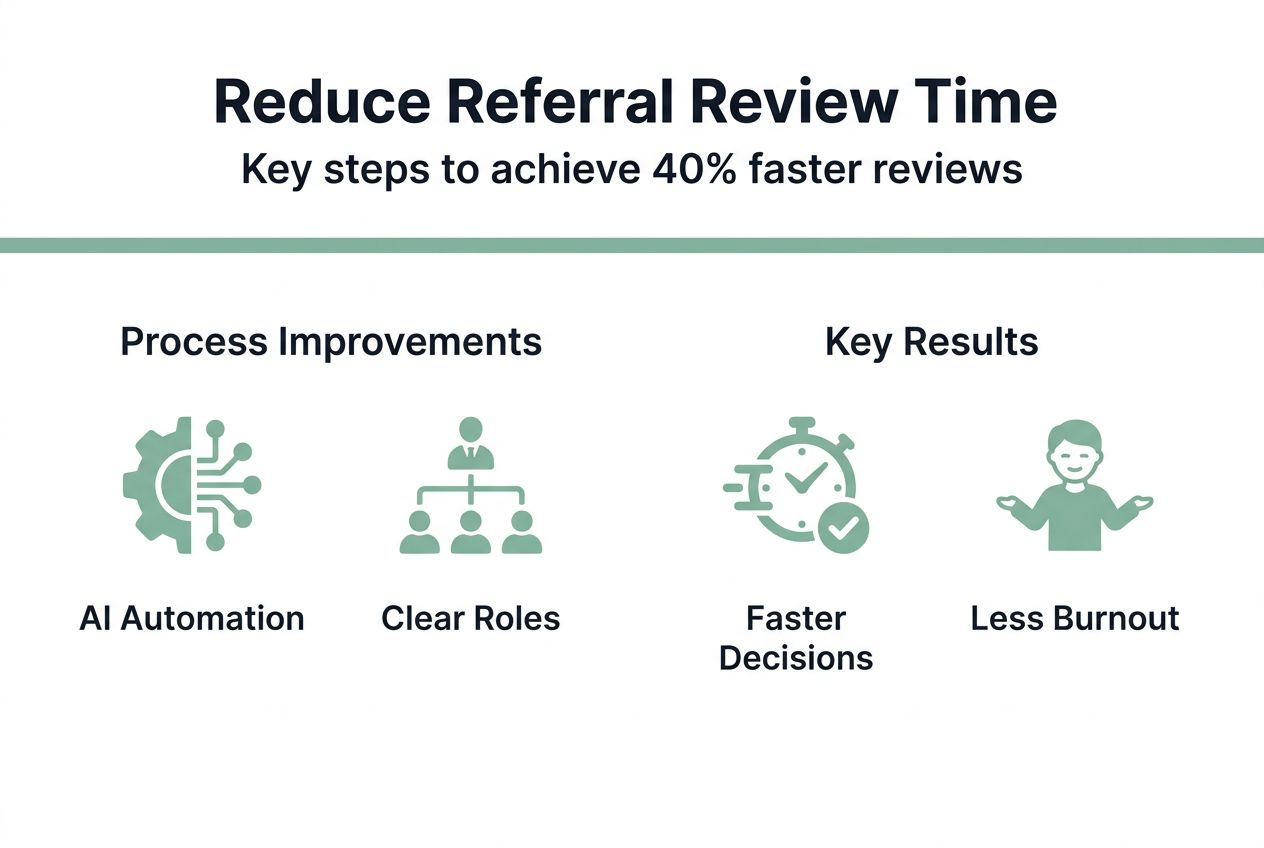
Automation delivers measurable reductions in both staff burnout and operational errors. Facilities report 30% decreases in staff turnover among admissions teams after implementing AI-assisted workflows, while error rates requiring rework drop by 25% due to standardized processes and automated validation.
Significant benefits appear within the first three months of AI adoption. Early wins typically include faster insurance verification, reduced phone tag with referral sources, and better visibility into pipeline status. These quick returns justify continued investment in more advanced optimization.
Bed occupancy improvements of 10-15% represent substantial revenue gains for most facilities. Faster referral processing means less time with empty beds, better matching of patient needs to facility capabilities, and stronger relationships with referral sources who appreciate quick responses.
Realistic implementation timeline
- Month 1: Planning, baseline measurement, and staff training
- Month 2: Pilot launch with one referral source or unit
- Month 3: Refinement based on pilot learnings and broader rollout
- Months 4-6: Optimization, troubleshooting, and process tuning
- Months 7-12: Continuous improvement and advanced feature adoption
Pro Tip: Set graduated targets that acknowledge the learning curve. Expecting immediate perfection creates frustration, while celebrating incremental progress builds confidence and commitment to the transformation journey.
Explore smart admissions solutions to streamline referral reviews
Transforming referral review efficiency requires the right combination of technology, processes, and expertise. Smart Admissions offers AI-powered platforms specifically designed for skilled nursing homes and rehabilitation centers facing the exact challenges this guide addresses.
Discover how leading facilities leverage referral management systems to achieve sub-24-hour review times while improving admission quality. Learn comprehensive approaches through our detailed step by step intake process that integrates seamlessly with your existing workflows. Explore foundational concepts through our guide on what is referral management to understand how modern systems transform admissions operations.
Frequently asked questions
What is the typical referral review time after implementing AI-powered automation?
Referral review times typically drop from around 48 hours to under 24 hours within three months of implementing AI automation. Facilities see consistent reductions as processes stabilize and staff become proficient with new workflows.
How can healthcare facilities ensure staff adopt new referral review technologies effectively?
Comprehensive training programs and ongoing support are essential for successful adoption. Engaging staff early in the selection process, collecting regular feedback, and celebrating quick wins builds confidence and commitment to new systems.
What are the key metrics to monitor for improving referral review efficiency?
Track referral review time from receipt to decision, error rates requiring rework, staff workload distribution, and bed occupancy percentages. Use analytics dashboards for real-time monitoring and quick identification of bottlenecks requiring attention.
Recommended
- Stop Wasting 45 Minutes on Each Referral: Try These 5 Post-Acute Care Automation Hacks – Smart Admissions
- From 45 Minutes to 5: How AI Is Transforming Referral Reviews – Smart Admissions
- 7 Mistakes You’re Making with Referral Response Times (And How AI Fixes Them) – Smart Admissions
- How to Cut Referral Processing Time from 45 to 5 Minutes | AI Admissions Automation for Skilled Nursing Facilities