
Healthcare admissions coordinators juggle complex workflows daily, from chasing incomplete referrals to verifying insurance eligibility across disconnected systems. These manual processes drain valuable time that could be spent on patient care coordination and relationship building with referring providers. In 2026, facilities that embrace strategic efficiency improvements see measurably faster bed fills, lower staff burnout, and stronger financial performance. This guide delivers expert-backed, actionable tips to transform your admissions operations and reclaim hours lost to administrative friction.
Table of Contents
- How To Evaluate Staff Efficiency Improvement Strategies
- Top Staff Efficiency Tips To Streamline The Patient Referral Process
- Comparing Referral Management Technologies For Healthcare Efficiency
- Making The Right Decision: Implementing Efficiency Strategies Effectively
- Enhance Your Admissions With Smart Automation
- Frequently Asked Questions
Key takeaways
| Point | Details |
|---|---|
| Automate repetitive tasks | AI-powered tools reduce manual data entry by up to 60%, freeing staff for strategic work. |
| Integrate referral systems | Unified platforms cut document chasing time by 40% and eliminate lost referrals. |
| Track referrals in real time | Live visibility into referral status improves decision speed and audit compliance. |
| Replace fax-based workflows | eReferral systems validate completeness upfront, preventing delays from missing information. |
| Implement smart order sets | Standardized referral templates reduce scheduling time by up to 93% for specific procedures. |
How to evaluate staff efficiency improvement strategies
Before implementing any efficiency solution, you need clear criteria for success. Start by mapping your current referral workflow from initial contact through admission. Identify specific bottlenecks where staff spend disproportionate time. Complex workflow challenges significantly lower operational efficiency, particularly when teams toggle between multiple systems to complete a single task.
Cost pressures make every decision critical. Healthcare staffing efficiency is a complex issue that requires balancing technology investment against operational savings. Look for solutions that reduce administrative burden without requiring additional headcount. The goal is to amplify your existing team’s capacity, not replace human judgment in clinical decision making.
Consider these evaluation factors:
- Integration capability with your current EMR and insurance verification systems
- Automation depth for repetitive tasks like data entry and status tracking
- Real-time visibility into referral pipeline and bottlenecks
- Scalability as your facility grows or adds service lines
- Training requirements and staff adoption curve
Technologies like AI in healthcare admissions offer powerful automation without eliminating positions. Instead, they handle routine data processing while your coordinators focus on relationship management and complex case reviews. This shift transforms admissions from a transactional function into a strategic growth driver.
Pro Tip: Calculate your current cost per admission by tracking staff hours spent on each referral from intake through bed assignment. This baseline helps you measure ROI accurately when evaluating new solutions.
Top staff efficiency tips to streamline the patient referral process
Implementing these evidence-backed strategies delivers measurable time savings and operational improvements.
- Deploy AI-powered automation for routine tasks. AI-powered automation can reduce manual administrative tasks by up to 60%, eliminating repetitive data entry and freeing coordinators to focus on care planning conversations. Modern automation in healthcare admissions handles insurance verification, clinical documentation review, and eligibility checks simultaneously.
- Adopt integrated referral management platforms. Disconnected systems force staff to manually transfer information between fax machines, email, EMRs, and insurance portals. Implementing integrated systems reduces time chasing documents by 40%, creating a single source of truth for every referral. This integration eliminates duplicate data entry and reduces errors from manual transcription.
- Enable real-time referral tracking and visibility. When everyone on your team can see referral status instantly, decision making accelerates. Real-time dashboards show which referrals need clinical review, which are pending insurance approval, and which are ready for bed assignment. This transparency creates accountability and prevents referrals from stalling in workflow gaps.
- Replace fax and email workflows with eReferral systems. Traditional referral methods lack validation, leading to incomplete submissions that require multiple follow-up calls. eReferral platforms check for required information upfront, ensuring coordinators receive complete packets ready for immediate review. This shift eliminates the frustrating back-and-forth that delays admissions.
- Create smart order sets for high-volume referral types. Standardized templates for common procedures like GI consults or physical therapy referrals ensure consistent information capture. These templates guide referring providers to include all necessary clinical details, reducing the need for clarification calls and speeding up scheduling.
Compare traditional versus optimized workflows:
| Task | Manual Process Time | Automated Process Time | Time Saved |
|---|---|---|---|
| Insurance verification | 25 minutes | 3 minutes | 22 minutes |
| Clinical document review | 30 minutes | 8 minutes | 22 minutes |
| Referral status tracking | 15 minutes | 2 minutes | 13 minutes |
| Follow-up coordination | 20 minutes | 5 minutes | 15 minutes |
These automated workflow benefits compound across your daily referral volume. A facility processing 15 referrals daily saves over 18 hours per week, equivalent to nearly half a full-time position redirected toward strategic growth activities.

Pro Tip: Start by automating your highest-volume, lowest-complexity referrals first. Quick wins build staff confidence and demonstrate ROI before tackling more complex workflow redesigns.
Comparing referral management technologies for healthcare efficiency
Understanding your technology options helps you select the right solution for your facility’s specific needs and constraints.
Manual and basic electronic systems rely on staff to move information between platforms. Coordinators receive referrals via fax or email, manually enter data into the EMR, separately verify insurance, and track status in spreadsheets. This approach requires no technology investment but creates significant labor costs and error risk.
Integrated eReferral platforms centralize referral intake and workflow management. They validate referral completeness, route cases to appropriate reviewers, and maintain audit trails automatically. These systems reduce lost referrals and improve coordination but still require manual clinical review and decision making.
AI-powered automation platforms add intelligent processing on top of integration. They extract data from unstructured documents, flag clinical concerns for review, predict bed availability conflicts, and suggest optimal placements based on historical patterns. Facilities using AI-driven referral management report 25% higher occupancy due to faster referral capture.
Key feature comparison:
| Feature | Manual/Basic | Integrated eReferral | AI-Powered Automation |
|---|---|---|---|
| Automatic data extraction | No | Partial | Yes |
| Referral completeness validation | No | Yes | Yes |
| Real-time status tracking | No | Yes | Yes |
| EMR integration | No | Yes | Yes |
| Intelligent routing | No | Limited | Advanced |
| Predictive analytics | No | No | Yes |
The efficiency impact varies significantly. Almost half of specialist referrals never get completed due to manual process gaps, representing substantial lost revenue. Advanced platforms close these gaps through automated follow-up and status monitoring.
Consider your facility’s referral volume and complexity when choosing. High-volume facilities with diverse payer mixes benefit most from AI automation, while smaller operations may achieve sufficient gains with integrated eReferral systems. Review referral management systems examples to see how different facilities have matched solutions to their operational profiles.
Making the right decision: implementing efficiency strategies effectively
Successful implementation requires thoughtful planning beyond technology selection. Start with a pilot program focused on one referral source or service line. This contained approach lets you refine workflows and build staff confidence before expanding facility-wide.
Follow these implementation steps:
- Assess current state: Document existing workflows, pain points, and time requirements for each referral stage
- Define success metrics: Establish baseline measurements for referral processing time, admission conversion rate, and staff hours per referral
- Select pilot scope: Choose a high-volume referral type or source relationship where improvements will be immediately visible
- Train thoroughly: Invest in hands-on training sessions and create quick reference guides for common scenarios
- Monitor and adjust: Review pilot metrics weekly, gathering staff feedback to identify friction points
- Scale strategically: Expand to additional referral types or sources once the pilot demonstrates consistent improvement
Change management determines whether efficiency tools deliver their potential value. Address staff concerns directly, emphasizing how automation eliminates frustrating busywork rather than threatening job security. Share early wins publicly, celebrating time savings and improved patient experiences.
Track these key performance indicators:
- Average time from referral receipt to admission decision
- Percentage of referrals requiring follow-up for missing information
- Referral conversion rate (admissions divided by total referrals)
- Staff hours spent per completed admission
- Days to achieve target census after bed becomes available
Real-world results validate this approach. Implementation of a GI smart order set reduced referral to procedure scheduling time by 93%, demonstrating how targeted improvements in high-impact areas deliver outsized returns. Similarly, over 10 hours per week per team member spent on follow-up calls can be saved with automation.
Pro Tip: Identify your single biggest manual bottleneck and address it first. Whether that’s insurance verification, clinical document review, or referral source communication, focusing initial efforts on the highest-pain area builds momentum and staff buy-in for broader changes.
Maintain regular communication with your implementation partner throughout the rollout. Quality vendors provide responsive support during the critical early weeks when questions arise frequently. This partnership approach smooths the transition and accelerates time to value.
Enhance your admissions with smart automation
Your admissions team deserves tools that match their expertise and dedication. Smart Admissions delivers AI-powered referral management designed specifically for skilled nursing facilities, rehabilitation centers, and post-acute care providers. Our platform integrates seamlessly with your existing EMR and insurance systems, automating repetitive tasks while keeping your coordinators in control of clinical decisions.
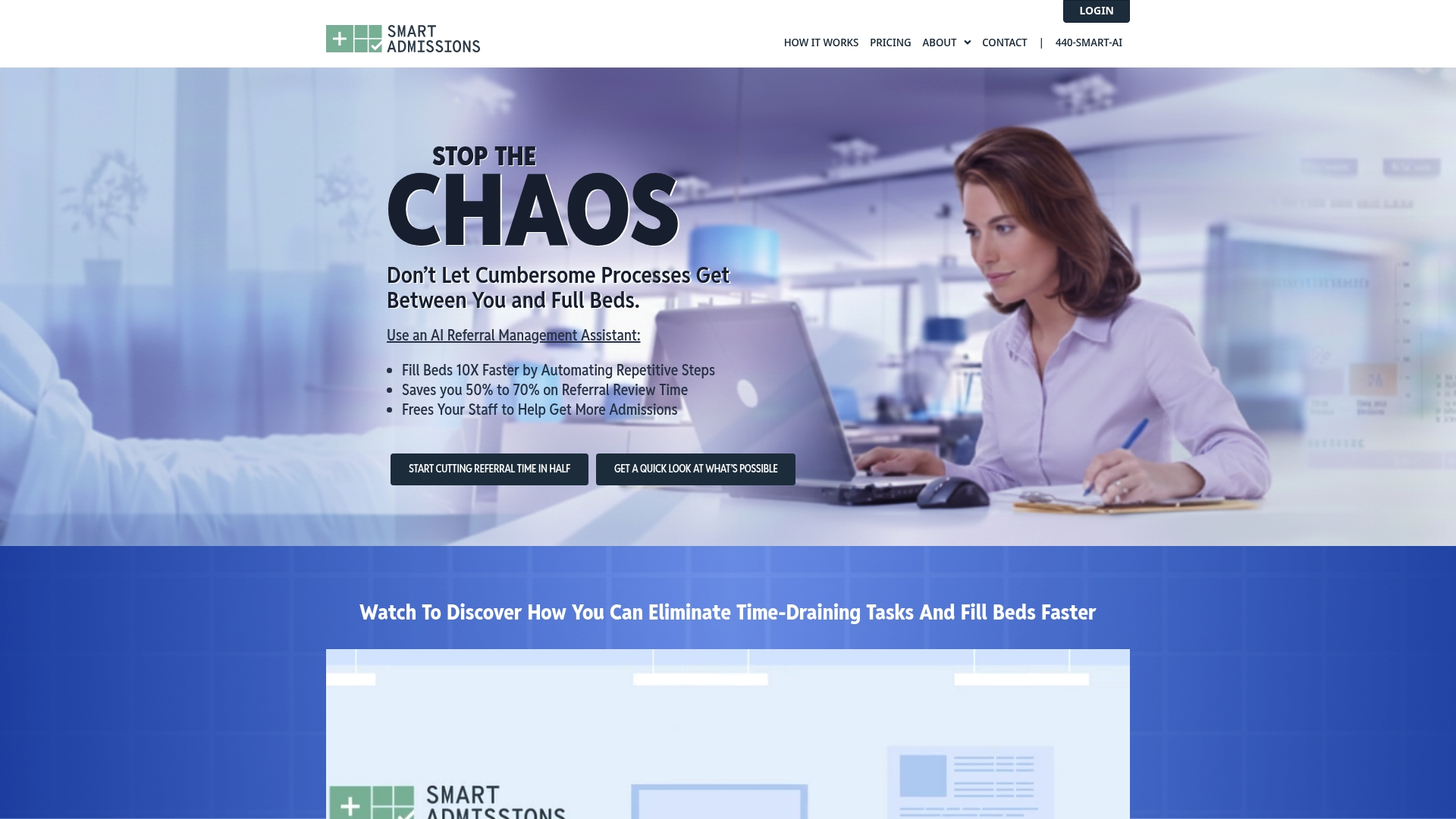
Facilities using Smart Admissions report faster bed fills, reduced staff overtime, and improved referral conversion rates. Our intelligent automation handles insurance verification, clinical documentation review, and real-time tracking, freeing your team to focus on relationship building and patient care coordination. Explore examples of referral management systems to see how leading facilities have transformed their operations. Learn more about automation in healthcare admissions and discover what is referral management in the context of modern post-acute care.
Frequently asked questions
What are the best ways to improve staff efficiency in healthcare admissions?
Prioritize AI-powered automation for repetitive tasks like data entry and insurance verification, which can reduce manual work by up to 60%. Implement integrated referral management systems that provide real-time visibility and eliminate the need to chase documents across disconnected platforms. Focus on standardizing high-volume referral types through smart order sets that ensure complete information capture upfront.
How can AI-powered tools reduce administrative workload without replacing staff?
AI supports admissions coordinators by automating repetitive tasks and reducing errors, handling routine data processing while staff focus on relationship management and complex clinical reviews. The technology augments human judgment rather than replacing it, enabling coordinators to spend more time on patient interaction and care planning conversations. This shift transforms admissions from a transactional function into a strategic growth driver that improves both staff satisfaction and facility outcomes.
What are the benefits of switching to an eReferral system?
eReferral reduces lost referrals, improves completeness, and provides real-time tracking, eliminating the delays and misdirection common with fax-based workflows. These systems validate that referrals contain all required clinical and insurance information before submission, preventing the frustrating back-and-forth calls that slow admissions. Real-time status visibility lets your entire team see exactly where each referral stands in the review process, improving coordination and accountability.
How much time can automation save admissions teams on follow-up tasks?
Automation can save over 10 hours per week per admissions team member by reducing follow-up calls, freeing staff to focus on higher-value activities like care coordination and relationship building. This time savings translates directly to faster referral processing and improved patient care timelines. Facilities that implement comprehensive automation often redirect these reclaimed hours toward proactive outreach to referral sources, driving census growth without adding headcount.