
Inpatient hospital discharge referrals to skilled nursing facilities surged to 56,000 in 2025, nearly double the 24,000 recorded in 2019. Meanwhile, patient acuity climbed 34% during the same period. For admissions coordinators, slow referral response times create cascading bottlenecks that reduce bed occupancy, delay patient placement, and strain already stretched teams. This guide reveals evidence-based strategies to accelerate referral processing, boost admission rates, and transform operational efficiency in 2026.
Table of Contents
- The Rising Demand For Skilled Nursing Facility Referrals
- Common Bottlenecks And Challenges In Referral Response Times
- How Automation And Technology Speed Referral Responses And Improve Admissions
- Best Practices To Improve Referral Response Times In 2026
- Discover Smarter Referral Management Solutions
Key takeaways
| Point | Details |
|---|---|
| Faster response improves admissions | Reducing referral processing time directly increases acceptance rates and bed occupancy by up to 15%. |
| Automation cuts administrative burden | Automated eligibility verification and referral workflows reduce manual tasks by 60-70%, freeing staff for patient care. |
| Integration enhances coordination | Connecting EMR systems with referral platforms eliminates communication delays and data entry errors. |
| Standardized processes drive consistency | Training teams on unified protocols ensures predictable response times and higher quality reviews. |
The rising demand for skilled nursing facility referrals
Post-acute care referrals have experienced explosive growth since 2019. Referral volumes nearly doubled while patient acuity increased 34%, creating unprecedented pressure on admissions teams. Skilled nursing facility admissions jumped 43% during this period, reflecting both demographic shifts and evolving hospital discharge practices.
The complexity of today’s referrals demands sophisticated referral management capabilities. Patients arrive with multiple comorbidities, complex medication regimens, and specialized care needs that require thorough clinical review. Each case involves coordinating insurance verification, clinical documentation, bed availability, and family communication.
Current referral patterns reveal significant inefficiencies:
- Facilities receive an average of 6.6 referral submissions per patient
- Overall acceptance rates hover around 32%
- Multiple submissions create redundant work across competing facilities
- Coordinators spend hours reviewing duplicate or incomplete referrals
| Metric | 2019 Baseline | 2025 Current | Change |
|---|---|---|---|
| Referral Volume | 24,000 | 56,000 | +133% |
| Patient Acuity Index | 100 | 134 | +34% |
| SNF Admissions Growth | 100 | 143 | +43% |
| Avg Referrals Per Patient | 5.2 | 6.6 | +27% |
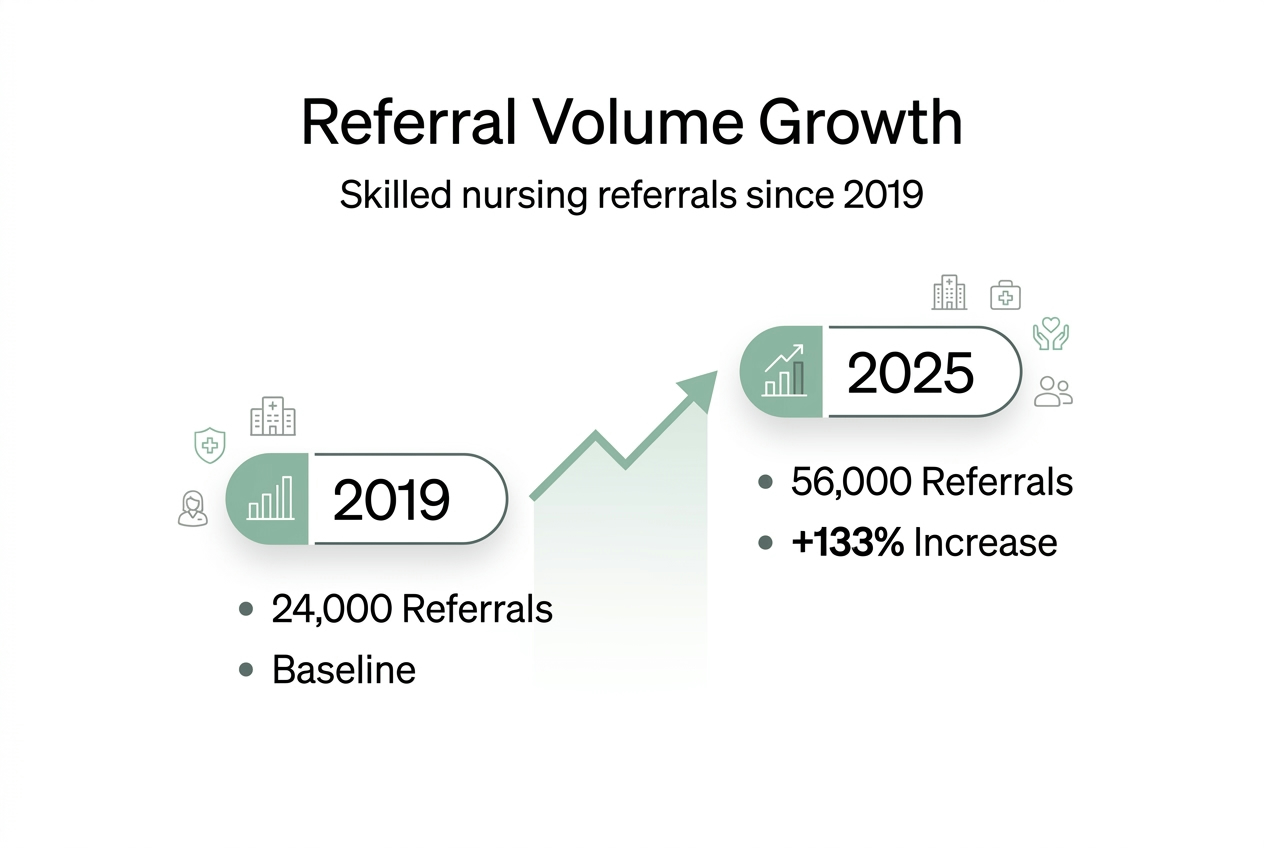
These numbers underscore why speed matters. When coordinators take days to respond, referring hospitals move to the next facility on their list. Every hour of delay represents lost revenue and empty beds. For a 120-bed facility, even a 5% improvement in acceptance rates translates to six additional admissions monthly.
The competitive landscape has intensified. Hospitals maintain preferred provider lists, and facilities that consistently respond fastest earn priority placement. Quick, accurate responses signal operational excellence and build trust with discharge planners. Conversely, slow responses damage referral relationships and reduce future volume.
Common bottlenecks and challenges in referral response times
Despite technological advances, most facilities struggle with outdated referral workflows. Only 55% of hospitals can electronically exchange patient information with skilled nursing facilities, forcing coordinators to rely on faxes, phone calls, and manual data entry. This fragmentation creates multiple failure points where referrals stall or get lost.
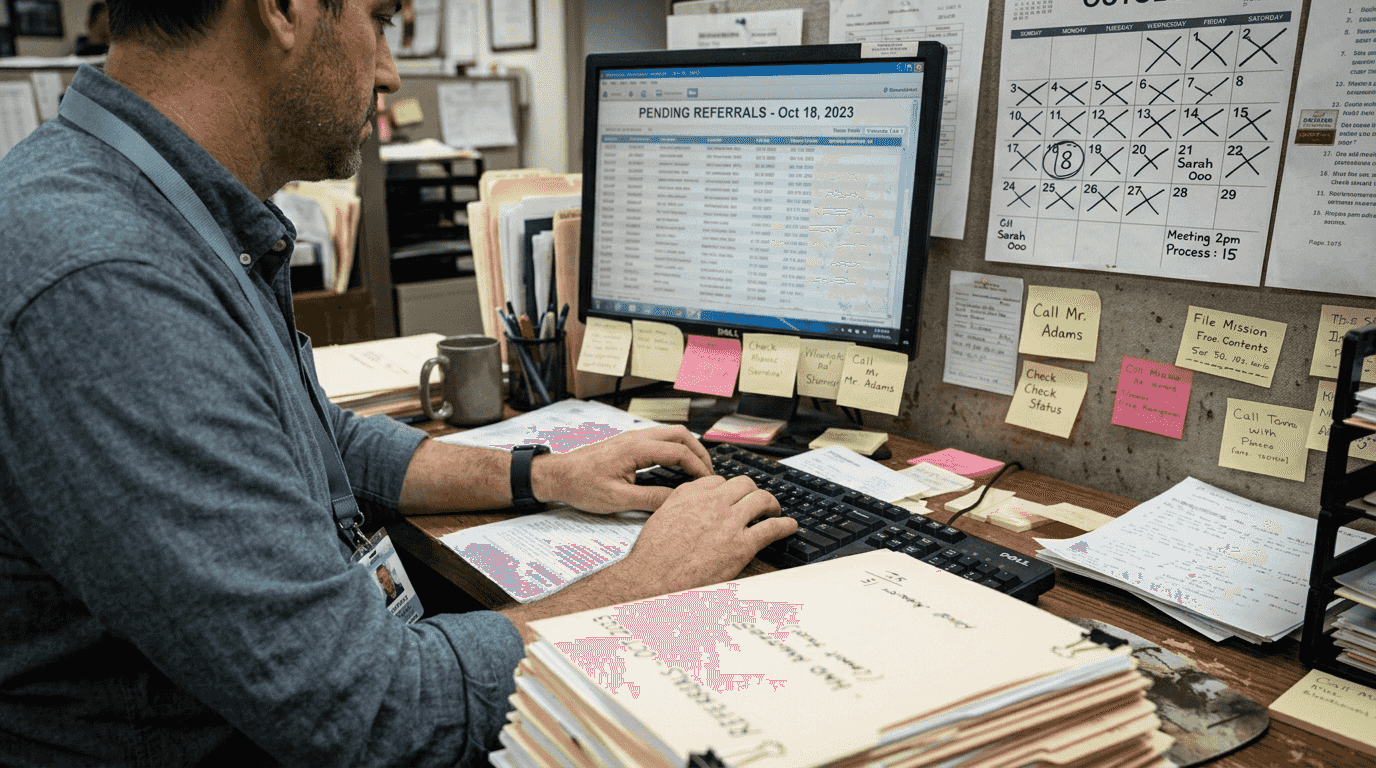
Manual processes dominate most admissions departments. Coordinators receive referrals through multiple channels including fax, email, phone, and online portals. Each submission requires manual review, data extraction, and entry into facility systems. Communication inefficiencies and manual handoffs extend referral-to-admission timelines by days, not hours.
Key obstacles slowing referral responses include:
- Lack of real-time bed availability visibility across departments
- Insurance verification requiring multiple phone calls and portal logins
- Incomplete clinical documentation necessitating follow-up requests
- Disconnected systems forcing duplicate data entry
- Staff shortages limiting review capacity during peak hours
The average coordinator spends 45 minutes processing a single referral. Multiply that across 20-30 daily referrals, and teams quickly become overwhelmed. Priority cases get buried under routine submissions. Urgent referrals from preferred hospital partners wait alongside lower-acuity cases, creating inefficient triage.
Multiple referral submissions compound these challenges. When hospitals send the same patient to six facilities simultaneously, each performs redundant eligibility checks and clinical reviews. Five facilities waste resources on patients they’ll never admit. This system benefits no one and drives up operational costs across the entire post-acute ecosystem.
Pro Tip: Prioritize electronic medical record integration to eliminate manual data entry and reduce processing errors by up to 80%.
Communication delays add another layer of friction. Coordinators wait hours for callbacks from insurance companies. Clinical questions require phone tag with hospital case managers. Family members need multiple attempts to reach for consent discussions. Each delay pushes admission dates further out and increases the risk of losing referrals to faster competitors.
Understanding these common referral response mistakes helps facilities identify improvement opportunities. The good news is that proven automation strategies can eliminate most bottlenecks without requiring massive technology investments.
How automation and technology speed referral responses and improve admissions
Automation transforms referral processing from a manual bottleneck into a streamlined competitive advantage. Automated eligibility verification reduces administrative burden and accelerates admissions by up to 70%, freeing coordinators to focus on clinical decision-making and relationship building rather than data entry.
The impact extends beyond time savings. Facilities implementing automated referral systems achieve 60% faster processing speeds and 15% higher bed occupancy rates. These improvements directly boost revenue while reducing staff burnout from repetitive administrative tasks.
Key automation capabilities that drive results:
- Electronic data capture automatically extracts patient information from referral documents
- Automated eligibility verification checks insurance coverage in real time without phone calls
- Intelligent referral prioritization routes urgent cases to coordinators immediately
- Automated status communications keep referring hospitals updated without manual follow-up
- Streamlined bed assignment matches patient needs with available resources instantly
| Process Step | Manual Time | Automated Time | Time Saved |
|---|---|---|---|
| Data Entry | 15 min | 2 min | 87% |
| Insurance Verification | 20 min | 5 min | 75% |
| Clinical Review | 25 min | 18 min | 28% |
| Communication/Follow-up | 10 min | 3 min | 70% |
| Total Per Referral | 70 min | 28 min | 60% |
These efficiency gains compound across dozens of daily referrals. A facility processing 25 referrals daily saves over 17 hours of coordinator time, equivalent to more than two full-time positions. Teams redeploy this capacity toward higher-value activities like building hospital relationships and improving care transitions.
Intake automation also improves accuracy and consistency. Automated systems apply standardized criteria to every referral, eliminating subjective variation between coordinators. Insurance verification happens instantly through direct payer connections, catching coverage issues before admission rather than discovering them during billing.
Pro Tip: Implement automation incrementally by starting with insurance verification and data capture, then expanding to clinical workflows once teams adapt to new processes.
Real-time analytics provide unprecedented visibility into referral performance. Administrators track response times by referral source, identify bottlenecks in specific workflow steps, and measure acceptance rates by payer type. This data drives continuous improvement and helps facilities optimize their competitive positioning.
The technology investment required is smaller than most administrators expect. Cloud-based platforms eliminate hardware costs and IT overhead. Implementation typically takes weeks, not months. Most solutions integrate with existing EMR systems through standard interfaces, preserving prior technology investments while adding powerful new capabilities.
Best practices to improve referral response times in 2026
Successful facilities combine technology with process optimization and staff development. Start by integrating EMR systems with referral platforms to enable seamless data exchange. This foundation eliminates manual data entry and ensures coordinators work from complete, accurate patient information.
Adopt comprehensive referral management software that centralizes all referral activities in a single platform. Look for solutions offering automated tracking, priority flagging, and real-time status dashboards. The best systems provide mobile access so coordinators can review urgent referrals from anywhere, not just at their desks.
Training drives adoption and maximizes technology value. Develop standardized protocols for referral triage, clinical review, and communication. Create quick reference guides showing decision trees for common scenarios. Role-play challenging situations so coordinators build confidence handling complex cases efficiently.
Key implementation strategies:
- Establish target response times by referral urgency level (urgent: 2 hours, routine: 24 hours)
- Assign referral sources to specific coordinators to build relationships and expertise
- Schedule daily huddles to review pending referrals and resolve bottlenecks
- Create templates for common communications to ensure consistency and save time
- Track individual and team metrics to identify coaching opportunities
| Approach | Manual Workflow | Automated Workflow |
|---|---|---|
| Data Capture | Coordinator types information from fax | System extracts data automatically |
| Insurance Check | Multiple phone calls to payers | Real-time portal verification |
| Bed Assignment | Manual spreadsheet review | Automated matching algorithm |
| Hospital Updates | Individual phone calls or emails | Automated status notifications |
| Performance Tracking | Monthly manual reports | Real-time dashboard analytics |
Continuous improvement requires measuring what matters. Track average response time from referral receipt to initial contact. Monitor acceptance rates by referral source and payer. Calculate days from referral to admission. These metrics reveal whether changes actually improve performance or just shift work around.
Nursing homes need integrated approaches connecting data, people, and processes across care settings to succeed in today’s competitive environment. Technology alone won’t solve referral challenges. Neither will training without proper tools. The winning combination integrates all three elements into a cohesive system.
Regularly solicit feedback from coordinators about workflow pain points. They see inefficiencies that administrators miss. Create safe channels for suggestions and act quickly on good ideas. Celebrate improvements publicly to build momentum for ongoing change.
Benchmark performance against industry standards and top performers. If your average response time is 48 hours while competitors respond in 12, you’re losing referrals. Use competitive intelligence to set ambitious but achievable targets. Share progress transparently so teams understand how their efforts drive facility success.
Consider the full workflow optimization picture beyond just referral intake. Streamline admission paperwork, coordinate transportation efficiently, and prepare rooms in advance. Every hour saved in the admission process increases capacity to accept more referrals without adding staff.
Discover smarter referral management solutions
Transforming referral response times requires the right combination of technology, process design, and team capability. Our platform simplifies referral intake for skilled nursing facilities through AI-powered automation that handles routine tasks while keeping coordinators focused on clinical judgment and relationship building.
Learn how leading facilities cut admissions time by 20% through intelligent automation. Explore proven referral management examples showing how facilities like yours improved efficiency and occupancy. Discover seamless EMR integration strategies that eliminate duplicate data entry and accelerate processing. Our resources provide actionable frameworks you can implement immediately to gain competitive advantage in your market.
Frequently asked questions
How do Medicare Advantage plans affect referral response times?
Medicare Advantage plans require additional authorization steps and network verification that extend processing time compared to traditional Medicare. Automated systems can check MA plan networks and authorization requirements instantly, reducing delays from hours to minutes.
What technology barriers prevent faster referral responses?
Legacy EMR systems often lack modern integration capabilities, forcing manual data transfer between platforms. Limited IT resources and budget constraints delay upgrades. Cloud-based referral platforms overcome these barriers by connecting directly to existing systems through standard interfaces without requiring expensive custom development.
How do referral delays impact bed occupancy rates?
Every day of delay increases the likelihood that referring hospitals place patients elsewhere. Facilities responding within 2 hours achieve 40% higher acceptance rates than those taking 24+ hours. Faster responses directly translate to higher census and revenue.
What metrics should facilities track for referral performance?
Track average response time from receipt to initial contact, acceptance rate by referral source, days from referral to admission, and coordinator productivity (referrals processed per hour). Monitor trends monthly to identify improvement opportunities and measure initiative impact.
How can small facilities compete with larger systems on referral speed?
Automation levels the playing field by eliminating the manual work advantage larger facilities gain from bigger teams. Small facilities using intelligent referral systems often outperform larger competitors still relying on manual processes. Focus on building strong hospital relationships and demonstrating consistent reliability.
What are the biggest mistakes facilities make with referral responses?
Common errors include treating all referrals equally rather than prioritizing by urgency, failing to communicate status updates proactively, and relying on manual processes that create bottlenecks. Learn about seven critical mistakes and AI solutions that transform referral performance.