
TL;DR:
- AI adoption in skilled nursing facilities remains low despite significant efficiency benefits.
- Implementing AI tools like automated document extraction and triage can halve admission times.
- Proper governance and staff training are crucial to manage AI risks and improve referral outcomes.
Despite the documented efficiency gains AI delivers, AI adoption at SNFs was only 4.5% in 2025. That gap is striking. Facilities already using AI-powered referral management are saving more than 30 minutes per admission, doubling conversion rates, and reducing documentation errors at scale. Yet most skilled nursing facilities and rehabilitation centers are still relying on manual intake processes that strain staff, slow bed fill rates, and create compliance exposure. This article breaks down the most important AI trends shaping patient intake and referral management heading into 2026, with practical guidance your team can act on now.
Table of Contents
- Why AI adoption matters now: Efficiency gains and missed opportunities
- AI applications transforming patient intake and referral workflows
- Prioritizing the right referrals: Smart strategies for SNFs and rehab
- Managing risks: Compliance, governance, and human oversight in AI-driven intake
- Perspective: What most SNFs get wrong about AI and how to lead in 2026
- Take the next step: Practical resources for AI-powered admissions
- Frequently asked questions
Key Takeaways
| Point | Details |
|---|---|
| AI delivers measurable time savings | Automating intake and referrals can save over 30 minutes per patient admission. |
| Low adoption leaves competitive advantage | Few SNFs use AI in 2026, meaning early adopters can lead their market. |
| Compliance and oversight are essential | AI introduces new risks, so strong governance and human checks remain key. |
| Focus strategy on referral quality | AI helps prioritize high-reimbursement, low-risk referrals for better financial outcomes. |
Why AI adoption matters now: Efficiency gains and missed opportunities
The numbers tell a clear story. WellSky SkySense AI doubles referral conversion, cuts document review time in half, and saves 30 minutes per admission. For a facility processing 20 or more referrals per week, that translates to hours of recovered staff time and measurable revenue impact. Yet only 4.5% of SNFs had adopted AI solutions as of 2025, leaving the vast majority of facilities behind.
The bottlenecks AI directly addresses in admissions and referrals include:
- Manual document review that delays clinical decisions by hours or days
- Redundant data entry across EMR systems, insurance portals, and intake forms
- Inconsistent referral triage that leads to missed high-value admissions
- Reactive compliance tracking instead of real-time alerts
Understanding the workflow automation benefits available today helps clarify why 2026 is a turning point. Three converging forces are driving urgency:
- Workforce shortages are making manual intake unsustainable for most facilities
- PDPM and value-based purchasing (VBP) compliance demands more precise documentation and referral data
- Reimbursement risk increases when intake errors lead to denied claims or delayed authorizations
Here is a snapshot of what AI-enabled facilities are achieving compared to the industry average:
| Metric | Manual process | AI-assisted process |
|---|---|---|
| Time per admission | 60+ minutes | Under 30 minutes |
| Referral conversion rate | Baseline | Up to 2x improvement |
| Document review errors | High | Significantly reduced |
| Staff hours on intake tasks | 15+ hrs/week | 6 to 8 hrs/week |
“Facilities that invest in AI-powered intake now will be better positioned to manage workforce constraints, meet evolving CMS requirements, and protect revenue under value-based models.”
The opportunity to close this gap is real. Facilities that start streamlining administrative tasks now will build the operational foundation needed for sustainable growth.
AI applications transforming patient intake and referral workflows
AI is not a single tool. It is a set of targeted applications that each remove friction from a specific step in your admissions process. Understanding where each one fits helps your team prioritize implementation and measure results.
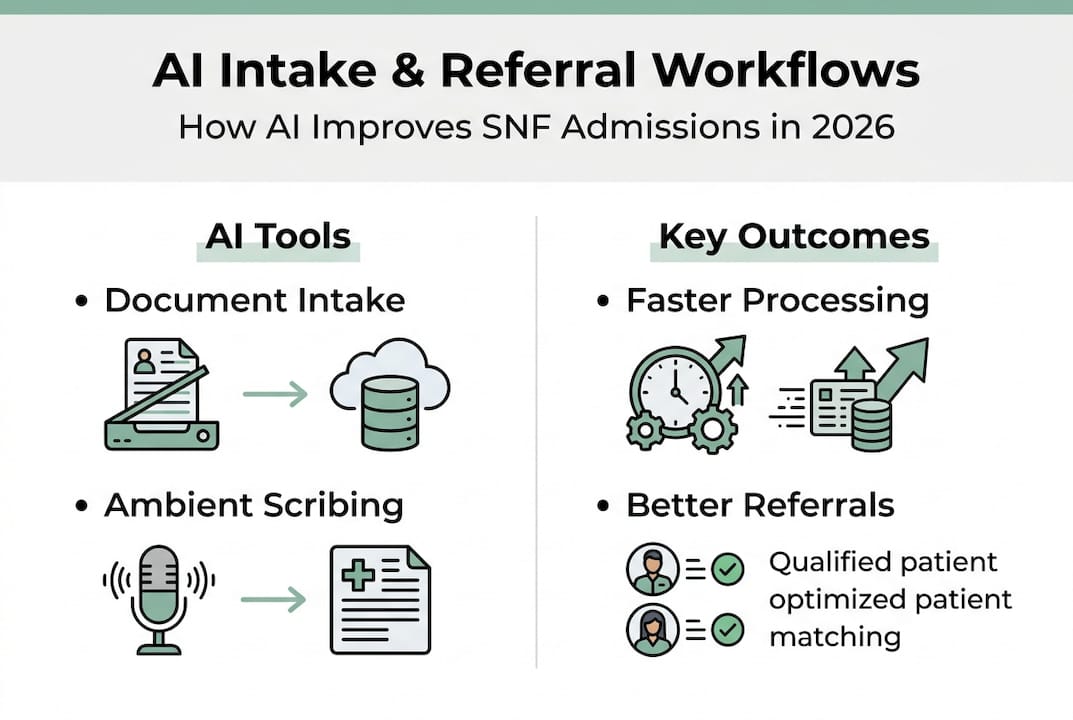
Document intake and extraction automates the ingestion of referral packets, pulling structured data from unstructured sources like faxed clinical notes, discharge summaries, and insurance authorizations. This eliminates manual re-entry and reduces processing time significantly.
Ambient scribing captures clinical conversations and generates documentation in real time. WellSky SkySense AI reduces documentation time by 50% using this approach, freeing admissions nurses and coordinators from time-consuming note-taking.
Referral triage and scoring uses predictive models to rank incoming referrals by clinical complexity, reimbursement potential, and fit with your facility’s capacity. This replaces gut-feel decisions with data-backed prioritization.

Outcome prediction analyzes patient history, diagnosis codes, and payor data to forecast length of stay, rehospitalization risk, and likely reimbursement. These insights support smarter bed management and resource planning.
Here is how manual and AI-driven workflows compare across key dimensions:
| Workflow step | Manual | AI-driven |
|---|---|---|
| Referral receipt to review | 2 to 4 hours | Under 15 minutes |
| Clinical document extraction | Manual, error-prone | Automated, structured |
| Eligibility verification | 1 to 2 days | Real-time |
| Bed assignment decision | Coordinator judgment | Data-supported recommendation |
A standard AI-powered referral workflow follows these steps:
- Referral received via fax, EMR, or portal
- AI extracts and structures clinical and insurance data automatically
- Triage algorithm scores and ranks the referral
- Eligibility and benefits verified in real time
- Clinical summary generated for admissions coordinator review
- Coordinator approves or adjusts the recommendation
- Bed assignment confirmed and patient notified
Exploring workflow automation examples from similar facilities can help your team visualize what this looks like in practice. For labs and diagnostics teams, AI lab management systems offer parallel efficiencies worth understanding.
Pro Tip: Integrate AI tools with your existing EMR using FHIR or HL7 standards from day one. A clean integration prevents duplicate records, reduces staff confusion, and ensures that admissions automation efficiency translates directly into measurable time savings rather than creating new workarounds.
Prioritizing the right referrals: Smart strategies for SNFs and rehab
Not every referral is worth accepting. That statement may seem counterintuitive when your goal is high occupancy, but accepting the wrong referrals can strain clinical staff, reduce reimbursement, and create compliance risk. AI gives your team the data to make smarter, faster decisions about which referrals to prioritize.
SNFs should prioritize high-reimbursement, low-LOS risk referrals and use AI to support PDPM and VBP compliance. Under PDPM, reimbursement is tied directly to patient characteristics at admission. Accepting referrals without evaluating those characteristics upfront increases the risk of underpayment or claim denial.
AI-supported criteria your team should use when triaging referrals include:
- Diagnosis and acuity level relative to your facility’s clinical capabilities
- Payor mix and expected reimbursement under PDPM or managed care contracts
- Predicted length of stay based on historical outcomes for similar patients
- Rehospitalization risk score to avoid admissions that may trigger VBP penalties
- Documentation completeness to ensure the referral packet supports clean billing
- Prior authorization status to prevent revenue delays after admission
Human oversight remains essential, particularly for referrals involving regulatory exceptions, complex diagnoses, or patients with limited documentation. AI should inform the decision, not replace the coordinator’s clinical judgment.
Reviewing intake improvement tips from facilities that have refined their triage criteria can accelerate your team’s learning curve. Connecting those insights to workflow automation in action shows how criteria translate into system configuration.
Pro Tip: Use your AI dashboard to review referral acceptance trends monthly. If your team is consistently declining referrals from a specific payor or diagnosis group, that pattern may signal a gap in clinical capacity or a contract renegotiation opportunity.
Managing risks: Compliance, governance, and human oversight in AI-driven intake
AI introduces real compliance risks if implemented without a governance framework. As your facility increases reliance on automated decisions, the stakes for auditability, transparency, and regulatory alignment go up. Administrators need to understand where the risks are and how to manage them proactively.
The main compliance areas affected by AI in admissions include:
- CMS Five-Star ratings, which can be impacted if AI-driven intake decisions affect quality metrics or staffing ratios
- HIPAA compliance, requiring that all AI tools handling protected health information meet data security and access control standards
- Auditability, meaning every AI-assisted decision must be traceable and explainable to surveyors or auditors
AI governance and TPRM remain immature at fewer than 50% of organizations, raising new challenges for compliance and oversight. That means most vendors and facilities are still building the frameworks needed to manage AI responsibly. You cannot assume your vendor has solved this for you.
Emerging benchmarks like MedHELM and MedTriage are being developed to evaluate AI accuracy and reliability in triage and referrals. Asking your vendor how their tools perform against these standards is a reasonable and necessary part of evaluation.
Practical safeguards your facility should put in place include:
- Routine audits of AI-generated decisions, at least quarterly
- Human-in-the-loop checkpoints at every clinical decision stage
- Vendor contracts that require transparency into model logic and data sources
- Staff training on how to identify and escalate AI errors
- Documentation protocols that capture both the AI recommendation and the human decision
“Interpretability is not optional. Every AI-powered admissions decision must be explainable to your team, your patients, and your regulators.”
Facilities that invest in streamlined task management alongside governance planning will be better positioned when CMS and state regulators increase scrutiny of AI use in post-acute care. For additional context on regulatory compliance guidance in adjacent care settings, reviewing how other providers approach oversight can inform your own policies.
Perspective: What most SNFs get wrong about AI and how to lead in 2026
Here is what we see consistently: facilities delay AI adoption not because the technology is unproven, but because the internal conversation stalls on IT budget approvals or fears that automation will erode clinical judgment. Both concerns are valid. Neither justifies inaction.
The facilities that adopt AI early are not just saving time. They are building institutional knowledge, refining their intake criteria, and influencing what good practice looks like before regulators formalize it. Early adopters often set the operational benchmarks that others are eventually required to meet.
Waiting for a perfect governance framework or a fully funded IT roadmap means your competitors are already learning from real data while your team is still processing referrals manually. The ROI from improving admissions with automation is not theoretical. It shows up in bed fill rates, staff retention, and cleaner billing within the first quarter of implementation.
Pro Tip: Identify two or three staff members, whether in nursing or administration, who are curious about technology and willing to pilot new tools. These internal AI champions will accelerate adoption, surface real workflow issues faster than any consultant, and build the credibility needed to bring the rest of your team along.
Take the next step: Practical resources for AI-powered admissions
You now have a clear picture of where AI delivers the most value in intake and referral management, and what it takes to implement it responsibly. The next step is connecting that knowledge to tools your facility can actually use.
Smart Admissions gives skilled nursing facilities and rehab centers the AI-powered infrastructure to automate referral intake, verify eligibility in real time, and fill beds faster. Explore referral management examples to see how similar facilities have structured their workflows. If you are ready to reduce manual work and improve occupancy, learn how to automate admissions for up to 20% faster bed fill. You can also review the full scope of intake automation capabilities available today. Acting now positions your facility ahead of the next wave of compliance requirements and workforce pressures.
Frequently asked questions
What is the single biggest efficiency gain from using AI in SNF admissions?
Automated document extraction saves over 30 minutes per admission and has been shown to double referral conversion rates, making it the highest-impact starting point for most facilities.
How mature are AI governance and compliance practices in healthcare today?
Fewer than 50% of organizations have robust AI governance in place, and emerging standards like MedHELM and MedTriage are still being developed to fill that gap.
Why is AI adoption in skilled nursing facilities still so low?
Adoption lags primarily because of IT funding constraints, concerns about clinician role erosion, and uncertainty about return on investment in the short term.
How can AI support PDPM and value-based programs in SNFs?
AI-driven referral prioritization helps facilities select admissions that are financially optimal and clinically aligned with PDPM scoring and VBP performance requirements.