
Hospitals generate an average of 6.6 referrals per patient, yet only about 32% of those referrals result in an actual admission. If your team is staring at a full referral inbox but still struggling with empty beds, the problem is rarely the number of referrals coming in. It is how well you understand, track, and act on where those referrals originate. This guide breaks down what referral sources are, how the SNF referral landscape has shifted since 2019, and what concrete steps your admissions team can take to improve occupancy and reduce wasted effort.
Table of Contents
- What are referral sources and why do they matter?
- The shifting landscape of SNF referrals: Key trends and stats
- Mapping and evaluating your facility’s referral sources
- Improving referral conversion: Best practices and technology enablers
- Why most facilities misunderstand referral source value—and what to do differently
- Turn referral insights into admissions results with smart solutions
- Frequently asked questions
Key Takeaways
| Point | Details |
|---|---|
| Referral sources defined | Referral sources are the origin points for patient admissions and must be tracked for effective facility management. |
| Current SNF referral trends | Admissions are rising while only a fraction of referrals convert, making conversion strategies crucial. |
| Mapping for success | Facilities should map and evaluate their referral sources to prioritize those that drive real outcomes. |
| Tech and efficiency | Modern technology and refined workflows help SNFs respond to evolving referral and patient acuity patterns. |
| Focus on value | Quality, not just volume, determines which referral sources matter most for sustainable occupancy. |
What are referral sources and why do they matter?
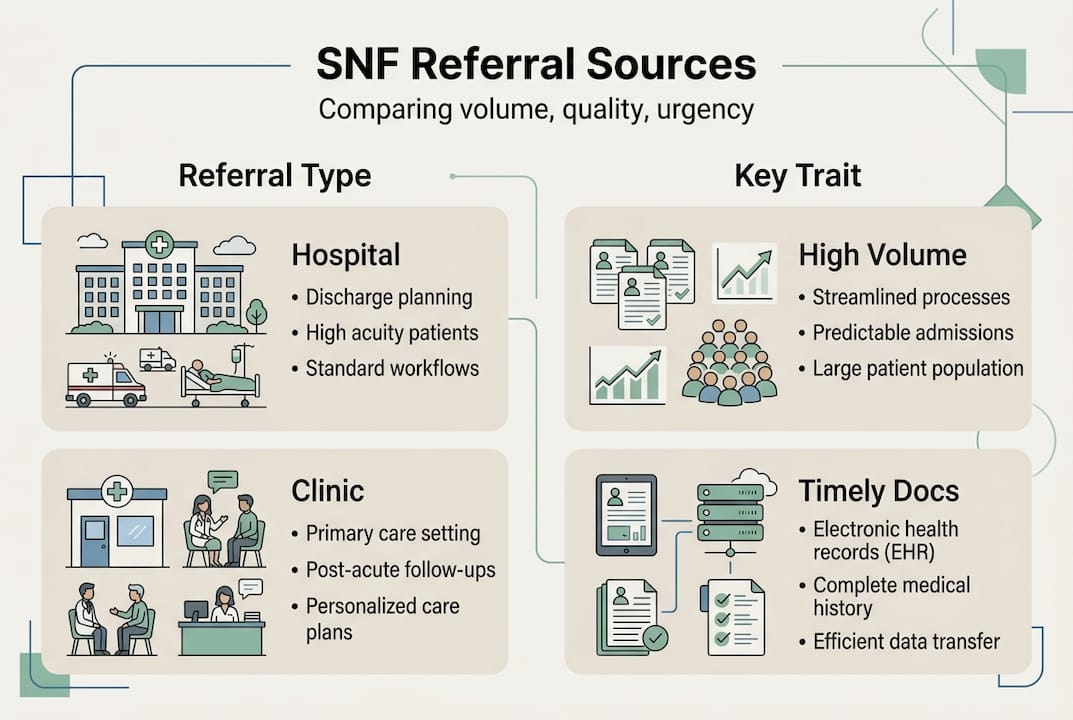
A referral source is any person, organization, or care setting that sends a potential patient to your skilled nursing facility or rehabilitation center for admission consideration. Understanding the key types of patient referrals your facility receives is the foundation of a high-performing admissions operation.
The most common referral sources in the SNF and post-acute care setting include:
- Acute care hospitals: The dominant source, typically through discharge planners or case managers who coordinate post-acute placement.
- Physician offices and medical groups: Primary care and specialty physicians who refer patients needing short-term rehab or long-term care.
- Home health agencies: Patients whose condition deteriorates at home may be redirected to SNF-level care.
- Assisted living and senior communities: Residents who need a higher level of clinical support are often referred to nearby SNFs.
- Emergency departments: Patients presenting without a primary care relationship sometimes enter the post-acute system through the ED.
Each source type carries different characteristics in terms of patient acuity, documentation quality, and conversion likelihood. A hospital discharge planner operates under time pressure and expects rapid responses. A physician office referral may come with more complete clinical history but lower urgency. Knowing these differences shapes how your team prioritizes and responds.
| Referral source | Typical volume | Documentation quality | Response urgency |
|---|---|---|---|
| Acute care hospital | High | Moderate | Very high |
| Physician office | Moderate | High | Moderate |
| Home health agency | Low to moderate | Moderate | Moderate |
| Assisted living | Low | Variable | Low to moderate |
| Emergency department | Low | Low | High |
Tracking which sources generate the most accepted admissions, not just the most referrals, is what separates reactive teams from strategic ones. Referral conversion in admissions depends heavily on your ability to match source behavior to your intake process.
Pro Tip: Run a 90-day audit of your referral log and sort by source type. Calculate the acceptance rate for each. You will likely find that two or three sources account for the majority of your actual admissions, regardless of overall referral volume.
Hospital-to-SNF referral rates have remained relatively stable, but admissions have climbed 43% since 2019. That means the same referral pipeline is producing more admissions, which points to improved coordination and intake processes at facilities that are growing.
The shifting landscape of SNF referrals: Key trends and stats
The SNF referral environment has changed significantly over the past several years. Understanding these shifts helps your team anticipate what is coming, rather than reacting after the fact.
Admissions grew 8% in 2024 alone, continuing a trend that started after the disruptions of 2020 and 2021. Yet despite this growth, acceptance rates have never exceeded 37%, meaning the majority of referred patients are still not admitted. The gap between referral volume and actual admissions remains wide.
Patient acuity has increased 34% since 2019, meaning the patients being referred today are clinically more complex than they were just a few years ago.
This rise in acuity has real implications. Your admissions team must evaluate more detailed clinical documentation, verify insurance coverage for higher-cost care, and coordinate with clinical staff earlier in the process. Facilities that have not updated their intake workflows to reflect this complexity are leaving admissions on the table.
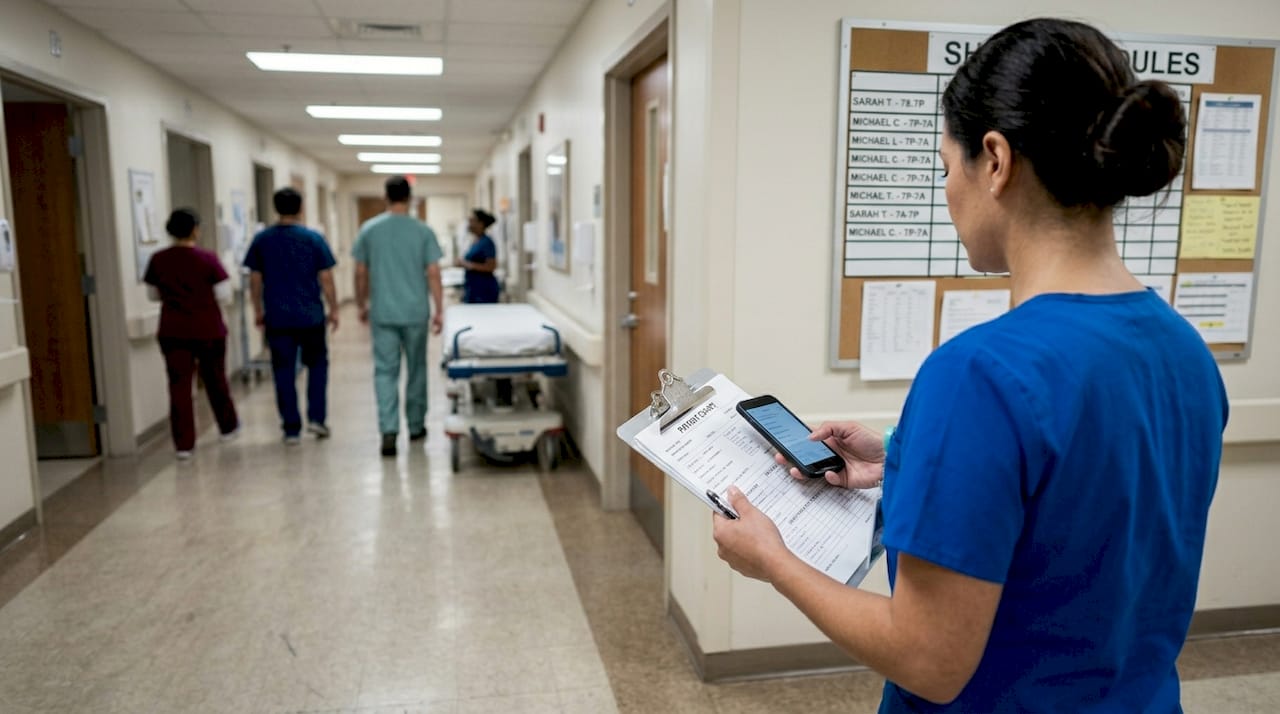
Technology is playing a growing role in closing the gap. Smarter coordination tools can help facilities enhance referral tracking and avoid unnecessary care transitions that cost the system an estimated $30 to $90 billion annually.
| Referral pattern | Pre-2019 approach | 2026 approach |
|---|---|---|
| Intake process | Manual fax and phone | Digital intake portals and EMR integration |
| Patient acuity assessment | Basic clinical review | Real-time eligibility and acuity scoring |
| Response time | 24 to 48 hours | Same-day or under 4 hours |
| Source tracking | Spreadsheets or memory | Automated dashboards and analytics |
| Communication with hospitals | Reactive | Proactive, relationship-based |
The facilities gaining ground are those investing in systems that reduce manual steps, surface the right data quickly, and keep referral partners informed throughout the intake process. Those still relying on fax-based workflows and manual tracking are not just slower. They are losing referrals to competitors who respond faster.
Mapping and evaluating your facility’s referral sources
With a clear picture of the trends, the next step is applying that knowledge to your own referral network. Mapping your sources is not a one-time exercise. It is an ongoing practice that keeps your admissions strategy grounded in real data.
Given that facilities receive referrals from an average of 6.6 sources per patient, and many larger facilities manage 30 or more active source relationships, a structured approach is essential.
Step-by-step: How to map and evaluate your referral sources
- Compile your referral log. Pull data from your EMR, fax records, and intake forms for the past 12 months. List every source that sent at least one referral.
- Categorize each source. Group by type: hospital, physician, home health, assisted living, or other. Note the contact person and typical communication method.
- Assign key performance indicators (KPIs). For each source, calculate: total referrals sent, acceptance rate, average length of stay for admitted patients, and payer mix.
- Score and rank sources. Weight your scoring toward sources with high acceptance rates, favorable payer mix, and appropriate patient acuity for your facility’s capabilities.
- Identify gaps and opportunities. Look for high-volume sources with low conversion. These may signal a process problem, a relationship issue, or a mismatch in patient fit.
KPIs worth tracking for each referral source:
- Referral-to-admission conversion rate
- Average time from referral receipt to decision
- Payer mix (Medicare, Medicaid, commercial insurance)
- Average patient acuity score
- Readmission rate for patients from this source
| KPI | Target benchmark | Why it matters |
|---|---|---|
| Conversion rate | Above 40% | Indicates source and facility fit |
| Response time | Under 4 hours | Directly impacts acceptance |
| Medicare payer mix | Facility-specific | Affects revenue per admission |
| Readmission rate | Below 15% | Signals care quality and source reliability |
Using automation tools for referral management can significantly reduce the time your team spends on this analysis, freeing staff to focus on relationship-building and clinical review.
Improving referral conversion: Best practices and technology enablers
With your sources mapped and ranked, the focus shifts to improving how many of those referrals convert to actual admissions. The national average of only 32% accepted is not a ceiling. It is a baseline your facility can exceed with the right practices and tools.
Best practices for higher referral acceptance:
- Respond within two hours. Speed is the single most impactful factor in referral acceptance. Hospital discharge planners move quickly, and a delayed response often means the patient goes elsewhere.
- Standardize your intake documentation checklist. Know exactly what clinical and insurance information you need before making an admission decision, and communicate that list to your top referral sources.
- Assign dedicated source contacts. When a discharge planner knows who to call at your facility and gets consistent, reliable responses, they prioritize you.
- Use preadmission clinical review tools. Real-time acuity scoring and insurance eligibility verification reduce back-and-forth and speed up your decision.
- Follow up on declined referrals. Document why each referral was declined and look for patterns. If a source consistently sends patients outside your clinical scope, address it directly.
Facilities that implement structured intake workflows report faster bed fill rates and fewer administrative errors, directly improving both revenue and staff satisfaction.
The role of technology in referral management is no longer optional for competitive facilities. Platforms that integrate with your EMR, automate eligibility checks, and centralize referral communications reduce the average time spent per referral from 45 minutes to under 15. That time savings compounds quickly across a full admissions team.
Looking at referral management system examples from similar facilities shows consistent results: faster response times, higher conversion rates, and reduced staff burnout.
Pro Tip: Avoid the two most common pitfalls in referral conversion. First, manual data entry across disconnected systems creates errors and delays. Second, unclear internal protocols about who reviews what and when lead to dropped referrals. Standardize both before adding any new technology layer.
Why most facilities misunderstand referral source value—and what to do differently
Here is something most admissions guides will not tell you: chasing referral volume is often the wrong goal. Many facilities celebrate a high number of incoming referrals without asking whether those referrals are actually a good fit.
We have seen teams spend significant effort maintaining relationships with high-volume hospital systems while overlooking a small physician group that consistently sends Medicare-eligible patients with straightforward acuity and excellent documentation. The physician group converts at 60%. The hospital system converts at 22%. Which one deserves more of your attention?
The uncomfortable truth is that types of patient referrals vary enormously in their actual value to your facility, and volume alone masks that reality. A facility receiving 200 referrals per month with a 20% acceptance rate is working harder for fewer admissions than one receiving 80 referrals with a 50% acceptance rate.
Re-evaluate your source rankings at least quarterly. Build relationships with sources that send the right patients, not just the most patients. And when a high-volume source consistently sends referrals your facility cannot accept, have a direct conversation about patient fit. That conversation protects your team’s time and often improves the quality of future referrals from that source.
Turn referral insights into admissions results with smart solutions
Understanding your referral sources is the first step. Acting on that understanding is where real occupancy growth happens. When your team knows which sources convert, how to respond faster, and where the gaps are, every part of the admissions process becomes more efficient.
Smart Admissions gives your team the tools to do exactly that. Our AI-powered platform integrates with your existing EMR and insurance portals to automate eligibility checks, centralize referral tracking, and surface the analytics your team needs to make faster, smarter admission decisions. Whether you are looking to explore referral management systems or ready to automate your admissions process entirely, we are here to support your next step.
Frequently asked questions
What is a referral source in skilled nursing facilities?
A referral source in SNF admissions is any person, clinic, or organization that sends potential patient admissions to an SNF or rehab center, such as hospitals, physicians, or case managers.
Why is tracking referral sources important for SNF admissions?
Tracking sources helps facilities focus outreach and resources on the highest-converting relationships, directly raising occupancy rates and improving the quality of patient placements.
How can technology improve referral management?
Technology streamlines intake, automates eligibility verification, and centralizes communication, making it significantly easier to boost admissions efficiency and reduce unnecessary transition costs.
What trends are shaping referral sources for SNFs in 2026?
Referral source volume is steady, but admissions are up 43% since 2019, with higher patient acuity and technology-enabled coordination playing a larger role in which facilities win the admission.