
TL;DR:
- Actionable insights are specific, timely signals that inform immediate admissions decisions.
- Key benchmarks like acceptance rates and readmission rates guide workflow improvements and targets.
- Implementing Lean Six Sigma and automation enhances speed, reduces waste, and addresses complex case barriers.
More patient data does not automatically produce better admissions decisions. Many skilled nursing facilities and rehabilitation centers sit on mountains of referral records, EMR exports, and payer reports, yet still struggle with slow bed fill rates and missed conversions. The real gap is not data volume. It is the ability to extract clear, timely signals that your admissions team can act on immediately. This article defines what actionable healthcare insights actually mean in a referral and admissions context, presents key benchmarks your team should track, explains how Lean Six Sigma and automation translate insights into results, and addresses the real-world barriers that complicate even the best-designed workflows.
Table of Contents
- Defining actionable healthcare insights for admissions
- Key benchmarks and metrics: Turning data into action
- Proven frameworks: Lean Six Sigma and automation in admissions
- Handling edge cases and real-world workflow barriers
- Why actionable insights, not just data dashboards, change admissions results
- Put actionable insights to work: Next steps for your admissions team
- Frequently asked questions
Key Takeaways
| Point | Details |
|---|---|
| Timely, targeted insights | Focusing on relevant metrics allows admissions teams to act quickly and efficiently. |
| Proven frameworks boost results | Lean Six Sigma and automation convert healthcare data into measurable gains for SNFs and rehab centers. |
| Address real-world barriers | Actionable insights help teams overcome common obstacles like incomplete packets and high-acuity referrals. |
| Benchmark performance monthly | Tracking admission metrics regularly makes it easier to identify trends and proactively improve outcomes. |
Defining actionable healthcare insights for admissions
Before your team can improve referral outcomes, you need a precise definition of what you are working with. Raw data is unprocessed information: a spreadsheet of referral timestamps, a list of payer codes, or a log of bed availability. Metrics are calculations derived from that data: acceptance rate, average review time, or readmission percentage. Actionable insights are a step further. They are specific, timely conclusions drawn from metrics that tell your team exactly what to do next.
For example, knowing your facility received 200 referrals last quarter is data. Knowing your acceptance rate was 34% is a metric. Knowing that referrals from one hospital partner convert at 58% while referrals from another convert at 19% is an actionable insight. It tells your admissions coordinator to prioritize the high-conversion source and investigate why the second source underperforms.
Actionable insights share three key attributes:
- Relevance: They connect directly to a decision your team faces right now, such as whether to accept a high-acuity referral or flag an incomplete packet.
- Clarity: They are specific enough to eliminate ambiguity. Vague trends do not drive action; precise signals do.
- Timeliness: They arrive when the decision window is open. An insight delivered 48 hours after a referral expires has no operational value.
The distinction matters because workflow automation only delivers results when it surfaces insights your team can use, not just data your team must interpret. Facilities that invest in dashboards without defining what decisions those dashboards should support often find their staff more overwhelmed, not less.
“Manual processes cause 20-40% leakage; automation combined with Lean methodologies yields faster admissions, higher conversions, and lower costs.”
The practical benefit of actionable insights in intake process optimization is that your team spends less time interpreting reports and more time making confident decisions. Speed and quality improve together, which is the outcome every admissions director is working toward.
After clarifying what actionable insights are, it is important to see how they are measured and used in real admissions workflows.
Key benchmarks and metrics: Turning data into action
Knowing which numbers to track is the first step toward converting data into decisions. The following benchmarks reflect current SNF performance and give your team a clear baseline for comparison.
| Metric | SNF benchmark |
|---|---|
| Hospital referral acceptance rate | 32-37% |
| Average referrals per patient | 6.6 |
| SNF admissions growth since 2019 | 43% increase |
| Current average occupancy | 84% |
| Preventable readmission rate (median) | 10.4% |
| Discharge to community rate | 50.9% |
| 30-day readmission rate | 23.5% |
| Average cost per readmission | ~$16,000 |
These SNF benchmarks reveal where the financial stakes are highest. A 23.5% readmission rate at $16,000 per event is not just a clinical problem. It is a significant revenue drain that actionable monitoring can reduce.
Here is how each metric drives a specific workflow decision:
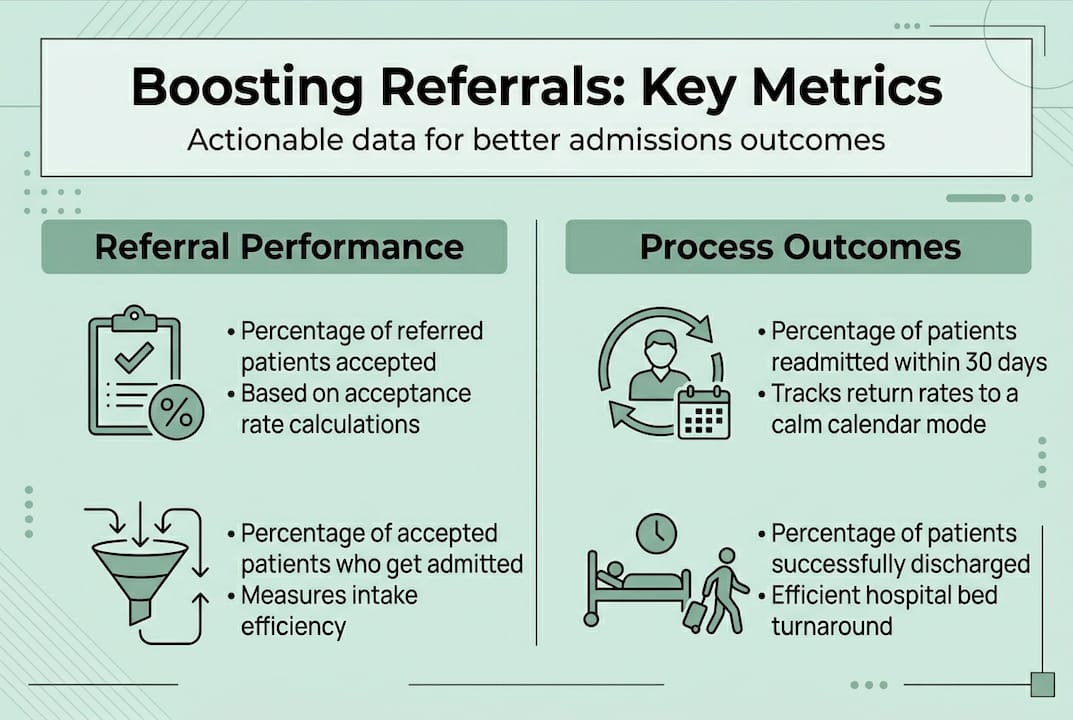
- Acceptance rate (32-37%): If your facility falls below 32%, your team should examine whether clinical criteria are misaligned with your referral sources or whether packet review is too slow.
- Referrals per patient (6.6 avg): High averages signal that patients are shopping multiple facilities. Faster response times directly improve your referral conversion rate.
- Preventable readmissions (10.4%): Tracking this monthly reveals whether post-admission monitoring protocols are working or need adjustment.
- Discharge to community (50.9%): This metric reflects clinical effectiveness and influences hospital referral partner confidence in your facility.
The financial impact of preventable readmissions is the metric most facilities underestimate. Reducing your readmission rate by even two percentage points across 100 annual admissions saves approximately $320,000. That is a measurable return on any investment in automation in admissions.

Pro Tip: Track these metrics monthly, not quarterly. Monthly tracking catches emerging trends early enough to correct them before they affect occupancy or payer relationships.
Once you know what to measure, you can implement proven frameworks to systematically act on your insights.
Proven frameworks: Lean Six Sigma and automation in admissions
Data and benchmarks only produce results when your team has a structured method for acting on them. Two approaches stand out in skilled nursing and rehabilitation settings: Lean Six Sigma and workflow automation.
Lean Six Sigma uses the DMAIC cycle (Define, Measure, Analyze, Improve, Control) to reduce process variation and eliminate waste. In admissions, this means identifying exactly where referral packets stall, where clinical review takes longer than necessary, and where payer verification creates bottlenecks. Lean Six Sigma optimizes referral workflows by identifying waste, reducing variation, and improving timeliness, and it has been applied successfully in safety-net referral programs and nursing quality initiatives.
Here is a comparison of three process improvement approaches:
| Approach | Speed of change | Cost | Scalability | Best for |
|---|---|---|---|---|
| Manual review | Slow | Low upfront | Poor | Very small teams |
| Lean Six Sigma | Moderate | Medium | Good | Systematic improvement |
| Workflow automation | Fast | Medium-high | Excellent | High-volume facilities |
To launch a DMAIC project in your admissions department, follow these steps:
- Define: Identify the specific problem, such as referral packet review taking more than four hours on average.
- Measure: Collect baseline data on current review times, acceptance rates, and conversion rates.
- Analyze: Identify root causes, whether it is incomplete packets, staff availability, or payer verification delays.
- Improve: Implement targeted changes, such as automated packet completeness checks or pre-authorization workflows.
- Control: Set monitoring rules to ensure improvements hold over time.
Automating admissions compresses what used to take days into hours. Facilities using automation report higher conversion rates and measurable cost savings compared to manual-only workflows. The workflow benefits extend beyond speed: staff burnout decreases when repetitive tasks are handled by the system rather than by your team.
Pro Tip: Start with the Measure phase. Accurate, timely referral packet data is the foundation of every downstream improvement. If your measurement is flawed, every subsequent step compounds the error.
Different SNFs and rehab centers must also adapt these frameworks to handle real-world complexity and edge cases.
Handling edge cases and real-world workflow barriers
Frameworks and benchmarks describe average conditions. Your admissions team operates in conditions that are rarely average. High-acuity patients, behavioral health overlays, incomplete documentation, and payer denials create friction that no dashboard eliminates on its own.
High-acuity patients have increased 34% since 2019, and behavioral health co-diagnoses, incomplete Non-Therapy Ancillary (NTA) qualifiers, and payer denials are now routine challenges rather than exceptions. Physiatrist-led monitoring has shown measurable results in preventing clinical decline and reducing readmissions in these complex cases.
Here is how actionable insights address each common barrier:
- Incomplete referral packets: An automated completeness check flags missing documents before clinical review begins, saving your team from discovering gaps mid-process. This connects directly to intake optimization strategies that reduce back-and-forth with hospital discharge planners.
- High-acuity cases: Real-time risk scoring alerts your admissions coordinator when a referral exceeds your facility’s clinical threshold, allowing faster escalation to clinical leadership rather than a delayed rejection.
- Behavioral health overlays: Insights that flag behavioral health diagnoses at intake allow your team to verify appropriate staffing and room availability before accepting, reducing post-admission crises.
- Payer denials: Tracking denial patterns by payer and diagnosis code reveals systemic issues. If one payer consistently denies a specific diagnosis, your team can adjust pre-authorization steps proactively.
“Actionable means responding to complexity, not just averages. A system that only performs well on straightforward referrals is not a system built for today’s post-acute environment.”
Monitoring strategies that prevent readmissions include physiatrist oversight for high-acuity patients, infection surveillance protocols, and falls risk assessments initiated at admission rather than after an incident. Each of these is most effective when triggered by a specific insight, such as a flagged diagnosis or a documented fall history, rather than applied uniformly to every patient.
These complexities reveal why it is crucial to move beyond data hoarding, toward truly actionable strategies.
Why actionable insights, not just data dashboards, change admissions results
Most skilled nursing facilities already have access to more data than their teams can process. The problem is not a shortage of information. It is a shortage of structured responses to that information.
We see facilities that invest heavily in analytics platforms but still review referrals manually, still miss high-conversion opportunities, and still track metrics quarterly instead of weekly. The data exists. The feedback loop does not.
Teams that act rapidly on even basic insights, such as referral packet completeness rates or time-outlier cases, consistently outperform facilities with sophisticated dashboards but no defined response protocols. Admissions conversion improves not because of better technology alone, but because teams build habits around responding to specific signals.
The pitfall to avoid is chasing metrics for compliance purposes rather than operational improvement. Tracking readmission rates to satisfy a reporting requirement is not the same as using readmission data to adjust your post-admission monitoring protocol. One is documentation. The other is improvement.
Real progress is iterative. Test a change, measure its effect, reflect on what worked, and adapt. One annual audit will not move your admissions outcomes. A monthly review cycle tied to specific response actions will.
Put actionable insights to work: Next steps for your admissions team
Understanding the difference between raw data and actionable insights is the foundation. Translating that understanding into faster referral decisions, higher bed fill rates, and lower readmission costs is where Smart Admissions delivers measurable results.
Smart Admissions automates referral packet review, surfaces real-time eligibility and clinical risk signals, and integrates with your existing EMR so your team acts on insights rather than hunting for information. Whether you are benchmarking your referral management systems or exploring the full range of admissions automation benefits, the platform is built to support every type of patient referral your facility handles. Book a demo to see how your team can start acting on insights today.
Frequently asked questions
What makes healthcare insights ‘actionable’ for admissions teams?
Actionable insights are timely, specific, and tied to a clear next step, such as prioritizing a high-conversion referral source or flagging an incomplete packet before clinical review. Manual process leakage of 20-40% drops significantly when teams replace generic data reviews with structured, insight-driven responses.
Which metrics matter most when tracking admissions performance?
Focus on acceptance rates, preventable readmissions, discharge to community rates, and referral conversion rates. SNF benchmarks show acceptance rates of 32-37%, preventable readmissions at a median of 10.4%, and discharge to community at 50.9%, giving your team clear targets to measure against.
How does Lean Six Sigma improve the admissions process?
Lean Six Sigma uses the DMAIC cycle to identify waste, standardize steps, and reduce variation in referral and admissions workflows. Referral workflow optimization through this method has demonstrated measurable improvements in timeliness and efficiency across post-acute care settings.
How do actionable insights help with complex, high-acuity cases?
Actionable insights surface risk flags, missing documentation, and payer challenges at the point of referral review, allowing your team to escalate or resolve issues before they cause delays or denials. High-acuity volume has risen 34% since 2019, making real-time insight tools essential rather than optional for today’s admissions teams.