
Admissions software ROI in a skilled nursing facility is the net financial return from faster, better referral decisions, measured against everything the software costs you in its first year. You calculate it as (verified first-year benefits minus first-year costs) divided by first-year costs, multiplied by 100. The hard part is not the formula. It is choosing a clean baseline, counting every cost, and crediting only the benefits you can trace to the software.
This guide walks your admissions team through that process step by step, with a worked example you can rebuild with your own numbers.
TL;DR
- Admissions software ROI = (first-year verified benefits − first-year costs) ÷ first-year costs × 100, per ServingIntel’s senior living ROI guidance.
- Set a baseline before go-live, then compare at 30, 60 and 90 days and keep reviewing after that.
- Count software fees, setup, training time, and the temporary productivity dip as costs.
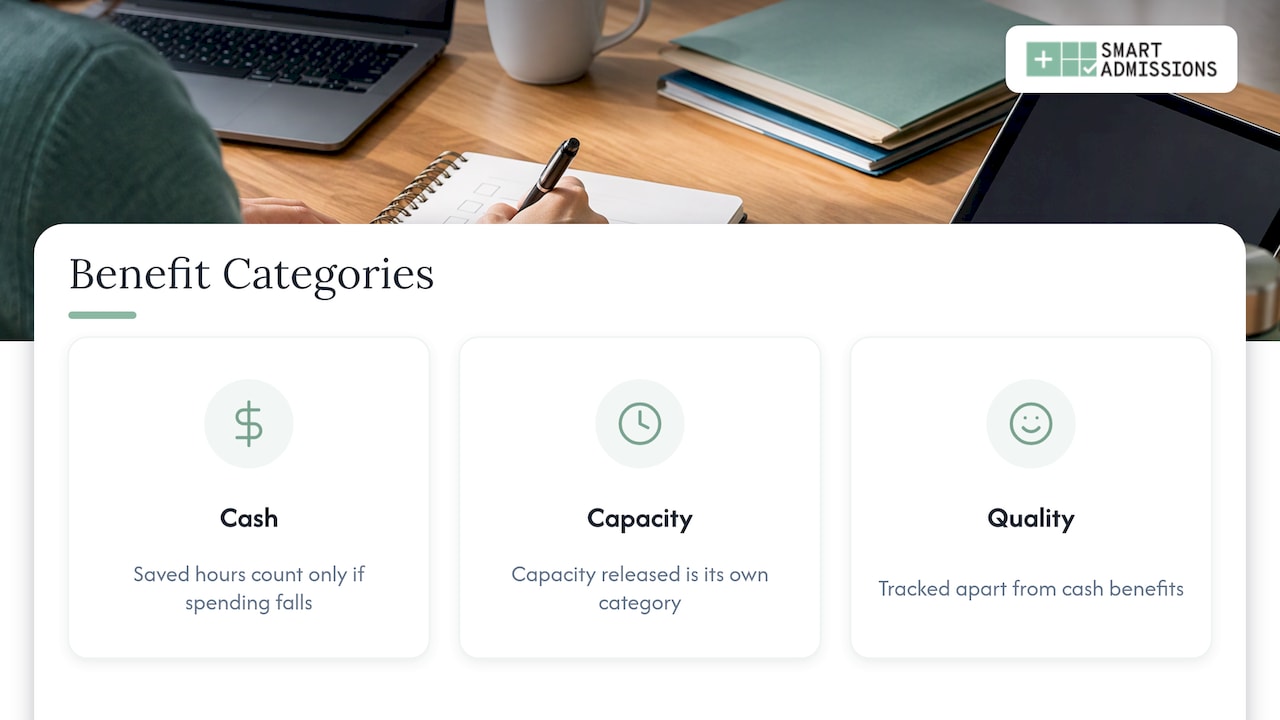
- Sort benefits into cash, released capacity, and quality or experience. Count saved hours as cash only when spending actually falls.
- Judge a projection by its baseline, data sources and review schedule, not by the size of the percentage.
Table of Contents
- What ROI means for admissions software in a skilled nursing facility
- Step 1: Build a baseline before you switch anything on
- Step 2: Count every cost, not only the subscription
- Step 3: Sort benefits into cash, capacity and quality
- Step 4: Use a worked example, then replace it with your numbers
- Step 5: Review at 30, 60 and 90 days, then keep going
- Step 6: Account for attribution and your own context
- What the research says about technology returns in nursing homes
- Perspective: why we measure ROI on decisions, not speed
- Step 7: Check whether a projected ROI is credible
- Where Smart Admissions fits in your calculation
- FAQ
- Sources
What ROI means for admissions software in a skilled nursing facility
Search results for this topic are dominated by higher education, where ROI means enrolled tuition revenue against recruiting spend. Skilled nursing works differently. Your “revenue per admission” depends on payer, clinical complexity, length of stay and the cost of care, so the same referral can be a strong admission or a loss.
For a nursing home, admissions software ROI has two sides:
- Gains from saying yes to the right referrals faster. More of the referrals that fit your capabilities, payer mix and beds become admissions instead of going to the next facility that answered first.
- Savings from avoiding wrong admissions. Fewer patients arrive whose medication costs, care needs or payer source your facility cannot support.
A third, softer category sits beside them: staff time released from reading faxes, portal messages and emails. That matters for burnout and capacity, but it is only a cash saving when it changes what you spend.
Readers should also know the evidence base is modest. A federal review of health IT in long-term and post-acute care noted that analysis of net benefits and ROI in this sector is limited, and that positive returns depend heavily on workflow redesign and the reimbursement environment. That is a reason to measure your own facility carefully rather than lean on a generic percentage.
Step 1: Build a baseline before you switch anything on
No baseline, no credible ROI. ServingIntel recommends capturing current performance over a representative period, such as a month, and accounting for seasonal cycles. Winter respiratory season and post-holiday hospital discharge surges can change referral volume enough to distort a before-and-after comparison.
Pull these numbers from your referral log, your EHR and your census reports:
- Referrals received per month, by source (hospital portal, fax, email, phone)
- Median time from referral receipt to your yes or no
- Acceptance rate, and denial reasons by category
- Referrals lost because another facility responded first
- Admissions per month, and average length of stay
- Payer mix of new admissions (Medicare Part A, Medicare Advantage, Medicaid, managed care, private pay)
- Staff minutes spent reviewing each referral
- Admissions later flagged as problems: unexpected high-cost medications, care needs beyond your capabilities, payer authorization failures
Write down where each number comes from and who owns it. If two people calculate “response time” differently, your ROI will be argued about instead of used.
Step 2: Count every cost, not only the subscription
The most common mistake in admissions software ROI is a cost side that holds only the subscription fee. Include these:
| Cost category | What to include |
|---|---|
| Software fees | Subscription for the full first year |
| Setup | Configuration of your facility rules, integration work, IT time |
| Training | Staff hours for admissions, nursing leadership, business office, valued at loaded wage |
| Transition dip | Temporary slowdown while your team learns the workflow |
| Ongoing support | Internal time to maintain rules, review reports, onboard new hires |
Research backs the last two. A federal assessment of health IT found that EHR adoption has been associated with significant productivity decreases during the first months, a soft cost providers find hard to quantify. A study of nursing homes found that the added costs of bedside EMR came from technology maintenance, technical support and ongoing staff training rather than from extra direct care staffing.
Those studies concern EHR systems, not referral decision tools, so treat them as a reminder of cost categories rather than as predictions. For Smart Admissions, the published subscription is $597 per month or $6,447 per year, and the plan you pick sets the first-year software line. Add your own internal time on top.
Step 3: Sort benefits into cash, capacity and quality
ServingIntel suggests grouping benefits as cash benefits, capacity released, and quality or experience, and counting saved hours as cash only when they reduce spending. That discipline keeps your admissions software ROI honest.
Cash benefits
These show up in your financial statements:
- Additional admissions from faster, confident responses. Value each at contribution margin, not gross revenue.
- Better payer mix. Shifting even a few admissions toward higher-reimbursing, well-matched payers changes margin. Our guide to payer mix analysis KPIs shows what finance leaders track.
- Avoided high-cost admissions. Med cost alerts that flag expensive drugs before acceptance protect margin on each admission.
- Reduced overtime or agency spend tied directly to referral processing.
Capacity released
If your admissions director spends less time on paperwork, that time can go to hospital relationships, case manager visits and follow-up on pending referrals. It is not a cash saving until it converts into more admissions or lower paid hours. Track it separately and label it plainly.
Quality and experience
Fewer admissions mistakes, fewer pended authorizations, smoother handoffs to nursing, and less staff burnout all matter. They are harder to price, so report them alongside the financial figure, not inside it.
Step 4: Use a worked example, then replace it with your numbers
The figures below are illustrative assumptions, not Smart Admissions results or industry benchmarks. Swap in your own.
Assumptions
- Average net revenue per patient day: $450
- Average length of stay for the incremental admissions: 28 days
- Contribution margin after direct care costs: 20%
- Contribution per additional admission: $450 × 28 × 20% = $2,520
- Additional admissions per year attributable to faster, better-matched decisions: 6
- Software cost (annual plan): $6,447
- Internal setup and training time, valued at: $1,000
Calculation
- Verified benefit: 6 × $2,520 = $15,120
- First-year cost: $6,447 + $1,000 = $7,447
- ROI = ($15,120 − $7,447) ÷ $7,447 × 100 ≈ 103%
Two useful by-products come from the same math. Break-even on the software fee alone is $6,447 ÷ $2,520, or roughly three additional admissions in a year. And if you add avoided costs, such as one admission you declined because a medication regimen would have cost more than the reimbursement supported, the benefit side grows without any new census.
Notice what the example does not do: it does not count saved staff hours as cash, and it does not include benefits you cannot trace. That restraint is what makes a number defensible in front of an owner or board.
Step 5: Review at 30, 60 and 90 days, then keep going
Define your measures, how each is calculated, where the data comes from and how often you will review it. ServingIntel’s guidance is to compare results with the baseline at 30, 60 and 90 days and keep reviewing longer-term outcomes.
A practical rhythm:
- Day 30: Check adoption. Are all referral channels flowing in? Is response time already moving?
- Day 60: Check decision quality. Review acceptance rate, denial reasons and any admissions that turned out poorly.
- Day 90: Calculate the first full ROI estimate against the baseline, separating cash, capacity and quality.
- Quarterly after that: Re-run it with seasonality in mind.
Do not stop at the first year. Federal analysts caution that short-term studies under three years may miss the full financial benefits of health IT and can lead to wrong conclusions. Treat year one as proof of concept and later years as the real picture.
Step 6: Account for attribution and your own context
Occupancy, payer mix and reimbursement vary widely, and census can rise for reasons that have nothing to do with software: a new hospital relationship, a competitor closing, a strong star rating. Before crediting the platform, ask:
- Did referral volume change, or only the share you converted?
- Did response time fall on the referral types that changed?
- Which admissions came from sources where response speed was the barrier before?
- Did anything else change in the same window: staffing, a new clinical program, a rate change?
Federal guidance also advises mapping who pays, how reimbursement is structured and who receives the benefits, since gains can accrue to payers or patients rather than the provider. For admissions, the provider-side gains are concrete: a decision on the right referral arrives while the hospital is still deciding where to send the patient.
PDPM adds another layer. Because case-mix drives payment, a referral’s reimbursement story matters before acceptance. Our PDPM preadmission checklist covers what to confirm before Day 1.
What the research says about technology returns in nursing homes
The published evidence is useful context, with limits. Be careful to note what each study measured.
- A 2022 analysis found that for high-Medicaid nursing homes, each unit increase in EHR implementation was associated with a 3.12% increase in total margin, suggesting long-term returns on the initial investment.
- A 2024 study of EHR implementation and financial performance notes that subsidies remain important for under-resourced nursing homes facing the initial financial burden.
- A 2010 study of 18 nursing facilities found bedside EMR was not cost-neutral, with total cost per resident per day rising 9.6% to 12.6%. That was clinical documentation technology, a different category from referral decision support.
- Reporting from Skilled Nursing News described a 90-day pilot at three East Texas facilities where a centralized intake center with bed board technology produced a 36% increase in referrals and a 24% increase in admissions. That result reflects an operating model plus technology at one operator.
- A 2023 federal report found 80% EHR adoption among nursing homes and home health providers, while many long-term and post-acute providers lacked the financial and workforce resources to optimize EHR use.
The pattern: returns come from using technology well, over time, with workflow changes behind it. That is the reason your measurement plan matters more than any single headline percentage.
Perspective: why we measure ROI on decisions, not speed
We built Smart Admissions after seeing the same problem in admissions offices again and again. Hospitals want an answer in minutes, and the pressure to say yes quickly leads to admissions your facility cannot care for or afford to serve.
That is why we do not treat speed as the whole story. Speed is table stakes. The return comes from a facility-specific decision engine that reads every referral, whether it arrives by portal, fax or email, and evaluates it against your clinical capabilities, staffing, payer mix, PDPM reimbursement and bed availability.
When you frame admissions software ROI that way, the benefits become easy to name. You respond to the right referrals with a confident yes. You give a defensible no to the ones that do not fit. Med cost alerts flag high-cost medications before acceptance. Referral-to-bed matching places the patient in a bed that suits them.
Our advice is to track those outcomes together: response time, acceptance rate, payer mix, lost opportunities and admission mistakes. Leadership can then see them across one facility or a whole network, and your admissions director can spend time on hospital relationships instead of paperwork.
Harry
Step 7: Check whether a projected ROI is credible
Whether a vendor, a consultant or your own finance team produced the projection, run it through this checklist before it goes to an owner or board:
- Baseline: Is it built from your facility’s data over a representative period, or from an industry average?
- Definitions: Are response time, acceptance rate and “lost referral” defined the same way before and after?
- Cost completeness: Does the cost side include training time, setup and the transition dip?
- Benefit classification: Are cash, capacity and quality separated, with saved hours treated as cash only when spending falls?
- Attribution: Does the projection explain what else could account for the gain?
- Margin, not revenue: Are added admissions valued at contribution margin?
- Review plan: Is there a schedule at 30, 60 and 90 days and beyond?
- Sensitivity: What happens to ROI if the number of additional admissions is half the estimate?
If the projection passes, you have a number you can defend. If it fails on two or three points, rebuild it with your own data before you decide.
Where Smart Admissions fits in your calculation
If you are building your own estimate, the inputs on our side are straightforward. Smart Admissions is a subscription priced at $597 per month or $6,447 per year, and it is EHR-independent with a PointClickCare integration, so accepted referrals flow into existing workflows without duplicate entry. You can see how the platform works step by step before you set your assumptions.
For the benefit side, these pages help you size the levers: referral conversion and intake process optimization. Plug your own baseline into the worked example above, and you will know within an afternoon whether the plan pays for itself in your building.
FAQ
What is a good admissions software ROI for a nursing home?
There is no universal benchmark, and published evidence for this specific category is thin. A better test is whether verified first-year benefits exceed total first-year costs on your own baseline, and how many additional or better-matched admissions it takes to break even. In the worked example above, that is about three admissions on the software fee alone.
How long does it take to see a return?
You can see operational movement, such as response time and acceptance rate, within the first 30 to 90 days. Financial return takes longer to confirm because stays, billing and payer mix play out over weeks. Keep reviewing beyond the first year, since short-term studies can understate the full benefit.
Should saved staff time count in the ROI?
Count it as cash only when it reduces spending, for example overtime or agency hours. Otherwise report it as capacity released, and show what the time was used for, such as more hospital visits and faster follow-up on pending referrals.
Which costs do facilities most often forget?
Training hours, internal setup and IT time, and the temporary slowdown while staff learn the new workflow. Federal research on health IT has flagged early productivity dips as a real but hard-to-measure cost. Include them so your estimate holds up under review.
Is ROI the only way to justify the purchase?
No. Some benefits, such as lower staff burnout, fewer admission mistakes and clearer reasons behind each decision, are hard to price. Present them next to the financial figure so decision-makers see the full picture.
Sources
- Senior Living Technology ROI: 12 KPIs to Track, ServingIntel
- HHS/ASPE, health IT in long-term and post-acute care (2006)
- HHS/ASPE, Assessment of Health IT and Data Exchange in Safety Net Providers (2010)
- Rantz et al., Cost, Staffing and Quality Impact of Bedside Electronic Medical Record in Nursing Homes (2010)
- EHR Implementation and Financial Performance in nursing homes (2022)
- Electronic Health Record Implementation Enhances Financial Performance (2024)
- HHS/ASPE, Health Information Technology Adoption and Utilization in LTPAC Settings (2023)
- Skilled Nursing News, StoneGate intake center pilot (2017)