
Admissions software cost for a skilled nursing facility (SNF) depends on the pricing model, the number of beds and facilities, and what the subscription includes. Tools built for colleges and schools quote very differently from tools built for post-acute referrals, so compare only like with like. Our own published plans are $597 per month or $6,447 per year, per the pricing page. This guide shows how to read any quote, what else to budget for, and how to judge the return.
TL;DR
- Most of the “admissions software” pricing you find online is for colleges and schools. SNFs need referral and admissions tools built for PDPM, payer mix and bed availability.
- Pricing models in post-acute care include flat subscriptions, per-facility fees, per-bed fees and custom enterprise quotes.
- Smart Admissions lists two plans: $597 per month (monthly) and $6,447 per year (annual).
- The subscription is only part of the total. Integration, onboarding, support and growth terms also shape what you pay.
- Judge cost against what one avoided bad admission or one recovered referral is worth to your facility.
Table of Contents
- Why admissions software cost looks so different from one source to the next
- The pricing models you will meet in post-acute care
- What Smart Admissions costs
- 5 factors that change the total cost
- What the quote may leave out
- How to estimate your total cost in five steps
- Weighing cost against return
- Questions to ask every vendor about pricing
- See the price against your own numbers
- FAQ
- Sources
Why admissions software cost looks so different from one source to the next
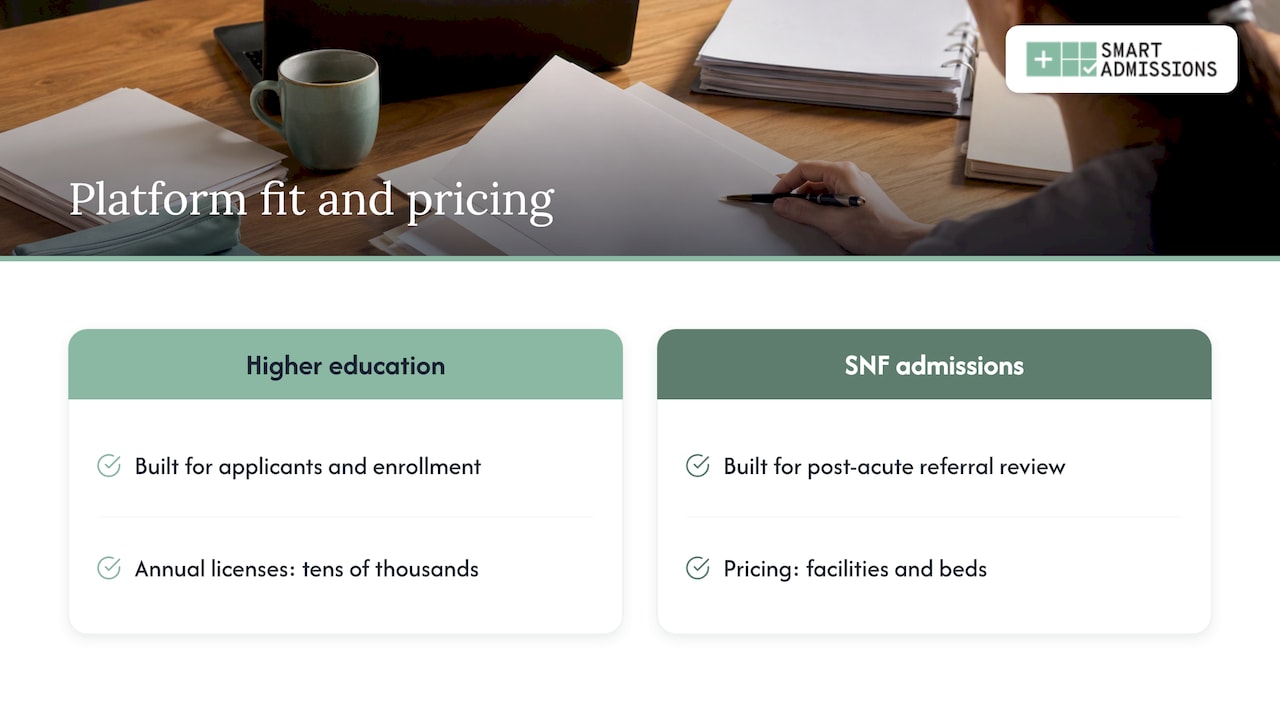
Search for admissions software cost and most results describe higher education platforms. Their prices are built around applicants, enrollment cycles and student information systems, which is why the figures run from per-user monthly fees to annual licenses in the tens of thousands of dollars. None of that maps to a nursing facility.
An SNF admissions director does something different. You receive referrals from hospital portals, fax and email. You decide within hours whether you can clinically care for the patient, whether the payer and PDPM reimbursement make the stay viable, and whether a suitable bed is open. Software for that job is priced on facilities and beds, not on applicants.
That is the first filter for any quote: confirm the product was built for post-acute referral review. If it was not, the price may look low or high, but it will not tell you what you will actually spend.
The pricing models you will meet in post-acute care
Quotes for SNF and other post-acute tools usually fall into four patterns. Knowing which one you are looking at makes quotes comparable.
| Pricing model | How it is charged | Where it fits | What to watch |
|---|---|---|---|
| Flat subscription | One monthly or annual price | Single facilities and small groups | Confirm what is included at that price |
| Per-facility fee | A set amount per building per month | Operators with several buildings | Volume tiers and user limits |
| Per-bed fee | A rate multiplied by licensed or occupied beds | Larger or growing facilities | How the bed count is measured and how it changes |
| Custom enterprise quote | Negotiated annual contract | Networks and large chains | Implementation fees, minimum terms |
One market estimate from an analysis of the post-acute space puts software spend for automated intake and decision support at roughly $40,000 per facility per year. Treat that as a concept-stage estimate of what facilities spend overall, not as a price list. Published SNF-specific prices vary widely, and a flat plan can sit well below that figure.
What Smart Admissions costs
We publish our prices so you can budget without a sales call. There are two plans on the Smart Admissions pricing page:
| Plan | Price | Billing |
|---|---|---|
| Monthly | $597 | per month |
| Annually | $6,447 | per year |
Twelve monthly payments would total $7,164, so the annual plan costs $717 less over a year. That is simple arithmetic from the two listed prices.
To put it in per-bed terms, take a 100-bed facility on the annual plan. $6,447 divided by 100 beds is $64.47 per bed per year. Your own number will differ with your bed count, but the exercise is the one to repeat with any vendor: convert every quote into cost per bed per year so you can compare flat, per-facility and per-bed pricing side by side.
5 factors that change the total cost
Two facilities can pay very different amounts for the same category of software. These five factors explain most of the gap.
1. Bed count and number of facilities
Per-bed and per-facility models scale with your footprint. A single 60-bed building and a 12-facility network will not see the same invoice structure. If you operate several buildings, ask whether multi-facility pricing and network-wide reporting are part of the plan or an add-on.
2. Referral volume and the number of intake channels
Some tools charge by volume or limit the channels they read. Because referrals reach SNFs through hospital portals, fax and email, make sure all three are covered by the price you are given. A tool that only reads one channel leaves manual work, and that work has a cost in staff hours.
3. Integration with your EHR
Accepted referrals should flow into your clinical record without retyping. Smart Admissions is EHR-independent and integrates with PointClickCare, so accepted referrals move into existing workflows without duplicate entry. When you evaluate any vendor, ask whether integration is included in the subscription, charged once, or billed per connection.
4. Decision-support depth
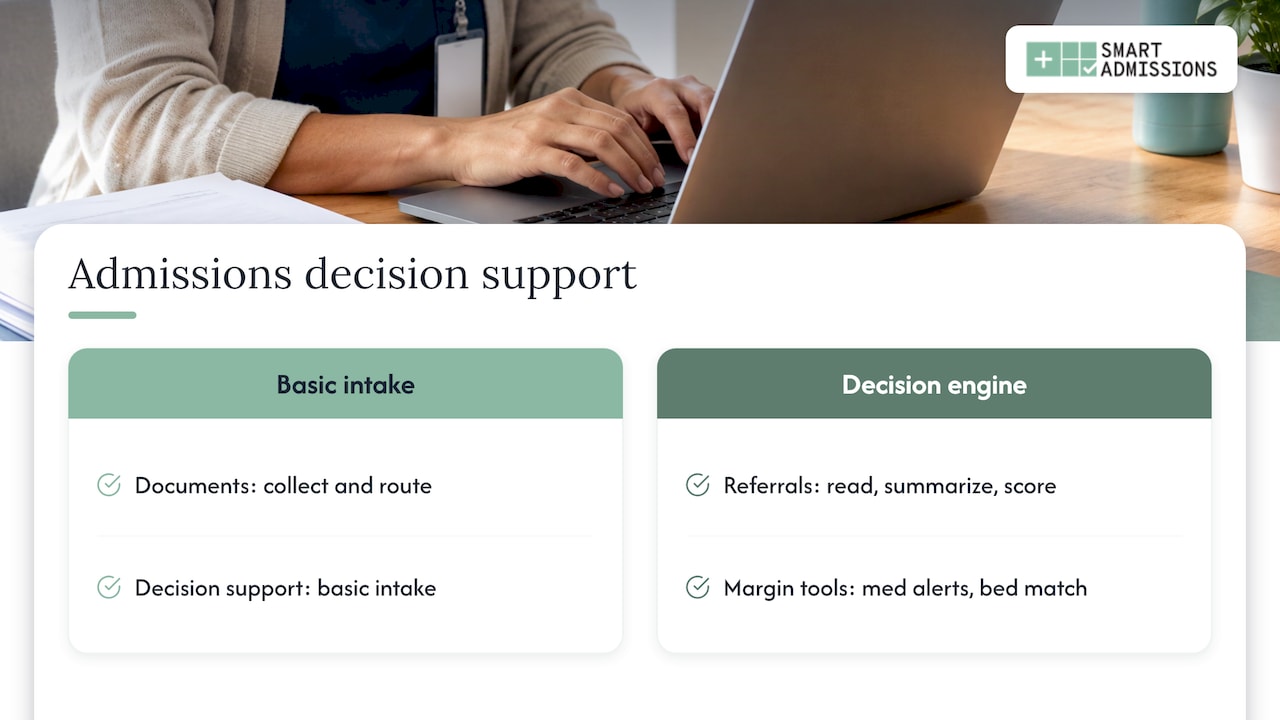
Basic intake tools collect and route documents. Decision engines go further: they read each referral, summarize it, and score it against your clinical capabilities, staffing, payer mix, PDPM reimbursement and bed availability. Features like med cost alerts, which flag high-cost medications before acceptance, and referral-to-bed matching are where software begins to affect margin rather than just paperwork. Deeper decision support typically sits in higher-priced tiers across the market, so check which features your quote actually covers.
5. Contract terms and growth clauses
Read how the rate changes when your facility does. Some senior living and SNF contracts tie pricing to bed count or occupancy, so adding beds or opening a wing can raise the bill automatically. Before you sign anything, ask how the price responds to a change in beds, how long the term runs, and how renewal pricing is set.
What the quote may leave out
The subscription line is rarely the whole budget. Build a short list of the items below and ask each vendor to confirm them in writing.
- Onboarding and configuration. Does the vendor set up your clinical capabilities, payer rules and admission criteria, or does your team?
- Training. Is training for admissions staff and leadership included?
- Support. Who answers questions, and do they understand SNF operations?
- Integration work. Is the connection to your EHR included?
- Additional users. Are there user caps or per-seat fees?
- Reporting. Is visibility into referral sources, response times, acceptance rates and lost opportunities part of the base plan?
- Internal time. Budget your own staff hours for rollout, even when onboarding is fast.
Our approach is to configure the platform to match each facility’s own rules, and support comes from people who understand SNF operations. Ask any vendor you consider to describe their equivalent in specifics.
How to estimate your total cost in five steps
Use this checklist before you request any quote. It takes about an hour with your admissions director and administrator.
- Count your footprint. List licensed beds, average census and number of facilities.
- Measure referral volume. Record how many referrals you receive per month and through which channels.
- Time your current process. Estimate the staff minutes spent on each referral. Our article on automation hacks for post-acute referrals walks through where those minutes go.
- Convert every quote. Turn flat, per-facility and per-bed quotes into annual cost and cost per bed per year.
- Add the extras. Add onboarding, integration, training and any user fees to the subscription line.
The result is a number you can compare across vendors and against the value the software should create.
Weighing cost against return
The price of software matters less than what it changes. The return for an SNF comes from four places.
Fewer costly admission mistakes. A single patient admitted with an expensive medication regimen that your PDPM payment does not cover can erase the margin on a stay. Med cost alerts exist to surface that before acceptance.
A stronger payer mix. PDPM-aware scoring shows the reimbursement picture up front, so you can accept the referrals that fit your facility and give a defensible no to the ones that do not. Our guides on payer mix analysis and the PDPM preadmission checklist show how to build that discipline.
Faster hospital response. Hospitals expect answers in minutes. A faster, confident response keeps you on the preferred list. See how automated referrals speed processing and how faster admissions affect bed occupancy.
Recovered staff time. When the platform reads and summarizes each referral, your admissions team spends less time on manual review and more time on hospital relationships. That also eases the burnout that comes with constant referral pressure.
A practical test: take your average per-admission revenue, then ask how many additional right-fit admissions, or avoided poor-fit ones, would cover the annual price. For many facilities the answer is a small number.
Our perspective on admissions software cost
We built Smart Admissions because speed alone is not the goal. Every vendor can promise a faster answer. What protects a facility is a faster answer that is also the right one.
That is why we describe the platform as a facility-specific decision engine. It reads each referral from the portal, fax or email and evaluates it against your clinical capabilities, staffing, payer mix, PDPM reimbursement and available beds. The aim is a confident yes or a defensible no in minutes.
When we talk about cost, we ask administrators to look at it that way. The question is not only what the subscription costs per month. It is what a poor-fit admission costs, what a missed good referral costs, and what your admissions director’s time is worth when it goes to hospital relationships instead of paperwork.
We publish two plans, $597 per month and $6,447 per year, so you can plan with real numbers. Our team has run admissions, MDS and reimbursement, and we configure the platform around your rules.
Harry
Questions to ask every vendor about pricing
Bring this list to each demo. Clear, specific answers are a good sign.
- What exactly is included in the listed price, and what is billed separately?
- Does the price cover all referral channels: hospital portals, fax and email?
- How does the platform connect to our EHR, and is that connection included?
- How does the price change if we add beds, add a facility or change our census?
- What is the contract term, and how is the renewal price set?
- Who supports our team after launch, and what is their SNF experience?
- What reports do leaders get on response times, acceptance rates and lost opportunities?
For a wider look at categories of tools, see our overview of how to choose post-acute care software and the referral management tools roundup.
See the price against your own numbers
If you want to run the five-step estimate with real figures, start with our monthly and annual plans. You can also read how the platform works to see which parts of referral review it handles before you decide which plan fits your facility.
FAQ
How much does admissions software cost for a skilled nursing facility?
It depends on the pricing model and what is included. Smart Admissions lists $597 per month or $6,447 per year. Other vendors use per-facility, per-bed or custom enterprise pricing, so convert each quote to cost per bed per year to compare.
Is monthly or annual billing cheaper?
Annual billing is cheaper on our plans. Twelve monthly payments of $597 total $7,164, while the annual plan is $6,447, a difference of $717. Monthly billing suits facilities that want more flexibility.
Why do college admissions software prices look so high?
Higher education platforms are priced around applicants, enrollment volume and student systems, and they often bundle large modules. That is a different product from SNF referral and admissions software, so those figures are not a useful benchmark for a nursing facility.
Are there costs beyond the subscription?
Possibly. Ask about onboarding, EHR integration, training, extra users and how the rate changes if you add beds. Get each item confirmed in writing so your total is clear before you commit.