
Affordable AI admissions software for independent skilled nursing facilities does one job well: it reads each referral against your own clinical capabilities, payer mix and open beds, so you can give the hospital a confident yes or a defensible no in minutes. Smart Admissions publishes its pricing at $597 per month or $6,447 per year, with no enterprise contract needed to see what you would pay. This guide shows what to expect from software like this, which costs and contract terms to check, and how to measure whether it pays for itself in your building.
Key Takeaways
- Admissions software is not an EHR. It decides whether a referral fits your facility before the patient is admitted, and the EHR documents care afterward.
- For an independent facility, affordable means a published price, no duplicate data entry and setup that does not need an IT department.
- The return comes from three places: staff hours saved on referral review, fewer admissions that lose money, and faster answers that win more hospital referrals.
- Measure your own baseline (response time, acceptance rate, lost referrals) before go-live so the savings are visible in your numbers.
- Check security, HIPAA terms and PointClickCare integration before you sign anything.
Table of Contents
- What AI admissions software does for an independent facility
- What the software evaluates on each referral
- What affordable really means for an independent facility
- Five tips for judging value before you commit
- Security, privacy and staff oversight
- Where Smart Admissions fits
- Our perspective
- FAQ
- Sources
What AI admissions software does for an independent facility
Every referral that reaches your admissions desk, by hospital portal, fax or email, raises the same questions. Can we meet this patient’s clinical needs? Do we have the staff? Which payer covers the stay, and what will it pay? Is there a bed that fits? A coordinator usually answers these by reading packets page by page while the hospital case manager waits.
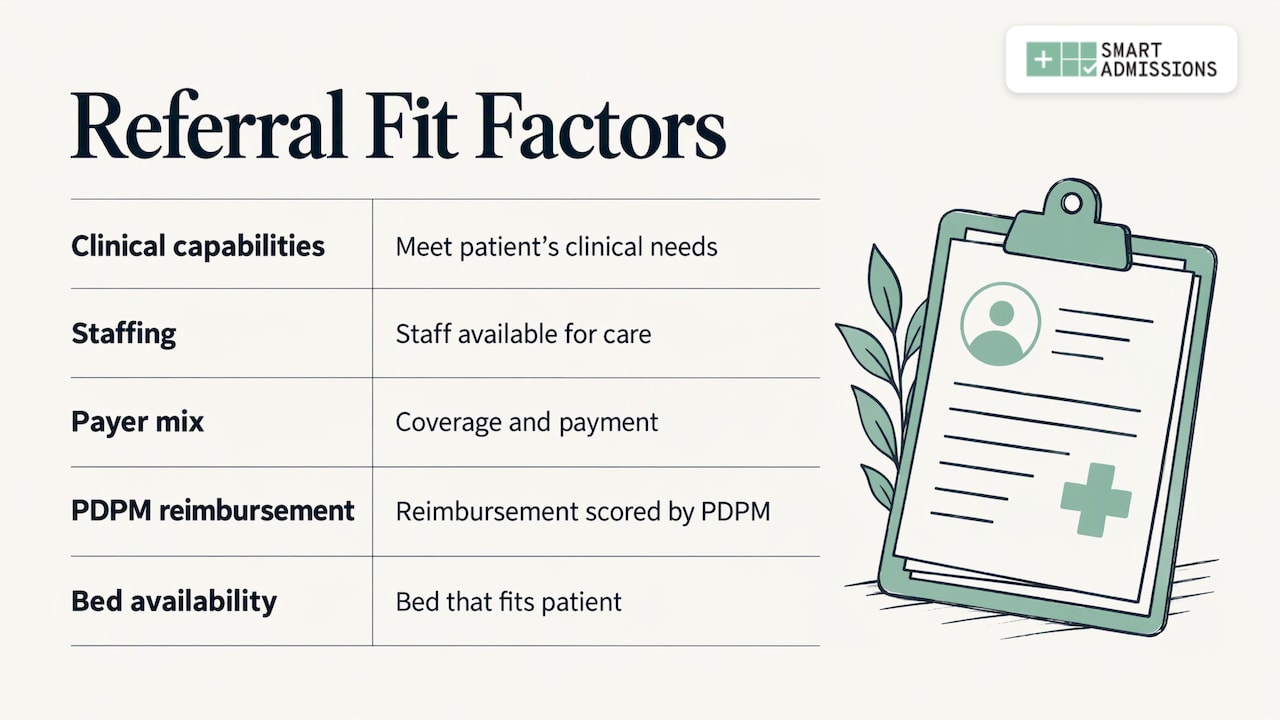
AI admissions software automates that first read. Smart Admissions reads each incoming referral, summarizes it, and scores it against your facility’s own clinical capabilities, staffing, payer mix, PDPM reimbursement and bed availability. You decide, with the evidence in front of you.
The point for an independent facility is that you do not have a corporate clinical team or a regional admissions office to lean on. One director or coordinator often carries the whole desk. A decision engine that holds your rules, and applies them the same way at 4 p.m. on a Friday as at 9 a.m. on a Tuesday, takes real weight off that person.
How it differs from an EHR or a general AI tool
An EHR records care after admission: assessments, orders, billing. A general-purpose AI chatbot can summarize a document, but it does not know your capabilities, your payer contracts or which beds are open. Admissions software sits upstream of both. It is facility-specific, it is configured to your rules, and it hands accepted referrals to your existing workflow.
Smart Admissions is EHR-independent and integrates with PointClickCare, so accepted referrals flow into the system your team already uses without duplicate entry. Our page on how the platform works walks through that flow.
What the software evaluates on each referral
A useful referral score is built from the same factors your team weighs by hand. Here is what a facility-specific engine looks at.
- Clinical fit. Does the patient’s diagnosis, treatment plan and level of care match what your clinicians can deliver? Our guide on assessing patient fit before admission covers the checks in detail.
- Staffing. A patient who needs intensive therapy or complex wound care is only a good admission if you can staff for it.
- Payer and reimbursement. Medicare Part A stays are paid under the Patient Driven Payment Model, which CMS began using on October 1, 2019 to classify patients in a covered stay. Seeing the likely reimbursement picture before you accept is the difference between a planned admission and a surprise.
- Medication costs. Med cost alerts flag high-cost drugs before acceptance, so a single expensive regimen does not erase the margin on a stay.
- Bed availability. Referral-to-bed matching places the right patient in the right bed.
- Veterans eligibility. For state veterans homes, DD214 review speeds eligibility decisions.
If PDPM is where you lose the most sleep, the 15-minute preadmission checklist shows how to protect day one revenue.
What the software must never do
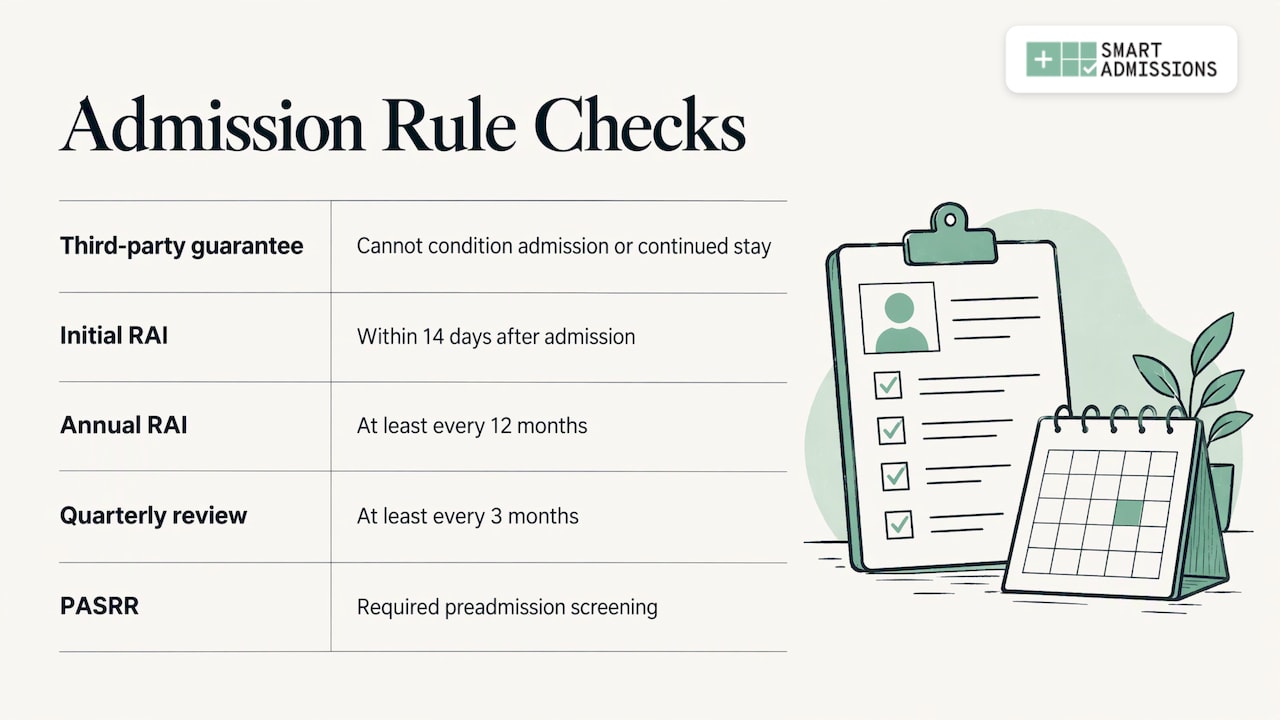
Automation has to respect the admission rules you already follow. Under 42 CFR §483.15(a)(3), a certified nursing facility may not request or require a third-party guarantee of payment as a condition of admission, expedited admission or continued stay. A scoring tool should help you judge fit and reimbursement within those rules, and your configuration should reflect them.
The same goes for assessments. Federal rules require a comprehensive resident assessment using the CMS-specified RAI within 14 calendar days after admission, and again at least every 12 months, with quarterly reviews at least every 3 months, as set out in 42 CFR Part 483. Good preadmission information makes that first assessment faster and more accurate.
PASRR, the preadmission screening for serious mental illness and intellectual disability, is another step that cannot be skipped. Our PASRR requirements guide explains how to keep it from delaying payment.
What affordable really means for an independent facility
Affordable is not the lowest sticker price. It is the price that is clear up front, the setup you can absorb with the staff you have, and a return you can see in your own numbers.
Start with a published price
Many healthcare software vendors ask you to book a demo before they will name a figure. A published price lets an owner or administrator budget in one sitting. Smart Admissions lists two plans on its pricing page:
| Plan | Price | Billing |
|---|---|---|
| Monthly | $597 | per month |
| Annually | $6,447 | per year |
Twelve months on the monthly plan comes to $7,164, so the annual plan is $717 lower over a year. The monthly plan suits a facility that wants to start with a shorter commitment. The annual plan suits one that has decided and wants the lower yearly total. Our subscription model also includes optional free trial periods.
For a deeper look at the budget, read our guide to the five factors behind admissions software cost.
Check every cost beyond the subscription
Whatever vendor you consider, ask for the full cost in writing. The LeadingAge Minnesota AI Technology Solutions Playbook includes budget guidance on potential costs, vendor questions on integration, security and clinical oversight, and implementation planning with timelines and team responsibilities. Use that structure for your own checklist:
- Setup or onboarding fees, and whether configuration to your rules is included.
- Integration charges, especially for PointClickCare.
- Per-user, per-bed or per-facility pricing, and what happens when you add a building.
- Contract length, renewal terms and how to change plans.
- Support hours and who answers the phone.
A flat, published subscription makes this list short. That matters for an independent facility, where an unexpected add-on lands directly on the owner’s desk.
Five tips for judging value before you commit
1. Record your baseline first
You cannot prove savings without a starting point. For one to two weeks, track these numbers by hand or from your existing logs:
- Average time from referral received to decision communicated.
- Referrals received, accepted, declined and never answered.
- Staff minutes spent reviewing each packet.
- Admissions in the last quarter that cost more to serve than expected.
These four numbers are the evidence later. Leadership dashboards in Smart Admissions show referral sources, response times, acceptance rates and lost opportunities, so you can compare the same measures after go-live.
2. Put a dollar value on staff time
Take the minutes per packet, multiply by referrals per month, and multiply by the loaded hourly cost of the person doing the review. Compare that with the $597 monthly price. If your coordinator spends hours each day on first-pass review, the time returned to hospital relationships and family conversations is the first return you will see.
3. Count the admissions you did not make
The second return is margin protection. One admission with an unexpected high-cost medication or a poor reimbursement fit can cost more than months of software. Ask your finance lead to identify two or three recent stays like that. Then ask whether a med cost alert or a PDPM-aware score before acceptance would have changed the decision. Our payer mix analysis guide shows which KPIs help you see this.
4. Count the referrals you did not win
Hospitals send patients to the facility that answers first with a clear answer. Referrals that sit unanswered go elsewhere, and most facilities have no record of how many. Track lost opportunities for a month. Each one is a potential admission, and your average daily rate shows what it was worth. Our article on automating admissions for faster bed occupancy covers the occupancy side.
5. Test the fit with your workflow
A tool that adds a screen without removing a step costs you time. Walk one real referral from arrival to bed assignment and note every point where staff would still re-key data. EHR-independent software that integrates with PointClickCare is built to avoid that re-keying, and our overview of AI referral screening in seven steps shows what a clean flow looks like.
Security, privacy and staff oversight
Referrals contain protected health information, so security is a purchasing criterion, not a footnote. HHS guidance on cloud computing states that when a cloud service provider creates, receives, maintains or transmits ePHI for a covered entity, it is a business associate and the two must sign a HIPAA-compliant business associate agreement. Make sure your vendor will sign one before any referral data moves.
Beyond the agreement, put these on your list:
- Who at your facility can see scores and summaries, and how access is assigned.
- How the system handles referrals that arrive by fax or email.
- How your team reviews and overrides a score. The software prepares the decision; your admissions director makes it.
- How alerts are tuned so staff are not buried. Our piece on alert fatigue in admissions offers five metrics to watch.
Where Smart Admissions fits
Smart Admissions was built for skilled nursing facilities, rehabilitation centers, state veterans homes and other post-acute providers. It reads every referral, scores it against your facility’s rules, flags high-cost medications, matches the patient to a bed and shows leadership where referrals come from and where they are lost. It was built by people with deep admissions, MDS and reimbursement experience, and configuration matches each facility’s rules.
If you want to see how that works in a building like yours, start with the pricing page and choose the monthly or annual plan.

The annual plan is $6,447 per year. The monthly plan is $597 per month. You can also explore the platform overview to see the workflow from referral to bed.
Our perspective
Speed is table stakes. Every hospital expects an answer in minutes, and every admissions team is trying to give one. What separates a good admission from a costly one is whether the answer is right for your facility.
That is why we built Smart Admissions as a facility-specific decision engine rather than a generic summarizer. Your clinical capabilities, your staffing, your payer mix and your open beds are different from the building down the road. The software should apply your rules, not an average.
For an independent facility, the case is simple. Your admissions director should spend time on hospital relationships, not on reading fax packets. When the referral arrives already summarized and scored, with reimbursement and medication costs visible up front, a yes is confident and a no is defensible.
We want facilities of every size to have that, which is why our pricing is published and why the platform works alongside your EHR instead of replacing it.
Harry
FAQ
How much does AI admissions software for a skilled nursing facility cost?
Prices vary by vendor, and many do not publish them. Smart Admissions lists $597 per month or $6,447 per year on its pricing page. Ask any vendor for setup, integration and renewal terms in writing before you compare.
Will it replace my EHR or PointClickCare?
No. It works before admission, evaluating referrals and matching them to beds. Smart Admissions is EHR-independent and integrates with PointClickCare, so accepted referrals move into your existing workflow without duplicate entry.
How do I know if it will pay for itself?
Record your referral response time, acceptance rate, lost referrals and review minutes before go-live. Then compare the same measures after a few months, and add the margin protected on admissions you screened for medication cost and reimbursement fit.
Is a referral score a clinical decision?
No. The score and summary prepare the decision. Your admissions director and clinical team still decide, and federal admission and assessment rules, including those in 42 CFR Part 483, continue to apply.
Sources
- Patient Driven Payment Model, CMS
- 42 CFR Part 483, 2025 edition, govinfo.gov
- 42 CFR §483.15, 2017 edition, govinfo.gov
- Guidance on HIPAA and Cloud Computing, HHS
- AI Technology Solutions Playbook Preview, LeadingAge Minnesota