

The AI admissions software that integrates with PointClickCare for skilled nursing facilities (SNFs) is the kind that reads every referral, scores it against your own facility’s rules, and sends accepted patients into PointClickCare without re-keying. Smart Admissions is built that way: it is EHR-independent, integrates with PointClickCare, and evaluates referrals from hospital portals, fax and email against your clinical capabilities, staffing, payer mix, PDPM reimbursement and open beds. This guide explains what “integrates” can mean, how to verify it, and what your team still does by hand.
Key Takeaways
- “Integrates with PointClickCare” covers three different routes: a native feature, a Marketplace partner connection, or a custom FHIR app. Ask which one applies before you sign.
- Good integration means accepted referrals reach your existing workflow without duplicate entry. It does not mean the AI makes the admission decision for you.
- Review the vendor’s business associate agreement (BAA) before any protected health information (PHI) flows, and confirm access controls and encryption.
- Your admissions director still owns the final yes or no. Software shortens the review; it does not replace clinical judgment.
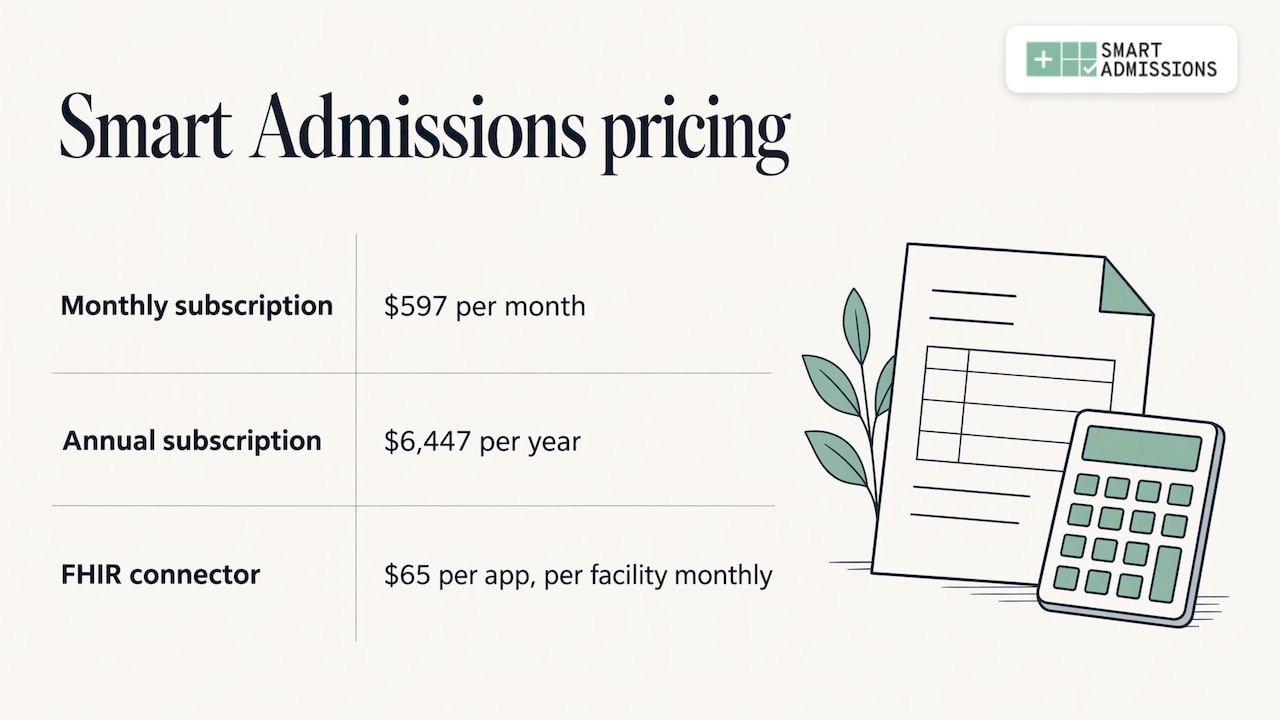
- Smart Admissions lists its plans publicly: $597 per month or $6,447 per year.
Table of Contents
- What “Integrates With PointClickCare” Actually Means
- Three Integration Routes You Will Hear About
- Which AI Admissions Software Works With PointClickCare
- What Moves Between the Systems
- Five Checks Before You Choose
- Security, HIPAA and Data Handling
- What Your Admissions Staff Still Does
- A Realistic Rollout Plan
- What It Costs
- Ready to See It in Your Workflow
- Our Perspective
- FAQ
- Sources
What “Integrates With PointClickCare” Actually Means
PointClickCare (PCC) is the electronic health record (EHR) most skilled nursing teams already live in. An AI admissions tool does not replace it. The tool sits in front of it, handling the messy part: referral packets that arrive as faxes, emails and hospital portal messages, each in a different format.
The integration question is therefore narrow and practical. When your team accepts a referral, does the patient information reach PCC, or does someone retype it? And does the tool need anything from PCC to judge the referral, such as census and bed status?
Vendors use the word “integration” for very different things. A tool that exports a PDF you upload by hand is not the same as a connected application. Before you compare products, decide which of the three routes below you are actually being offered.
Three Integration Routes You Will Hear About
Native features
A native feature is built and sold by the EHR vendor itself. It lives inside PCC and uses PCC’s own data. That is convenient, but it ties the capability to one EHR and to the vendor’s own roadmap, and a facility cannot tailor it to the way its own team decides.
Marketplace partner connections
PCC runs a Marketplace of third-party applications. According to a 2026 review of PCC’s integration options, the Marketplace lists more than 375 connected partners across more than 20 categories and promotes API-based connections that can be set up in two days or less. That is a promotional figure for the connection itself, not a guarantee for your full rollout, which also includes configuration and staff training.
Custom FHIR applications
FHIR is a standard for exchanging health data between systems through an API, a defined channel one program uses to talk to another. The same review reports that custom FHIR apps registered through PCC’s USCDI Connector program cost a flat $65 per app per facility per month. Ask any vendor whether that fee, if it applies, is included in their price or billed separately to you.
| Route | What it is | What to ask |
|---|---|---|
| Native | Built into the EHR by its vendor | Can it use our own acceptance rules? |
| Marketplace partner | Third-party app connected through PCC’s partner program | Is the connection live for our facility today? |
| Custom FHIR app | App registered through PCC’s connector program | Who pays the per-facility fee? |
Which AI Admissions Software Works With PointClickCare
Smart Admissions is an AI-powered referral intelligence and admissions platform for skilled nursing facilities, rehabilitation centers, state veterans homes and other post-acute providers. It integrates with PointClickCare, so accepted referrals flow into your existing workflow without duplicate entry. It is also EHR-independent, which matters for operators running more than one system across a network.
What sets it apart is what happens before the handoff. Speed is table stakes; every hospital expects an answer in minutes. Smart Admissions acts as a facility-specific decision engine:
- It reads each incoming referral, whether it comes through a hospital portal, fax or email.
- It summarizes and scores the referral against your clinical capabilities, staffing, payer mix, PDPM reimbursement and bed availability.
- Med cost alerts flag high-cost medications before you accept.
- Referral-to-bed matching places the patient in the right bed.
- For state veterans homes, DD214 review supports faster eligibility decisions.
Our PointClickCare integration page covers the enablement checklist in more detail.
What Moves Between the Systems
The useful way to picture the handoff is in three stages.
- Intake. The referral arrives from a hospital in whatever format the hospital uses. The AI tool extracts the clinical and financial details your team would otherwise pull out by reading the packet.
- Decision. The tool presents a summary and a score tied to your own rules. Your admissions director decides yes or no, with the reasoning in front of them.
- Handoff. On acceptance, the patient record goes into PointClickCare so nursing, billing and MDS staff work from one record.
The point of the integration is the third stage. If staff must copy the face sheet, diagnoses and payer details into PCC by hand, the time saved at the first two stages leaks away, and so does accuracy. For a deeper look at the first stage, see our AI referral screening walkthrough.
Five Checks Before You Choose
Use these five checks with any vendor. Each takes one conversation or one document request.
1. Confirm the integration route
Ask the vendor to state in writing whether the connection is native, a Marketplace partner connection or a custom FHIR app. Then ask what data flows in each direction. A clear vendor answers in one sentence.
2. Match the decision logic to your facility
A generic acceptance score treats every facility alike. Yours does not. You have a particular wound care capability, a ventilator or dialysis policy, a staffing ratio and a payer mix you are trying to protect. Look for software configured to your rules rather than a fixed scoring model. Smart Admissions configuration matches each facility’s own rules, and our PDPM admission workflow shows how the reimbursement side fits into the decision.
3. Look at what the tool catches before acceptance
The costly admission mistakes happen before the patient arrives: a high-cost drug nobody priced, a payer that will not cover the stay, a bed that does not suit the patient. Ask how the tool surfaces each of these. Med cost alerts and PDPM-aware scoring are built for this moment.
4. Check the reporting
Leadership needs to see referral sources, response times, acceptance rates and lost opportunities, for one building or a whole network. If a tool cannot report these, you cannot find out which hospital relationships need attention.
5. Verify security and privacy
This check has its own section below because it is the one that cannot be skipped.
Security, HIPAA and Data Handling
Referral packets contain PHI, so privacy review comes before go-live. The 2026 review cited above recommends a short list of actions for facilities, which we have adapted here:
- Review the vendor’s BAA before any PHI flows. A BAA is the contract that obliges a vendor to protect PHI as HIPAA requires.
- Request PointClickCare’s SOC 2 Type II report and its HIPAA/HITECH security overview. SOC 2 Type II is an independent audit of a company’s security controls over time.
- Validate multi-factor authentication, single sign-on, role-based access controls, encryption in transit and at rest, and automatic screen logoff.
- Confirm that record retention matches your state’s law, and the federal floor of five years from discharge cited in the review.
The same review notes that PCC’s 2025 subscription agreement commits it to HIPAA administrative, physical and technical safeguards and requires the facility to verify AI outputs independently before relying on them. That second point shapes your workflow, which the next section covers.
Bring your compliance officer or privacy counsel into the BAA review. Do not treat a vendor’s brochure as a substitute for the signed agreement.
What Your Admissions Staff Still Does
AI shortens review; it does not remove people from it. Plan for these tasks to remain with your team:
- The final decision. Your admissions director or clinical liaison confirms every yes and every defensible no. The score and summary give them the reasoning in minutes instead of hours.
- Clinical questions. When a referral raises something the packet does not answer, a nurse still calls the hospital.
- Verification of AI output. Read the summary against the source document, especially for medications, diagnoses and payer details.
- Hospital relationships. With the paperwork reduced, your director has more time for case managers and discharge planners, who are the reason referrals arrive at all.
- Exceptions. Unusual payers, incomplete packets and veteran eligibility edge cases need human judgment.
A realistic goal is less manual review time and fewer rekeying errors, not an unattended admissions desk. Our piece on how referral review drops from 45 minutes to 5 shows where the time comes back.
A Realistic Rollout Plan
The Marketplace promotion of connections in two days or less describes the technical link. Your own rollout involves people, so plan in phases.
Phase 1: Prepare your rules
Write down what you accept, what you decline and what needs a second look. Include clinical capabilities, payer thresholds, medication cost limits and bed constraints. This document becomes the configuration.
Phase 2: Complete the privacy review
Sign the BAA, collect the security documents and name who at your facility owns access permissions.
Phase 3: Connect and configure
Enable the PointClickCare connection, load your rules and set referral intake channels: portal, fax and email.
Phase 4: Train and go live
Walk admissions coordinators through reading the summary and score, checking it against the source, and accepting into PCC. Review response times and acceptance rates weekly at first.
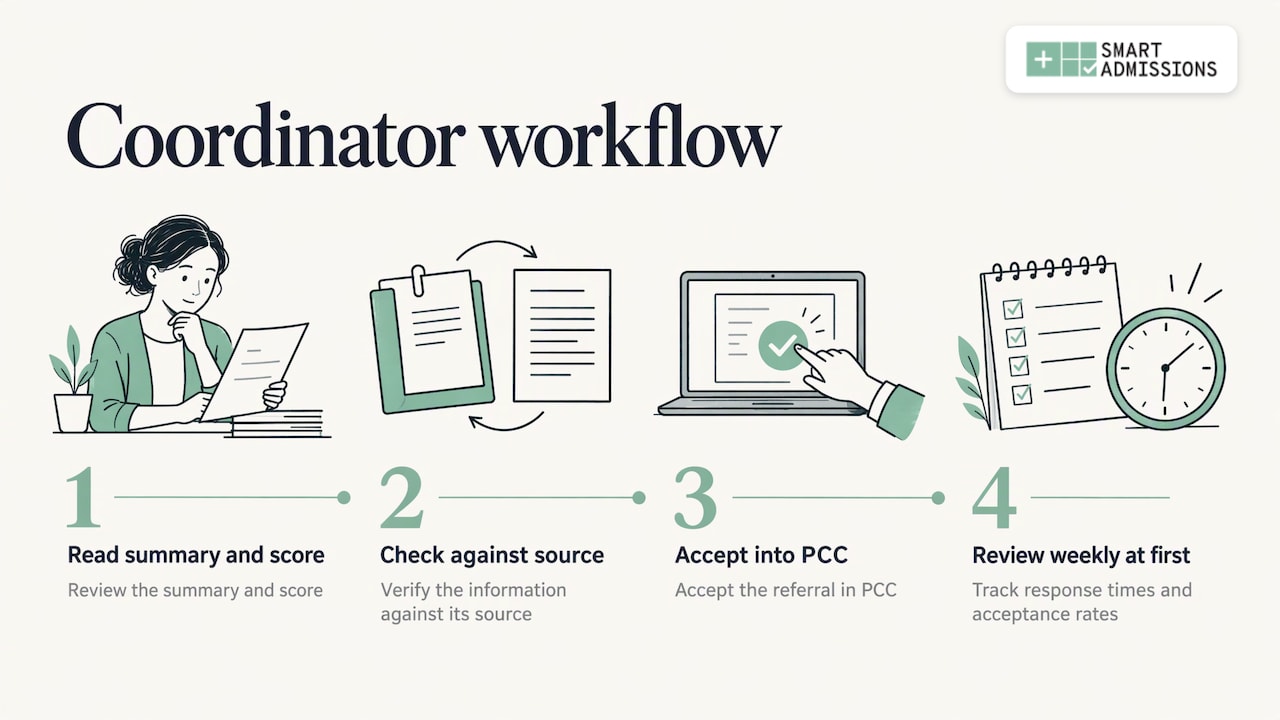
Onboarding with Smart Admissions is fast, configuration follows each facility’s rules, and support comes from people who understand SNF operations. For intake design in this phase, our guide to intake process optimization is a useful companion.
What It Costs
Price is published, which makes budgeting simple. Smart Admissions is a subscription: $597 per month or $6,447 per year. Compare that to what one poor admission costs you: an unpriced medication, an underpaying payer or a bed held for the wrong patient. Our guide to admissions software cost factors lays out how to weigh the numbers for your building.
If you use a custom FHIR route with any vendor, ask whether the $65 per app per facility monthly connector fee is part of the quoted price.
Ready to See It in Your Workflow
If your team reads referrals from three channels, retypes accepted patients into PointClickCare and answers hospitals later than you want, Smart Admissions is designed for exactly that gap. It reads the referral, matches it to your rules and beds, flags costly drugs and hands the accepted patient to PCC.
See plans and start on the Smart Admissions pricing page, or visit smartadmissions.ai to learn more.
Our Perspective
Admissions teams do not lose money because they are slow. They lose it because they say yes to the wrong patient or no to the right one, and they do it under a clock set by the hospital.
That is why we built Smart Admissions as a decision engine for one facility at a time. Your clinical capabilities, staffing, payer mix, PDPM reimbursement and open beds are different from the building down the road. A score that ignores them is only a faster guess.
We built it with people who have run admissions and know MDS and reimbursement. So the integration with PointClickCare is not the headline. It is the way a good decision becomes a clean admission without anyone retyping a face sheet.
Your director stays in charge. Our job is to give them the summary, the cost flags and the reimbursement picture in minutes, so they can spend their day on hospital relationships.
Harry
FAQ
Does PointClickCare have its own AI admissions tools?
Yes. PointClickCare has announced AI features of its own, including a referral tool announced January 13, 2026, which that document describes as an analytical layer over existing PCC data. Facilities that want decisions tied to their own rules, payer mix and beds look to Smart Admissions, which is EHR-independent and integrates with PointClickCare.
How long does it take to connect an AI tool to PointClickCare?
PCC’s Marketplace promotes API-based connections that can be set up in two days or less. Your full timeline also includes the BAA review, rule configuration and staff training. Smart Admissions onboarding is fast and configured to each facility’s rules.
Do we need to sign a BAA with an AI admissions vendor?
Yes, before any PHI flows. A business associate agreement is the contract that binds the vendor to HIPAA safeguards. Have your compliance officer or counsel review it, along with the vendor’s security documentation.
Will the software replace our admissions coordinators?
No. It reads, summarizes and scores referrals, which cuts manual review time and eases burnout. Your coordinators and director make the final call, verify the summaries and manage hospital relationships.
Does it work for state veterans homes?
Yes. Smart Admissions supports DD214 review to speed eligibility decisions for veterans homes, alongside the same referral scoring and bed matching used by other post-acute providers.
Sources
- PointClickCare AI Charting: Is It HIPAA Compliant? (IntuitionLabs, 2026)
- AI Documentation for Skilled Nursing Facilities Explained (IntuitionLabs, 2026)