
TL;DR:
- Accurate, real-time clinical documentation is essential for compliant billing, patient safety, and audit defense. Implementing structured templates, immediate documentation practices, and consistent training improves record quality and reduces denials. Compliance requires understanding retention policies, electronic standards, and fostering a culture that prioritizes clinical documentation as a quality and safety measure.
Getting clinical documentation right is one of the most consequential things your admissions team does every day. Clinical documentation essentials are not administrative formalities. They are the foundation of compliant billing, defensible payer claims, and safe patient transitions. Yet many admissions teams still treat documentation as something to complete after the clinical work is done. That misunderstanding leads to delayed records, payment denials, and compliance exposure. This guide gives you a precise, practical framework for understanding what regulators require, what quality actually looks like, and how your team can build documentation practices that hold up under audit.
Table of Contents
- Key takeaways
- Clinical documentation essentials and regulatory requirements
- Quality standards and common documentation pitfalls
- Implementing best practices for clinical documentation
- Document retention, patient access, and electronic standards
- My take on real-time documentation and why it changes everything
- How Smartadmissions supports better documentation workflows
- FAQ
Key takeaways
| Point | Details |
|---|---|
| CMS defines documentation components | Every admission record must include reason for visit, history, exam, diagnosis, clinical rationale, and a dated, legible provider identity. |
| Real-time documentation prevents denials | Capturing diagnoses and assessments during care is more defensible to payers than retrospective additions or corrections. |
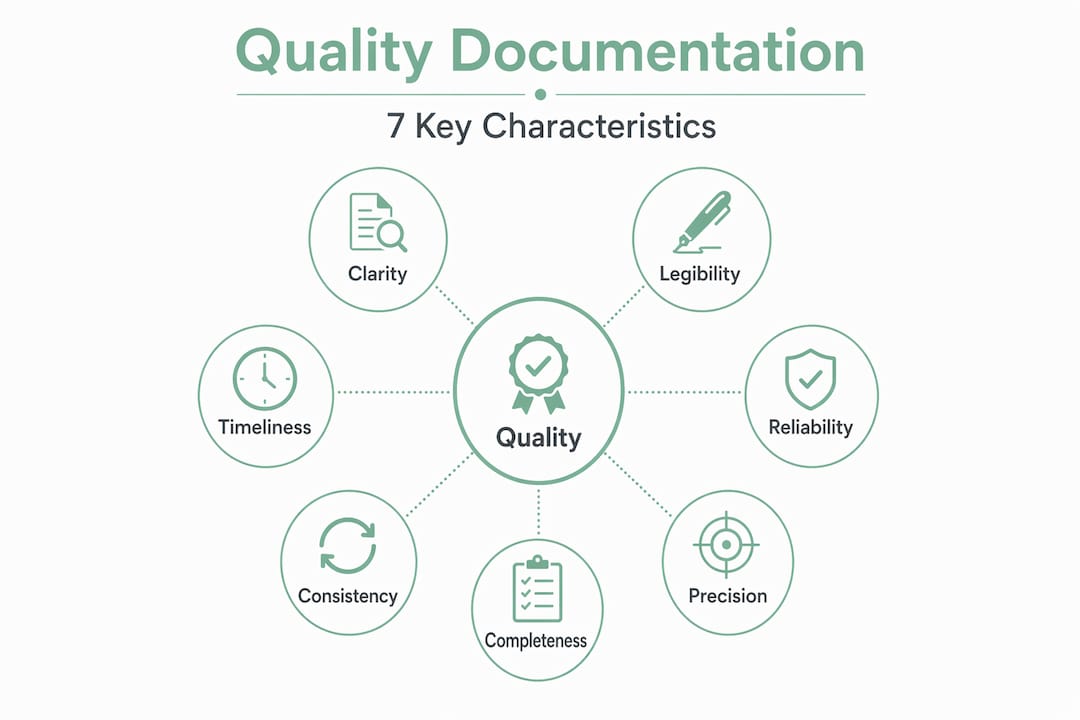
| Quality has 7 measurable criteria | Legibility, reliability, precision, completeness, consistency, clarity, and timeliness are the benchmarks every note should meet. |
| Retention policies must be mapped by document type | Permanent medical records and ancillary documents have different retention triggers under Joint Commission and CMS standards. |
| Electronic standards are now required for claims | CMS has adopted HIPAA standards for electronic claims attachments, making documentation format part of your compliance obligation. |
Clinical documentation essentials and regulatory requirements
Documentation during patient admissions is governed by a specific set of rules from CMS, HIPAA, and accreditation bodies like The Joint Commission. Understanding these requirements is the first step toward building a compliant admission workflow.
CMS documentation requirements for Evaluation and Management (E/M) services are clear. Every patient encounter record must contain:
- Reason for the visit or chief complaint
- Relevant history, including medical, surgical, family, and social history
- Examination findings, documented with clinical specificity
- Diagnosis or assessment with supporting clinical reasoning
- Rationale for diagnostic tests ordered during the encounter
- The medical management plan tied directly to the assessment
- Date of service and a legible identity of the clinician completing the record
These are not optional elements. Missing any one of them creates a gap that payers can use to deny a claim or flag a record for audit.
CMS also addresses timing. Documenting the service during or immediately after the encounter is expected. Late documentation introduces questions about accuracy and can compromise the integrity of the medical record. Your admissions team should treat real-time documentation as the standard, not the exception.
On the retention side, Joint Commission International requires that records remain accessible back to the last full survey. This applies to the permanent medical record. Ancillary documents carry different retention expectations, and conflating the two is a compliance risk.
HIPAA adds another layer. Under federal rules, providers must deliver records within 30 days of a patient request, with one possible 30-day extension. Electronic delivery often carries no fee, while paper copies may have a reasonable cost attached. Your documentation system needs to support timely patient access, not just payer compliance.
Pro Tip: Build a short documentation checklist based on CMS E/M requirements and attach it to your admissions intake template. Even experienced clinicians benefit from a structured prompt during high-volume admission periods.
Quality standards and common documentation pitfalls
Knowing what to include is only half the challenge. How you document matters just as much as what you document.
Seven characteristics define quality documentation in clinical practice: legibility, reliability, precision, completeness, consistency, clarity, and timeliness. These criteria are not abstract ideals. They are measurable standards that payers and auditors use when reviewing records.
The table below contrasts strong documentation with weak documentation across these dimensions.
| Documentation element | Strong example | Weak example |
|---|---|---|
| Reason for visit | “Patient admitted for skilled PT following right hip arthroplasty on 04/10/2026.” | “Patient admitted for rehab.” |
| Clinical reasoning | “Skilled nursing required for wound assessment and IV antibiotic management.” | “Needs nursing care.” |
| Diagnosis linkage | “Diagnosis of cellulitis, right lower extremity, supports daily wound care and antibiotic monitoring plan.” | “Wound care ordered.” |
| Timeliness | Note completed at time of admission assessment on 04/11/2026 at 14:30. | Note added 3 days after admission. |
| Legibility/attribution | Signed by M. Torres, RN, with date and time stamp. | Unsigned, no date. |
Retrospective documentation is one of the most significant liability risks your team faces right now. Payers are increasingly denying late-added diagnoses, even when the clinical presentation supports them. The problem is not just clinical plausibility. It is that the record does not show the diagnosis was part of the real-time clinical decision-making process.
A note completed three days after admission with a diagnosis added post-payment review looks like record manipulation, regardless of intent. Capturing diagnoses and clinical reasoning at the time of care is the only defensible practice.
Pro Tip: When completing SNF admission notes, document your clinical reasoning explicitly. Write why a diagnosis was identified and how it connects to the ordered service plan. A sentence like “Diagnosis of malnutrition identified on admission assessment supports medical nutrition therapy order” creates a defensible link that survives audit scrutiny.
Implementing best practices for clinical documentation
Understanding the standards is necessary. Building systems and habits that support them every day is where facilities actually improve. Here is a practical framework for your admissions team.
- Adopt CMS-aligned documentation templates. Templates that mirror CMS and ACEP documentation guidelines reduce the risk of missing required elements. They also make audits faster and less disruptive. Work with your clinical informatics team or EHR vendor to configure admission note templates that prompt for every required field.
- Require real-time documentation as a workflow standard. Your admissions intake workflow should include documentation completion as a defined step, not an afterthought. Assign it a specific window, such as within one hour of the admission assessment. Make the expectation explicit in staff protocols.
- Use structured assessment tools at admission. Structured tools like the MDS (Minimum Data Set) for skilled nursing facilities or standardized intake forms ensure consistent data capture. When these tools are integrated into your EHR, they reduce manual entry errors and support claims defensibility.
- Integrate referral management and EHR systems. When your referral management platform connects directly to your EHR, clinical information from the referring facility flows into the admission record without manual transcription. This reduces errors, saves time, and creates a more complete record from day one. Facilities using automated documentation systems report measurable reductions in claim denials tied to incomplete records.
- Conduct regular clinical documentation training. Clinical documentation training should not be a one-time onboarding event. Schedule quarterly reviews that address payer policy updates, common denial reasons, and documentation audit findings from your own facility. Rotate case examples through team meetings so staff see the difference between defensible and non-defensible notes.
- Establish a performance monitoring and feedback loop. Track denial rates tied to documentation reasons. Review a sample of admission notes each month against your CMS compliance checklist. Share findings with your team in a non-punitive way. Improvement comes from continuous feedback, not periodic corrections.
These steps transform clinical documentation from a reactive task into a proactive quality function embedded in your admission process.
Document retention, patient access, and electronic standards
Your documentation obligations do not end when the note is completed. Retention governance, patient access rights, and electronic exchange standards create a second layer of compliance that your admissions team must understand.
On retention, the Joint Commission approach distinguishes between the permanent medical record and ancillary supporting documents. Each category carries different retention triggers. Rather than applying a single indefinite retention rule to everything, effective facilities maintain a retention matrix that maps document types to specific retention periods and survey triggers.
Key retention governance principles include:
- Permanent medical records must be retained per state law minimums, often 7 to 10 years for adults and longer for minors.
- Ancillary documents such as fax cover sheets, intake screening forms, and pre-authorization requests may have shorter retention windows.
- Survey readiness requires that records be accessible going back to the facility’s last full accreditation survey date.
- State law governs minimum periods, but federal payer contracts or accreditation standards may require longer retention.
On patient access, HIPAA gives patients the right to request and receive copies of their records. Providers must fulfill requests within 30 days. Electronic records are often provided at no charge, while paper copies may carry a cost-based fee. This means your documentation system must support fast retrieval and electronic delivery.
The electronic standards dimension is one that many admissions teams underestimate. CMS has adopted HIPAA standards for electronic claims attachments, including the X12N 275/277 and HL7 C-CDA formats. These standards govern how supporting clinical documentation is transmitted to payers during claims adjudication. If your documentation does not meet these format requirements, your claims may be delayed or denied even when the clinical content is correct.
Align your documentation policies with your electronic health information exchange capabilities. The format your records are created in affects how well they can be exchanged, attached to claims, and accessed by patients.
My take on real-time documentation and why it changes everything
I have worked with admissions teams at skilled nursing facilities who are genuinely committed to compliance. They follow up on denials, they attend training, and they care about accuracy. But when I look at their documentation workflows, the same problem comes up repeatedly. Notes are being finished hours or days after the clinical work is done.

The risk here goes beyond audit exposure. When documentation happens after the fact, the clinical reasoning that actually drove the care decision is no longer fresh. Clinicians reconstruct rather than record. The note reflects what they remember, not necessarily what they observed and decided in the moment.
Payer scrutiny of retrospective documentation is increasing in 2026. What I have learned is that fixing this problem is not primarily a technology issue. It is a cultural and workflow issue. Real-time documentation has to be positioned as part of the clinical act itself, not the paperwork that follows it. When leadership communicates this clearly and builds workflows that make real-time documentation the path of least resistance, teams adapt faster than most expect.
Use your SNF documentation practices as a starting point, not a ceiling. The facilities that perform best in payer audits are the ones that treat documentation integrity as a clinical quality measure, not just a billing requirement.
— Harry
How Smartadmissions supports better documentation workflows
If your admissions team is spending significant time on manual documentation entry, record retrieval, or chasing down clinical information from referring facilities, that is capacity being drained from direct patient care and compliance work.
Smartadmissions is built specifically for skilled nursing facilities, rehabilitation centers, and post-acute care providers. The platform integrates with your existing EMR and insurance portals to automate documentation capture at the point of referral, verify patient eligibility in real time, and support audit-ready records from the first point of contact. Admissions staff can access clinical assessments, referral documentation, and insurance data in one place without manual transcription.
Facilities using Smartadmissions have seen 20% faster bed occupancy as a direct result of faster documentation turnaround and fewer intake bottlenecks. If your team is ready to reduce documentation errors and improve claims defensibility, explore what Smartadmissions can do for your facility.
FAQ
What are the required elements of clinical documentation for admissions?
CMS requires that admission documentation include the reason for visit, relevant history, exam findings, diagnosis or assessment, rationale for tests, the management plan, service date, and legible clinician identity. Missing any element creates a compliance and claims risk.
How soon must clinical documentation be completed after a patient encounter?
CMS guidance expects documentation to be completed during or immediately after the encounter. Delayed notes, particularly those completed days after admission, increase audit risk and payer denial rates.
What are the 7 characteristics of high-quality clinical documentation?
High-quality clinical documentation meets seven criteria: legibility, reliability, precision, completeness, consistency, clarity, and timeliness. Each characteristic is measurable and directly affects a record’s defensibility in payer reviews and accreditation surveys.
How long must clinical records be retained under Joint Commission standards?
The Joint Commission requires that records be accessible back to the facility’s last full accreditation survey. Retention periods for permanent medical records and ancillary documents differ, so maintaining a retention matrix by document type is the most reliable approach.
What electronic standards apply to clinical documentation in claims processing?
CMS has adopted HIPAA standards including X12N 275/277 and HL7 C-CDA for electronic claims attachments. Your clinical documentation must be created in formats compatible with these standards to support clean claims submission and avoid administrative delays.