
TL;DR:
- Manual admissions involve multiple handoffs that lead to high error rates, delays, and increased costs. Automating these processes reduces errors, speeds up check-in times, and significantly decreases per-patient costs, while also improving data accuracy for better patient care. Successful automation requires staff involvement, proper integration, and a culture that embraces organizational change rather than viewing technology as a standalone solution.
When your admissions team processes a referral by hand, the odds are not in your favor. Manual paper-based intake carries a 15 to 22% error rate, translating directly into denied claims and costly rework. For skilled nursing facilities and post-acute care providers managing high patient volumes, understanding the difference between manual and automated admissions is no longer a theoretical exercise. It is a financial and operational decision that affects bed fill rates, staff retention, and patient outcomes every single day.
Table of Contents
- Key takeaways
- The difference between manual and automated admissions
- Operational advantages that automation delivers
- Drawbacks of the manual admissions process
- Best practices for adopting automated admissions
- Admissions automation tools: what to look for
- My take on why automation alone is not enough
- How Smartadmissions helps your facility move forward
- FAQ
Key takeaways
| Point | Details |
|---|---|
| Error rates favor automation | Manual intake produces 15 to 22% data errors; automated systems reduce this significantly through AI extraction. |
| Cost savings are substantial | Digital intake costs $3.80 per patient versus $12.40 manually, saving over $89,000 annually for a 40-patient daily practice. |
| Staff involvement drives adoption | Excluding front desk staff from automation design causes 3x higher abandonment rates of new systems. |
| Fallback workflows are non-negotiable | Always design a manual intervention path for patients who do not complete digital pre-registration. |
| Integration quality determines outcomes | Incomplete EHR integration creates rework bottlenecks that cancel out automation gains entirely. |
The difference between manual and automated admissions
At the most basic level, manual admissions rely on paper forms, verbal data collection, and staff manually entering patient information into your EHR system. The manual application process typically follows this sequence: a referral arrives by fax or phone, a coordinator reviews clinical documents by hand, demographic and insurance data are transcribed into your system, and eligibility is verified through separate phone calls or portal logins. Each handoff in that chain is a potential point of error or delay.
Automated admissions replace those handoffs with connected digital workflows. An automated admission system collects patient information through digital pre-registration forms, uses AI to extract and validate data from clinical documents, verifies insurance eligibility in real time through direct payer integrations, and pushes confirmed data directly into your EHR without manual re-entry.
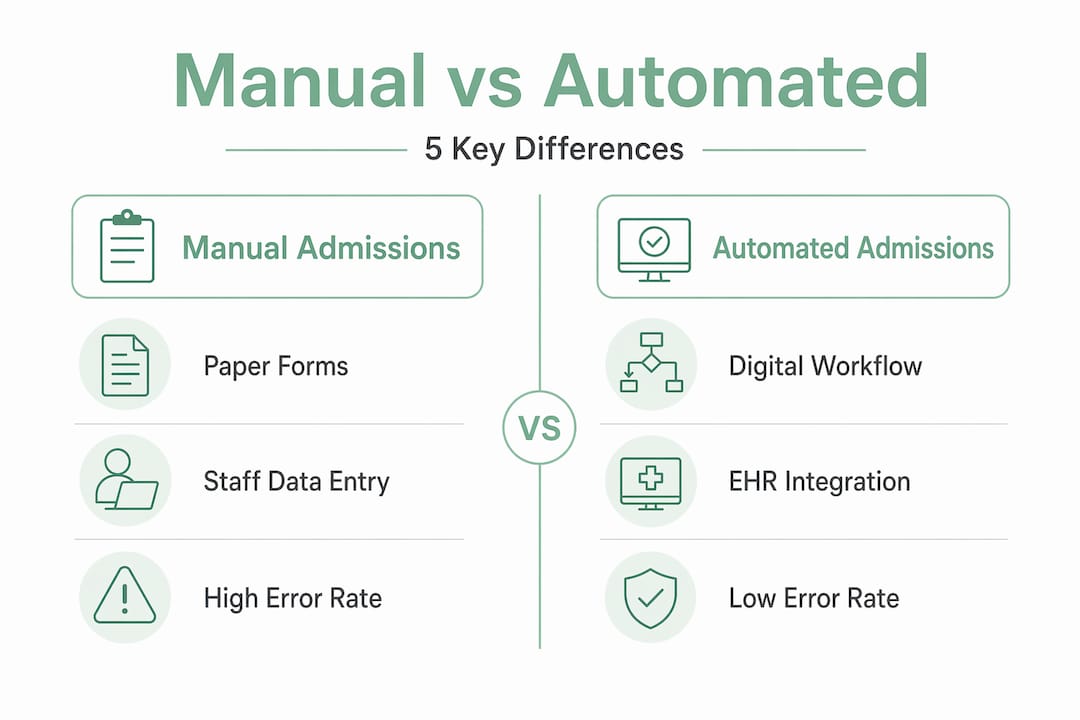
Here is how the two approaches compare at the workflow level:
Manual admissions workflow steps:
- Referral received by fax, phone, or email
- Coordinator manually reviews clinical notes and demographic documents
- Staff transcribes insurance and patient data into the EHR
- Eligibility verified by calling the payer or logging into a separate portal
- Bed assignment coordinated through phone calls or spreadsheets
- Admission paperwork printed, signed, and scanned
Automated admissions workflow steps:
- Referral received through a connected intake portal or HL7/FHIR feed
- AI assistant extracts clinical and demographic data from uploaded documents
- Insurance eligibility verified automatically through integrated payer connections
- Data pushed directly into the EHR with validation flags for staff review
- Bed assignment managed within the platform using real-time census data
- Digital consent forms sent, signed electronically, and stored automatically
The practical difference is significant. Where the manual application process requires coordinators to touch the same data multiple times across multiple systems, the automated admission system consolidates those touchpoints into a single, validated workflow.
Operational advantages that automation delivers
The benefits of automated admissions are measurable, and the numbers are worth examining closely.
| Metric | Manual admissions | Automated admissions |
|---|---|---|
| Patient check-in time | Baseline | Up to 70% faster |
| Data entry error rate | 15 to 22% | Significantly reduced via AI validation |
| Cost per patient intake | $12.40 | $3.80 |
| Coordination of benefits denials | Baseline | Reduced by 44.1% |
| Eligibility denials | Baseline | Reduced by 37.3% |
The financial case is direct. For a facility admitting 40 patients daily, switching from manual to digital intake produces annual savings exceeding $89,000. That is not a projection. It is the documented result of eliminating redundant data handling.
Beyond cost, automation improves data quality in ways that matter clinically. AI-extracted medication lists are consistently more complete and accurate than verbal histories collected by intake staff under time pressure. This matters at the point of care, not just at the billing stage.
Staff time also shifts in meaningful ways. When coordinators are no longer spending their shift transcribing fax documents, they can focus on clinical assessment review, family communication, and complex case coordination. That is where their expertise actually belongs.
Pro Tip: Track your denial rate by denial type before and after implementing automation. Segmenting coordination of benefits denials from eligibility denials helps you measure exactly where your automated system is generating the most impact.

Drawbacks of the manual admissions process
If your facility still relies on manual admissions, you are dealing with a set of compounding problems that do not resolve on their own. Here is how those problems typically stack up:
- High administrative cost per admission. At $12.40 per patient versus $3.80 with digital intake, manual admissions consume budget that could support direct care staffing or capital investment.
- Frequent data entry errors and rework. A single transposed digit in an insurance ID number generates approximately 25 minutes of staff time per denial to resolve. Multiply that across a high-volume facility and the cumulative burden is substantial.
- Cognitive overload contributing to errors. EHR documentation error rates in complex, high-stress environments can escalate dramatically, sometimes reaching 90% on specific task types when cognitive load is elevated. Manual data entry compounds this risk because staff are processing multiple information streams simultaneously.
- Delayed bed occupancy. When verification and documentation require manual coordination across systems, the time between referral receipt and admission decision stretches. Each additional hour of delay is a bed-day of revenue your facility does not recover.
- Scaling limitations. A manual workflow that functions adequately at 15 admissions per week does not scale to 40 without proportional staffing increases. Automation scales without adding headcount.
- Negative patient and family experience. Slow intake processes, repeated requests for the same information, and paperwork delays all register with patients and families. Satisfaction scores reflect this, and in a competitive referral environment, that matters.
The drawbacks of manual admissions are not simply inconveniences. They represent systemic constraints on your facility’s capacity to grow, perform, and retain staff.
Best practices for adopting automated admissions
Knowing the efficiency of automated admissions is only useful if your implementation actually works. Most automation failures are not technology failures. They are change management failures. Here is how to protect your investment:
- Involve front desk and admissions staff from day one. Excluding front desk staff from the design and selection process causes 3x higher abandonment rates once systems go live. Your coordinators understand the workflow edge cases that no vendor has anticipated. Use that knowledge early.
- Verify complete EHR integration before go-live. Incomplete EHR integration that requires staff to manually re-enter data from the automation platform back into your EHR defeats the purpose entirely. Confirm that data flows bidirectionally and that your EHR fields map correctly to your intake forms.
- Use multi-touch reminders to drive pre-registration completion. Pre-registration completion rates climb from 60 to 70% with two reminders and exceed 80% with three automated touchpoints. Build those reminders into your workflow from the start, not as an afterthought.
- Design fallback workflows for every digital step. When patients or referral sources do not complete digital intake, your staff need a defined process to intervene. Fallback mechanisms such as automated SMS reminders 24 hours before admission and front-desk alerts two hours prior give your team the information to act before a gap becomes a delay.
- Maintain human oversight at high-risk decision points. AI-driven admissions workflows are built to include human-in-the-loop validation checkpoints for complex or high-risk cases. Do not remove those checkpoints in pursuit of speed. They exist to protect both your patients and your facility.
Pro Tip: Run a 30-day parallel pilot where your team processes admissions through both the new automated system and your existing manual process. This reveals integration gaps before full cutover and gives staff confidence in the new workflow.
Admissions automation tools: what to look for
The category of admissions automation tools has expanded significantly, and the options vary substantially in architecture and capability. Understanding those differences helps you select the right solution for your facility’s size and EHR environment.
| Tool type | Best suited for | Key capabilities | Integration approach |
|---|---|---|---|
| Platform-native intake modules | Single-EHR environments | Digital forms, e-signatures, eligibility checks | Built into existing EHR |
| Standalone intake platforms | Multi-system or complex facilities | Pre-registration, insurance verification, analytics | API-based EHR connection |
| AI-powered referral management | Post-acute, SNF, rehab centers | Document extraction, clinical assessment, bed management | EMR and payer portal integration |
| Full lifecycle orchestration | Large health systems | End-to-end workflow, cross-department coordination | HL7/FHIR standards-based |
For skilled nursing facilities and post-acute care providers, platform-native EHR modules often lack the referral-specific features your admissions team actually needs. Standalone platforms with deep EMR and payer portal integration tend to perform better in your setting because they are built around referral management workflows rather than general outpatient intake.
When evaluating any tool, confirm support for real-time eligibility verification, HIPAA-compliant document handling, and the ability to integrate AI patient intake workflows with your current EMR without requiring parallel data entry. The technology should work with your existing systems, not force a workaround.
My take on why automation alone is not enough
I have seen facilities invest in well-designed automation platforms and still struggle six months after go-live. In most cases, the technology was not the problem.
What I have consistently observed is that automation fails when leadership treats it as a software project rather than an organizational change. Your admissions coordinators have years of embedded workflow knowledge. When they are handed a new system without meaningful input into its design, they find workarounds. Those workarounds become shadow processes that undermine the very efficiency you paid for.
In my experience, the facilities that succeed with automation do two things differently. They involve frontline staff in vendor selection and workflow mapping before anything is purchased. And they treat the first 90 days post-launch as a structured learning period, not a proof-of-concept. Staff need to trust that their feedback will change how the system is configured, not just be acknowledged and filed away.
The other lesson I keep returning to is that automation improves data quality as much as it saves time, and often more. The facilities that measure this outcome are the ones that sustain their investment. When your clinical team is working from more complete and accurate intake data, the downstream benefits compound across care planning, billing, and compliance. That is the case for automation that actually holds up over time.
Technology is a tool. The culture and processes around it determine whether it delivers or disappoints.
— Harry
How Smartadmissions helps your facility move forward
If the operational picture above reflects challenges your team is dealing with, Smartadmissions is built specifically for facilities like yours. The platform is designed for skilled nursing homes, rehabilitation centers, and post-acute care providers that need more than a generic intake form. It connects directly to your EMR and payer portals, provides real-time eligibility verification, and uses AI to extract and validate clinical documentation so your coordinators spend time on decisions, not data entry.
Facilities using Smartadmissions report 20% faster bed occupancy and measurable reductions in denial rates from the first month. Onboarding is structured, support is responsive, and the platform is configurable to your existing workflow without requiring a full IT overhaul. For a closer look at how the platform maps to your specific intake process, explore the admissions workflow guide or connect with the team to schedule a demonstration.
FAQ
What is the main difference between manual and automated admissions?
Manual admissions rely on paper forms, phone-based verification, and staff manually entering data into the EHR at each step. Automated admissions use connected digital workflows, AI-assisted data extraction, and real-time payer integration to move patients through intake with significantly fewer handoffs and errors.
How much can automation reduce admissions errors?
Manual intake processes carry a 15 to 22% data error rate. Automated systems with AI validation and direct EHR integration reduce this significantly, with documented reductions in coordination of benefits denials by 44.1% and eligibility denials by 37.3%.
What are the biggest drawbacks of manual admissions in healthcare?
The primary drawbacks include high per-patient processing costs ($12.40 versus $3.80 with automation), frequent data entry errors that generate claim denials, cognitive overload contributing to staff burnout, and an inability to scale without proportional staffing increases.
Why do some automated admissions implementations fail?
Most failures result from poor change management, specifically excluding front desk and admissions staff from the design process. Research shows this causes 3x higher abandonment rates. Incomplete EHR integration that forces manual re-entry is the second most common cause of implementation failure.
What should healthcare facilities look for in admissions automation tools?
Prioritize real-time insurance eligibility verification, HIPAA-compliant document handling, bidirectional EHR integration using HL7 or FHIR standards, and AI-assisted data extraction from referral documents. For post-acute and skilled nursing settings, referral-specific workflow support is more important than general outpatient intake features.