
Manual patient intake workflows cost skilled nursing facilities between $14 and $23 per patient, with errors driving claim denials that require $25 to $117 in rework per rejected submission. These inefficiencies create bottlenecks that delay admissions, frustrate staff, and drain revenue. Intake workflow automation transforms this landscape by using AI to extract, verify, and organize patient information instantly, eliminating repetitive tasks that burden your admissions team. This guide explains how automation works, the measurable benefits it delivers, and practical steps to implement it successfully in your facility.
Table of Contents
- Understanding Intake Workflow Automation In Healthcare
- Benefits Of Automating The Intake Process For Skilled Nursing Facilities
- How To Implement Intake Workflow Automation Effectively
- Comparing Manual Vs Automated Intake: Costs And Efficiencies
- Explore Proven Intake Automation Solutions For Skilled Nursing
- Frequently Asked Questions
Key takeaways
| Point | Details |
|---|---|
| Error reduction | Automation minimizes data entry mistakes that cause rejected insurance claims and costly rework. |
| Faster admissions | Streamlined referral processing accelerates bed occupancy and improves collaboration with hospitals. |
| Cost savings | Eliminating manual intake tasks reduces per-patient costs and claim denial expenses significantly. |
| Staff relief | Automation cuts repetitive work, lowering burnout and freeing clinicians for patient care. |
| AI integration | Effective systems use intelligent data extraction, verification, and real-time eligibility checks. |
Understanding intake workflow automation in healthcare
Automated patient intake systems use AI to extract, verify, and organize patient information without human intervention. For skilled nursing and rehabilitation facilities, this means transforming referral packets, insurance documents, and clinical assessments from unstructured PDFs and faxes into actionable data your team can review instantly. The technology relies on machine learning algorithms trained to recognize medical terminology, insurance codes, and clinical indicators across varied document formats.
Intake workflow automation addresses three core challenges your admissions team faces daily. First, it handles document variability by processing referrals regardless of whether they arrive as scanned handwritten notes, typed forms, or electronic health record exports. Second, it performs real-time insurance verification by connecting to payer portals and checking eligibility, authorization status, and coverage details automatically. Third, it organizes extracted information into standardized fields that integrate seamlessly with your facility management system, eliminating manual data entry.
The scope of automation extends beyond simple data capture. Advanced systems analyze clinical information to flag potential care gaps, identify patients requiring specialized services, and match referrals to available beds based on acuity levels and staff capabilities. This transforms intake forms from static documents into structured data assets that drive decision-making.
Key AI technologies powering these systems include:
- Natural language processing that interprets clinical notes and physician orders
- Optical character recognition that digitizes handwritten referral information accurately
- Rules engines that validate data against facility admission criteria and payer requirements
- Integration APIs that connect to EMR systems, insurance portals, and state databases
Pro Tip: Before selecting automation tools, map your current workflow from initial referral contact through admission confirmation. Document every handoff, approval step, and data entry point to identify where automation delivers maximum impact.
Understanding these technical foundations helps you evaluate vendors and set realistic expectations during implementation. The goal is not replacing human judgment but augmenting your team’s ability to process referrals quickly and accurately.
Benefits of automating the intake process for skilled nursing facilities
Automated intake workflows can reduce manual data entry errors, leading to fewer rejected claims. When your staff manually transcribes insurance information, diagnosis codes, and medication lists from referral packets, typos and omissions create claim denials that require expensive rework. Automation eliminates these transcription errors by extracting data directly from source documents with 98% accuracy rates, ensuring clean submissions to payers from the start.
The financial impact extends beyond claim acceptance rates. Physicians and staff spend 13 hours weekly completing prior authorizations, leading to burnout and delays. Automated systems handle authorization requests by pulling required clinical documentation, submitting requests electronically, and tracking approval status without manual follow-up. This frees your admissions coordinators to focus on patient communication and care coordination rather than paperwork.
Enhanced collaboration represents another critical advantage. When referral information flows automatically to your clinical team, social workers, and billing department simultaneously, everyone accesses the same verified data in real time. This eliminates the communication breakdowns that plague manual workflows, where phone calls, emails, and paper handoffs create information silos. Communication failures contribute to about two out of every three sentinel adverse events, making seamless information sharing a patient safety imperative.
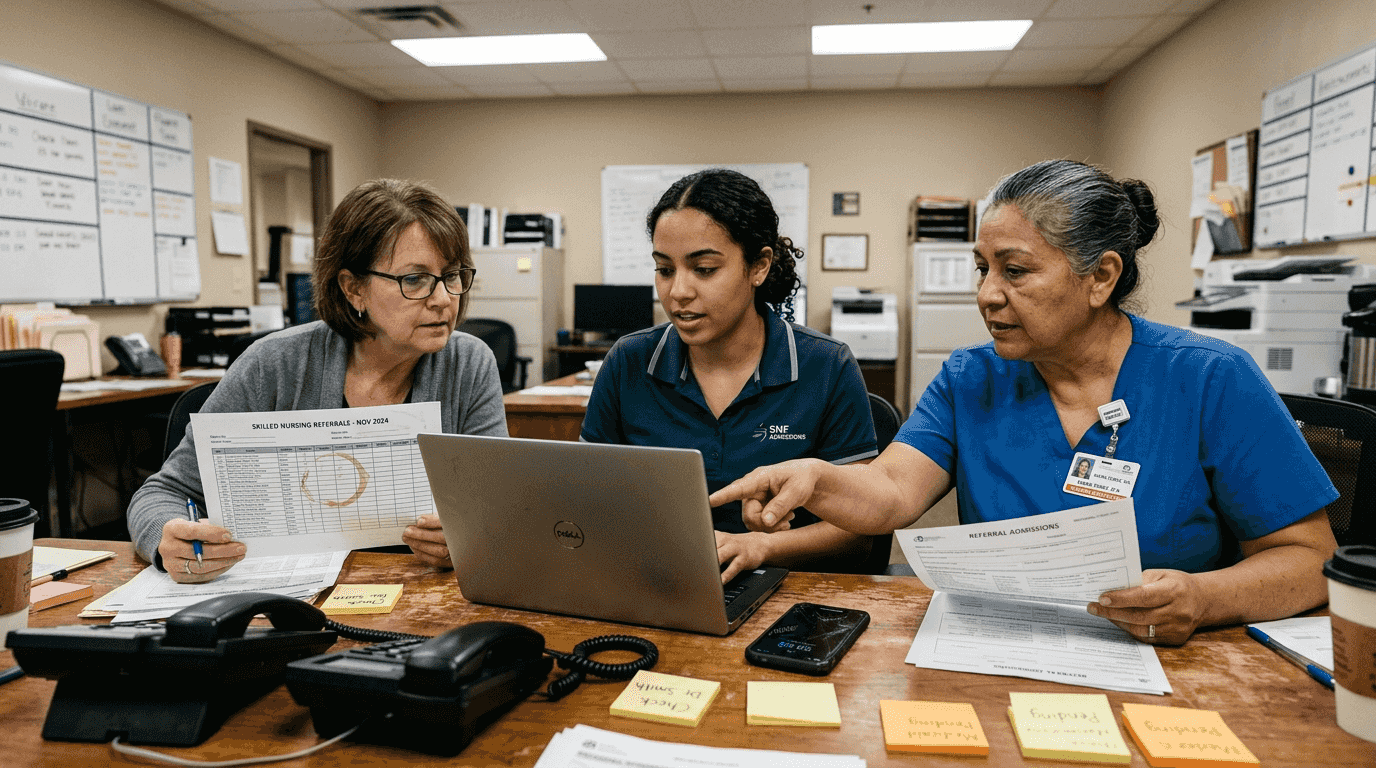
Automation also accelerates admission timelines dramatically. Traditional intake processes require 24 to 72 hours to review referrals, verify insurance, and confirm bed availability. Automated systems complete these tasks in minutes, enabling you to accept appropriate patients before competitors. Faster turnaround improves relationships with hospital discharge planners who value facilities that respond quickly to referrals.
Cost savings compound across multiple areas:
- Reduced labor hours spent on manual data entry and verification
- Lower claim denial rates that eliminate rework expenses
- Decreased phone time chasing missing information from referring providers
- Improved bed utilization through faster admission processing
Beyond measurable financial returns, automation improves staff satisfaction by eliminating tedious tasks that contribute to turnover. When your team spends less time on paperwork, they experience greater job fulfillment and remain with your facility longer, reducing recruitment and training costs.
How to implement intake workflow automation effectively
A comprehensive assessment of the current intake workflow is the foundational first step toward meaningful optimization. Start by documenting every stage of your referral process, including initial contact, information gathering, clinical review, insurance verification, bed assignment, and admission confirmation. Identify bottlenecks where referrals stall, such as waiting for insurance authorization responses or tracking down missing clinical documentation from hospitals.
Create visual workflow diagrams that map how information flows between your admissions coordinators, nursing staff, billing department, and external partners like hospitals and insurance companies. These diagrams reveal redundant steps, unnecessary handoffs, and opportunities where automation delivers immediate value. Pay special attention to tasks your team performs repeatedly, such as copying patient demographics into multiple systems or calling insurance companies to verify coverage.
Once you understand your current state, follow these implementation steps:
- Define success metrics including average referral processing time, claim acceptance rates, and staff hours spent on intake tasks to measure improvement.
- Evaluate automation vendors based on their ability to handle varied document formats, integrate with your existing EMR, and provide real-time insurance verification.
- Pilot the system with a subset of referrals to identify configuration needs and workflow adjustments before full deployment.
- Train your entire admissions team on the new system, emphasizing how automation supports rather than replaces their expertise.
- Monitor performance data weekly during the first 90 days to fine-tune rules, address integration issues, and optimize workflows.
- Gather staff feedback continuously to identify pain points and celebrate efficiency gains that boost adoption.
Choosing the right technology requires evaluating several critical capabilities. Your automation solution must handle the document variability inherent in healthcare referrals, processing everything from clean electronic forms to poor-quality faxes. It should integrate AI-powered verification that checks patient information against insurance databases, state licensing records, and clinical guidelines automatically. Look for systems offering customizable workflows that match your facility’s unique admission criteria and approval processes.
| Feature | Manual Process | Automated Process |
|---|---|---|
| Data entry | Staff manually types information from referral packets | AI extracts data automatically with 98% accuracy |
| Insurance verification | Phone calls to payer requiring 30-45 minutes | Real-time portal checks completed in under 2 minutes |
| Document organization | Paper files or scanned PDFs in folders | Structured digital records searchable by any field |
| Clinical review | Printed packets distributed to nurses | Electronic alerts sent to appropriate reviewers instantly |
| Bed matching | Manual review of census and patient needs | Automated matching based on acuity and availability |
Pro Tip: Do not underestimate document variability during vendor selection. Request pilot testing with your actual referral packets, including the messiest faxes and most complex cases, to verify the system handles real-world conditions.
Successful implementation requires securing buy-in from clinical staff who may resist workflow changes. Involve nurses and admissions coordinators in vendor selection and configuration decisions to build ownership. Emphasize how automation eliminates frustrating tasks rather than threatening job security.
Comparing manual vs automated intake: costs and efficiencies
Cost of manual intake is $14 to $23 per patient, driven by staff time spent on data entry, phone calls, and document handling. These expenses accumulate quickly in facilities processing hundreds of referrals monthly. When errors occur, cost to rework intake-related claim denials is $25 to $117 per denied claim, adding substantial financial burden beyond initial processing costs.
The time investment tells an equally compelling story. Manual intake requires admissions staff to spend 45 to 90 minutes per referral extracting information, verifying insurance, and entering data into multiple systems. This limits your facility’s capacity to process referrals quickly, creating bottlenecks during high-volume periods when hospitals discharge patients needing post-acute care. Automated systems complete the same tasks in 5 to 10 minutes, enabling your team to handle significantly more referrals without adding headcount.
Error rates represent another critical comparison point. Manual data entry produces error rates between 1% and 5% depending on document complexity and staff fatigue levels. These mistakes manifest as incorrect insurance member IDs, transposed diagnosis codes, or missing medication allergies that trigger claim denials or patient safety concerns. Automation reduces error rates to below 0.5% by eliminating human transcription and validating data against authoritative sources automatically.
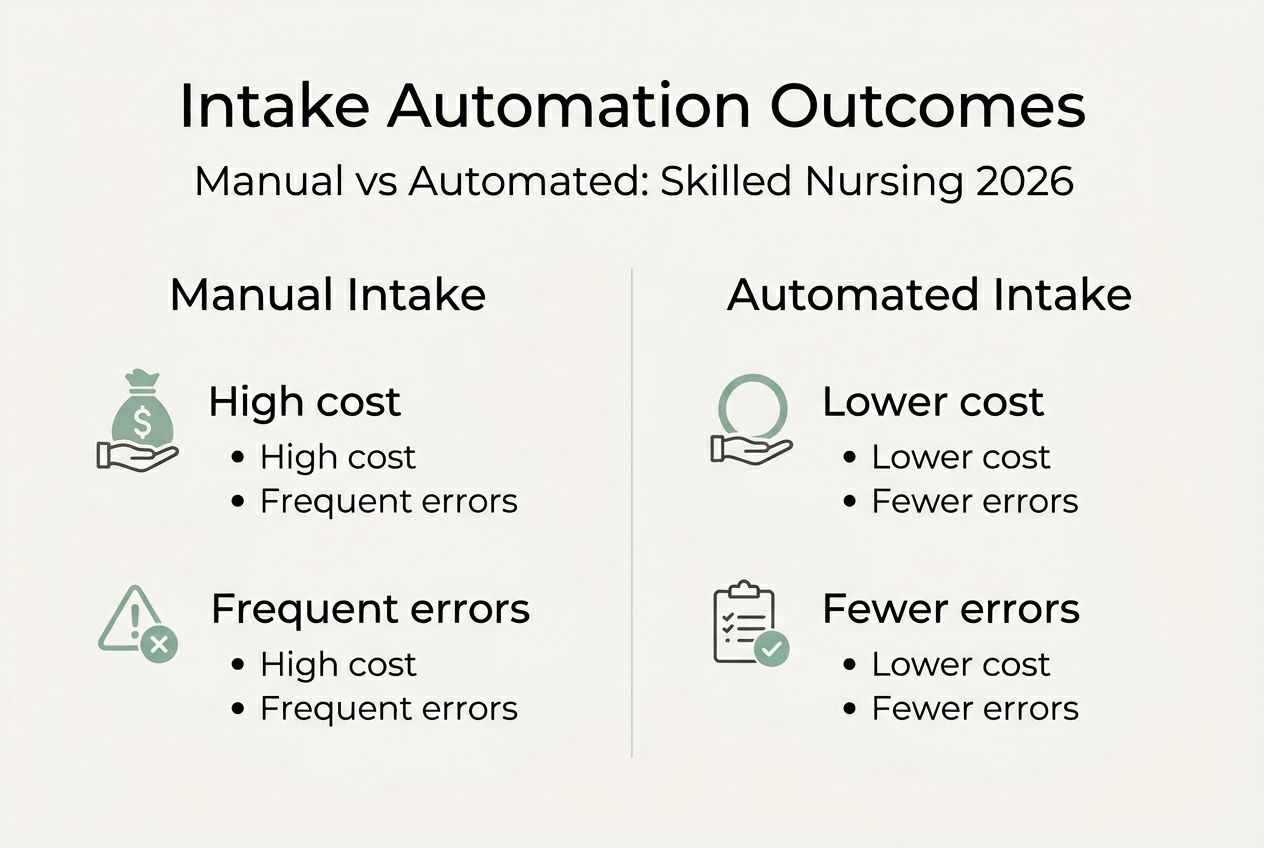
Admission speed differences create competitive advantages that directly impact revenue. Facilities using manual vs automated intake processes experience dramatically different response times. Manual workflows require 24 to 72 hours to review referrals and confirm admissions, while automated systems enable same-day decisions. Hospital discharge planners prioritize facilities that respond fastest, meaning automation helps you capture patients who might otherwise go to competitors.
Key efficiency comparisons include:
- Staff productivity: Automation enables one coordinator to handle workload previously requiring three staff members
- Claim acceptance: Automated intake achieves 95% first-pass claim acceptance versus 75% to 85% for manual processes
- Referral capacity: Facilities can process 3x more referrals without increasing admissions staff
- Authorization turnaround: Automated prior authorization submission reduces approval wait times from days to hours
The return on investment calculation extends beyond direct cost savings. Faster admissions improve bed occupancy rates, generating additional revenue that compounds monthly. Reduced staff burnout lowers turnover costs, which average $50,000 per admissions coordinator when factoring in recruitment, training, and productivity losses. Better data accuracy improves relationships with payers, reducing audit risk and payment delays.
Pro Tip: Calculate your facility’s current cost per admission by tracking total admissions staff hours and dividing by monthly admission volume. Compare this baseline against vendor pricing to determine realistic payback periods, typically 6 to 12 months for most skilled nursing facilities.
Understanding these quantitative differences helps you build compelling business cases for automation investment. The combination of cost reduction, efficiency gains, and revenue improvement creates financial returns that justify implementation effort.
Explore proven intake automation solutions for skilled nursing
Transforming your admissions workflow starts with exploring specialized automation platforms designed specifically for skilled nursing and rehabilitation facilities. Examples of referral management systems demonstrate how AI-powered tools streamline every step from initial referral receipt through admission confirmation. These solutions integrate seamlessly with your existing EMR and insurance portals, eliminating the technical complexity that derails many automation initiatives.
Facilities implementing intake automation report measurable improvements in bed occupancy rates, often achieving 20% faster admissions by eliminating manual bottlenecks. The technology handles document variability, performs real-time eligibility verification, and routes referrals to appropriate reviewers automatically, freeing your team to focus on patient care rather than paperwork. Explore proven solutions that deliver these outcomes while providing responsive support during implementation and beyond.
Frequently asked questions
What is intake workflow automation?
Intake workflow automation uses artificial intelligence to extract, verify, and organize patient information from referral documents without manual data entry. The technology processes varied formats including faxes, PDFs, and electronic submissions, then populates your facility management system automatically. This eliminates repetitive tasks that consume admissions staff time while improving data accuracy and admission speed.
How does intake automation reduce rejected insurance claims?
Automated intake workflows reduce manual data entry errors, leading to fewer rejected claims by ensuring accurate transcription of insurance member IDs, diagnosis codes, and authorization numbers. The systems validate information against payer databases in real time, flagging discrepancies before claim submission. This proactive verification prevents the costly rework cycle that occurs when claims are denied due to data quality issues.
What steps should skilled nursing facilities take to implement intake workflow automation?
A comprehensive assessment of the current intake workflow is foundational to optimization, requiring you to map every process step and identify bottlenecks. Select automation vendors that handle your specific document types and integrate with existing systems. Train staff thoroughly on new workflows, emphasizing how technology supports their expertise rather than replacing it, and monitor performance metrics weekly during initial rollout.
Can intake workflow automation help reduce staff burnout?
Physicians spend 13 hours weekly on prior authorizations, causing burnout; automation reduces this workload by handling repetitive administrative tasks electronically. Staff experience greater job satisfaction when freed from tedious data entry and phone calls, allowing them to focus on meaningful patient interactions and clinical coordination. This improved work-life balance reduces turnover and creates more sustainable admissions workflows.