
Level of care screening is the clinical review that determines whether a resident’s functional and medical needs meet the standard for nursing facility placement under Medicaid. It works alongside, not instead of, PASRR (Preadmission Screening and Resident Review) for mental illness and intellectual disability. Before admitting any Medicaid-relevant resident, your team must complete both the LOC evaluation and any indicated PASRR level, in the correct sequence, or risk denied payment.
TL;DR:
- Completing both LOC and PASRR screenings before admission is essential to secure Medicaid reimbursement and avoid claim denials.
- State-specific assessments vary in process and tools, requiring facilities to use tailored documentation and workflow practices for accurate evaluation.
- Detailed, face-to-face observation documentation with precise behavioral notes is critical for audits and maintaining eligibility.
- Missing or untimely screenings, vague functional descriptions, or absent required forms are leading causes of payment refusals.
- Automated tracking systems can help ensure all screening steps are completed correctly and on time, reducing errors and improving compliance.
Table of Contents
- How Level of Care Screening Connects to PASRR and Medicaid Rules
- When a Screening Is Required and Who Completes It
- What a Level of Care Assessment Actually Measures
- State Screening Tools Vary More Than You’d Expect
- Documentation Steps That Keep Payment Moving
- Why Screenings Get Denied and What to Do Next
- Why Standardized Screening and Automation Matter
- How Smartadmissions Keeps LOC and PASRR Workflows on Track
- Sources
- FAQ
How Level of Care Screening Connects to PASRR and Medicaid Rules
Federal rules require PASRR screening for every applicant to a Medicaid-certified nursing facility. Level I identifies possible serious mental illness or intellectual disability. Level II, a deeper clinical evaluation, follows whenever Level I flags a concern.
LOC screening asks a different question: does this person’s functional and medical condition meet the state’s standard for nursing facility care? Think of it as functional eligibility, separate from the financial eligibility Medicaid caseworkers verify through income and asset review. A resident can pass one and fail the other.
Both matter for payment. CMS guidance ties Federal Financial Participation directly to completed PASRR and LOC requirements, which means:
- Admitting before either screen is finished puts reimbursement at risk
- A completed LOC does not substitute for a required PASRR Level II
- Facilities that treat the two as one step often miss a required form
Your PASRR requirements guide breaks down the distinction further for admissions staff who handle both processes daily.
When a Screening Is Required and Who Completes It
Not every admission triggers the same screening path, but most Medicaid-relevant ones require at least one review before or shortly after move-in.
- Initial placement. New nursing facility admissions need both LOC and PASRR Level I completed, with Level II following if indicated.
- Retroactive eligibility. When a resident’s Medicaid application is pending, states allow a look-back period, but the clinical screen still has to happen. Missing this window can cost the facility reimbursement even when the resident would have qualified.
- Service-level changes. A resident whose condition improves or declines may need rescreening to confirm continued eligibility at the current LOC.
- Time-limited determinations. Some approvals, including certain pediatric specialty placements, expire and require resubmission before the date lapses.
- Hospital or special admissions. When Level I can’t be completed before admission, most states have a special-admission procedure with its own paperwork and deadline. Skipping it can cost facilities FFP even if a later LOC would have passed, according to Kansas CARE program guidance.
Facility staff or an Area Agency on Aging typically handle Level I. Level II almost always requires a state-contracted clinician or psychiatric evaluator, since it demands specialized judgment Level I screeners aren’t trained to make.
What a Level of Care Assessment Actually Measures
A level of care assessment looks at four domains, and each one can independently push a resident into a higher LOC category.
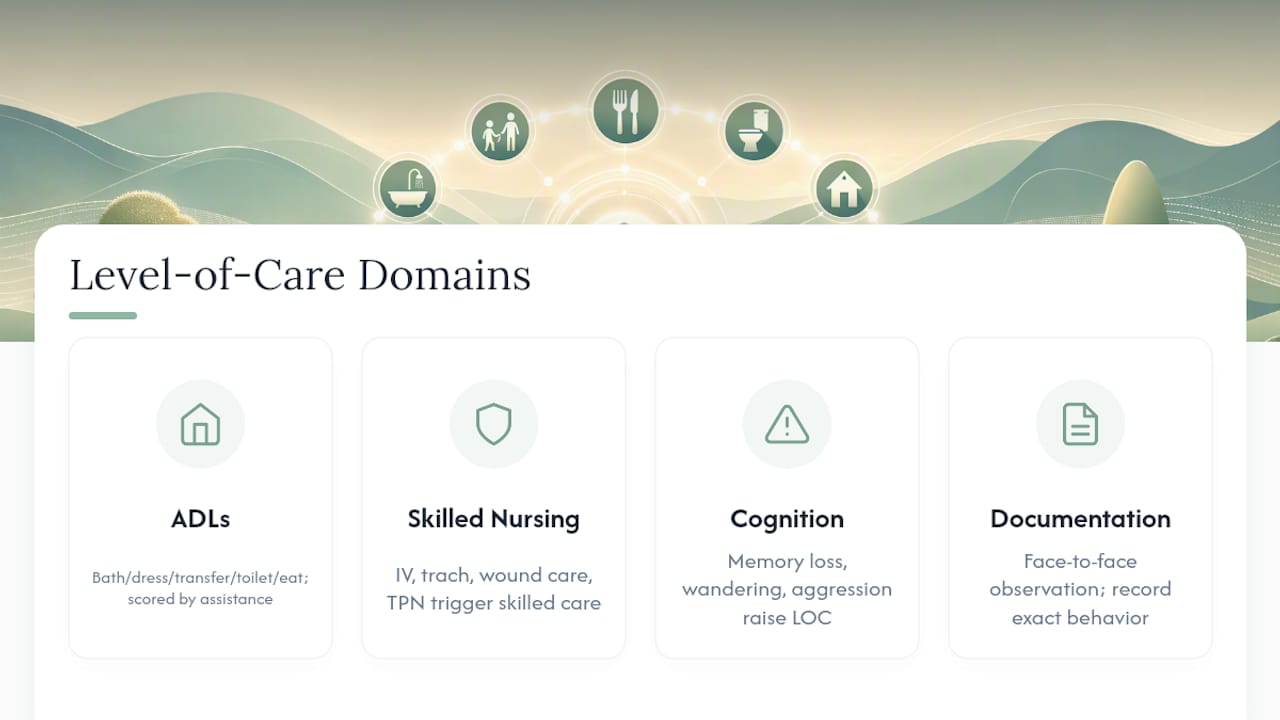
Activities of daily living (ADLs). Bathing, dressing, transferring, toileting, and eating are scored based on how much physical assistance a resident needs, not how much they say they need. Scoring windows matter. A resident who needed help transferring three times in the last week scores differently than one needing it once.
Skilled nursing and therapy needs. IV therapy, tracheostomy care, wound management, and TPN administration are classic triggers that push a case from custodial to skilled care.
Cognition and behavior. Memory loss, wandering, aggression, or a diagnosed condition affecting judgment can raise the LOC even when physical ADLs look moderate.
Documentation standard. Every state manual reviewed, including Virginia’s LTSS screening manual_Final.pdf), requires face-to-face observation, not a phone interview or a family report.
Pro Tip: Write down the exact observed behavior, not a summary. “Requires assistance with pivot transfer using one staff, three times this week” survives an audit. “Needs help moving” does not.
State Screening Tools Vary More Than You’d Expect
Every state runs its own LOC process, and the mechanics differ enough that a workflow built for one state won’t transfer cleanly to another.
- Nevada built a combined online system where LOC and PASRR run through one tool. Its LOC Screening Tool auto-adjudicates straightforward cases, looks up existing applicant records, and generates notification letters automatically. Cases the system can’t resolve get routed to manual review.
- Colorado’s LTSS Level of Care Screen module breaks the assessment into mobility, behavior, cognition, and ADL sections, with scoring rules that let assessors stop early once LOC criteria are clearly met.
- Kansas runs its process through CARE (Client Assessment, Referral, and Evaluation). Level I produces a formal level of care score and must be finished before admission, with the resulting certificate retained in the resident’s medical record.
Forms and instructions for each state live on that state’s Medicaid agency site, and it’s worth bookmarking those pages rather than relying on a printed copy that may already be outdated.
Documentation Steps That Keep Payment Moving
Reimbursement delays trace back to documentation gaps more often than to a genuinely ineligible resident. A predictable sequence prevents most of them.
- Complete Level I first. Confirm it’s on file before scheduling admission, and flag immediately if it points to a required Level II.
- Submit the LOC request with observed ADL performance, physician orders, and the frequency of any skilled services.
- Track the notification letter. Most states issue a written determination. File it and don’t assume verbal approval is sufficient.
- Retain the certificate in the resident’s permanent medical record, ready for any future audit.
- Coordinate with the Medicaid clearinghouse separately for financial eligibility, and request retroactivity promptly if the application timeline requires it.
Pro Tip: Auditors judge adequacy by exact phrasing and timestamps. A note reading “unable to complete without physical assistance, observed 6/12 at 2:15 p.m.” holds up far better than a same-day summary written from memory.
Research on interrater reliability in level of care assignment found that the assessment method itself changes reimbursement outcomes by a meaningful margin, which is exactly why consistent, time-stamped documentation matters more than it might seem.
Why Screenings Get Denied and What to Do Next
Most denials trace back to one of three problems: functional detail that’s too vague to justify the LOC, a submission filed after the required deadline, or a missing PASRR form that should have accompanied the LOC request.
- Insufficient functional detail (vague notes instead of observed, dated behavior)
- Mis-timed submission relative to admission or the retroactive window
- Missing forms, especially a Level I certificate that was never filed
If a screening is denied, retain every piece of supporting evidence and follow your state’s specific reconsideration or appeal route. Most states set a firm deadline for filing, so treat the denial letter’s timeline as non-negotiable. A genuine change in a resident’s condition, an improvement or a decline, is grounds for requesting a fresh LOC determination, and timing that resubmission close to the actual change date makes the clinical justification far stronger than waiting weeks to file.
Why Standardized Screening and Automation Matter
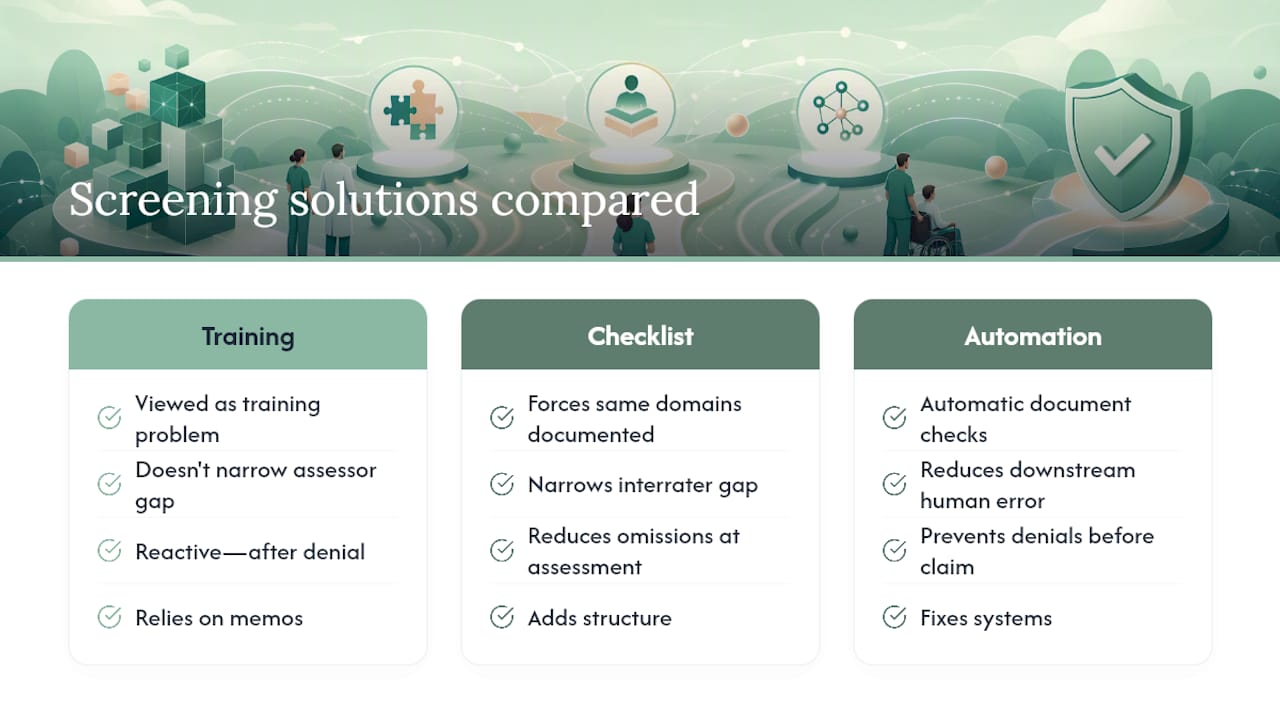
Interrater reliability research on level of care assignment methods makes an uncomfortable point: two qualified assessors can look at the same resident and land on different LOC categories, and that gap changes reimbursement. Checklists narrow that gap by forcing every assessor to document the same domains the same way. Automation goes further, catching a missing Level I certificate or an expired time-limited determination before it becomes a denied claim instead of after.
The conventional view treats screening variability as a training problem. It’s really a systems problem, and systems get fixed with structure, not more memos.
— Harry
How Smartadmissions Keeps LOC and PASRR Workflows on Track
The platform offers automated tracking that can flag a missing Level I certificate or an unfinished PASRR step before a resident is admitted, rather than after a claim is denied.

This solution can perform automated eligibility checks alongside EMR systems, incorporate clinical assessment data into templated documentation, and flag gaps that might otherwise be found only during an audit with healthcare SEO services to increase care visibility and patient appointments. Such built-in structure helps teams manage multiple state forms and deadlines, reducing errors that could impact reimbursement. Review the patient intake checklist for 2026 to see what a fully documented admission looks like.
Sources
- Preadmission Screening and Resident Review | Medicaid
- Assessment of level of care: Implications of interrater reliability on health policy
- LOC Screening Tool – Nevada
- Client Assessment, Referral and Evaluation (CARE) | KDADS
FAQ
What Is a Level of Care Assessment For?
A level of care assessment determines whether a resident’s medical, functional, and cognitive needs meet the standard required for nursing facility placement, which directly affects Medicaid payment eligibility.
What Are the Three Types of Screening Involved in Nursing Facility Admissions?
Admissions typically involve functional LOC screening, PASRR Level I (identifying possible serious mental illness or intellectual disability), and PASRR Level II when Level I flags a concern.
What Does a Higher Level of Care Mean in a Long-Term Care Setting?
A higher level of care indicates the resident needs more intensive skilled nursing, therapy, or behavioral support, such as wound care, IV therapy, or supervision for cognitive impairment, beyond basic custodial assistance.
What Is the Difference Between PASRR Level I and Level II?
Level I is a brief preliminary screen for possible serious mental illness or intellectual disability; Level II is the in-depth clinical evaluation that follows when Level I identifies a concern, per Medicaid’s PASRR guidance.