
Referral partner onboarding is the structured process of integrating a clinical referral source, meaning a hospital, physician group, or case management team, into your facility’s intake system so referrals arrive complete, verified, and ready for fast clinical review. The approach that works is operational: map the transfer process with frontline staff first, layer in minimum viable data sharing, and only then expand technical integration. Done right, it cuts referral review time and speeds bed occupancy, whether your intake staff work the fax machine or an automated referral management platform.
TL;DR:
- Most onboarding processes take four to six weeks, focusing first on process mapping and setting up temporary secure pathways before technical integration.
- Clear documentation and eligibility checklists, verified within hours of referral, significantly speed up the review process and reduce incomplete packets.
- Ongoing relationship management requires designated liaisons, regular performance reviews, and structured communication protocols to sustain long-term referral growth.
- Automated tools like AI referral assistants can verify eligibility and flag incomplete packets in real time, shortening review times and easing manual workload.
- Prioritizing relationship-building and process discipline over full technical interoperability yields faster, more reliable referral data and improves overall onboarding success.
Table of Contents
- What Does Referral Partner Onboarding Involve Step by Step?
- What Technical Integrations Do You Actually Need First?
- Who Owns the Relationship After Go-Live?
- Which KPIs Prove the Onboarding Worked?
- What Goes Wrong During Onboarding, and How Do You Fix It Fast?
- How Do You Verify Referral Documentation and Eligibility?
- How Long Does Onboarding Take, and What Resources Does It Need?
- What Training and Support Do Referral Partners Need?
- How Often Should Partners Communicate After Onboarding?
- What Legal and Compliance Issues Should You Address?
- How Do You Keep Referral Partnerships Growing Long-Term?
- Why People and Process Beat Perfect Technology First
- How Smart Admissions Speeds Up Referral Partner Onboarding
- Sources
- FAQ
What Does Referral Partner Onboarding Involve Step by Step?
Onboarding a new referral source is not a single meeting and a signed agreement. It is a sequence, and skipping steps is exactly why so many partnerships stall out within the first 90 days.
- Map the transfer process with frontline staff from both sides. Get your intake nurse and the hospital’s discharge planner in the same room (or video call) to walk the actual sequence: who calls whom, what information moves when, and where handoffs break down. Process mapping consistently surfaces gaps that policy documents never catch.
- Agree on required data fields and timing. Build a shared documentation checklist: medications, diagnoses, recent labs and vitals, behavioral status, advance directives, and a firm deadline for when each item arrives relative to the transfer.
- Set up a temporary secure pathway. While IT sorts out formal access, use a secure text platform or a shared portal upload so referrals do not sit in limbo during week one.
- Assign named liaisons and an escalation path. Every partner needs one person on each side who owns the relationship and a documented path for what happens when something goes wrong at 6 p.m. on a Friday.
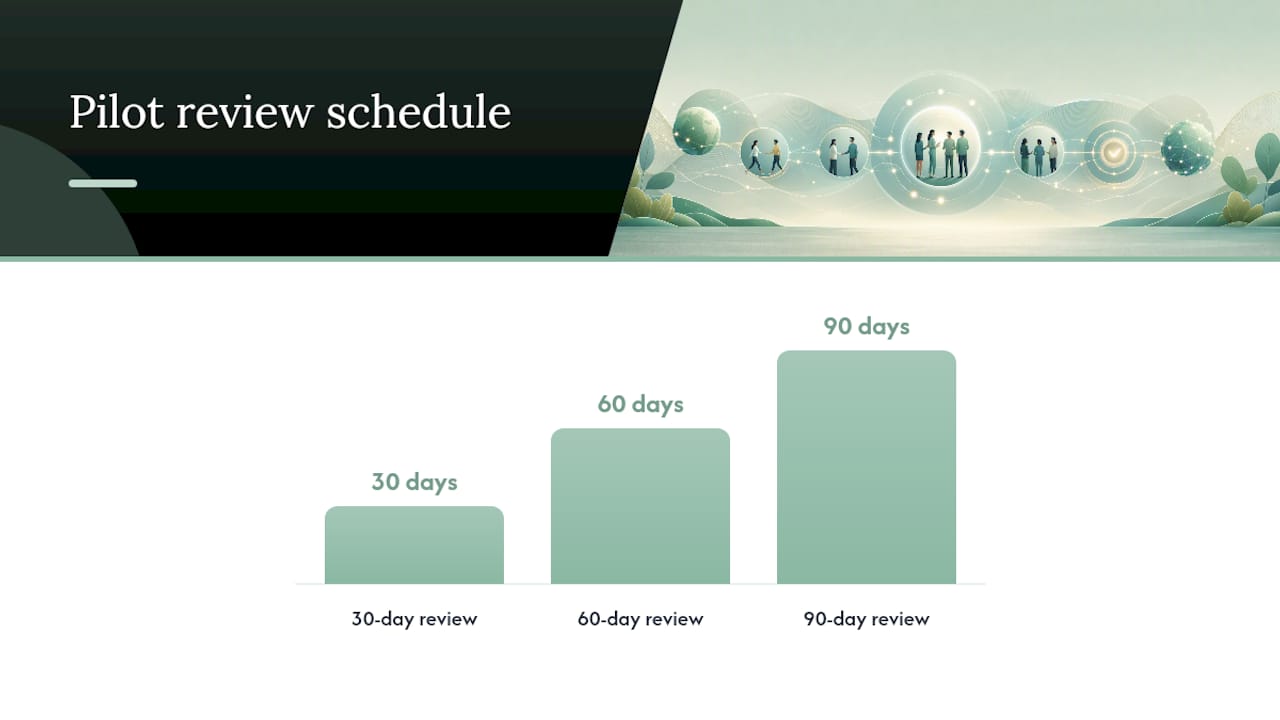
- Schedule governance checkpoints. Put 30, 60, and 90 day pilot reviews on the calendar before you even go live, not after problems pile up.
- Pilot with low volume, measure, then scale. Start with a handful of referrals a week, track your KPIs, fix what breaks, and only then open the floodgates.
Pro Tip: Run your pilot with the referral sources most likely to give honest feedback, not the ones most likely to send volume. A partner who tells you the intake form is confusing in week two saves you months of quiet frustration later.
For a deeper walkthrough of transfer sequencing, see this guide on coordinating patient transfers.
What Technical Integrations Do You Actually Need First?
Perfect interoperability is not the bar. Usable, timely information is. A recent synthesis on hospital-SNF transitions found that interoperability alone is insufficient unless organizations also structure active coordination around the data exchange.
Your realistic starter options:
- View-only EHR access for your intake reviewer
- A feed from your regional Health Information Exchange (HIE)
- Portal upload with a structured referral form
- Secure text for urgent or off-hours referrals
Referral packets missing behavioral status information, or arriving after the patient has already reached your door, remain a common breakdown point in hospital-to-SNF transfers.
Prioritize the fields that change your admission decision: current medications, diagnoses, recent labs and vitals, behavioral status, and advance directives. Set a timeliness target, ideally within a few hours of the referral call, and hold your partner to a service level agreement on portal or secure-text uploads rather than waiting for a full chart export. Start with structured forms and secure text as your quick win, then layer in HIE or EHR access once the relationship proves itself.
Who Owns the Relationship After Go-Live?
Onboarding does not end at go-live. It shifts into ongoing coordination, and that requires clearly assigned roles.
- Referral liaison: owns the relationship, fields questions, and flags friction early
- Intake reviewer: verifies documentation completeness and eligibility against your rulebook
- Clinical triage staff: assess acuity fit and flag cases needing physician input
- IT liaison: manages access issues and portal or secure-text troubleshooting
Facilities with hospital clinician presence on-site report meaningfully better completeness, timeliness, and usability of shared patient information than those relying on formal data transfer alone. A shared or visiting clinician model is worth the investment for high-volume partners.
Keep governance simple: a kickoff meeting, reviews at 30, 60, and 90 days, a monthly performance huddle once the pilot stabilizes, and a one-page responsibility matrix so nobody wonders who owns what. Train both sending and receiving staff together whenever possible. Separate training sessions tend to produce two different mental models of the same process.
Which KPIs Prove the Onboarding Worked?
You cannot manage what you do not measure, and referral partner onboarding lives or dies on a handful of numbers.
| KPI | Data source | What it tells you |
|---|---|---|
| Referral review time | EMR timestamps | How fast your team can say yes or no |
| Percent complete on first pass | Manual audit sample | Whether the partner is sending usable packets |
| Time from referral to bed offer | Portal/EMR logs | Overall intake speed |
| Bed fill rate | Census/admissions system | Revenue impact of faster intake |
| 30-day readmission rate | EMR/claims data | Quality of the clinical handoff |
Baseline your current numbers before the pilot starts, then track weekly. Facilities can often expect a noticeable reduction in referral review time during a pilot cycle, depending on how manual the current process is. Tie each KPI review directly to your 30/60/90-day governance meetings so the numbers drive decisions instead of sitting in a spreadsheet nobody reopens.
What Goes Wrong During Onboarding, and How Do You Fix It Fast?
Most onboarding failures follow the same handful of patterns.
- Incomplete referral packets. Require a minimum documentation checklist and enforce a soft-stop rule: no packet, no review, until the missing pieces arrive.
- Misaligned eligibility rules. Build a written rulebook with sample cases so both sides know what “yes” and “no” actually look like before disputes happen.
- Technical lag or no access. Fall back to secure text or portal upload immediately, and put IT access requests on a prioritized service level agreement instead of a general ticket queue.
- No clear accountability. Name your liaisons on day one, document a simple RACI chart, and put governance meetings on the calendar before launch, not after friction starts.
Pro Tip: If the same problem shows up in two consecutive weekly reviews, escalate it past the liaison level immediately. Waiting for the 30-day review to fix a recurring issue just burns three more weeks of bad data.
How Do You Verify Referral Documentation and Eligibility?
Clear documentation standards are the difference between a referral your team can act on in minutes and one that sits in a queue while someone chases down missing labs. Build a written checklist covering demographic and insurance information, current diagnoses and medications, recent labs and vitals, functional and behavioral status, and any advance directives. Require it on every referral, not just the complicated ones.
Eligibility verification runs in parallel. Your intake reviewer should confirm insurance coverage and authorization status, clinical acuity fit against your facility’s capabilities, and bed availability by unit type, ideally within the same review window. Facilities that separate these two checks into sequential steps, verifying documentation completeness first and eligibility second, tend to move faster than those trying to do both at once from an incomplete packet.
Document your standard checklist and share it with every referral partner during onboarding, not after the first rejected referral. A partner who knows exactly what “complete” looks like sends fewer incomplete packets. For a structured approach, this guide on referral documentation best practices breaks down the specific fields worth standardizing first.
How Long Does Onboarding Take, and What Resources Does It Need?
Most facilities can get a new referral partner from first conversation to live pilot in four to six weeks, assuming process mapping happens early and technical access does not become a blocker. The timeline breaks down roughly like this: one to two weeks for process mapping and documentation agreement, one to two weeks to stand up a temporary secure pathway, and two weeks of low-volume piloting before scaling.
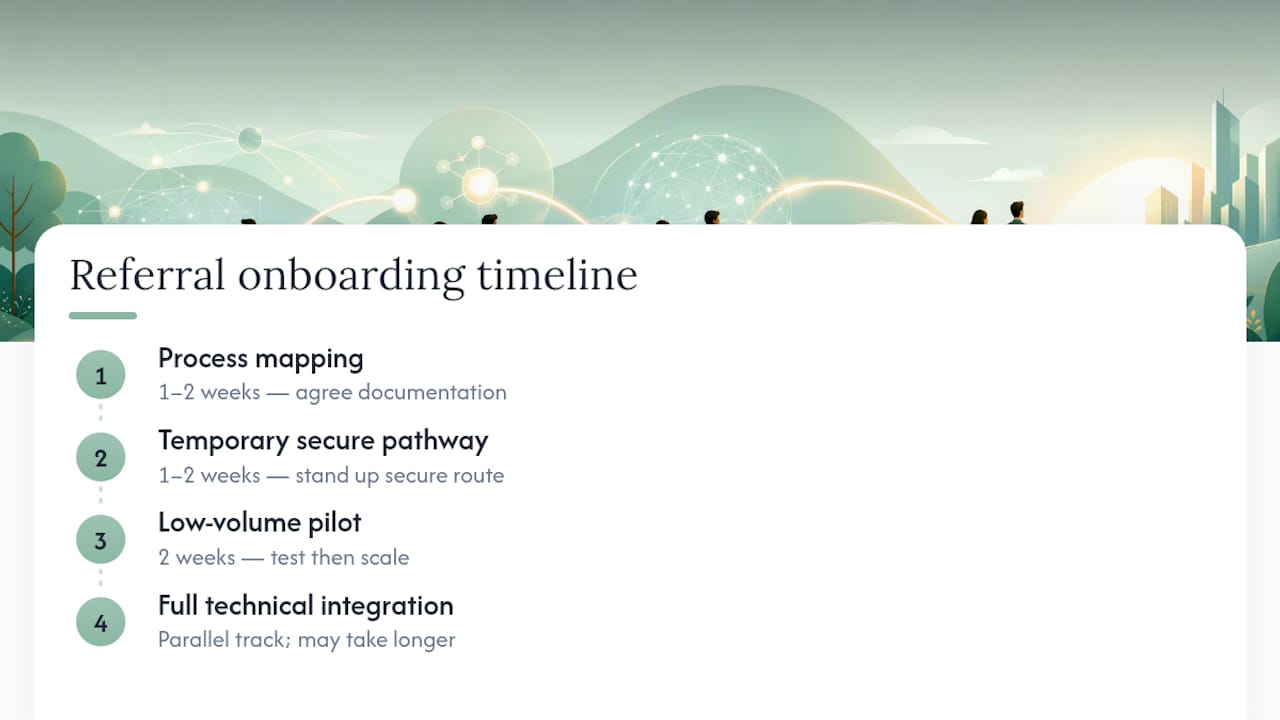
Full technical integration, meaning EHR view access or an HIE feed, often takes longer and should never hold up the pilot. Run the relationship on secure text or portal upload while IT works in parallel.
Resource needs are lighter than most administrators expect. You need a named liaison willing to spend a few hours a week during the first month, an intake reviewer trained on the new partner’s documentation habits, and IT support available for access provisioning, even if that support is external. Facilities that try to onboard three or four new partners simultaneously without adding liaison capacity tend to see all of them stall at once. Leveraging Healthcare SEO Services can help improve your digital presence and streamline appointment generation to support growing referral sources. Stagger your onboarding calendar instead of running parallel pilots when your team is small.
What Training and Support Do Referral Partners Need?
Referral partner training is not optional overhead. It is the mechanism that turns a documented checklist into consistent behavior. Start with a joint kickoff session covering your documentation checklist, your eligibility rules with real sample cases, and exactly how to reach your liaison when something is unclear.
Give sending staff a one-page reference sheet they can keep at their desk: required fields, submission method, and contact information. Follow up within the first two weeks of the pilot with a short check-in call specifically asking what is confusing, not just whether things are going well. Partners rarely volunteer friction unprompted.
Ongoing support matters as much as initial training. Your liaison should be reachable during business hours at minimum, and any technical hiccup with a portal or secure-text platform needs a fast response, since a slow fix in week two can quietly kill a promising partnership before it produces useful volume. Facilities using an automated referral platform often build a short walkthrough video or live demo into this stage. A tool like an AI referral management assistant can shorten this training curve considerably since the interface itself guides partners through what is required.
How Often Should Partners Communicate After Onboarding?
Communication frequency should be explicit, not assumed. Weekly check-ins during the pilot phase, dropping to biweekly once volume stabilizes, gives both sides enough contact to catch problems without turning into a scheduling burden.
Beyond scheduled check-ins, set clear protocols for real-time issues. Urgent eligibility questions go to the liaison directly by phone or secure text. Documentation gaps get flagged same-day, not batched into the next weekly call. Performance concerns, like a rising rate of incomplete packets, belong in the monthly governance huddle rather than an ad hoc email that gets lost.
Put the cadence in writing during onboarding itself: who initiates each type of contact, what channel to use, and what response time to expect. Partners who know exactly when they will hear from you, and how, tend to self-correct problems faster because the relationship feels active rather than transactional. This structured touchpoint pattern also gives you a natural venue to revisit KPIs and raise any drift in eligibility interpretation before it becomes a pattern.
What Legal and Compliance Issues Should You Address?
Referral partnerships carry real compliance exposure, and onboarding is the right time to address it, not the aftermath of an audit. Any data-sharing arrangement involving protected health information needs a signed Business Associate Agreement where required, along with a clear understanding between both organizations of HIPAA obligations for whichever transmission method you use, whether that is a portal, secure text, or an HIE feed.
Referral relationships also sit under anti-kickback and Stark Law scrutiny in the United States, particularly where financial relationships or preferred-referral arrangements exist between organizations. Keep your referral criteria clinically and operationally justified, documented, and applied consistently across partners, rather than tied to volume incentives that could raise compliance questions.
Document your data retention and access policies for referral information, including who can view incoming packets and how long incomplete or declined referrals are stored. Loop in your compliance officer or legal counsel during onboarding setup, not after a new partner is already sending referrals through an unreviewed channel. A short compliance checklist reviewed at kickoff costs far less than a retroactive fix.
How Do You Keep Referral Partnerships Growing Long-Term?
Onboarding gets a partnership live. Keeping it productive for years takes a different kind of attention. The facilities and hospitals that sustain the strongest referral relationships tend to be the ones that treat them as operational linkages rather than one-off transactions, building shared staff, joint care planning, or preferred-referral arrangements over time.
Revisit your KPIs with the partner quarterly, not just internally. Sharing performance data both directions, including your own bed fill and readmission numbers tied to their referrals, builds trust that a one-way reporting relationship never does. Ask what is working from their side, since discharge planners juggling multiple facilities notice friction points your own staff may never see.
Expand gradually rather than all at once: more referral volume, then deeper technical integration, then perhaps a shared clinician arrangement for high-volume partners. Recognize your best partners explicitly, whether through faster response commitments or a dedicated liaison, since referral sources remember which facilities made their job easier. For more on how these networks function at scale, see this breakdown of post-acute referral network dynamics.
Why People and Process Beat Perfect Technology First
The evidence on hospital-SNF collaboration keeps pointing the same direction: relationships and process discipline outperform technology deployed in isolation. Facilities chasing full EHR integration before fixing their documentation checklist usually end up with fast, unreliable data instead of slow, trustworthy data. Fix the process first.
Smart Admissions builds its onboarding approach around this exact sequence: automate the repetitive verification work once the process and data fields are agreed, rather than trying to automate a broken handoff. That order matters more than most software vendors admit.
— Harry
How Smart Admissions Speeds Up Referral Partner Onboarding
Once your process is mapped and your liaisons are named, the bottleneck usually shifts to manual review. That’s where an AI referral assistant earns its place. An AI referral assistant can integrate with EMR and insurance portals to verify eligibility in real time, flag incomplete packets before your reviewer opens them, and surface clinical status automatically instead of requiring a manual chart chase for every referral.
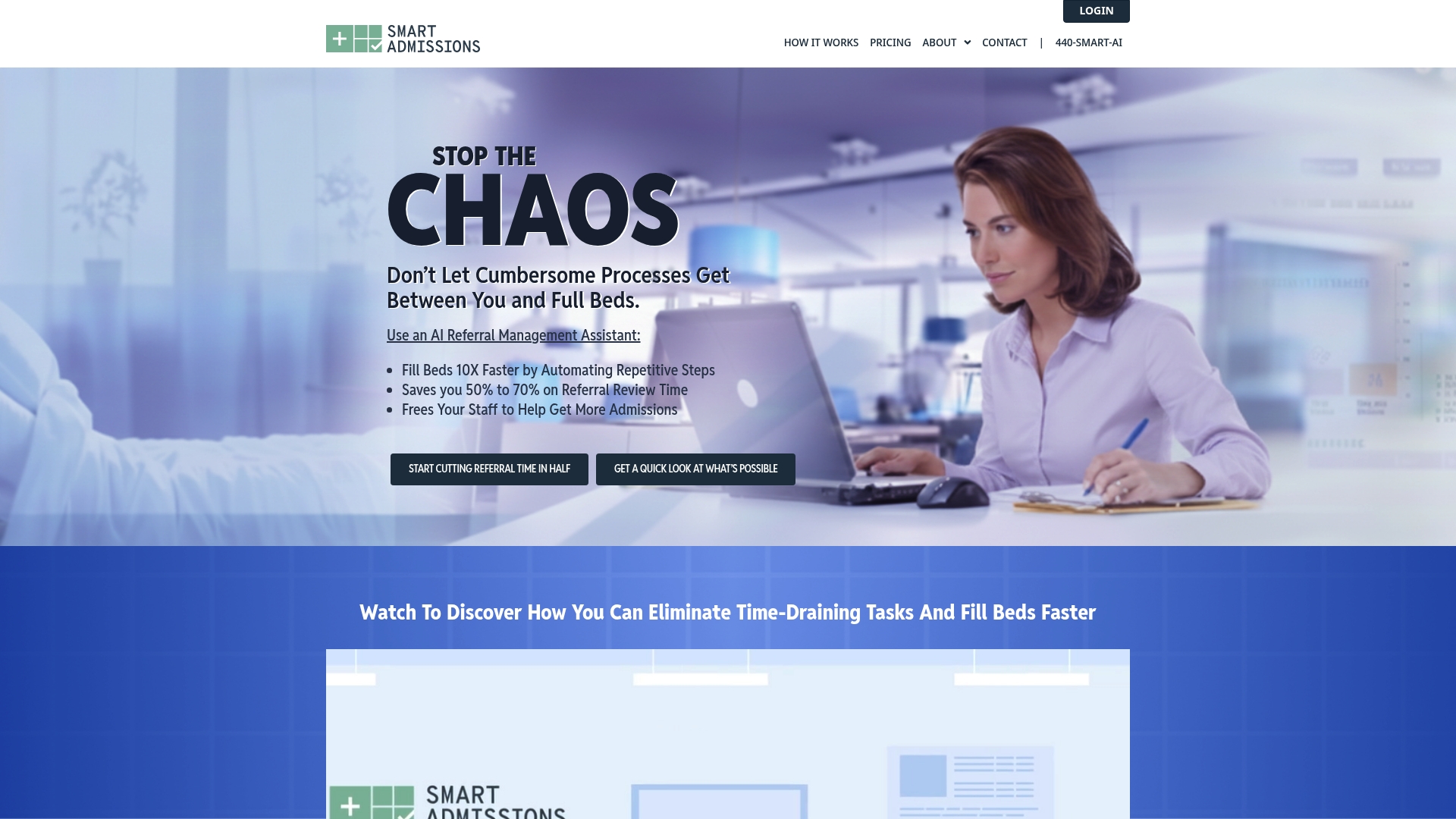
Such platforms can be designed for admissions teams onboarding new referral sources, not just running existing ones: customizable workflows adapt to each partner’s documentation habits, and onboarding support is provided to get teams live without a lengthy IT project. If referral review time is the metric you are trying to move, explore how automation improves admissions speed and book a demo to see how a new partner pilot could run on the platform.
Sources
For deeper evidence on hospital-SNF linkage and care transitions, see the mixed-methods study on collaboration strategies and the care transition process mapping research.
- Information sharing practices between US hospitals and skilled nursing facilities to support care transitions
- Motivating and enabling factors supporting targeted improvements to hospital-SNF transitions
FAQ
What Is Referral Partner Onboarding in Healthcare?
It’s the process of integrating an external clinical referral source, like a hospital or case management team, into your facility’s intake system, covering documentation standards, eligibility rules, and data sharing.
How Long Does Referral Partner Onboarding Take?
Most facilities move from first conversation to a live pilot in four to six weeks, with full technical integration often continuing in parallel after go-live.
What KPIs Show Onboarding Is Working?
Referral review time, percent complete on first pass, time from referral to bed offer, bed fill rate, and 30-day readmission rate are the core metrics to track.
Do You Need Full EMR Integration to Start Onboarding?
No. Structured referral forms, portal uploads, and secure text can support a pilot while deeper EMR or HIE integration is arranged in parallel.
Can Software Like Smart Admissions Help With Onboarding?
Yes. Platforms like Smart Admissions automate eligibility verification and integrate with EMR and insurance portals, reducing manual review once your documentation and process steps are in place.