
TL;DR:
- EMRs improve compliance, communication, and intake accuracy when effectively integrated and used strategically.
- Successful adoption depends on staff training, ongoing optimization, and aligning workflows with system capabilities.
- Technology alone does not reduce readmissions; staffing quality and process design are essential for optimal outcomes.
Many skilled nursing facilities (SNFs) and rehabilitation centers invest significantly in electronic medical record (EMR) systems expecting immediate, dramatic improvements in patient intake and referral handling. The reality is more nuanced. True gains come from strategic integration, rigorous compliance documentation, and aligning your team’s workflows with the system’s capabilities. This guide cuts through the noise to show you exactly where EMRs deliver measurable value, where they fall short, and how your admissions and clinical teams can leverage every feature for maximum operational impact.
Table of Contents
- Why EMRs matter in skilled nursing and rehab: Benefits and realities
- EMR integration: Impact on patient intake and referral management
- Challenges of EMR adoption in SNFs and rehab centers
- EMRs, staffing quality, and the real drivers of optimal outcomes
- What most guides miss: EMRs as opportunity multipliers, not magic bullets
- Ready to leverage EMR for better admissions?
- Frequently asked questions
Key Takeaways
| Point | Details |
|---|---|
| EMRs boost intake efficiency | Electronic medical records speed up documentation and improve referral coordination when integrated with admissions processes. |
| Outcomes require team investment | Optimal results come when EMRs are paired with high-quality staffing, compliance training, and process improvement. |
| Compliance drives reimbursement | Robust EMR use helps secure Medicare reimbursements by supporting proper level-of-care documentation. |
| Technology is not a cure-all | EMRs maximize impact when used as part of an ongoing, collaborative approach rather than a standalone fix. |
Why EMRs matter in skilled nursing and rehab: Benefits and realities
EMRs, or electronic medical records systems, are digital platforms that centralize patient histories, intake forms, physician orders, and interdisciplinary communications in one accessible location. For SNFs and rehabilitation centers, this centralization addresses a core operational challenge: fragmented data that slows referral decisions and creates compliance risk. With an overview of what EMRs are expected to accomplish, let’s explore their actual impact in the intake and referral landscape.
The most commonly cited EMR value points in post-acute care settings include:
- Compliance documentation: Automated tracking of Minimum Data Set (MDS) 3.0 assessments, physician certifications, and audit trails reduces reimbursement risk.
- Communication efficiency: Shared care plans and real-time messaging reduce phone tag between nursing, therapy, and admissions staff.
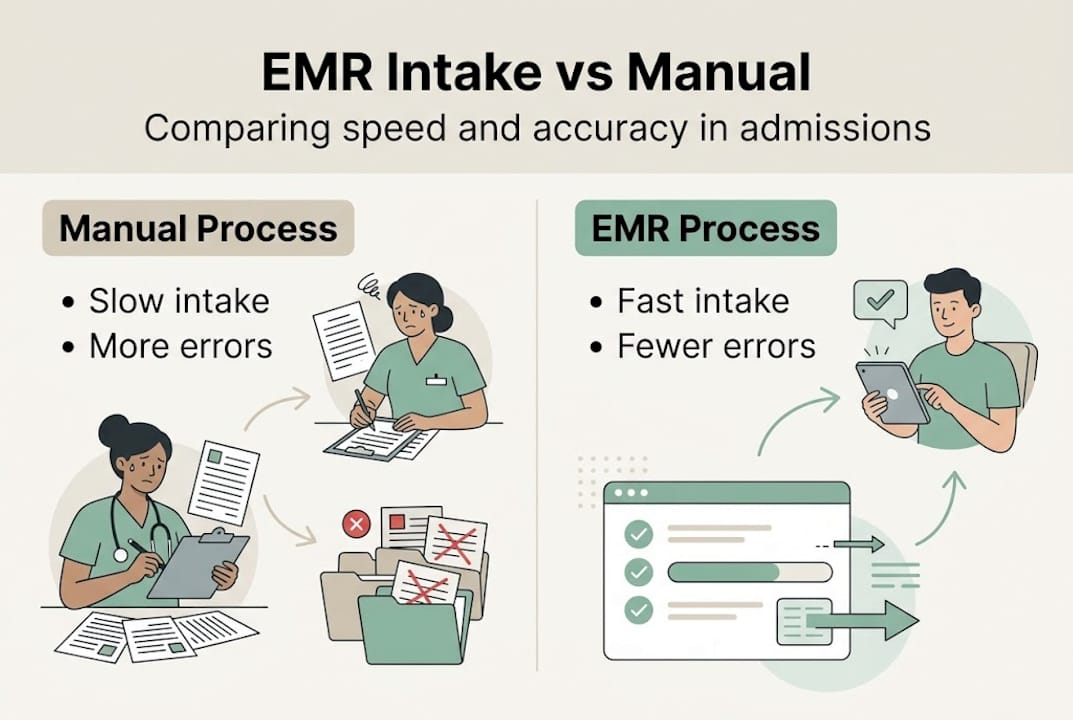
- Intake accuracy: Digital intake forms eliminate transcription errors and speed pre-admission clinical reviews.
- Referral visibility: Centralized referral tracking lets admissions coordinators monitor status without manual follow-up.
Despite these advantages, EMRs alone do not guarantee lower readmission rates. Research on the Hospital Readmissions Reduction Program (HRRP) shows a 1.4% decrease in adjusted 30-day readmission rates from SNFs between 2011 and 2015, with the strongest results linked to hospital-based, rural, not-for-profit facilities with higher registered nurse (RN) ratios. Technology was a supporting factor, not the primary driver.
Separate research on cardiac surgery patients found that CABG readmissions fell from 14.7% to 12.7% between 2008 and 2013 despite rising SNF utilization, suggesting that staffing quality and care processes matter more than technology adoption alone.
| EMR attribute | Expected outcome | Real-world result |
|---|---|---|
| Centralized records | Faster intake decisions | Faster when staff are trained |
| Compliance tracking | Fewer denials | Effective with accurate data entry |
| Referral management | Higher closure rates | Improved with workflow alignment |
| Communication tools | Reduced delays | Dependent on team adoption |
Pro Tip: Prioritize EMR use for compliance documentation first. Accurate MDS 3.0 entries and physician certifications directly protect your reimbursement stream and reduce audit exposure before you optimize other workflows. You can learn more about automating skilled nursing documentation to reduce manual entry burden.
EMR integration: Impact on patient intake and referral management
Understanding the benefits is only the start. Let’s look at how EMR integration directly shapes intake and referrals in practice.
Before EMR integration, most SNF admissions teams managed referrals through phone calls, faxed documents, and spreadsheets. A single referral could involve five or more manual handoffs before a bed was assigned. After integration, the workflow becomes structured and traceable. EMR implementation requires meeting government and vendor compliance standards, building staff collaboration through training and support, and developing ongoing competence through continuous optimization, with upfront costs remaining a key barrier.
Here is a step-by-step EMR-driven referral workflow your team can follow:
- Referral receipt: The EMR captures incoming referral data from hospital discharge planners via direct messaging or HL7 interface.
- Clinical review: Admissions staff access the patient’s clinical summary, diagnoses, and insurance information in one screen.
- Eligibility verification: The system queries payer portals to confirm Medicare or Medicaid coverage before bed assignment.
- Pre-admission assessment: Clinical staff complete a structured digital assessment using standardized templates.
- Decision and notification: The admissions coordinator records the accept or decline decision, triggering automatic notification to the referring hospital.
- Intake documentation: Upon arrival, nursing staff complete MDS 3.0 entries and physician order sets directly in the EMR.
- Audit trail creation: Every action is time-stamped and stored, supporting compliance reviews and reimbursement claims.
| Factor | Manual process | EMR-driven process |
|---|---|---|
| Referral response time | 4 to 8 hours | Under 2 hours |
| Documentation accuracy | Variable | Standardized |
| Compliance readiness | Reactive | Proactive |
| Referral closure rate | Lower | Measurably higher |
Compliance is a critical outcome of proper integration. 60% of Medicare denials stem from insufficient documentation to support the level of care billed. Your EMR must capture MDS 3.0 data, physician certifications, and therapy minutes accurately to protect revenue. Review EMR-referral integration best practices to ensure your setup supports these requirements.
Pro Tip: Involve your admissions coordinators at every integration milestone, not just at go-live. Their daily experience reveals usability gaps that IT staff and vendors often miss, and their buy-in is essential for consistent data quality.
Challenges of EMR adoption in SNFs and rehab centers
After exploring integration’s practical value, it’s vital to acknowledge common roadblocks and solutions for successful EMR adoption.

The three most consistent adoption challenges are regulatory compliance requirements, high upfront costs, and the ongoing need for staff training. Research confirms that successful EMR implementation depends on meeting government and vendor mandates, sustaining collaboration across teams, and building competence through continuous optimization, with cost identified as the primary barrier for many facilities.
Common pitfalls that derail EMR adoption include:
- Lack of ongoing support: Many facilities treat go-live as the finish line, but EMR optimization is continuous.
- Fragmented data entry: When staff use workarounds, records become inconsistent and compliance risk rises.
- Insufficient RN input: Clinical staff must shape workflows, not just follow them, to ensure accuracy.
- Compliance gaps: Failing to update EMR templates when regulations change creates audit exposure.
- Siloed teams: When admissions, nursing, and IT don’t communicate, integration breaks down at handoff points.
“Cost is consistently identified as the primary barrier to EMR implementation in skilled nursing facilities, but facilities that invest in ongoing optimization and staff development achieve the strongest long-term results.” — Electronic Medical Record Implementation in Skilled Nursing Facilities, JMIR 2025
Sustainable EMR adoption requires engaging care, admissions, and IT teams together from planning through post-implementation review. Treating your EMR as a living system, not a one-time installation, is what separates high-performing facilities from those that stagnate. Explore EMR workflow optimization strategies and consider how streamlining healthcare admin tasks can reduce the burden on your team during and after implementation.
Regulatory documentation requirements, including MDS assessments and audit trails, evolve regularly. Your EMR configuration must keep pace, which means scheduling periodic reviews with your vendor and compliance officer.
EMRs, staffing quality, and the real drivers of optimal outcomes
Challenges aside, it’s time to focus on what truly moves the needle: how EMRs amplify, but cannot replace, great staff and process design.
EMR systems produce their strongest results when paired with adequate RN staffing, consistent training, and a culture of process improvement. Facilities that invest only in technology without addressing staffing ratios or workflow design see limited gains. The data supports this clearly. No significant association was found between increased SNF utilization and readmission rates in cardiac surgery patients, confirming that technology adoption alone does not drive clinical outcomes.
The true drivers of optimal performance in SNF and rehab settings are:
- EMR plus workflow design: Technology must be configured to match your actual care pathways, not generic templates.
- Staffing adequacy: Higher RN ratios consistently correlate with better outcomes across multiple studies.
- Ongoing training: Staff who understand the system’s full capabilities use it more effectively and make fewer errors.
- Continuous improvement culture: Regular audits of EMR data quality and workflow performance identify gaps before they become costly.
- Cross-team collaboration: Admissions, clinical, and administrative staff must share ownership of the system.
Practical examples reinforce this point. A rehabilitation center that redesigns its referral intake workflow using EMR data, while also increasing RN coverage during peak admission hours, will outperform a facility that simply upgrades its software. The EMR surfaces the data; your team acts on it. Review ongoing workflow optimization resources to build this capability systematically, and consider admissions workflow automation to reduce manual steps that slow your team down.
The facilities that achieve sustainable efficiency gains treat EMR adoption as one component of a broader operational strategy, not a standalone solution.
What most guides miss: EMRs as opportunity multipliers, not magic bullets
Most implementation guides focus on features and timelines. What they rarely address is the mindset shift required for lasting results.
Facilities that chase EMR adoption as a quick fix consistently underperform those that treat the system as a tool for strengthening already-solid processes. The highest value comes when your EMR amplifies what your admissions and clinical teams already do well. If your referral review process is inconsistent, the EMR will document that inconsistency at scale. If your staffing is thin, no software will compensate.
Real improvement requires continuous optimization, genuine collaboration between admissions and clinical teams, and leadership buy-in that goes beyond the go-live date. The facilities we see achieving measurable gains share one trait: they review EMR workflows regularly with direct staff feedback, making incremental adjustments that compound over time.
Pro Tip: Schedule quarterly EMR workflow reviews with frontline admissions and nursing staff. Their feedback reveals friction points that aggregate data alone won’t show. Explore workflow automation insights to identify where automation can remove repetitive steps and free your team for higher-value work.
Don’t neglect the human elements. Invest in training, measure what matters, and build a culture where staff feel accountable for data quality. That combination is what turns an EMR investment into a genuine performance advantage.
Ready to leverage EMR for better admissions?
If you’re ready to put these lessons to work, here’s how Smart Admissions can help.
Smart Admissions connects your EMR strategy with purpose-built intake, referral, and automation tools designed specifically for SNFs and rehabilitation centers. The platform integrates with your existing EMR to automate eligibility verification, streamline referral review, and protect compliance documentation in real time.
Learn how automating admissions for faster bed occupancy can reduce your referral response time and improve bed fill rates. Explore the EMR and referral integration guide to see how Smart Admissions aligns with your current systems. And discover practical steps for improving admissions efficiency with automation that your team can act on today.
Frequently asked questions
What is the main benefit of EMRs in skilled nursing intake?
EMRs streamline documentation, reduce errors, and support compliance requirements for faster, more accurate patient admission and referral handling across your facility.
How do EMRs affect readmission rates?
EMR use alone does not guarantee lower readmission rates. Outcomes improve most when higher RN staffing ratios and robust workflow processes accompany technology adoption.
What are the main challenges during EMR implementation?
Key challenges include meeting regulatory standards, managing high initial costs, and sustaining ongoing staff training and vendor support throughout the system’s lifecycle.
Why is compliance documentation important in EMRs?
Accurate EMR documentation is critical for Medicare reimbursement. 60% of denials stem from insufficient support for the level of care billed, making precise MDS 3.0 entries essential.